Act I
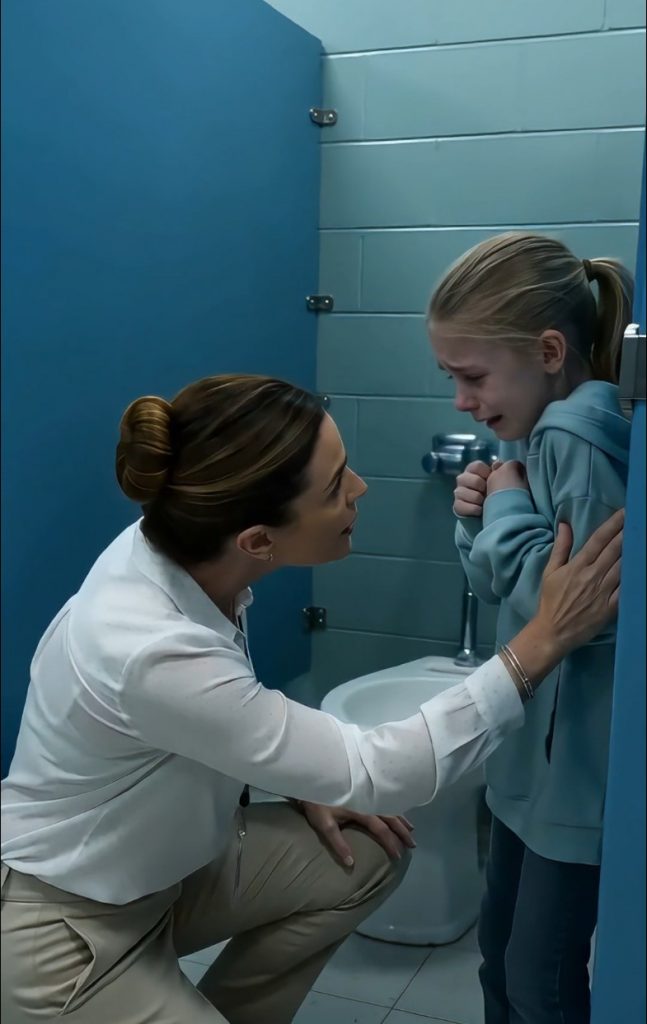
The little girl was hiding in the last bathroom stall when Mrs. Harper found her.
At first, the teacher heard only the faintest sound beneath the hum of the fluorescent lights. A small breath. A swallowed sob. The kind children make when they are trying very hard not to be found.
“Sweetheart?” Mrs. Harper called softly.
No answer.
The school bathroom was cold and bright, tiled in blue-green from floor to wall. The sinks were clean, the mirrors harsh, the stall doors painted the same dull institutional blue the district used everywhere. It was the kind of room where every sound echoed too much.
Mrs. Harper stepped closer.
The last stall door was half open.
Inside, seven-year-old Lily Bennett stood pressed into the corner, swallowed by an oversized pale blue hoodie. Her blonde ponytail had come loose, and her face was pale except for the red around her eyes.
Mrs. Harper lowered herself to one knee.
“Lily,” she whispered, “are you hurt?”
The girl’s hands tightened around the bottom of her hoodie.
Her lips trembled.
“I fell.”
Mrs. Harper had taught children long enough to know when a sentence had been practiced.
She kept her voice calm.
“Can I take a look?”
Lily stared at her for a long moment, frightened and ashamed, then gave the smallest nod.
Mrs. Harper lifted the edge of the hoodie only enough to check.
Then she stopped breathing.
There were dark marks along the child’s side and lower back. Not the kind a playground fall usually leaves. Not one mark. Not one accident.
Mrs. Harper lowered the hoodie immediately and looked into Lily’s face.
The girl was crying silently now.
“It’s okay,” Mrs. Harper whispered. “You did the right thing by letting me see.”
Lily shook her head fast.
“No. Mommy will be mad.”
Before Mrs. Harper could answer, the bathroom door swung open with a heavy thud.
Lily’s whole body went rigid.
A woman stepped inside carrying a floral lunchbox.
She was blonde, polished, and smiling too brightly.
“Hi there!” she sang. “Lunchtime! Ready to go, honey?”
Mrs. Harper rose to her feet.
The woman’s smile stayed fixed until she saw the teacher standing between her and the child.
Then it disappeared.
Mrs. Harper squared her shoulders.
“She needs to see the nurse.”
The mother’s eyes hardened.
“That’s not necessary.”
Lily shrank behind the teacher.
And in that small movement, Mrs. Harper understood the truth completely.
This child was not afraid of being in trouble.
She was afraid of being taken home.
Act II
Lily Bennett had been new to Brookside Elementary for only six weeks.
On her first day, she arrived in a hoodie two sizes too big and shoes with little silver stars on the sides. She carried a purple backpack and held her mother’s hand so tightly Mrs. Harper noticed from across the hall.
The mother, Celeste Bennett, was charming at first.
Too charming, Mrs. Harper later thought.
She introduced herself with bright confidence, praised the school, praised the classroom, praised the art display on the wall. She spoke about Lily as if presenting a fragile antique.
“She’s shy,” Celeste said. “Very sensitive. Sometimes dramatic. We’re working on that.”
Lily said nothing.
Mrs. Harper crouched to the child’s level.
“We’re happy you’re here.”
Lily looked up at her, then quickly back down.
That became the pattern.
Lily was polite. Quiet. Careful. She folded her worksheets perfectly. She lined up her crayons by color. She apologized when another student bumped into her desk.
At recess, she stood near the fence and watched other children play.
When invited to join, she smiled faintly and said, “Maybe tomorrow.”
Tomorrow rarely came.
Mrs. Harper kept notes.
Not formal accusations. Not yet. Just observations.
Lily flinched when someone dropped a book.
Lily became anxious before dismissal.
Lily checked the classroom clock every few minutes after lunch.
Lily once cried because paint got on her sleeve and whispered, “She’ll see.”
When Mrs. Harper mentioned these things gently to Celeste during pickup, the woman laughed.
“Oh, she gets herself worked up,” she said. “Lily likes attention.”
The words sounded ordinary.
The tone did not.
There were other moments.
A missing field trip form Celeste insisted Lily had lost, though Mrs. Harper had watched the child place it carefully into her folder. A lunchbox packed beautifully for the first week, then strangely empty on days Lily had “misbehaved.” A winter morning when Lily arrived without a coat and said her mother told her cold air helped children “remember.”
Mrs. Harper brought concerns to the counselor.
The counselor advised documentation.
The principal advised caution.
“No one wants to accuse a parent without certainty,” he said.
Mrs. Harper understood that.
But she also knew certainty often arrived too late.
That morning, Lily asked to use the restroom after math.
Ten minutes passed.
Then fifteen.
Mrs. Harper sent another teacher to watch the class and went looking.
She found Lily in the stall.
Now, standing in the bathroom with Celeste blocking the door and Lily trembling behind her, Mrs. Harper realized caution had reached its limit.
Celeste lifted the floral lunchbox slightly.
“She’s fine,” she said. “Lily, come here.”
Lily did not move.
Mrs. Harper felt the child’s fingers catch the back of her blouse.
The mother saw it.
Her expression changed—not dramatically, not enough for anyone else to notice from far away. But Mrs. Harper was close enough.
The brightness left Celeste’s face.
Something cold replaced it.
“Lily,” Celeste said, softly now. “Don’t embarrass me.”
The child began to shake.
Mrs. Harper kept her voice even.
“I’m taking her to the nurse. After that, we’ll call the principal.”
Celeste’s smile returned, but it no longer reached her eyes.
“I said that won’t be necessary.”
Mrs. Harper slid one hand slowly toward her trouser pocket.
Her phone was there.
She did not look away from Celeste.
And while the bathroom hummed under fluorescent light, she began dialing 911 by touch.
Act III
The emergency operator answered in Mrs. Harper’s pocket.
She could not speak freely.
Not yet.
So she did the only thing she could.
She kept the line open.
Celeste tilted her head.
“Are you trying to make this into something?”
Mrs. Harper let the phone rest low in her hand, partly hidden behind her hip.
“I’m trying to keep Lily safe.”
The mother laughed once.
It was a small, brittle sound.
“Safe? From what? A scraped back? Children fall.”
Lily made a tiny noise behind the teacher.
Celeste heard it.
Her eyes snapped toward the child.
Mrs. Harper stepped slightly to the side, blocking the view again.
“Do not look at her like that.”
The words surprised even her.
She was not a confrontational woman by nature. She taught second grade. She spoke in gentle reminders and sticker charts. She believed in calm voices, morning routines, and children feeling safe enough to make mistakes.
But something inside her had changed when she saw Lily’s skin under that hoodie.
A line had been crossed.
Celeste took one step forward.
Mrs. Harper did not step back.
“Move,” Celeste said.
“No.”
The bathroom seemed to shrink around them.
Behind Mrs. Harper, Lily whispered, “Please don’t let her take me.”
The words were barely audible.
But the phone was still connected.
Mrs. Harper prayed the operator heard.
Celeste’s gaze dropped briefly to the teacher’s hand.
The phone.
For one second, her face went blank.
Then her right hand moved toward her trench coat pocket.
Slowly.
Too slowly.
Mrs. Harper saw the fingers curl inside the fabric.
Saw the pocket shift.
Saw a small dark handle begin to appear.
Her heart slammed once against her ribs.
She did not scream.
Screaming would frighten Lily.
Instead, Mrs. Harper lowered her voice.
“Lily, go into the stall and lock the door.”
Lily froze.
“Now, sweetheart.”
The girl slipped backward, sobbing silently, and pulled the stall door closed. The lock clicked.
Celeste’s eyes flashed.
“You had no right.”
Mrs. Harper lifted her chin.
“I have every right to protect a child in my care.”
A faint sound came from the phone.
The operator’s voice, tiny and distant.
“Ma’am, if you can hear me, help is being sent.”
Celeste heard it too.
Her expression twisted.
The bathroom door opened behind her.
Not with force.
With timing.
The school principal stood there with Officer Daniels, the resource officer assigned to the neighboring high school, and two staff members behind him.
Mrs. Harper had never been so grateful for open lines, fast dispatchers, and a front office that still paid attention when police entered the building.
Officer Daniels took in the scene in a single glance.
The teacher’s stance.
The locked stall.
The mother’s hand in her pocket.
“Ma’am,” he said, voice firm, “take your hand out slowly.”
Celeste’s face changed again.
The weapon vanished back into performance.
“I don’t know what she told you,” Celeste said, suddenly breathless and wounded. “This teacher is unstable.”
Mrs. Harper kept her eyes on the pocket.
Officer Daniels did not move closer too quickly.
“Hand out. Now.”
Celeste hesitated.
Then slowly removed her hand.
Empty.
But the pocket sagged with the shape of what remained inside.
The officer stepped forward and secured her wrist before she could reach again.
Celeste’s voice sharpened.
“Lily! Tell them I didn’t do anything!”
From inside the stall came a small, broken cry.
Mrs. Harper turned toward the door.
“Lily,” she said gently, “you don’t have to answer her.”
That was when the child began to sob for real.
Not quietly.
Not neatly.
Like someone who had been holding her breath for years and had finally been told she could let it out.
Act IV
The nurse’s office became a shelter before it became an examination room.
They brought Lily there wrapped in a school blanket, Mrs. Harper walking beside her the entire way. The principal cleared the hallway. The counselor met them at the door. Officer Daniels stayed outside until child services arrived.
Celeste was taken from the school in silence.
She did not scream.
That was almost worse.
She looked calm again by the time they escorted her past the front office, as if this were merely an inconvenience she intended to correct later.
But Mrs. Harper saw the truth now.
So did others.
The marks were documented carefully by professionals. Lily answered questions slowly, sometimes in whispers, sometimes with nods. No one rushed her. No one called her dramatic. No one told her she was embarrassing anyone.
When asked whether she felt safe going home, Lily shook her head so hard the blanket slipped from one shoulder.
Mrs. Harper caught it and tucked it back around her.
The counselor asked, “Is there someone you trust?”
Lily looked at Mrs. Harper.
Then away, as if ashamed of needing anyone.
Mrs. Harper’s chest tightened.
“You’re not in trouble,” she said.
Lily’s eyes filled.
“I thought I was.”
“Not for telling the truth.”
The words seemed almost impossible for the child to believe.
Later, investigators found more than enough to confirm the danger Mrs. Harper had sensed. The object in Celeste’s pocket. The lunchbox with no food inside, only a folded napkin and a message written in sharp block letters: Smile today. People are watching. The locked cabinet at home. The hidden school notes Lily had never been allowed to turn in.
There were no easy explanations.
No misunderstanding that made the bathroom scene harmless.
Celeste had built a life around appearances. The clean coat. The cheerful voice. The perfect lunchbox. The polished mother at pickup.
And behind it, control.
Punishment.
Fear.
The school community reacted with horror once they learned enough to understand what had happened. Parents asked how it had gone unnoticed. Teachers replayed conversations in their minds. The principal apologized to Mrs. Harper for moving too slowly.
She accepted the apology.
But she did not soften the truth.
“We wait for certainty because we’re afraid of being wrong,” she said. “But children live inside that waiting.”
The principal had no answer.
Lily was placed temporarily with her aunt, a quiet woman named Rebecca who arrived at the school in tears and kept saying, “I knew something was wrong. I knew it.”
Lily did not run into her arms at first.
She watched.
Measured.
Waited to see what kind of adult this one would be.
Rebecca knelt on the floor of the counselor’s office and held out both hands without grabbing.
“I’m not going to make you come to me,” she said. “But I’m here.”
After a long moment, Lily stepped forward.
Mrs. Harper looked away, giving the child privacy for the courage it took to trust.
That evening, after everyone left, Mrs. Harper returned to the classroom.
The desks were still in rows. Math papers waited ungraded. A half-finished art project sat on Lily’s desk, a picture of a small blue house under a yellow sun.
In the corner of the page, Lily had drawn a tiny figure standing outside the door.
Not inside.
Outside.
Mrs. Harper sat at her desk and cried.
Then she picked up her pen and began writing a report so detailed no one could ever claim they did not know.
Act V
Lily came back to school eleven days later.
Not to class at first.
Just to visit.
She arrived holding her aunt’s hand, wearing a yellow sweater instead of the blue hoodie. Her hair was braided loosely, and she carried no lunchbox. Rebecca had packed food in a paper bag covered with hand-drawn stars.
Mrs. Harper met them at the front entrance.
She did not hug Lily immediately.
She had learned that safe adults ask first.
“It’s good to see you,” she said.
Lily nodded.
Her eyes moved toward the hallway.
“Is she here?”
“No,” Mrs. Harper said. “She will not come here.”
Lily studied her face, searching for the part that might be a lie.
There was none.
They walked slowly to the classroom.
The other children had been told only that Lily had been away and that she deserved kindness and privacy. Children can be careless, but they can also be beautifully simple when adults give them the right instructions.
Maya from the front row offered Lily a sharpened pencil.
Jonah showed her the class plant had grown a new leaf.
Sam whispered, “I saved your seat.”
Lily sat down.
For the first hour, she said nothing.
During reading, she opened her book.
During art, she drew a house again.
This time, the small figure stood in the doorway.
Not all the way inside.
But not outside anymore.
Healing did not come like a miracle.
It came in tiny permissions.
Lily learned she could spill paint and no one would shout.
She could say she was not hungry and still be offered food later.
She could ask to use the bathroom and Mrs. Harper would send a class buddy to wait outside, not because Lily was being watched, but because she did not have to be alone.
Some days she cried for reasons she could not explain.
Some days she laughed and then looked guilty afterward.
Mrs. Harper told her joy was not a rule she had broken.
Months passed.
The case moved through court. Celeste’s charming mask did not survive evidence, witnesses, or Lily’s carefully supported testimony. Rebecca was granted long-term guardianship while the legal process continued.
On the last day of school, Mrs. Harper found an envelope on her desk.
Inside was a drawing.
The same bathroom, but transformed.
Blue-green tiles. A sink. A stall door. Three figures.
A little girl.
A teacher standing in front of her.
And outside the door, in big uneven letters, Lily had written:
YOU HEARD ME EVEN WHEN I WAS QUIET.
Mrs. Harper pressed the paper to her chest.
At dismissal, Lily lingered near the classroom door.
“I made it for you,” she said.
“I love it,” Mrs. Harper replied, voice thick.
Lily looked down at her shoes.
“I was scared you’d think I was bad.”
Mrs. Harper crouched slowly.
“You were never bad.”
“My mom said I made people upset.”
“Your feelings were trying to tell the truth,” Mrs. Harper said. “That upsets people who want lies to stay hidden.”
Lily thought about that.
Then she nodded, as if storing the sentence somewhere important.
“Will you be my teacher next year?”
“I’ll be down the hall,” Mrs. Harper said. “And you can always come find me.”
Lily looked uncertain.
“Even if it’s not an emergency?”
Mrs. Harper smiled gently.
“Especially then.”
Lily hugged her.
It was quick, fierce, and gone almost before Mrs. Harper could return it.
Then she ran to Rebecca, who waited near the front doors with the paper-bag lunch covered in stars.
That summer, Brookside Elementary changed its policies.
Teachers were trained to document patterns, not just incidents. Children were taught body safety and trusted-adult rules in language they could understand. The nurse’s office became a place students could request privately. The district installed a system that let staff alert the office without leaving a child alone.
But Mrs. Harper knew policies were only part of it.
The real work was listening.
To the child who suddenly stopped eating.
To the one who flinched.
To the one who said “I fell” in a voice that sounded rehearsed.
To the one hiding in the bathroom stall, waiting to see whether any adult would be brave enough to believe fear before proof became unbearable.
Years later, Lily would remember the cold tile, the fluorescent hum, the sound of the bathroom door opening, and the way her whole body turned to ice when her mother smiled.
But she would remember something else more.
Mrs. Harper standing between them.
One hand hidden low with a phone.
One voice steady in the room.
One adult saying no when no was the only word that could save her.
And for a child who had been taught that silence was survival, that no became the beginning of a new language.
A language where safety did not have to be earned.
Where love did not arrive with conditions.
Where the door could open, and the person walking in could be help.
Not danger.