Act I
The silver sedan stopped inches from the old man’s knees.
Tires screamed across the wet asphalt. The front bumper dipped hard, the engine shuddered, and the whole street seemed to hold its breath beneath the gray afternoon sky.
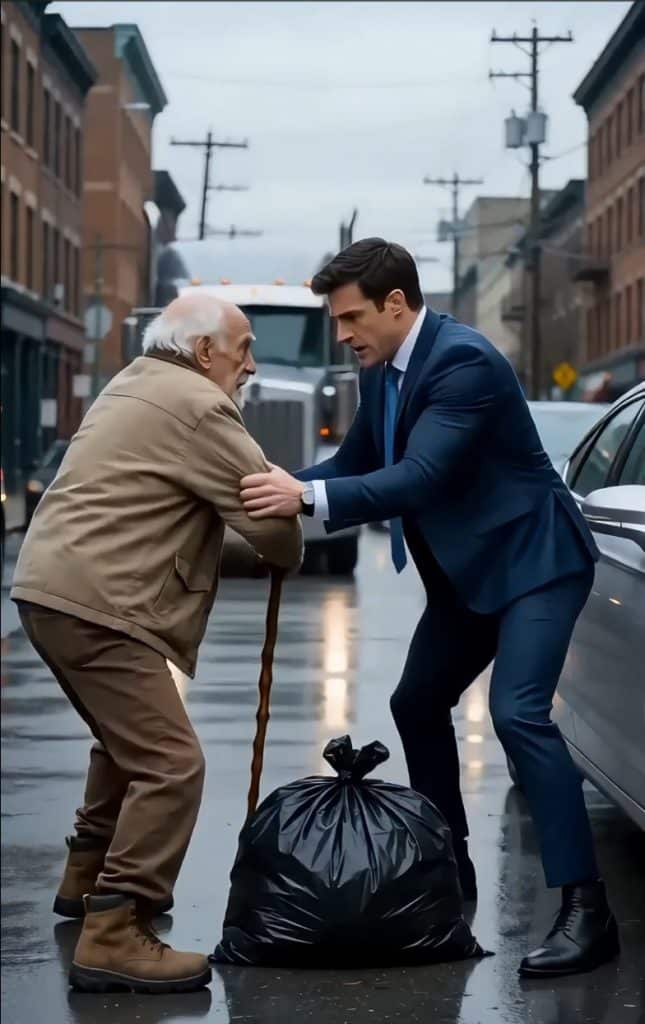
The old man stood in the lane with one arm raised and his wooden cane planted crookedly against the road.
Behind him sat a large black plastic bag.
It was tied at the top. Heavy. Overstuffed. Wet from the drizzle.
To everyone else, it looked like trash.
To the old man, it looked like something worth dying for.
The driver’s door flew open.
A young businessman stepped out in a navy suit, face twisted with fury.
“Get out of the road!” he shouted.
The old man did not move.
He was breathing hard, his thin white hair plastered to his scalp by the rain. His tan-olive jacket hung loose from his shoulders. One hand gripped his cane; the other hovered protectively near the black bag.
The businessman stormed toward him.
“Are you crazy? Move!”
The old man tried to stand taller, but his knees shook. He placed himself more firmly between the sedan and the bag.
“Don’t touch it,” he said.
His voice was weak.
But the warning in it was not.
The businessman looked at the bag and scoffed.
“You almost caused a pileup over garbage?”
He grabbed at the old man’s cane arm.
The crowd gasped. Drivers had stepped out of their cars now, gathering near wet bumpers and glowing brake lights. Brick buildings rose on either side of the street. Overhead power lines cut through the gray sky. The whole city seemed stalled around one absurd scene.
An old man.
An angry driver.
A trash bag in the road.
Then a semi-truck hissed to a stop behind the traffic.
Its door opened with a heavy creak.
A massive bearded trucker stepped down onto the wet asphalt, boots landing like a warning.
The businessman released the old man’s arm.
The trucker walked toward them slowly.
“What’s going on here?” he asked.
The businessman pointed at the bag, but his voice had lost some of its force.
“He’s blocking the street for that.”
The trucker looked down.
The old man’s grip tightened around his cane.
Then the black bag twitched.
Everyone froze.
The businessman took half a step back.
The bag shifted again, swelling from the inside as something pressed against the plastic.
A muffled rustle rose from within.
The old man closed his eyes.
“Please,” he whispered. “Not too late.”
And suddenly, nobody on that street thought it was garbage anymore.
Act II
His name was Walter Price, and for thirty-two years he had worked sanitation on the east side of the city.
He knew what people threw away.
Broken chairs. Wedding albums. Eviction notices. Birthday cards. Toys. Photographs. Things that had once mattered to someone until life became too heavy and the curb became confession.
Walter had seen waste.
He had seen carelessness.
But he had never gotten used to cruelty.
Years earlier, his wife, Marlene, used to tease him because he came home from work with more rescues than paychecks. A kitten found inside a cardboard box. A half-starved beagle tied behind a diner. A pigeon with a broken wing he kept in the laundry room until Marlene threatened to move out unless the bird did first.
She never meant it.
Marlene had a softer heart than his, which Walter considered almost dangerous.
Together, they ran a tiny neighborhood rescue out of their garage after Walter retired. Nothing official at first. Just food bowls, old blankets, phone calls, and stubborn love. People began bringing them animals when shelters were full. Walter complained every time.
Then he built extra cages.
Marlene died two winters ago.
After that, the garage stayed too quiet.
Walter still kept food in the trunk of his old car. Still carried a pocketknife, gloves, and a folded blanket. Still listened for sounds other people ignored.
That afternoon, he had been walking home from the pharmacy when he saw a dark SUV slow near the curb.
A back window opened.
The black bag came out.
It hit the wet street with a soft, heavy thud.
The SUV sped away before Walter could read the plate.
At first, he thought it was illegal dumping. Then the bag moved.
Not much.
Just a faint push from inside.
Walter’s heart stopped.
He stepped off the curb too fast, nearly falling before his cane caught him. Traffic had been crawling. Horns had been sounding. The silver sedan was already coming.
Walter did not think.
He moved into the lane.
If he had been younger, stronger, faster, maybe he could have dragged the bag to the sidewalk before the car reached it.
But Walter was seventy-six.
His hip ached in the rain. His balance was poor. His hands were slower than they used to be.
So he did the only thing his body could still do.
He stood between the car and the bag.
Now, with the businessman glaring at him and the trucker staring down at the shifting plastic, Walter could feel every second passing like a door closing.
The trucker crouched slowly.
“Sir,” he said to Walter, “do you know what’s inside?”
Walter’s voice cracked.
“No. But it’s alive.”
The businessman’s face changed.
Not enough.
But a little.
The bag rustled again.
This time, a tiny sound came from inside.
Not loud.
Not human.
A thin, frightened whimper.
The trucker’s jaw tightened.
He looked at the businessman.
“Still want him to move?”
The businessman said nothing.
Walter lowered himself carefully to one knee beside the bag.
His fingers trembled as he reached for the knot.
“Help me,” he said.
And this time, the entire street moved.
Act III
The trucker’s name was Ray Cobb.
He took one look at Walter’s shaking hands and knelt beside him on the asphalt.
“I’ve got it,” Ray said.
He pulled a folding knife from his belt, but he did not cut right away. He pressed two fingers against the plastic, feeling for movement, making sure he would not hurt whatever was trapped inside.
“Easy,” he murmured. “Easy now.”
The businessman stood behind them, rain dripping from his expensive haircut onto his suit collar. His name was Daniel Mercer, and five minutes earlier he had believed the worst thing happening to him was a delay.
Now he looked as if the street itself had turned against him.
Ray made a small cut near the tied top.
Air rushed into the bag.
The plastic sagged.
Walter leaned forward.
Inside was an old towel.
Then another.
Then movement.
Ray opened the bag wider.
A small brown dog lifted her head from the dark.
She was trembling, soaked, and curled around three tiny puppies pressed against her belly. Her eyes were wide with terror, but she did not growl. She only tried to cover the puppies with her body, weak but still protecting them.
A woman in the crowd began to cry.
“Oh my God,” someone whispered.
Walter covered his mouth.
The puppies squirmed blindly under the towel, making thin, desperate sounds. One was pale gold. One black. One brown with a white mark on its chest.
The mother dog shook so hard the towel moved around her.
Ray’s face hardened into something dangerous.
“Who does this?” he said.
No one answered.
The businessman looked sick.
Walter reached into his jacket pocket and pulled out the folded blanket he always carried. Ray helped him spread it on the sidewalk. Together, they lifted the mother and puppies from the bag with slow, careful hands.
The dog flinched at first.
Then her head dropped against Walter’s wrist.
She had no strength left to fight kindness.
Daniel stood frozen near the sedan.
Walter looked up at him.
“You almost ran over them.”
Daniel swallowed.
“I didn’t know.”
Walter’s eyes filled, not with anger, but with exhaustion.
“That’s the trouble,” he said. “People decide what something is before they look.”
The words landed on the wet street and stayed there.
A bystander called animal emergency services. Another woman brought a coat from her car. Ray used the cab of his truck to block the lane properly, waving traffic around with the authority of a man who had hauled freight through storms and had no patience for cowards.
Daniel slowly stepped closer.
“Can I…” He stopped, ashamed of how useless he sounded. “Can I help?”
Walter looked at him for a long moment.
Then he pointed to the sedan.
“Turn your heat on. Clear the back seat.”
Daniel moved immediately.
No argument.
No arrogance.
He opened the rear door, threw his briefcase into the front, and stripped off his suit jacket. He laid it across the seat before realizing it was probably too expensive for muddy paws.
Then he looked at the shivering puppies.
And left it there.
Act IV
The mother dog was barely conscious by the time they reached the emergency veterinary clinic.
Daniel drove.
Walter sat in the back seat, one hand resting near the towel bundle, speaking softly to the mother dog as if she understood every word.
Ray followed in the semi as far as the clinic lot, then parked illegally across two spaces and dared anyone to complain.
The receptionist took one look at the blanket and shouted for a tech.
Within seconds, the dog and puppies disappeared through double doors.
Walter stood in the waiting room with rain on his jacket and bloodless fingers curled around his cane. He looked smaller without the street around him. Not heroic. Just old, tired, and terrified that he had not been fast enough.
Daniel stood several feet away.
He had not sat down.
His shirt cuffs were wet. His polished boots were smeared with road grime. His suit jacket was gone, wrapped around the towel bundle somewhere in the treatment area.
Ray leaned against the wall with his arms crossed.
Nobody spoke for a while.
Then Daniel said, “I’m sorry.”
Walter did not look at him.
Ray did.
“Louder,” the trucker said.
Daniel’s jaw tightened, but he nodded.
He stepped toward Walter.
“I’m sorry,” he said again. “For grabbing you. For yelling. For assuming.”
Walter’s eyes stayed on the treatment doors.
“I’ve heard worse.”
“That doesn’t make it right.”
“No,” Walter said. “It doesn’t.”
The honesty sat between them.
A vet finally came out.
The mother dog was severely stressed and weak, but alive. The puppies were cold and dehydrated, but responding. They would need care through the night.
Walter gripped his cane so tightly his knuckles went pale.
“Can I see them?”
The vet nodded.
Before Walter could move, Daniel spoke.
“I’ll pay.”
Walter turned.
Daniel cleared his throat.
“All of it. Treatment. Recovery. Whatever they need.”
Walter studied him.
“Why?”
Daniel’s face flushed.
“Because I nearly became the man who killed them without even knowing they were there.”
Walter’s expression softened by one degree.
“That’s not the same as saving them.”
“I know.”
“Paying a bill doesn’t make you decent.”
Daniel lowered his eyes.
“I know that too.”
Ray uncrossed his arms.
“Good start, though.”
Walter almost smiled.
The clinic let them into a small treatment room. The mother dog lay under warm blankets with the puppies tucked against her. Her eyes opened when Walter entered.
He moved slowly to her side.
“There you are,” he whispered.
The dog’s tail gave one faint tap.
That tiny sound did what the near-collision, the shouting, and the moving bag had not.
It broke Walter.
He sat in the chair beside the table and cried silently, one hand hovering near the mother dog’s head.
Daniel stood in the doorway watching an old man mourn and hope at the same time.
For the first time in years, he thought of his own father.
Not the version he had turned into an inconvenience. Not the man whose calls he ignored because they always came at the wrong time. The real one. The man who fixed Daniel’s first car. The man who once stood in the rain for two hours after Daniel missed a bus home from soccer practice.
Daniel took out his phone.
His father’s last message was three weeks old.
Call me when you’re not busy.
Daniel stared at it.
Then he stepped into the hallway and called.
Act V
The story spread because someone had filmed the bag moving.
By morning, half the city had seen the clip. The old man standing in front of a sedan. The businessman shouting. The trucker stepping down from his cab. The black bag twitching on the asphalt.
Then the reveal.
The mother dog.
The puppies.
The city reacted the way cities do: anger, outrage, donations, arguments, and finally action.
The clinic received enough money to cover treatment within hours. Walter refused to let them spend it all on one case.
“Set up a fund,” he told the vet. “For the next bag somebody doesn’t look inside.”
They named it Marlene’s Fund.
Walter pretended not to cry when he saw the sign.
Ray came by the clinic every day during his route. He brought coffee for Walter and a ridiculous stuffed duck for the puppies.
Daniel came too.
At first, Walter suspected guilt was driving him.
He was right.
But guilt, if it stays long enough and does useful work, can become something better.
Daniel paid the vet bill. Then he paid to repair Walter’s garage so it could legally reopen as a foster space. Then he used his company’s resources to help the police pull traffic camera footage from the street where the bag was dumped.
The SUV was found.
So was the person responsible.
Walter did not attend the hearing. He said he had seen enough cruelty in his life and did not need to sit in a room with it.
Ray went instead.
So did Daniel.
When the judge asked for statements, Daniel stood.
He did not speak like a businessman.
He spoke like a man who had looked at himself through rain and not liked what he saw.
“I used to think inconvenience was the worst thing that could happen in public,” he said. “An old man blocking traffic. A bag in the road. A delay. A mess.”
He paused.
“Now I know the worst thing is deciding not to care before you understand what you’re looking at.”
Walter read the transcript later.
He said nothing for a long time.
Then he folded the paper and placed it beside Marlene’s photograph.
The mother dog recovered.
Walter named her Grace because Ray said “Trash Bag Lady” was inappropriate and Daniel said nothing because he had finally learned when not to offer branding advice.
The puppies grew fat and loud. The pale gold one went home with a nurse from the clinic. The brown one with the white chest went to Ray, who claimed he did not want a dog and then bought it a custom bed bigger than some apartments.
The black puppy stayed with Walter.
He named her Marlie.
Short for Marlene.
On the day Walter brought Grace and Marlie home, Daniel arrived at the garage with bags of dog food, cleaning supplies, and a wooden sign.
Walter looked at it.
Marlene’s Rescue Room.
His mouth tightened.
“You made this?”
“My father did,” Daniel said.
Walter looked up.
Daniel’s smile was small and embarrassed.
“I called him. We’re… working on things.”
Walter ran his fingers over the carved letters.
“He did good work.”
“He always has.”
They stood together in the garage doorway while Grace sniffed the blankets and Marlie attacked Ray’s bootlace with the confidence of a creature who had survived too much to be polite.
Weeks later, Walter returned to the same street.
Not because he wanted to.
Because fear shrinks places until you return to them.
The traffic moved normally now. Cars hissed over damp asphalt. People crossed at the light. Nobody knew where the bag had been unless they had seen the video.
Walter stood at the curb with Marlie tucked inside his jacket, her small head poking out beneath his chin.
A silver sedan pulled up beside him.
Daniel rolled down the window.
“You need a ride?”
Walter eyed him.
“You stopping this time?”
Daniel gave a quiet laugh.
“Always.”
Walter opened the passenger door.
Marlie sneezed.
As they drove away, Walter looked through the windshield at the road ahead. For a moment, he saw the black bag again. The near-collision. The anger. The fear.
Then Marlie shifted against his chest, warm and alive.
That was the part he chose to keep.
Not the bag.
Not the shouting.
Not the wet street full of people who almost looked away.
The moment after.
When they finally opened what everyone else had dismissed.
When a trucker knelt, a businessman changed, and an old man’s stubborn heart proved stronger than traffic.
Because sometimes the thing blocking your path is not the problem.
Sometimes it is the warning.
And sometimes, if you stop long enough to listen, what looks like trash is the very thing begging the world not to drive past.