Act I
The fire was almost out when the black SUVs arrived.
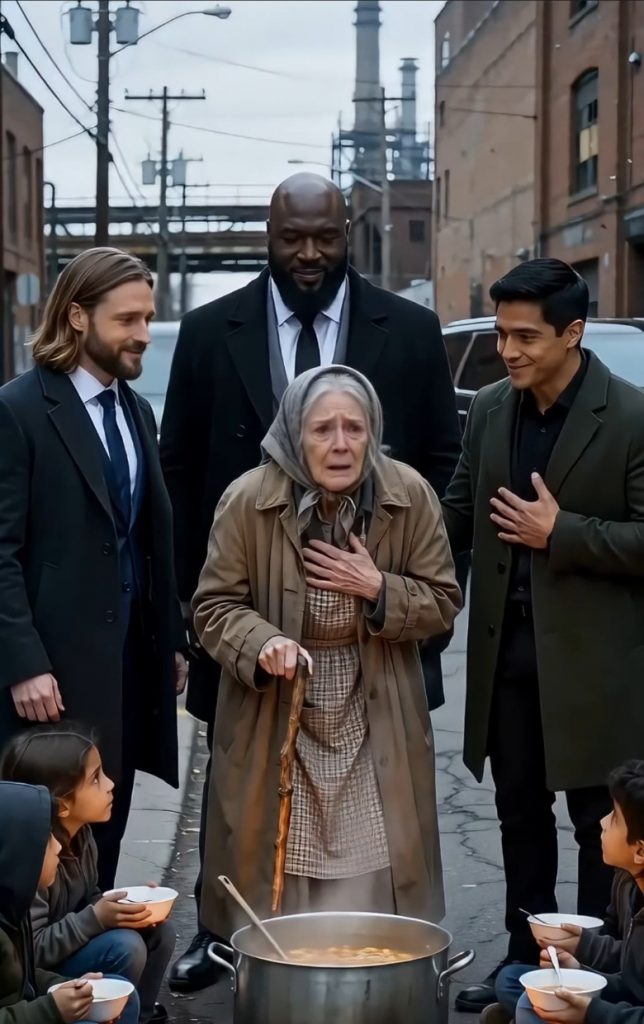
Mrs. Rosa Bell had been stirring the last of the soup, coaxing heat from a few split pieces of wood beneath the dented metal pot. Steam rose into the cold gray air, carrying the smell of potatoes, carrots, onion, and the one chicken bone she had boiled for so long it had surrendered everything it could.
Three children sat on flattened cardboard near the curb, holding white bowls in both hands.
They ate quietly.
Children who had known real hunger did not chatter when food was in front of them. They bent close, guarded the bowl, and watched the world from beneath their eyelashes.
Rosa knew that look.
She had seen it for forty years.
The street around them looked like a place the city had forgotten on purpose. Boarded-up windows. Weathered brick. graffiti on the walls. utility poles leaning into a pale winter sky. Beyond the corner, an old factory chimney rose like a broken tooth.
Then the SUVs stopped.
Both were black. Clean. Expensive. Their tires rolled slowly through the cracked pavement and parked along the curb as if they belonged to a different city entirely.
The children stopped eating.
Rosa’s hand tightened around the ladle.
Three men stepped out.
The first was a white man in a navy suit and dark wool coat, shoulder-length brown hair tucked behind his ears, beard neatly trimmed. The second was tall and broad, a Black man with a shaved head, full beard, charcoal suit, and heavy black overcoat. The third was younger, Hispanic, clean-shaven, wearing a dark green suit beneath his coat, his polished brown shoes avoiding the puddles without seeming to try.
They walked toward her slowly.
Not like police.
Not like city workers.
Not like gang boys.
That somehow made Rosa more afraid.
She had been warned this would happen. A woman from the city had come last week with a clipboard and a mouth full of rules. No open flame. No food service permit. No public obstruction. No feeding minors without authorization.
Rosa had listened, nodded, and cooked again the next day.
Because the children still came.
Now these men looked important enough to make threats real.
Rosa stepped between them and the children, leaning on her gnarled cane. Her trench coat hung loose over her narrow shoulders. Her gray headscarf was tied beneath her chin, and her old checkered apron was stained from years of soup, smoke, and weather.
“Please,” she said, her voice trembling. “I don’t want any trouble.”
The men stopped.
The fire cracked softly beneath the pot.
One of the little boys lowered his spoon.
The first man looked at Rosa’s face as if he were searching for something he had spent years trying not to lose.
“You really don’t remember us?” he asked.
Rosa stared at him.
There was gentleness in his voice, and that unsettled her more than anger would have.
She looked from him to the tall man, then to the younger one in green. All three were strangers. All three looked rich enough to change a poor woman’s life with a signature and ruin it just as easily.
“No,” she whispered. “Who are you?”
The tall man stepped forward, eyes shining.
“You fed us,” he said. “When we had nowhere to go.”
Rosa’s hand rose slowly to her chest.
The youngest man placed his palm over his heart.
“You were an angel to us,” he said. “Now it’s our turn to take care of you.”
The ladle slipped from Rosa’s fingers and clattered against the pot.
Because somewhere beneath the suits, the coats, the polished shoes, and the years, she finally saw three starving boys standing in the snow.
And one of them had once called her Mama Bell.
Act II
Long before the SUVs, before the suits, before the cameras and city permits and charity boards, there had been a back door behind a diner called The Blue Lantern.
Rosa had worked there six nights a week.
She was younger then, though not young. Her husband had died early, her only son had moved west and stopped calling, and the diner had become the place where she kept herself from disappearing. She washed dishes, swept floors, made soup, and brought home whatever food the owner said was too old to sell.
Then she began leaving bowls near the back door.
At first, it was for one boy.
He was twelve, maybe thirteen, with long brown hair, angry eyes, and a coat too thin for January. Rosa caught him digging half a sandwich from the trash one night and shouted before she could stop herself.
The boy ran.
The next night, she left a bowl of soup on the milk crate by the alley.
It was gone by morning.
After a week, she saw him again. He stood under the broken fire escape with both hands in his pockets, pretending he had not come for food.
Rosa opened the back door and said, “You can eat inside if you wash your hands.”
He stared at her like she had offered him a trap.
“I don’t want cops.”
“I don’t want dirty fingerprints on my bread basket,” she said. “So we both have problems.”
That was how Jonah came in.
Two nights later, he brought Darius.
Darius was bigger, quieter, with a bruise near his eye and shoes held together by tape. He did not trust chairs. He stood while eating until Rosa slapped a towel onto the table and said, “No child eats standing in my kitchen.”
He sat.
A week after that, Mateo appeared.
He was the smallest, eight years old, maybe nine, with a cough that sounded too deep for his chest. He carried a plastic grocery bag with everything he owned in it. He would not speak for three days, but he ate every bite Rosa put in front of him and cried when she wrapped leftovers in foil.
They were not brothers.
Not by blood.
But hunger made them loyal to one another.
Jonah had run from a foster home where locks were used on the wrong side of doors. Darius slept under a church stairwell after his mother was taken away and no relative came forward. Mateo had crossed half the city with an older cousin who vanished after a raid, leaving him with no papers anyone could find and no adult willing to claim him.
Rosa did not ask for every detail at once.
Children told the truth in fragments.
A flinch at footsteps.
A pocket full of stolen ketchup packets.
A panic when a man raised his voice.
She fed them first.
Questions came later.
For one winter, those boys came to the Blue Lantern almost every night after closing. Rosa gave them soup, day-old bread, socks from the church bin, and the warm corner near the dish machine where Mateo could sleep for an hour without shaking.
The owner found out in February.
He shouted that Rosa was bringing trouble. That inspectors could shut him down. That she was not running a shelter. That boys like that always stole eventually.
Rosa stood between him and the children just like she stood between the suited men and the children decades later.
“They’re hungry,” she said.
“So are rats,” he snapped.
Rosa took off her apron.
Then she walked out with the three boys behind her.
She lost the job.
She did not regret it.
For a while, she cooked from her apartment. Then from church basements. Then from alleys, parks, underpasses, anywhere the hungry knew to find her. People began calling her Mama Bell, and she pretended to dislike it because accepting love made her shy.
The boys stayed with her as long as the world allowed.
Then life scattered them.
A social worker found Jonah a placement across the state. Darius was taken into a church youth program after a pastor saw him carrying Mateo through a snowstorm. Mateo entered a children’s home two counties away.
Rosa wrote letters.
Some were returned.
Some were never answered.
Years passed.
She told herself that if the boys forgot her, that was good. It meant life had become full enough to leave hunger behind.
But she never forgot them.
Not Jonah, who read every newspaper scrap he found because he said words were free weapons.
Not Darius, who saved half his bread for smaller children.
Not Mateo, who once asked Rosa if people could grow new families the way trees grew new branches after being cut.
She had told him yes.
She just had not known whether the world would prove her right.
Now, standing on a broken sidewalk beside a soup pot, Rosa saw those boys again.
And the past came back with their faces.
Act III
Jonah Carter was the first to kneel.
Not fully. Not dramatically. Just one knee bending until he was closer to Rosa’s height, his expensive coat brushing the dirty pavement without a flicker of concern.
“You gave me a book once,” he said.
Rosa stared at him.
“A law dictionary,” he continued. “It was missing the first twenty pages. You found it behind the diner and told me if people were going to use big words to scare me, I should learn bigger ones.”
Rosa covered her mouth.
“Jonah?”
His smile broke.
“Yes, ma’am.”
The cane trembled in her hand.
The tall man stepped forward next.
Darius King removed his leather glove and held out his palm.
Across it was a thin scar near the thumb.
“You wrapped this with a dish towel,” he said. “I cut myself opening a can behind the church. You told me my hands were made for building, not bleeding.”
Rosa’s eyes flooded.
“Darius.”
He nodded once, but his face had gone soft with the effort not to cry.
The third man in the green suit looked at the children near the fire before looking back at Rosa.
“You told me families could grow new branches,” Mateo Alvarez said.
Rosa made a small sound.
Mateo’s voice shook. “I didn’t believe you then.”
“And now?” she whispered.
He smiled through wet eyes.
“I run three youth clinics. I have two daughters. And every winter, I make soup on the first snow because I still remember yours.”
One of the children on the cardboard mats set down his bowl.
Rosa turned toward the pot, overwhelmed, as if the soup itself might steady her.
“You shouldn’t have come here,” she whispered. “Not dressed like this. People will think I called for money.”
Jonah stood slowly.
“Did you?”
“No.”
“We know.”
Darius glanced at the boarded building behind her.
“We also know the city cited you.”
Rosa stiffened.
That brought fear back into her face.
“I’ll move the pot,” she said quickly. “I told them I would. I just needed to finish feeding these little ones today.”
Mateo’s expression changed.
“Mrs. Bell.”
She hated the pity she expected to hear.
But there was no pity in his voice.
Only pain.
“We didn’t come to shut you down.”
Jonah reached into his coat and took out a folded paper.
Rosa looked at it and stepped back.
“No more papers,” she said. “Please. I can’t read another notice.”
“This isn’t a notice.”
He handed it to her gently.
Rosa unfolded it with shaking fingers.
The top line blurred through tears, but she could still make out the address.
The boarded brick building behind her.
The one with graffiti across the first-floor windows and pigeons nesting under the cracked sign.
The deed listed three buyers.
Jonah Carter.
Darius King.
Mateo Alvarez.
Rosa looked up, confused.
Darius spoke softly.
“We bought it this morning.”
Mateo looked toward the children.
“And we’re turning it into a kitchen.”
Rosa’s breath caught.
Jonah’s voice lowered.
“A real one. Permitted. Heated. Safe. With showers, laundry, tutoring rooms, a clinic office, and a bed upstairs for you if you’ll take it.”
Rosa stared at the building.
For years, it had been an empty shell behind her fire.
Now it stood like a door.
But she had been poor too long to trust sudden gifts.
And she had been disappointed too many times to believe rescue came without a cost.
So she asked the only question fear could find.
“What do you want from me?”
The three men looked at one another.
Then Jonah said the answer that broke her.
“Soup.”
Act IV
Rosa began to cry before she could stop herself.
Not gentle tears. Not the polite kind people dab away with a handkerchief.
She cried with her whole frail body, one hand pressed to her mouth, the other gripping her cane as if the sidewalk had begun to move under her feet. The children watched wide-eyed, unsure whether to be afraid until Darius stepped close and steadied her by the elbow.
“I’m sorry,” he said quickly. “We didn’t mean to overwhelm you.”
“Yes, you did,” Rosa choked.
Darius paused.
Then he laughed once, low and wet with emotion.
“Maybe a little.”
The children relaxed at that.
The smallest girl, wearing a purple hoodie with frayed sleeves, looked at Rosa.
“Are they your sons?”
Rosa looked at the three men.
Jonah with his lawyer’s calm and the hurt boy still hiding behind his eyes.
Darius with his broad shoulders and scarred hand, a man who looked like he could command a room but still remembered standing hungry in a kitchen.
Mateo with his warm smile and soft voice, no longer the silent child with the cough.
Rosa swallowed.
“For a winter,” she said. “Yes.”
Mateo crouched near the children.
“She fed us when nobody had to,” he said. “That’s why you’re eating today.”
The little girl looked into her bowl as if the soup had changed.
Maybe it had.
Maybe food tastes different when you learn it comes from a love old enough to return in suits.
A city car pulled up at the corner.
Rosa’s fear returned instantly.
A woman stepped out holding a clipboard.
The same woman from the week before.
“Mrs. Bell,” she called, already sounding tired. “I told you this setup cannot continue.”
Jonah turned.
The air shifted.
He did not raise his voice.
He did not need to.
“Ms. Reynolds,” he said, “Jonah Carter. I represent the Bell Street Community Trust.”
The woman slowed.
Darius stepped beside him.
“Darius King,” he said. “King Urban Development. We now own this building.”
Mateo joined them.
“Dr. Mateo Alvarez. I’ll be overseeing the clinic partnership.”
Rosa stared.
The woman with the clipboard looked from one man to the next.
“This is an active violation,” she said, though her voice had lost force.
Jonah smiled politely.
“For another twenty minutes.”
“Excuse me?”
“We are relocating the food operation inside the property line today. Temporary covered service begins tomorrow through licensed partners. Fire department inspection is scheduled for Monday. Health department documentation has already been filed.”
Ms. Reynolds blinked.
Darius looked toward the pot.
“And until the children finish eating, no one is touching that fire.”
There was nothing aggressive in his tone.
That made it final.
The city woman glanced at the children, then at Rosa.
For the first time, she seemed to actually see them.
Not the violation.
The children.
The bowls.
The old woman standing in the cold because hunger did not wait for forms to be approved.
“I’ll note the transition plan,” she said quietly.
Jonah nodded. “Thank you.”
She left without another threat.
Rosa watched the car pull away.
“You filed papers?” she asked.
Mateo grinned. “A terrifying number of papers.”
Darius looked at Jonah. “He enjoyed it.”
“I enjoy justice in proper formatting,” Jonah said.
Rosa gave a laugh so sudden it startled her.
The sound was thin, rusty, almost unfamiliar.
Then the side door of one SUV opened.
A woman stepped out carrying a box of clean blankets. Behind her came two young volunteers with folding tables, then another person with a medical kit, then a man unloading crates of bread and fruit.
Rosa looked around, stunned.
“What is all this?”
Darius’s voice softened.
“What you started.”
Inside the boarded building, workers had already begun clearing debris. Through the broken front window, Rosa could see movement, light, dust rising. Someone had hung temporary work lamps from the ceiling.
The building that had watched her cook from the sidewalk like a dead thing was waking up.
And for the first time in years, Rosa wondered if she might be allowed to rest.
Act V
They named it Bell House.
Rosa argued for three days.
She said it was too much. Too fancy. Too embarrassing. She said if they named it after her, people would think she was dead.
Mateo told her that was exactly why they had to do it while she was alive.
“You don’t get to miss your own thank-you,” he said.
She had no answer for that.
The renovation took six months.
Not because the men lacked money, but because Darius insisted the work be done properly. The old brick was cleaned, not covered. The graffiti on one side wall was preserved and framed by a mural of children holding bowls beneath a painted sun. The windows were replaced. The roof was repaired. The kitchen became bright, stainless steel, and warm enough that Rosa cried the first time she saw the ovens.
Upstairs, there were beds for emergency shelter.
A small clinic room.
A reading corner named after Jonah’s missing law dictionary.
A workshop named for Darius’s hands.
A family room named Branches, because Mateo never forgot.
Rosa moved into the small apartment on the second floor only after the three men agreed she could still cook whenever she wanted.
“You are not retiring me into a chair,” she warned.
“No, ma’am,” Darius said.
“But you are no longer carrying firewood alone,” Jonah added.
That part she allowed.
The children from the sidewalk came every day.
So did others.
Some arrived hungry. Some arrived cold. Some came because they had nowhere safe to do homework. Some came because they heard there was a grandmother upstairs who remembered every name and never let anyone eat standing up.
Rosa kept her old cane by the kitchen door.
She kept the dented sidewalk pot too.
It was cleaned and placed near the entrance, not as decoration, but as testimony.
People who entered Bell House passed it first.
Above it hung a simple sign.
This is where it began.
On opening day, reporters came.
Rosa hated that.
She wore the checkered apron anyway because Mateo’s daughters begged her to. The two little girls followed her around the kitchen calling her Grandma Bell within twenty minutes of meeting her.
That almost undid her.
Jonah spoke first at the opening ceremony. He did not mention his net worth, his law firm, or the cases that made him famous. He spoke about a woman who handed him a broken dictionary and made him believe language belonged to him too.
Darius spoke next. He told the crowd that buildings were not saved by investors but by purpose. Then he looked at Rosa and said, “She saw foundations in us before anyone else did.”
Mateo spoke last.
He held up a bowl of soup.
“When I was a boy,” he said, “I thought hunger meant no one knew I existed. Then Mrs. Bell put a bowl in front of me and said, ‘Eat slow. There’s more.’”
His voice broke.
“Those two words kept me alive in ways food alone could not.”
There’s more.
Rosa sat in the front row with tears slipping silently down her cheeks.
The children from the old sidewalk corner sat beside her, scrubbed and fed and restless in the way children become when they finally feel safe enough to be bored.
When the ceremony ended, Rosa tried to stand quietly and escape to the kitchen.
Jonah caught her arm.
“No running.”
“I am eighty-one years old.”
“You’re surprisingly slippery.”
She sighed, but stayed.
Darius handed her the first bowl from the new kitchen.
Mateo placed a ladle in her hand.
The room went quiet.
Rosa looked at the soup, then at the crowd, then at the three men standing before her.
For a moment, time folded.
She saw them as boys again.
Jonah pretending not to be scared.
Darius saving bread for others.
Mateo asking whether families could grow new branches.
Then she saw them as they were now.
Living proof that kindness did not disappear just because years passed over it.
It traveled.
It grew.
It came back wearing polished shoes on a broken street.
Rosa dipped the ladle into the pot and filled the first bowl.
She handed it to the little girl in the purple hoodie, the one who had asked if the men were her sons.
The girl accepted it with both hands.
Rosa smiled.
“Eat slow,” she said. “There’s more.”
Across the room, Jonah looked down.
Darius pressed one hand over his mouth.
Mateo turned away, wiping his eyes.
Years later, people in the neighborhood would speak of Bell House as if it had always been there. As if warmth had naturally belonged on that corner. As if children had always had a place to go when the streets got too cold.
But Rosa knew the truth.
It began with a dented pot, a dying fire, three hungry children on cardboard, and three men who stepped out of black SUVs not to judge her, not to remove her, not to shame what she had built from scraps.
They had come back because once, when they had nothing, she fed them like they mattered.
And on the coldest corner in the city, that forgotten kindness finally returned home.