Act I
The puppy’s cry was the only sound in the forest that did not belong to winter.
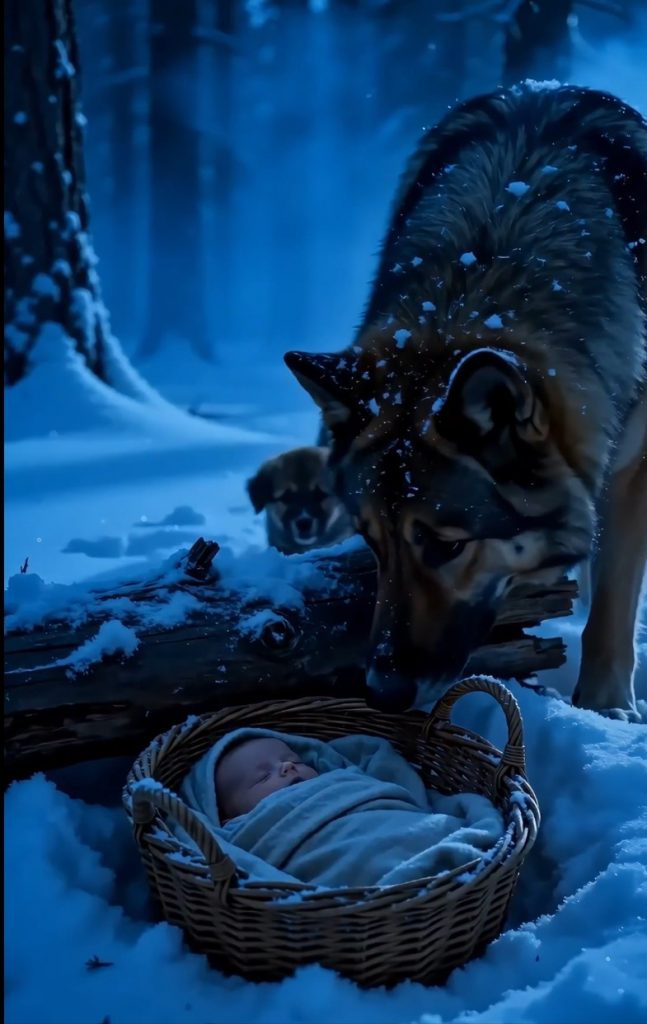
It rose thin and desperate between the black pine trunks, trembling through the blue mist while snow fell softly over the path. The ancient forest was almost silent otherwise. Wind brushed through needles. Ice clung to branches. The moon turned the untouched snow silver.
The mother German Shepherd stopped first.
Her name was Freya, and snow had gathered along her muzzle and shoulders like ash. She stood tall in the path, ears forward, amber eyes fixed on the fallen log ahead.
Her puppy stumbled into her back legs, whining.
Scout was only a few weeks old, all oversized paws and floppy ears, too young to understand danger but old enough to feel it. He cried again, louder this time, his tiny body shaking in the deep snow.
Freya moved toward the log.
There, half buried in a drift, was a wicker basket.
At first, it looked like something the forest had taken from a picnic and forgotten. A pale blanket tucked inside. A handle dusted white. Snow gathering along the rim.
Then the blanket shifted.
Freya lowered her head.
She sniffed once. Then again.
Her body changed.
Every muscle drew tight, but her movements became careful. Not hunting. Not guarding.
Protecting.
Scout barked in a high, frightened burst, then looked up at his mother as if begging her to explain why the cold thing in the basket smelled alive.
Freya nudged the blanket with her nose.
A tiny human sound came from inside.
Not a full cry.
Just a weak breath, soft enough that the wind nearly carried it away.
The puppy stopped crying.
Freya looked into the basket.
A baby lay wrapped in the light-colored blanket, face mostly hidden, small body tucked against the cold as if sleep had come too close to something more dangerous.
The forest seemed to hold still.
Freya opened her jaws around the wicker handle.
She lifted slowly.
The basket creaked under the weight, but she kept it level. Scout pressed against her front legs, whimpering softly.
Then Freya turned away from the fallen log.
She did not go deeper into the forest.
She turned toward the only place in three miles where smoke still rose from a chimney.
The old ranger cabin.
And she began to walk.
Act II
No one in Pine Hollow called the forest kind after dark.
By day, tourists photographed its towering trees and fresh snow. They rented cabins, drank cocoa, and said the woods looked magical.
The locals knew better.
At night, the forest became a maze of frozen streams, hidden drops, and old logging paths that vanished under drifts. Sound bent strangely there. A person could be fifty yards from the road and still feel as if the world had forgotten them.
Elias Ward had spent thirty-one years pulling people out of those woods.
Lost hikers. Runaway teenagers. Drunk hunters. Children who wandered too far from rental cabins. Once, a bride in a ruined wedding dress who had fled her own reception and gotten stuck in the snow.
He had retired the year his wife died.
Or tried to.
People still came to him when the storm line moved in.
Elias lived alone in a ranger cabin at the edge of the old trailhead, where the pines thinned enough to see the road. Freya had been his late wife’s dog before she became his.
Mara Ward used to say Freya had a mother’s soul.
“She hears what people don’t say,” Mara told him.
Elias believed it after the dog began sleeping outside his bedroom door during the worst months of his grief, never pushing in, never leaving. Just there. Breathing. Waiting.
When Freya had her single puppy in the shed that winter, Elias named him Scout because he kept escaping the blanket nest and waddling toward the door as if the world had requested his inspection.
On the night of the basket, a storm had been predicted to roll in before dawn.
Elias had stacked wood, checked the generator, and eaten soup straight from the pot because there was no one left to impress. He was washing the bowl when Freya began barking from outside.
Not her usual warning bark.
Not the bark for deer.
Not the bark for coyotes.
This one cut through him.
Elias grabbed his coat and opened the cabin door.
Snow rushed in.
Freya stood at the edge of the porch with a wicker basket hanging carefully from her mouth. Scout bounced beside her, whining so hard his little paws kept slipping on the packed snow.
For one second, Elias only stared.
Then the blanket moved.
He ran.
Freya set the basket down gently at his feet and stepped back, panting, eyes locked on him.
Elias dropped to his knees.
Inside was a baby.
Cold. Silent. Alive.
His hands, old but still steady from years of rescue work, moved fast. He lifted the child against his chest, pulled the blanket tighter, and carried the baby inside.
“Easy,” he whispered. “Easy, little one. You’re inside now.”
Freya followed him to the hearth and lay down close, pressing her body against Scout to keep the puppy from climbing into the blanket.
Elias called emergency services.
The line crackled under the storm.
“Infant found in the north pine trail,” he said. “Alive, but exposed to freezing temperatures. I need an ambulance and sheriff’s department at my cabin immediately.”
The dispatcher asked questions.
Age. Breathing. Condition. Location.
Elias answered them all until his eyes caught something tucked beneath the basket lining.
A folded piece of cloth.
No, not cloth.
A hospital bracelet.
Still attached to a torn strip of paperwork.
The name printed on it made him stop speaking.
Baby Girl Vale.
Elias knew that name.
The whole county did.
That baby had died three days ago.
Or at least, that was what everyone had been told.
Act III
The Vale family owned half of Pine Hollow and frightened the rest.
They owned the lumber contracts, the old mill, the lodge, two warehouses by the river, and the private clinic where every politician in the county seemed to have a donor plaque on the wall.
Richard Vale was the kind of man who smiled for newspaper photographs with children he would never remember afterward. His wife, Celeste, wore pearls to charity events and spoke of family values as if she had invented them.
Their son, Adrian, had married a young nurse named Lily Harper two years earlier.
People whispered about that marriage from the start.
Lily was not wealthy. Not polished. Not raised behind gates and private roads. She had grown up in a trailer park outside town, paid for nursing school with overnight shifts, and smiled like someone who had spent her whole life surviving without asking permission.
Adrian seemed to adore her at first.
Then Lily stopped appearing in town.
Then came the announcement.
Complications. A baby lost. A private family tragedy.
No service. No questions.
Now Elias Ward sat in his cabin with a living infant wrapped in a blanket beside his fire, holding proof that the Vale baby had not died at all.
Freya watched him from the rug.
Scout had finally gone quiet, curled against her front leg, but his eyes remained fixed on the baby as if he understood he had helped call something back from the edge.
Elias checked the basket again.
Beneath the lining was a note folded into a square.
His name was written across it.
Not “To whoever finds her.”
Not “Please help.”
Elias Ward.
The handwriting was shaky, but careful.
He opened it.
Mr. Ward,
Mara told me once that if I was ever truly afraid, I should find the old ranger cabin because you helped people who had nowhere else to go.
Elias felt the room tilt.
His late wife had worked at the county library after retiring from teaching. She had known everyone, helped everyone, collected wounded young people the way other women collected recipes.
Lily Harper had been one of them.
The note continued.
They said my baby died. She didn’t. I heard her cry after they told me she was gone. I found the transfer papers. Richard Vale signed them. They were sending her away before Adrian could know the truth.
I took her from the clinic tonight.
I couldn’t make it through the woods with her. They were behind me.
I hid her by the old fallen log because I thought I could lead them away.
Please save my daughter.
Her name is Wren.
Elias read the last line twice.
Please tell her I wanted to keep her.
The paper shook in his hand.
Outside, headlights moved through the trees.
Not red emergency lights.
White.
Slow.
Searching.
Freya rose before Elias did.
Her ears flattened. Her body placed itself between the cabin door and the baby.
Elias folded the note and slipped it into his shirt pocket.
Then he turned off the lamp.
The cabin fell into firelight and shadow.
A vehicle stopped somewhere beyond the trees.
A car door shut.
Freya gave a low growl.
And Elias understood that the mother dog had not just brought him a baby.
She had brought him the truth before the people who buried it could get there first.
Act IV
The first knock came gently.
That made it worse.
No lost hunter knocked like that in a winter storm. No deputy on an emergency call knocked like he was arriving for tea.
Elias stood beside the fireplace with the baby in his arms.
Freya stood at the door.
Scout hid behind her, trembling but silent.
“Mr. Ward?” a man called from outside. “County sheriff’s office. We received a report.”
Elias did not move.
The sheriff’s office was twelve miles away. The dispatcher had said units were delayed by the storm road. Whoever stood outside had arrived too quickly.
“Show me your badge at the window,” Elias called.
A pause.
Then a soft laugh.
“Cold night to play games.”
Elias looked down at the baby. Wren’s tiny face had warmed slightly near the fire. Her mouth moved in sleep, fragile and stubborn and alive.
“I already called state dispatch,” Elias lied.
Silence.
Then another voice, lower.
“Open the door, old man.”
Freya barked.
Not loud.
Final.
The door handle turned once.
Locked.
Something hit the wood hard enough to rattle the frame.
Scout yelped.
Elias backed toward the old gun cabinet, though the rifle inside had not been loaded in years. He did not need to fire it. He only needed whoever was outside to believe he would.
Then sirens rose in the distance.
Real ones.
The men outside heard them too.
Feet crunched through snow. A car engine turned over. Tires spun, caught, and faded down the forest road.
Elias exhaled only when red and blue lights flashed through the pines.
The first person through the door was not a local deputy.
It was State Trooper Lena Alvarez, who had once been rescued by Elias from a washed-out ravine when she was seventeen and had trusted him ever since.
She took in the room in one glance.
The baby.
The dog.
The note in Elias’s hand.
“What happened?” she asked.
Elias looked at Freya.
“She found what they tried to lose.”
By dawn, Pine Hollow was no longer sleeping.
State police raided the Vale private clinic. A records clerk, terrified and exhausted, gave them the locked file before anyone even asked twice. It contained falsified birth records, a forged death certificate, and an adoption transfer request arranged through an out-of-state broker.
Richard Vale was arrested in his own driveway.
Celeste fainted in front of the cameras.
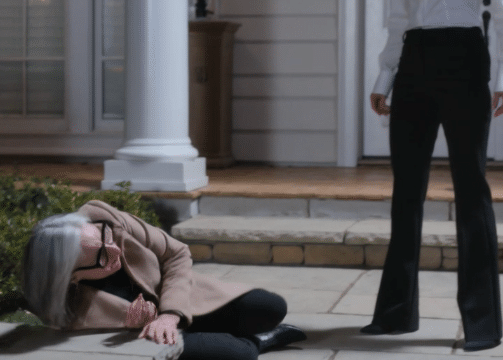
Adrian Vale was found at the hospital where Lily had been taken after collapsing near a logging road. He had been told his wife was hysterical from grief and sedated for her safety.
When he learned the baby was alive, something in him broke open.
He demanded to see his daughter.
But Lily demanded it first.
Wrapped in a hospital blanket, weak from cold and shock, she sat upright in bed and refused to lie back down until Trooper Alvarez placed Wren in her arms.
No one in the room spoke.
Lily touched the baby’s cheek with one shaking finger.
“My girl,” she whispered.
Wren stirred.
Lily bowed over her and cried without sound.
Adrian stood at the door, hand over his mouth, watching the truth of his family’s cruelty breathe in his wife’s arms.
Elias came later.
Freya came with him, because he no longer trusted any room that did not include her.
The moment Lily saw the German Shepherd, her face crumpled all over again.
“She found her?”
Elias nodded.
“Her puppy heard her first.”
Scout peeked from behind Freya’s legs, suddenly shy in the bright hospital hallway.
Lily reached out.
Freya stepped close enough to rest her head beside the bed.
Lily placed one hand on the dog’s snow-damp fur.
“Thank you,” she whispered.
Freya closed her eyes.
As if the words were accepted.
Act V
Wren Vale did not leave the hospital under the Vale name.
Lily changed it before the first month ended.
Wren Harper.
No hyphen. No compromise. No family legacy attached to the people who tried to erase her.
Adrian signed the paperwork without argument.
He had begun the painful work of learning that love meant choosing against the family that raised him when that family became dangerous. He cooperated with the investigation. He testified against his father. He gave Lily every document she needed and every distance she asked for.
Whether their marriage survived was a question for another season of life.
But Wren survived.
That was the miracle.
Richard Vale’s trial exposed more than one stolen baby. The clinic had been hiding quiet arrangements for years: falsified records, coerced signatures, frightened young mothers told they had no choices while wealthy families purchased silence through donations and legal threats.
Lily’s case broke the door open.
Other women came forward.
Some found answers. Some found heartbreak. Some found children they had been told were gone.
The town changed after that, though not overnight.
Power rarely disappears politely.
But the Vale name stopped opening every door.
And the old ranger cabin became something else.
At first, people came because of the news story.
The heroic dog. The baby in the basket. The puppy who cried in the snow. Reporters called. Producers offered money. Strangers sent toys, blankets, dog treats, and letters written in shaky handwriting from people who had once been lost and wished a Freya had found them too.
Elias turned most of it away.
But Lily came every week.
At first, she came with Wren bundled against her chest, still pale, still moving like someone expecting the world to reach for what was hers. She would sit by Elias’s fire while Freya lay beside the cradle and Scout tried to climb into Lily’s lap.
“You don’t have to keep coming,” Elias told her once.
Lily looked at him.
“I know.”
But she came anyway.
Some bonds are not made of blood.
Some are made in snow, terror, and the moment a living creature decides your child is worth carrying through the dark.
By spring, Wren was stronger.
Her cheeks filled. Her cry grew louder. She learned to grip Freya’s fur with tiny fists, and the great dog endured it with royal patience.
Scout grew too.
He became all legs, mischief, and misplaced confidence. He still followed Freya everywhere, but now he walked a little taller, as if he had never forgotten that his first important job had been sounding the alarm when the world went quiet around a child.
One year later, Lily returned to the fallen log.
Elias went with her.
So did Freya and Scout.
The forest looked different in daylight. Sunlight threaded through the pines. Snow no longer covered the ground. Moss clung to the old log, and tiny green shoots pushed through the thawed earth.
Lily stood for a long time at the place where she had left the basket.
Wren slept against her shoulder, warm and heavy.
“I thought I was leaving her to die,” Lily said.
Elias shook his head.
“You left her where hope could find her.”
Lily cried then.
Not like the first time, when tears came from terror.
These tears came from the strange mercy of standing in the same place and not being destroyed by it.
Freya walked to the old snowbank, now only grass and pine needles, and sniffed the ground. Scout copied her, then sneezed.
Wren woke and made a small sound.
Freya immediately turned back.
Lily laughed through her tears.
“She still thinks that baby is hers.”
Elias looked at the dog.
“In a way,” he said, “she’s not wrong.”
Years later, Wren would grow up knowing the story.
Not all at once. Not the cruel parts first.
At five, she would know that a brave dog found her in the snow.
At eight, she would know that her mother fought to keep her.
At twelve, she would know that powerful people lied, and ordinary people, dogs included, told the truth with their actions.
At sixteen, she would stand beside the old fallen log and ask her mother if she had been afraid.
Lily would answer honestly.
“Yes.”
Then Wren would ask how she kept going.
Lily would look toward the cabin smoke rising beyond the pines, toward Freya’s resting place beneath a young cedar tree, toward Scout lying in the path with a graying muzzle and watchful eyes.
“I didn’t,” Lily would say. “Not alone.”
On the night the basket was found, the forest had seemed endless.
Cold.
Silent.
Unforgiving.
But that was not the whole truth.
Because somewhere in that winter dark, a puppy cried loudly enough to make his mother stop.
A mother dog listened.
A child breathed.
And through falling snow, under ancient pines, love took the handle of a wicker basket gently in its teeth and carried the impossible home.