Act I
The old man sat alone on the park bench with his cane resting against his knee, staring at the path like he was waiting for someone who had stopped coming years ago.
The morning was gray and quiet.
Bare branches scratched softly against the sky. Wind moved through the grass in thin waves. Somewhere beyond the trees, birds called to each other, but even their voices sounded far away.
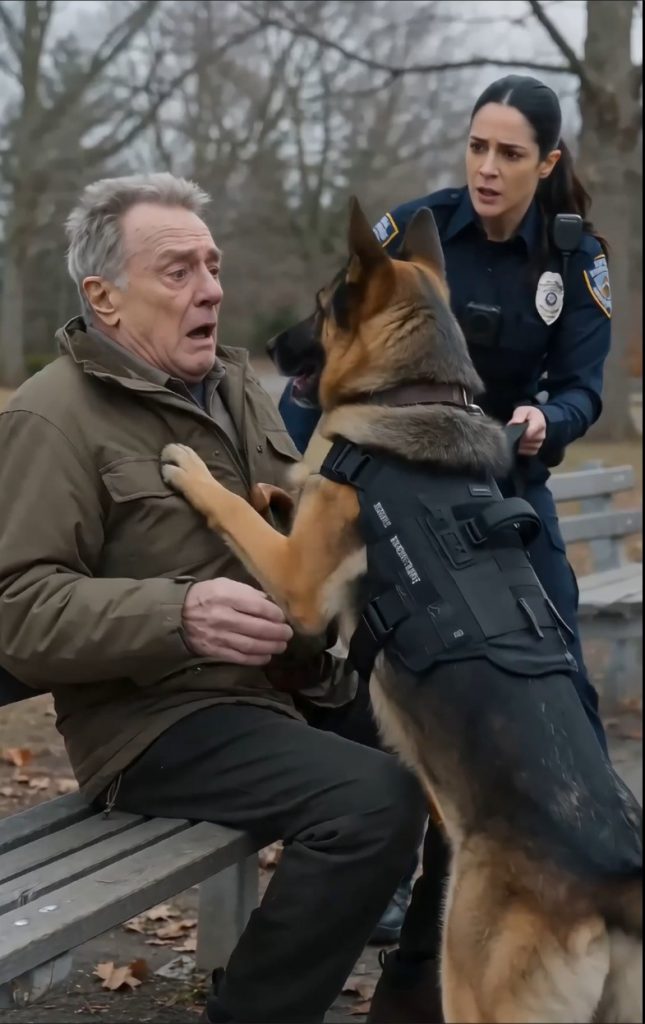
Walter Hayes did not look up when the young police officer came down the path with the German Shepherd at her side.
He had learned how to become invisible.
Old men on benches were easy for the world to pass by. People saw the weathered jacket, the bowed shoulders, the wooden cane, and they decided the story was already over.
But the dog saw him.
The German Shepherd stopped so suddenly that Officer Lena Brooks nearly lost her grip on the leash.
“Kira?” she said.
The dog’s ears snapped forward.
Her body went rigid.
Then she barked.
Once.
Sharp enough to split the quiet park open.
Walter lifted his head.
The moment his eyes met the dog’s, something changed in his face. Confusion passed first. Then disbelief. Then something so painful that Lena loosened her hand on the leash without meaning to.
Kira lunged.
“Hey!” Lena gasped, bracing her boots against the asphalt.
The leash snapped taut. The dog pulled with her whole body, paws scraping, harness creaking, tail moving in a low, frantic arc. This was not normal excitement. Kira did not jump on strangers. She did not break command. She did not ignore Lena.
Ever.
But now she dragged the officer toward the bench like the man sitting there was the only thing in the world that mattered.
Walter’s cane fell sideways and clattered against the pavement.
Kira reached him and rose gently but urgently, placing both front paws against his chest.
The old man caught her out of instinct.
His hands, thin and trembling, sank into the thick fur at her shoulders. Kira whined and pressed her muzzle into his neck, licking his cheek once, then burying her head beneath his chin.
Walter froze.
Then he broke.
He wrapped both arms around the dog and held on as if someone had pulled him from deep water.
Lena stood a few feet away, breathing hard, the leash slack in her hand.
“She never does that,” she whispered.
Walter did not seem to hear her.
His eyes were closed. His face was buried in the dog’s fur. His shoulders shook once, then again.
And then Lena heard him say one word.
Not Kira.
Not girl.
Not anything the dog should have recognized.
He whispered, “Maggie.”
The German Shepherd went perfectly still.
Then she gave a soft, trembling whimper and pushed closer into his arms.
Lena felt the cold move through her uniform.
Because Maggie was not this dog’s name.
But according to the old file locked in the department basement, it had been the name of a K9 who died twenty-three years ago.
And no one was supposed to remember her except the man they blamed.
Act II
Walter Hayes had been a ghost long before age made him look like one.
In the old department photographs, he stood taller. Wider in the shoulders. Clean-shaven, sharp-eyed, always with a German Shepherd beside him.
Back then, people called him Sergeant Hayes.
Children called him the dog man.
Officers called him when a suspect ran into the woods, when a lost child disappeared near the river, when a frightened woman would not leave a locked room unless a dog came in first.
Walter had trained six K9s in his career.
But Maggie was different.
She had arrived at the unit half-starved, suspicious of every hand, too smart to be fooled and too hurt to trust easily. The department nearly rejected her. Walter took her home for one weekend and returned Monday morning with scratches on his arms, no sleep in his eyes, and the quiet certainty of a man who had seen something worth saving.
“She’s not broken,” he told them. “She’s waiting to see who gives up first.”
He never did.
Maggie became the best dog the county had ever seen.
She could find a missing child by scent after rain. She could sit calm beside a trauma victim for an hour. She knew Walter’s moods before he did, nudging his hand when his temper rose, leaning against his knee when grief came for him after his wife died.
For nine years, they were a pair.
Then came the fire at Alder Ridge.
A warehouse on the edge of town. Stolen medical supplies. Two armed men. A bad radio signal. A command decision no one wanted to own afterward.
Walter was ordered to send Maggie in.
He refused.
He said the building was unstable. He said there were chemicals inside. He said no dog and no officer should enter until the fire crew cleared the structure.
Captain Raymond Pike overruled him.
Maggie went in with another handler.
The roof came down three minutes later.
The department told the public it was a tragic accident.
Privately, they needed someone to blame.
Walter had argued on record. Walter had refused a direct order. Walter had shouted in front of witnesses that Pike was going to get someone killed.
So Pike wrote the story first.
He said Walter lost control of the dog.
He said Walter delayed the rescue.
He said Walter’s emotional attachment made him unfit for command.
Walter fought it until the file disappeared, until witnesses changed their statements, until one young officer came to his house at midnight and begged him to stop because Pike could ruin more than one career.
So Walter resigned.
He buried Maggie’s collar in his backyard beneath the maple tree his wife had planted.
Then he stopped answering the phone.
Years passed.
The police department changed uniforms, chiefs, patrol cars, and slogans. New officers came in knowing only the official version. Walter Hayes became a cautionary tale told in half-sentences.
A good handler who fell apart.
A man who loved a dog too much.
A man who could not let go.
Only Walter knew the truth.
He had not broken because Maggie died.
He had broken because men in clean offices turned her death into paperwork and called it honor.
Now, on a quiet park bench, a young officer watched her disciplined K9 tremble in an old man’s arms.
Lena Brooks had trained Kira for two years.
Kira never reacted this way.
Not to food.
Not to children.
Not to other dogs.
Not even to Lena after a week apart.
Yet here she was, pressed against Walter Hayes like she had found home in a stranger’s coat.
Lena stepped closer. “Sir?”
Walter opened his eyes.
For a second, he looked embarrassed by his own tears.
“I’m sorry,” he said, voice rough. “I didn’t mean to upset your dog.”
“You didn’t.” Lena swallowed. “She pulled me to you.”
Walter’s hand moved slowly over Kira’s neck, then stopped near the harness patch.
“Kira,” he read softly.
The dog’s ears flicked.
Walter looked at her face again.
“No,” he whispered. “Not Maggie.”
His fingers found a small pale mark near Kira’s left ear, almost hidden beneath the fur.
His face drained of color.
Lena noticed.
“What is it?”
Walter did not answer at first.
He looked down at the dog’s eyes, then toward the empty path.
“That scar,” he said. “Maggie had the same one.”
Lena frowned gently. “That could be coincidence.”
Walter nodded, but his hand was shaking.
“It could.”
Kira whined and nudged the inside pocket of his old military-style jacket.
Walter froze.
Lena saw it then.
Not recognition in the dog.
Recognition in the man.
He reached slowly into the pocket and pulled out a worn leather strip, cracked with age and polished from years of being touched.
A collar tag.
Not metal.
Leather.
Embossed with one faded name.
MAGGIE
Kira lowered her head and pressed her nose against it.
Then she lay down at Walter’s boots and refused to move.
Act III
Lena called her supervisor from the edge of the park path.
She kept her voice steady, but her eyes stayed on Walter and Kira the whole time.
The old man sat bent over the dog, one hand resting on her back, the other holding that old leather tag like it might vanish if he loosened his fingers. Kira had settled against his legs with her body positioned between him and the rest of the world.
A protective posture.
Lena knew it well.
“Lieutenant, I need you to pull an archived K9 file,” she said into the phone. “Alder Ridge. Handler Walter Hayes. Dog named Maggie.”
There was a pause.
Then Lieutenant Grant said, “Why?”
“Because my K9 just broke command to reach him.”
Another pause.
Longer this time.
“Brooks,” he said carefully, “that file is old.”
“I know.”
“It was closed.”
“I’m asking you to open it.”
“Why are you really calling?”
Lena looked at Walter.
He had begun whispering something to Kira. Not words at first. Sounds. Old working cues perhaps. Soft syllables shaped by muscle memory.
Kira responded to all of them.
Sit.
Down.
Watch.
Not Lena’s commands.
His.
Lena turned away slightly.
“Because she knows him,” she said. “And I think someone should have asked why.”
Grant exhaled.
“I’ll meet you at the park.”
While they waited, Walter told her pieces of the story.
Not all at once.
Men who have been silenced for decades do not suddenly become easy with the truth. He spoke slowly, in fragments, with long pauses where the wind filled in what he could not say.
He told Lena about Maggie’s first winter.
How she refused to sleep in the kennel until Walter sat on the concrete floor beside her for three nights.
He told her how Maggie found a four-year-old boy in a drainage ditch after everyone else had searched the wrong field.
He told her about Alder Ridge.
Not the department version.
The real one.
“She looked back at me before they took her in,” Walter said.
Kira lifted her head at the pain in his voice.
Walter scratched behind her ear.
“I should have cut the leash,” he whispered. “I should have stopped them.”
Lena sat on the far end of the bench, close enough to listen, far enough not to crowd him.
“You were one man against command.”
Walter gave a tired smile. “That’s what people say when they want the dead to stay quiet.”
The words landed hard.
Before Lena could answer, Lieutenant Grant arrived.
He was in his late fifties, with gray at his temples and a face that carried too much history to be neutral. He stopped when he saw Walter.
For a moment, neither man spoke.
“Sergeant Hayes,” Grant said finally.
Walter’s eyes narrowed. “Tommy Grant?”
Grant looked down. “No one calls me that anymore.”
“I do.”
Lena glanced between them.
Grant had been young once. Of course he had. Everyone had. But watching him stand in front of Walter now, she suddenly saw the rookie beneath the lieutenant’s uniform.
The one who might have been there.
The one who might know.
Grant stepped closer to Kira. “She really came to him?”
“She pulled me across the path,” Lena said.
Kira watched Grant but did not rise.
Grant’s jaw tightened. “There’s something you need to know.”
Walter’s hand stilled on the dog.
Grant looked at him, shame darkening his face.
“Maggie didn’t die in the collapse.”
The park seemed to go silent.
Walter stared.
“What?”
Grant swallowed.
“She was badly injured. Burned, smoke-sick, but alive. Pike ordered it kept quiet.”
Walter’s face went white.
Lena felt her pulse in her throat.
Grant continued, voice lower now. “If the report showed she survived, the timeline would prove Pike sent her in after the evacuation order. He would’ve lost his badge. Maybe worse.”
Walter’s lips parted, but no sound came.
“What did he do with her?” Lena asked.
Grant looked at Kira.
“Maggie was transferred to a private kennel under a false intake number. She had one litter before she died two years later.”
Walter closed his eyes.
His hand tightened around the leather tag.
Grant’s voice broke slightly. “Kira is from that line.”
Lena looked at her dog.
Kira had laid her head across Walter’s boots again, eyes soft, breathing calm.
Walter bent over her slowly, one shaking hand covering his mouth.
For twenty-three years, he had mourned Maggie as if she had died calling for him beneath a collapsed roof.
But the truth was worse.
She had lived.
She had been hidden.
And the man who loved her most had never been allowed to say goodbye.
Act IV
The truth should have ended there.
It did not.
Pain that old has roots.
And when Lena began pulling on one thread, the whole department history started to loosen.
Lieutenant Grant brought them to the station that afternoon because Walter refused to leave Kira, and Kira refused to leave Walter. No one joked about it. Not after seeing the old handler walk through the doors with one hand on his cane and the other resting lightly on the dog’s harness.
People stopped talking.
Some recognized him from old photos.
Some recognized the shame before they knew the story.
Grant led them to the records basement, a windowless room with metal shelves and boxes labeled in fading marker. The Alder Ridge file was supposed to be there.
It was not.
“Of course,” Lena muttered.
Walter stood near the door, face unreadable.
Kira sniffed the air.
Then she moved.
Not randomly.
With purpose.
She passed two rows of boxes, stopped near a locked storage cabinet, and began pawing at the bottom drawer.
Grant looked at Lena.
Lena looked at Walter.
Walter’s voice came quiet. “Trust the dog.”
Grant found the key.
Inside were old training logs, retired equipment, and a sealed evidence envelope marked with a case number that did not match Alder Ridge.
But Walter recognized the handwriting immediately.
“Pike,” he said.
Inside the envelope was Maggie’s original collar.
Not the leather tag Walter carried.
The department collar.
Burn-scarred. Smoke-darkened. Still bearing the brass plate with her name.
Beneath it were photographs.
Maggie alive after the fire.
Maggie in a kennel.
Maggie with bandages.
And one document transferring her to Black Creek Working Dogs, signed by Captain Raymond Pike.
Walter reached for the collar, then stopped before touching it.
His eyes filled, but his voice stayed steady.
“He told me there was nothing left to bury.”
Grant looked like the words had struck him in the chest.
“There’s more,” Lena said.
At the bottom of the envelope was a memo.
A report draft written by Grant twenty-three years earlier.
The true timeline.
The evacuation order.
Pike’s command.
Walter’s objection.
Maggie’s survival.
Grant’s signature was there.
So was a red stamp across the page.
REJECTED — INTERNAL USE ONLY
Walter turned toward him slowly.
Grant did not defend himself.
“I was twenty-six,” he said. “Pike told me if I pushed it, I’d be fired and charged with falsifying command records. I had a wife, a baby, a mortgage. I told myself I’d fix it later.”
Walter’s face hardened.
“But you didn’t.”
“No.”
The silence that followed was worse than shouting.
Kira moved between them, pressing her shoulder into Walter’s leg.
Grant’s eyes shone. “I’m sorry.”
Walter looked at him for a long time.
Then he said, “Sorry is what you say when you step on someone’s foot. Not when you help bury the truth.”
Grant nodded as if he deserved that.
Maybe he did.
Lena picked up the transfer document. “Pike is retired, but he’s still alive.”
Grant looked at her sharply.
“He’s on the civilian advisory board,” she said. “He gives a speech at the K9 memorial every year.”
Walter let out a sound that was almost a laugh.
No humor in it.
“He stands in front of their names?”
Lena’s face tightened. “Not after today.”
The department tried to handle it quietly at first.
Departments always do.
But Lena had already made copies. Grant, perhaps finally tired of being the man he had become that day twenty-three years ago, signed a sworn statement before anyone could convince him not to.
By evening, the chief called an emergency meeting.
By morning, the local paper had the story.
By noon, Walter Hayes stood outside the police station as reporters shouted questions he did not want to answer.
Kira stood beside him in her harness.
Lena held the leash.
For the first time in decades, Walter did not look invisible.
He looked tired.
He looked heartbroken.
But he also looked like a man standing in the sun after being locked too long in someone else’s lie.
When Raymond Pike arrived through the side entrance, Walter saw him.
Pike was older now. Thinner. More polished. A man preserved by ceremonies and titles.
He stopped when he saw Walter holding Maggie’s collar.
For one second, his face betrayed him.
Fear.
Then Walter knew.
Pike had not forgotten.
He had simply counted on everyone else doing it for him.
Act V
The K9 memorial stood behind the station beneath two oak trees.
Walter had never visited it.
He could not bear to see Maggie’s name carved under a lie.
For twenty-three years, the plaque had read:
MAGGIE — END OF WATCH: ALDER RIDGE
It made people cry.
It made officers bow their heads.
It made Captain Raymond Pike look solemn every spring while he spoke about sacrifice.
Three weeks after Kira found Walter in the park, the plaque was removed.
Not destroyed.
Corrected.
The new one was unveiled on a cold Saturday morning beneath a sky as gray as the day everything began. Officers stood in uniform. Retired handlers came with old dogs. Families gathered quietly along the path behind the station.
Walter did not want a ceremony.
Lena told him Maggie deserved one.
He had no answer for that.
So he came.
He wore the same dark olive field jacket. His cane was in his right hand. Maggie’s old leather tag was in his left.
Kira walked beside him without pulling.
Not because she had forgotten the urgency of that first day.
Because now there was no need to drag anyone toward the truth.
It was waiting for them.
The corrected plaque read:
MAGGIE
K9 Partner of Sergeant Walter Hayes
Survived Alder Ridge. Hidden by misconduct. Remembered with honor.
Walter stared at the words for a long time.
Then his mouth trembled.
Lena stood beside him but said nothing.
Grant approached slowly from the edge of the crowd. He wore his dress uniform, but he looked smaller in it than he had before. In his hands was a folded paper.
“My resignation,” he said. “Effective after the internal hearing.”
Walter looked at the paper, then at him.
Grant’s voice broke. “I should have told the truth when it mattered.”
“Yes,” Walter said.
Grant nodded.
He did not ask for forgiveness.
That was the first decent thing he had done.
Raymond Pike did not attend the ceremony. His lawyer issued a statement denying wrongdoing, blaming incomplete records, faded memories, and administrative confusion.
But documents do not tremble.
Photographs do not misremember.
And dogs do not lie.
The investigation stripped him of every honorary title he had collected. The advisory board removed him. The department reopened every K9 disciplinary case under his command.
Some people called it justice.
Walter called it late.
After the ceremony, when the crowd thinned, Lena unclipped Kira’s leash inside the fenced training yard.
The German Shepherd crossed straight to Walter.
She sat in front of him, lifted one paw, and placed it on his boot.
Walter laughed softly through tears.
“Maggie used to do that,” he said.
“I know,” Lena replied.
He looked at her.
She smiled. “I read the training logs.”
Walter stroked Kira’s head. “She was stubborn.”
“So is this one.”
“Good.”
Kira leaned into his hand.
For weeks afterward, Walter kept returning to the park.
At first, he came on patrol days, when Lena and Kira passed through the path. Then he came on his own. Then, slowly, other people began to sit with him.
Old officers with apologies.
Young handlers with questions.
A woman whose son Maggie had found in a drainage ditch thirty years earlier.
She brought a photograph. In it, Walter was kneeling in mud beside a little boy wrapped in a blanket, while Maggie stood alert at his shoulder.
Walter held the photo for almost a minute before speaking.
“I forgot his face,” he whispered.
The woman smiled with tears in her eyes. “He didn’t forget yours.”
That was how the world returned to Walter Hayes.
Not all at once.
In pieces.
A corrected plaque.
A dog’s head on his knee.
A rookie asking how to read the difference between fear and aggression.
A letter from the chief formally clearing his name.
A box of Maggie’s records delivered to his porch with no ceremony, just truth finally arriving at the right address.
And Kira.
Always Kira.
Lena began bringing her by Walter’s house on Sundays. At first, she told herself it was good socialization. Then she stopped lying.
Kira would leap from the cruiser, race up the path, and wait at the porch until Walter opened the door.
She never knocked him down.
Never rushed too hard.
Somehow, she knew the difference between joy and care.
Walter started keeping treats in an old coffee tin. He bought a new brush. He polished Maggie’s leather tag and hung it in a small frame beside a photograph of the two of them from 1998.
Under it, he placed a new photo.
Walter on the park bench.
Kira’s head against his chest.
Lena standing nearby, leash slack in her hand, stunned by a reunion she had not yet understood.
Months later, on the first warm day of spring, Walter returned to the same bench where Kira had found him.
The trees were no longer bare. Small green leaves trembled on the branches. Sunlight moved over the asphalt path in broken gold.
Lena arrived in uniform with Kira beside her.
This time, the dog did not bark.
She walked calmly to Walter, placed her paws carefully on the bench, and rested her head against his shoulder.
Walter closed his eyes and held her.
Lena sat at the other end of the bench.
For a while, none of them spoke.
The park breathed around them.
Children shouted near the playground. A cyclist passed. Birds moved overhead. Life continued with its ordinary sounds, unaware that one old man was learning how to belong to the world again.
Finally, Walter opened his hand.
Inside was Maggie’s leather tag.
“I carried this because I thought it was all I had left,” he said.
Lena looked at him gently. “And now?”
Walter fastened the old tag to a small chain beside Kira’s training badge. It did not replace her name. It rested beside it.
A memory beside a living heartbeat.
“Now it’s not all I have,” he said.
Kira pressed closer.
Walter smiled, small but real.
Years of silence had not been erased. Nothing could give Maggie back the life stolen from her, or return Walter the years he spent buried under another man’s cowardice.
But truth had found him anyway.
Not through a judge.
Not through a headline.
Not through an apology spoken too late.
It came down an empty park path on four paws, pulling against a leash, refusing to obey the lie a single second longer.
And when the dog reached him, Walter Hayes finally understood.
Love remembers what people try to bury.