Act I
The German Shepherd did not blink when the heart monitor started beeping faster.
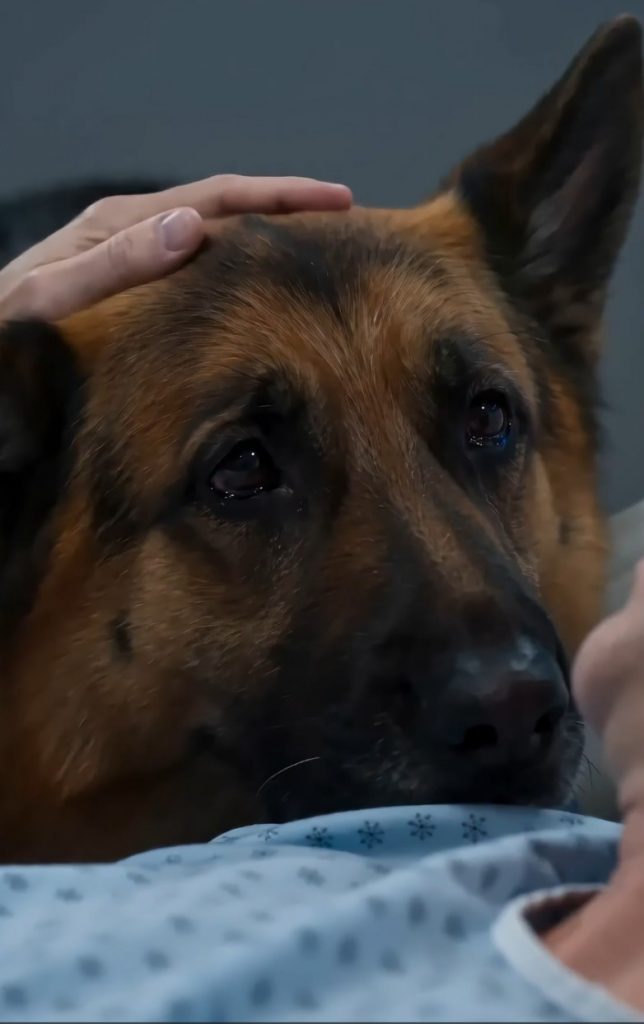
He only pressed his head harder against the hospital bed, his dark eyes fixed on the man lying against the white pillow.
The room was dim and sterile, washed in cool blue light from the medical screens. A thin green pulse line moved across the monitor behind the bed. The air smelled faintly of antiseptic, plastic tubing, and rain-soaked fur.
Mark Rylan lay almost motionless beneath the striped hospital blanket.
His skin was pale. His lips were dry. Every breath seemed to cost him something.
But his hand still moved.
Slowly, with the kind of effort that made the nurse at the doorway stop breathing, Mark lifted his trembling fingers and placed them between the dog’s ears.
The German Shepherd leaned into the touch like he had been waiting for it his whole life.
“Easy, Valor,” Mark whispered.
The dog whimpered.
Not loudly.
Just enough to break the room.
A single tear gathered at the edge of Valor’s eye and slipped down through the black-and-tan fur of his face. Nurse Hannah Ellis saw it catch the monitor glow, silver for one fragile second before it disappeared near his muzzle.
She had worked in hospitals long enough to know people saw miracles when they were afraid.
But this was not imagination.
The dog was grieving.
Mark’s fingers brushed weakly through Valor’s fur.
“I’m still here,” he whispered.
The words were barely sound.
But Valor heard them.
His ears shifted forward. His body stilled. His eyes stayed locked on Mark’s face, as if he could hold the man in the world by refusing to look away.
Hannah stood by the door with a medication tray in her hands, unable to move.
Visiting hours had ended forty minutes ago. Hospital policy did not allow animals in critical care unless paperwork had cleared three departments, two supervisors, and a lawyer who never answered after five.
But Valor was not a pet.
He was Mark Rylan’s former K9 partner, a retired German Shepherd with a county service record longer than most officers’ careers. And when the ambulance brought Mark in three nights earlier, Valor had jumped into the back and refused to come out until Mark did.
The paramedics tried coaxing him.
Security tried blocking him.
Then Mark, half-conscious and barely able to speak, had made one sound.
“Valor.”
The dog had climbed beside him and lowered his head to Mark’s chest.
No one tried again.
Now, in the quiet room, Hannah watched the man and dog breathe together.
One weak.
One steady.
Both terrified.
She stepped forward to check the IV line, but Valor suddenly lifted his head.
His body changed.
The grief vanished.
His ears rose. His nose twitched. A low growl moved through his chest.
Hannah froze.
“What is it?” she whispered.
Valor stared at the medication tray in her hands.
Then he looked back at Mark.
The heart monitor beeped again.
Faster.
And Hannah realized the dog was not only saying goodbye.
He was warning her.
Act II
Before the hospital room, before the machines, before the whispered promise, Mark Rylan had been the kind of man people called when every other plan had failed.
Missing child in the woods.
Elderly man lost after a winter storm.
Evidence buried beneath collapsed drywall after a fire.
Mark and Valor went in.
That was what they did.
They went where fear told everyone else to stop.
Mark had raised Valor from a reckless, oversized puppy who chewed bootlaces and slept under the kitchen table. By the time Valor was two, he could track a scent across wet asphalt, ignore gunfire drills, locate hidden medication, and sit perfectly still beside a child in shock until help arrived.
To the county, Valor was a tool.
To Mark, he was family.
Mark had no wife anymore. No children. No parents alive to wait up when he worked late. His house outside town held two coffee mugs, one old leather couch, and a row of framed photographs he rarely dusted.
But there was always Valor.
Valor at the foot of the bed.
Valor in the passenger seat.
Valor waiting at the gate when Mark came home from hearings, storms, searches, and the kind of days no one wanted to talk about afterward.
Then came the Millner case.
A twelve-year-old girl disappeared from a roadside rest area during a school trip. Volunteers searched fields, ditches, and drainage tunnels for almost eighteen hours. The sheriff’s department called Mark near midnight.
Valor found her before dawn.
She was alive, frightened, and hidden in an abandoned maintenance shed two miles from where everyone had been looking.
The county called Mark a hero.
The newspapers printed Valor’s picture.
The sheriff stood behind a podium and said it was proof the department’s search unit deserved more funding.
But Mark had seen something the department wanted buried.
The maintenance shed Valor led them to had been unlocked from the outside.
Inside were fresh tire tracks.
A county-issued flashlight.
And a torn strip of fabric from a private security uniform belonging to Northstar Response, the company trying to take over the county’s search-and-rescue contract.
Mark reported it.
The evidence vanished.
The official story changed.
The girl had “wandered.”
The shed had been “random.”
Northstar had “no connection.”
Mark refused to sign the final report.
Two weeks later, he was suspended for “procedural misconduct.”
A month after that, Valor was forced into retirement.
Mark fought it. He filed complaints. He called state investigators. He sat across from men in polished conference rooms while they smiled and told him he was emotional, exhausted, mistaken.
Then the calls began.
Unknown numbers.
A voice breathing and hanging up.
A black SUV parked across from his house.
A warning note tucked beneath his windshield wiper.
Let it go.
Mark did not let it go.
He kept copies of everything.
Photos. Time stamps. Old emails. Dispatch records. The missing evidence list. Names of people who had signed forms they never should have touched.
He hid the files where no one would think to look.
Not in a safe.
Not in a cloud drive.
In Valor’s old training trunk beneath a false bottom, under leashes, faded tennis balls, scent cloths, and the first collar Mark ever bought him.
Three nights before Hannah saw the dog growl at the medication tray, Mark called a reporter.
He never made it to the meeting.
His truck was found on a service road after midnight, hazard lights blinking in the rain. Mark was inside, unconscious but alive. No crash damage. No obvious explanation.
Valor was found beside him, barking until a passerby stopped.
The doctors said Mark’s condition looked like a severe reaction to something in his system. They were careful with their words. Too careful.
By the second night, he improved.
By the third, he suddenly got worse.
That was when Valor stopped sleeping.
He stayed awake beside the bed, watching every nurse, every doctor, every syringe, every hand that came near Mark.
And now he was growling at Hannah’s tray.
Hannah looked down.
One medication cup.
One syringe.
One sealed vial.
All standard.
All ordered.
All signed by Dr. Andrew Voss, the attending physician.
But Valor’s growl deepened.
Mark’s hand twitched weakly on the blanket.
Hannah set the tray on the counter and checked the chart again.
Then her stomach tightened.
The medication was marked as safe.
But the allergy warning that had been on Mark’s file that morning was gone.
Someone had deleted it.
And Valor knew before anyone else did.
Act III
Hannah did not administer the medication.
She closed the door quietly, locked the tray in the cabinet, and called pharmacy from the hallway.
Her voice stayed calm because hospital walls had ears.
“I need verification on Rylan, Mark. Critical care, Room 412. Pull his medication history from admission, not the updated chart.”
The pharmacist sighed like it was routine.
Then went silent.
“Hannah,” he said finally, “where did this order come from?”
“Voss signed it.”
“No. I mean why was it ordered at all? There was an allergy alert attached until…” Paper rustled. “Until 6:43 p.m.”
Hannah looked down the hall.
Dr. Voss stood at the nurses’ station, speaking softly to a man in a dark overcoat.
Not family.
Not hospital staff.
The man had a square jaw, close-cropped hair, and a visitor badge turned backward so his name did not show.
Hannah felt the hospital become colder.
“Can you restore the alert?” she asked.
“I can flag it.”
“Do it.”
“Hannah, what’s going on?”
She looked through the window into Mark’s room.
Valor had lowered his head back to the bed, but his eyes were still open.
“Something is wrong,” she said.
The pharmacist did not argue.
When Hannah returned to the room, Mark was awake.
Barely.
His eyes moved toward her, unfocused at first, then sharper when he saw her empty hands.
“You didn’t…” he whispered.
“No,” Hannah said. “I didn’t.”
Valor gave a soft breath, almost relief.
Mark’s fingers tightened weakly in the dog’s fur.
“He knows,” Mark breathed.
“What does he know?”
Mark swallowed. Even that seemed painful.
“Northstar.”
Hannah came closer.
The name meant nothing to her at first. Then she remembered a headline from weeks ago. Something about a county contract. A retired K9. A suspended handler.
“Mark,” she said carefully, “who was the man talking to Dr. Voss?”
His face changed.
Fear passed through it, but not for himself.
For Valor.
Hannah leaned down. “Listen to me. I need you to tell me what’s happening.”
Mark’s lips moved.
No sound came.
The monitor beeped steadily, cruelly patient.
He tried again.
“Collar,” he whispered.
Hannah looked at Valor.
The dog’s thick collar was old leather, worn soft with age. A small silver tag hung beside his retired K9 identification badge.
Hannah gently touched it.
Valor did not move.
Behind the identification badge, tucked flat and nearly invisible, was a tiny black storage drive sealed in plastic.
Hannah stared.
Mark’s eyes closed, then opened again.
“Backup,” he breathed.
A chill ran up Hannah’s arms.
She slipped the drive into her pocket just as footsteps approached the door.
Dr. Voss entered without knocking.
He smiled, but his eyes moved immediately to the cabinet where the medication tray had been locked away.
“Everything all right?” he asked.
Hannah turned.
“Yes. I was confirming dosage.”
Voss glanced at Mark. “The order was clear.”
“Pharmacy flagged a concern.”
His smile thinned. “Pharmacy doesn’t know the full clinical picture.”
Valor lifted his head.
The growl returned.
Voss looked at the dog with open irritation. “This animal needs to be removed. Now.”
Mark’s hand moved weakly.
“No,” he whispered.
Voss ignored him. “This is a hospital, not a kennel.”
Hannah stepped between Voss and the bed.
“He’s a registered retired service K9, and the patient responds to him.”
“The patient is unstable.”
“Then we should avoid distressing him.”
Voss’s voice dropped. “Nurse Ellis, you are interfering with treatment.”
Hannah felt the drive in her pocket like a heartbeat.
“No,” she said. “I’m preventing a medication error.”
For a second, the room held its breath.
Then Valor stood.
Slowly.
His body placed itself between Voss and Mark.
Not lunging.
Not attacking.
Guarding.
Voss stared at the dog, and something in his expression betrayed him.
Recognition.
He knew Valor.
And Valor knew him.
The door opened again.
The man in the dark coat stepped inside.
He looked at Mark first.
Then at the dog.
“Well,” he said quietly. “That’s unfortunate.”
Hannah understood then.
This was not a medical mistake.
It was a cleanup.
And Mark Rylan had hidden the truth on the one partner they never thought to search.
Act IV
The man in the dark coat introduced himself as Caleb Trent.
He said he was with hospital security.
He was not.
Hannah knew every security supervisor on the night shift, and none of them wore Italian shoes or watched a retired K9 like a problem needing disposal.
“I’ll take the dog,” Trent said.
Valor’s ears pinned forward.
Mark’s breathing became shallow.
Hannah reached for the call button, but Voss stepped in front of it.
“Nurse Ellis,” he said, “leave the room.”
She did not move.
Trent sighed. “This doesn’t need to become difficult.”
Valor barked once.
The sound cracked through the quiet room so sharply that someone outside stopped walking.
Hannah saw her chance.
She knocked the metal tray from the counter.
It hit the floor with a crash that rang down the hallway.
Valor barked again.
This time, louder.
A nurse opened the door. “Hannah?”
“Call a code assist,” Hannah said. “Now.”
Voss turned. “Do not—”
But it was too late.
Hospital staff moved fast when they heard fear in one of their own.
Within seconds, two nurses, a respiratory therapist, and a real security guard appeared in the doorway. Trent stepped back, adjusting his coat, already calculating.
Voss raised both hands. “There’s been a misunderstanding.”
Hannah pulled the storage drive from her pocket.
“No,” she said. “There’s been a crime.”
Mark’s eyes opened at the sound of the word.
Valor moved closer to him, but his gaze stayed on Trent.
The real security guard looked confused. “Who is this man?”
Trent smiled. “County liaison.”
“Show ID.”
Trent did not.
Instead, he glanced at Voss.
And that glance was enough.
Hannah backed toward the hallway and handed the drive to the charge nurse. “Lock this in the medication room. Call the hospital administrator. Then call the police.”
Voss lunged for it.
Valor moved faster.
He slammed his body against the bed rail and barked so fiercely that Voss stumbled backward. The doctor hit the wall, stunned more by exposure than pain.
No one touched Mark.
No one touched the dog.
The hospital went from quiet to chaos in under a minute.
Police arrived first.
Then a county investigator.
Then, just before midnight, a woman named Dana Whitcomb came running through the ICU doors with rain in her hair and a press badge clipped to her coat.
She was the reporter Mark had tried to meet.
When she saw him alive, her face crumpled with relief.
“I thought they got to you,” she whispered.
Mark’s eyes shifted toward Valor.
“They tried,” Hannah said.
The drive was opened under police supervision in the administrator’s office.
Inside were files Mark had been collecting for months.
Photos of Northstar vehicles near restricted scenes.
Emails between company executives and county officials.
Evidence logs altered after the Millner case.
Payment records.
Names.
And one video taken from Mark’s dashboard camera the night he collapsed.
It showed a man approaching his truck on the service road.
Caleb Trent.
It showed him speaking to Dr. Voss by phone minutes before Mark was found.
It showed Valor in the passenger seat, barking wildly, trying to push between Trent and his handler.
Mark had not imagined the threat.
He had documented it.
Valor had protected it.
By morning, Dr. Voss was suspended and under investigation. Caleb Trent was arrested in the parking garage, where he had been trying to leave through a staff exit. Northstar’s county contract was frozen before sunrise.
But none of that mattered inside Room 412.
Not yet.
Because Mark’s body had been through too much.
The danger was no longer only outside the room.
It was inside his fragile breath.
Hannah returned after giving her statement and found Valor with his head on the bed again.
Mark’s hand rested between his ears.
The monitor beeped.
Slow.
Steady.
Mark opened his eyes.
“Did he do good?” he whispered.
Hannah looked at the German Shepherd, at the damp fur beneath his eye, at the loyal body that had refused to leave when every human system had almost failed.
“No,” she said softly. “He did perfect.”
Mark’s mouth curved faintly.
Valor exhaled and closed his eyes for the first time in hours.
But his head stayed pressed against the bed.
As if sleep was allowed.
Leaving was not.
Act V
Mark did not recover all at once.
Stories like his rarely do.
There was no sudden sunrise, no dramatic leap from the bed, no clean ending wrapped in applause.
There were long mornings when he could barely sit up.
Afternoons when speaking exhausted him.
Nights when Valor woke from sleep with a sharp whine and pushed his nose beneath Mark’s hand until Mark touched him and whispered, “Still here.”
The first time Mark stood, he managed seven seconds.
Valor stood with him.
The second time, he managed twelve.
Valor watched his knees.
By the end of the second week, Mark could take five slow steps with a walker while Valor paced beside him, matching every movement like they were back in training, back before betrayal had entered the story wearing a badge and a medical coat.
Hannah visited on her breaks.
At first, she told herself she was checking on a patient.
Then she stopped pretending.
She brought Valor ice chips in a cup because he liked crunching them. She brought Mark updates from the investigation when he was strong enough to hear them.
The Millner family had been contacted.
The missing evidence had been restored.
Two county officials resigned.
Northstar’s offices were searched.
Dana Whitcomb’s article ran on a Sunday morning under a headline that made half the county stop over coffee and read in silence.
But the photograph everyone remembered was not of handcuffs or court steps.
It was Valor beside Mark’s hospital bed, his head pressed to the blanket, one eye shining in the cool monitor light.
People called him a hero.
Mark hated that word for dogs.
“He was loyal,” he told Hannah one afternoon. “That’s better.”
Hannah smiled. “Most people use hero because loyal is harder.”
Mark looked at Valor, who was sleeping with one paw against the bed frame.
“Yeah,” he said. “It is.”
Three weeks after the night Valor warned her, Hannah wheeled Mark toward the hospital exit.
He insisted on wearing jeans instead of pajama pants. He insisted on walking the last twenty feet. He insisted, most of all, that Valor go first.
The German Shepherd stepped through the sliding doors into the bright winter morning, then stopped.
He turned back.
Waiting.
Mark gripped the walker and took one careful step.
Then another.
Hospital staff lined the hallway, pretending they had gathered by accident. Nurses. Orderlies. A pharmacist. Two security guards. Even the respiratory therapist who had answered the crash in Room 412.
No one clapped at first.
They were afraid to break the moment.
Then Hannah did.
Softly.
Once.
The sound spread.
Mark lowered his head, embarrassed and overwhelmed.
Valor walked back to him, pressed his shoulder gently against Mark’s leg, and steadied him without being asked.
That was when Mark cried.
Not loudly.
Not dramatically.
Just one hand over his face, one hand reaching for the dog who had carried him through the worst night of his life without ever leaving the floor beside him.
The investigation would continue.
Courtrooms would follow. Testimony. Denials. Lawyers trying to make the truth sound uncertain. Men in suits claiming they did not remember emails they had written with their own hands.
But Mark had survived.
Valor had stayed.
And the truth had made it out of the room.
Six months later, Mark returned to the hospital.
Not as a patient.
He walked through the front doors with Valor at his side and a folder tucked under one arm. His limp was still there, but less visible now. His face had color again. His hair had grown longer. Valor’s muzzle had more gray in it, though he carried himself with the calm pride of a dog who knew exactly where he belonged.
Hannah was at the nurses’ station when she saw them.
For a second, she could only stare.
Then she laughed, covered her mouth, and came around the counter.
“Look at you,” she said.
Mark smiled. “He wanted to visit.”
Valor leaned into her legs.
Hannah knelt and buried both hands in his fur. “Sure he did.”
Mark handed her the folder.
Inside was the proposal.
A new hospital program for critical patients with service animals and retired working dogs. Clear policies. Emergency exemptions. Safe visitation guidelines. Training for staff. A way to make sure no one had to beg for common sense during the worst hour of their life.
At the bottom was the program name.
The Valor Protocol.
Hannah read it twice.
Her eyes filled.
“You named it after him?”
Mark looked down at the German Shepherd.
“He earned it.”
That afternoon, they walked together to Room 412.
It was empty now.
Clean sheets. Silent monitor. Sunlight instead of blue hospital glow.
Valor approached the bed slowly.
For a moment, he simply stood there, looking at the place where Mark had almost disappeared from him.
Then Mark sat on the edge of the mattress and rested his hand between the dog’s ears.
The same gesture.
The same promise.
Only this time, his hand did not tremble.
Valor closed his eyes.
Mark whispered, “I’m still here.”
Hannah stood in the doorway, remembering the night those words had sounded like a thread stretched over darkness.
Now they sounded different.
Not desperate.
Not fragile.
A vow kept.
Outside the room, the hospital moved on. Phones rang. Wheels rolled across tile. Families waited. Doctors hurried. Somewhere, another machine beeped beside another bed, and another person prayed for one more morning.
But inside Room 412, a man and his dog sat quietly in the light.
No danger.
No hidden order.
No stranger at the door.
Just breath.
Just loyalty.
Just the simple, impossible miracle of staying.