Act I
“Max, stop!”
Grandpa’s voice cracked through the forest like a branch snapping under weight.
Max did not stop.
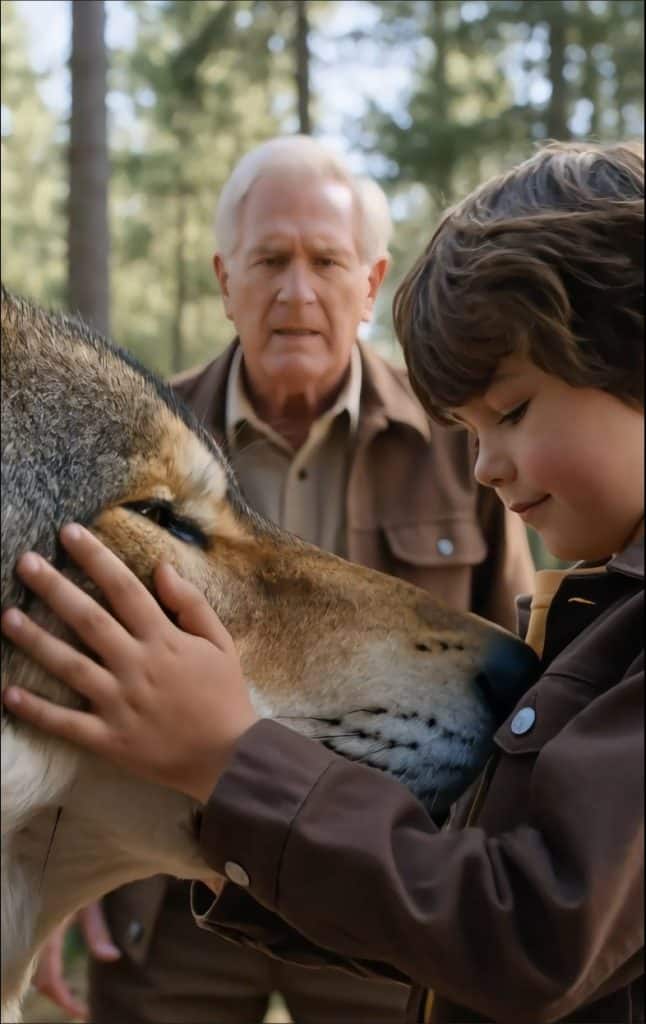
He stood in a pool of golden sunlight, small and still, his shaggy brown hair catching the glow where it slipped through the leaves. In front of him, half-hidden among brown pine needles and dry fallen leaves, lay the biggest wolf his grandfather had ever seen.
It was enormous.
Gray, tan, and black fur rose and fell with each slow breath. Its head was powerful enough to make the forest seem smaller around it. Its yellow-orange eyes stayed locked on Max’s face with the terrible focus of an animal deciding whether the next movement would mean danger.
Grandpa froze several feet away, one hand lifted, the other gripping his walking stick so hard his knuckles whitened.
“Max,” he said again, softer now, more afraid. “Come back.”
The wolf’s lip twitched.
A low growl rolled through the leaves.
Grandpa’s heart nearly stopped.
But Max only turned his head slightly.
“No, Grandpa,” he said.
The boy’s voice was quiet. Not stubborn. Not reckless.
Certain.
Then he took one careful step forward.
Leaves whispered beneath his shoe.
The wolf raised its head, just enough to warn him. Its eyes narrowed. Its breath came heavier. Near the top of one massive shoulder, beneath clumped fur, a small dark mark showed through.
Max saw it.
Grandpa did too.
But Grandpa saw danger.
Max saw pain.
“Don’t,” Grandpa pleaded. “Please, Max.”
Max lowered his hand slowly, palm open, fingers relaxed the way his father had once taught him to greet frightened animals. He did not reach for the wolf’s eyes. He did not rush. He did not smile too brightly or speak too loudly.
He simply waited.
The wolf growled again.
Max paused.
The forest went silent around them.
Even the birds seemed to hold their breath.
Then, inch by inch, Max placed his small hand against the thick fur of the wolf’s neck.
The growl stopped.
Grandpa stared, unable to move.
The wolf closed its eyes.
Not all the way at first. Just enough for its face to change from a warning into something older, heavier, exhausted.
Max stroked the fur gently.
“There,” he whispered. “You’re not bad.”
The wolf leaned into his palm.
Grandpa’s mouth opened, but no sound came out.
Because as the wolf shifted under Max’s touch, sunlight fell across the wounded shoulder again.
And beneath the mud and matted fur, Grandpa saw an old white scar shaped like a crescent.
The same scar he had seen once before.
On the night Max’s father disappeared.
Act II
Three years earlier, no one in Briar Hollow locked their doors before sunset.
Children rode bicycles along gravel lanes until their mothers called them in. Men drank coffee outside the feed store and argued about weather as if arguing could change it. The forest behind the town was not considered dangerous then.
Deep, yes.
Wild, yes.
But not cruel.
That changed when Daniel Reed vanished.
Daniel was Max’s father, a wildlife rescue officer with gentle hands, a stubborn jaw, and a habit of bringing home injured animals as if the house were a hospital and his family had accidentally become staff.
A hawk with a broken wing once lived in the laundry room for two weeks.
A fawn slept in the barn.
A fox kit bit through Grandpa’s best leather glove, and Daniel laughed so hard Grandpa threatened to move out.
“You can’t save the whole forest,” Grandpa used to tell him.
Daniel would only smile.
“No,” he said. “But you can save what crosses your path.”
Max adored him.
At five years old, he followed Daniel everywhere, asking questions about tracks, feathers, scat, nests, weather, and why Grandpa acted angry when he was actually worried.
Daniel answered every question like it mattered.
He taught Max how to stand still near wild things. How to breathe slowly. How to look at an animal’s body before deciding what its teeth meant.
“Most creatures don’t want to hurt you,” Daniel told him. “They want to survive. There’s a difference.”
The last rescue Daniel worked was in the north ridge forest.
Someone had been setting illegal traps.
Not for wolves officially, because the law protected them. Not for bears either, because that brought too much attention. The traps were hidden and unmarked, placed where animals moved at dusk. Daniel had been furious when he found the first one.
Grandpa remembered that evening too clearly.
Daniel stood in the kitchen, rain dripping from his jacket, holding a torn strip of gray-black fur in one hand and a bent metal snare in the other.
“There’s a wolf out there hurt,” he said.
Grandpa set down his coffee.
“A wolf?”
“Big female. Maybe the alpha. She’s dragging one leg, but she’s still moving.”
“Then call the state team.”
“I did. They’ll be here tomorrow.”
“Then wait.”
Daniel’s face hardened.
“She won’t have tomorrow if the wound gets infected or the poachers come back.”
Grandpa hated that word.
Poachers made the forest sound like a battlefield. He preferred accidents. Trespassers. Fools. Anything that felt less deliberate.
Daniel did not give him that comfort.
“Someone is baiting the ridge,” Daniel said. “And if they’re willing to trap a protected wolf, they’re willing to do worse.”
That night, Daniel went back into the forest.
He never came home.
Search teams found his truck near the old logging road. They found his radio smashed under wet leaves. They found signs of a struggle near the ravine.
And they found wolf tracks.
Huge ones.
The town made up its mind quickly.
A rescue officer went after a wounded wolf. The wolf turned on him. Nature took what it wanted. Tragic, but simple.
Grandpa accepted that story because the alternative was worse.
If men had hurt Daniel, then men could be blamed.
If a wolf had done it, grief had somewhere to go.
So Grandpa hated the wolf.
Quietly at first.
Then more openly.
He stopped taking Max to the north ridge. He packed away Daniel’s field journals. He sold the old rescue cages. He told Max that wild animals were not storybook friends and that some things, no matter how beautiful, were born dangerous.
Max listened.
But he never believed it.
Because Max remembered his father’s voice.
Most creatures don’t want to hurt you. They want to survive.
Three years later, walking with Grandpa through the sunlit forest to gather pinecones for a school project, Max heard a low whimper beyond the trees.
Grandpa told him to stay back.
Max stepped through the brush anyway.
And there, lying in the leaves, was the giant wolf with the crescent scar.
Act III
Grandpa knew that scar because Daniel had drawn it.
Not in the official report.
Not in anything the police ever saw.
In a private field journal Grandpa had locked in a cedar chest after the funeral because looking at Daniel’s handwriting hurt too much.
The sketch showed the head and shoulder of a massive wolf.
Female. Approx. 110 lbs. Crescent scar across right shoulder from old injury. Highly intelligent. Defensive but not aggressive. Protecting den area.
Daniel had written one name beside the drawing.
Asha.
Grandpa had not thought of it in years.
Now the wolf lay in front of Max, older and heavier, with the same crescent mark beneath the fresh wound.
Asha.
The name struck Grandpa so hard his knees weakened.
Max kept his hand against the wolf’s face. The animal’s breathing slowed. Her eyes stayed half-closed, not from sleep, but from surrender to the only kindness she had found all day.
“Grandpa,” Max whispered. “She’s hurt.”
Grandpa swallowed.
“Move away from her.”
“She knows us.”
“No, she doesn’t.”
Max looked back at him.
“She knew Dad.”
The words made the forest tilt.
Grandpa wanted to deny it. He wanted to shout. He wanted to drag Max back and call someone else to deal with the wolf, the wound, the memories, all of it.
Instead, he saw something tangled near Asha’s shoulder.
Not just fur.
Not just mud.
A strip of old green fabric was caught beneath a broken piece of trap wire, wrapped loosely but painfully around her upper back. The fabric had faded with weather and age, but Grandpa recognized the color.
Daniel’s field jacket.
His breath caught.
Max noticed his face.
“What is it?”
Grandpa took one slow step closer.
Asha’s eyes opened.
Her growl returned, low and warning.
Max immediately placed his hand more firmly against her cheek.
“It’s okay,” he said softly. “He’s scared too.”
Grandpa almost laughed from the pain of it.
The boy was seven years old and somehow understood more than the grown man who had spent three years turning grief into fear.
Grandpa lowered himself to one knee.
The wolf watched him.
He did not reach for her. Not yet.
“I knew your father’s scar,” he whispered.
Max frowned. “Dad had a scar?”
“No,” Grandpa said. His voice broke. “He knew hers.”
The wind moved through the trees. Sunlight shifted across the leaves.
Asha turned her head, slow and deliberate, toward the deeper forest.
Then she whined.
It was not the sound of an animal asking for comfort.
It was a call.
Grandpa heard it this time.
Not a threat.
A request.
Max leaned close to her.
“What is it, girl?”
Asha tried to stand.
Her front legs pushed beneath her. Her body trembled. Pain rolled through her, and she nearly collapsed, but her eyes remained fixed on the trees beyond them.
Grandpa rose quickly.
“No. She can’t move.”
Asha pulled again.
The old green fabric tugged at the wire.
Max looked toward the shadowed ridge.
“She wants us to follow.”
Grandpa shook his head.
“No.”
But Asha’s gaze shifted to him.
And in those yellow-orange eyes, he saw something that destroyed the story he had clung to for three years.
Not guilt.
Not wildness.
Recognition.
The wolf had not forgotten Daniel.
And maybe, Grandpa realized with a cold rush of shame, she had been trying to lead someone to the truth all along.
Act IV
They did not follow immediately.
First, Grandpa called the wildlife emergency number with shaking hands and gave them their location. Then, using the small knife from his belt and every ounce of nerve he had left, he cut the trap wire loose from Asha’s shoulder while Max kept one hand against her muzzle.
The wolf flinched once.
Grandpa froze.
Max whispered, “Easy.”
Asha did not bite.
She only breathed through the pain.
When the wire finally fell away, Grandpa saw the wound more clearly. It was not old. Someone had trapped her recently. Someone was still setting snares in Daniel’s forest.
His stomach twisted.
“She didn’t hurt him,” Max said.
Grandpa looked at him.
The boy’s eyes were wet, but steady.
“You know that now, don’t you?”
Grandpa could not answer.
Asha stood again, slowly this time, and limped toward the trees.
“Max, stay behind me,” Grandpa said.
For once, Max obeyed.
They followed the wolf through the forest.
Not far.
Just beyond a cluster of fallen trunks, past a dry creek bed, up toward the old logging road where the canopy thickened and the light turned green-gold. Asha moved slowly, stopping often, but never changing direction.
Then they reached the ravine.
Grandpa’s chest tightened.
This was where the search teams had found Daniel’s broken radio.
This was where the tracks had ended.
For three years, Grandpa had refused to come here.
Asha stopped beside a hollow beneath a fallen cedar.
She lowered her head and whined.
Max grabbed Grandpa’s sleeve.
Inside the hollow, wrapped in leaves and dirt, was a rusted metal field case.
Daniel’s field case.
Grandpa staggered forward.
His hands shook so badly he could barely open the latch. The hinges resisted, then gave with a soft crack.
Inside were three things.
A water-damaged notebook sealed in a plastic sleeve.
A memory card in a cracked protective case.
And Daniel’s rescue badge.
Grandpa touched the badge first.
A sound came out of him that Max had never heard before.
Not crying exactly.
Something older than crying.
Max moved closer and slipped his small hand into Grandpa’s.
Together, they opened the notebook.
Daniel’s final entries were rushed, written in pencil, but still readable.
Asha led me to the den. Three pups alive. Trap line active. Human boot tracks everywhere. Saw truck near old quarry road. Not hunters. Organized. Taking animals alive.
Grandpa turned the page.
The last entry was shorter.
If I don’t make it back, Asha did not attack me. She tried to lead me out. Men on ridge. I hid the case near cedar hollow. Tell Max the wolf remembered kindness.
Grandpa covered his mouth.
For three years, he had blamed the creature who had tried to save his son.
Asha lay down near the hollow, exhausted. Her eyes watched the trees, not them.
Protecting.
Still.
Max knelt beside her again.
“She kept it safe,” he whispered.
Grandpa nodded, tears running freely now.
“She kept his truth safe.”
A branch snapped somewhere uphill.
Grandpa turned.
Two men stood between the trees.
One held a coil of wire traps.
The other had a tranquilizer rifle lowered at his side.
For a long second, nobody moved.
Then Asha rose with a growl that shook the leaves.
Act V
The men ran when they heard the sirens.
Wildlife officers arrived faster than Grandpa expected, guided by the GPS pin from his call and the emergency note he had shouted into the phone after finding Daniel’s case. By the time they reached the ravine, the two poachers had already dropped half their gear trying to escape through the brush.
They did not get far.
The memory card from Daniel’s field case held photos. Clear ones. License plates. Faces. Trap sites. Crates. The old quarry road. Enough evidence to reopen every question the town had buried beneath the easier story of a dangerous wolf.
But none of that mattered to Max in the first hour.
Only Asha mattered.
The wildlife team sedated her carefully, after Grandpa insisted they wait until Max was the one sitting near her head. The boy kept his palm against her fur as her eyes grew heavy.
“She’ll wake up?” Max asked.
The veterinarian nodded.
“She’ll wake up.”
Max did not move until he believed her.
Grandpa sat beside him on the leaves, Daniel’s rescue badge held in both hands.
“I was wrong,” he said.
Max leaned against his shoulder.
“About the wolf?”
Grandpa looked at Asha.
Then at the trees.
Then at the field case that had waited three years in the hollow.
“About grief,” he said quietly. “I let it make me cruel.”
Max was silent for a moment.
Then he said, “Dad wouldn’t be mad.”
Grandpa’s throat tightened.
“How do you know?”
“Because he saved hurt things too.”
That broke him.
Grandpa folded forward, one arm around Max, the other hand clutching Daniel’s badge. He cried in the forest where he had refused to stand for three years, while the wolf he had feared breathed softly nearby and the boy who carried Daniel’s gentleness held him together.
The truth came out slowly after that.
The town did not like it at first. Towns rarely enjoy having their simple stories corrected. It was easier to fear a wolf than admit men with trucks, money, and hidden buyers had turned the forest into a trap line.
But Daniel’s evidence was too clear.
The poachers were arrested. The old quarry was searched. More traps were pulled from the ridge. The local officers who had dismissed Daniel’s warnings were forced to answer for why the search had ended so quickly and why no one had followed the signs he left behind.
At Daniel’s memorial, the plaque was changed.
Not much.
Just one line added beneath his name.
He died protecting the wild things that trusted him.
Grandpa stood in front of it for a long time.
Max stood beside him.
Neither of them spoke.
Asha healed at a wildlife rehabilitation center two counties away. For weeks, Max asked about her every morning before breakfast and every night before bed. Grandpa drove him there on Saturdays, pretending each visit was for the boy.
But the first time Asha lifted her head at the sound of Grandpa’s voice, he turned away so Max would not see his eyes fill.
“You can pet her,” Max said.
Grandpa shook his head.
“She may not want me to.”
Max smiled softly.
“She forgave you before you forgave yourself.”
The words sounded too old for him.
Or maybe children simply understood forgiveness before adults taught them pride.
A month later, Asha was released back into the north ridge forest.
Wildlife officers gathered quietly near the tree line. Grandpa stood with Max beside the open transport crate. The air smelled of pine, damp earth, and new leaves. Sunlight filtered through the canopy in warm strips, just as it had on the day they found her.
Asha stepped out slowly.
For a moment, she looked at the forest.
Then she turned back.
Her yellow-orange eyes found Max first.
He raised one hand.
Not waving.
Just open.
Asha crossed the small space between them and pressed her great head gently into his palm.
No growl.
No fear.
Only recognition.
Max stroked her fur the way he had that first day, slow and careful.
“I knew you were good,” he whispered.
Then Asha turned to Grandpa.
He stopped breathing.
The wolf came close enough that he could see the crescent scar on her shoulder, pale beneath the new growth of fur. The mark no longer looked like a warning. It looked like a signature.
Proof of survival.
Proof of memory.
Grandpa lowered his hand.
Asha sniffed his fingers.
Then, softly, she leaned her head against his palm.
Grandpa closed his eyes.
“I’m sorry,” he whispered.
The wolf stayed there for one heartbeat more.
Then she turned and slipped into the trees.
Max watched until her gray and gold body disappeared into the forest light.
Grandpa placed Daniel’s old rescue badge into Max’s hand.
“I think he’d want you to have this.”
Max looked down at it, then back at the place where Asha had vanished.
“Will she come back?”
Grandpa breathed in slowly.
The forest was quiet again, but not empty.
Somewhere beyond the ridge, a wolf called once.
Low.
Long.
Alive.
Max smiled.
Grandpa looked at his grandson, at the badge, at the trees that had finally given back the truth.
“Yes,” he said. “When it matters.”
And this time, when the forest answered with silence, it did not feel like a secret.
It felt like trust.