Act I
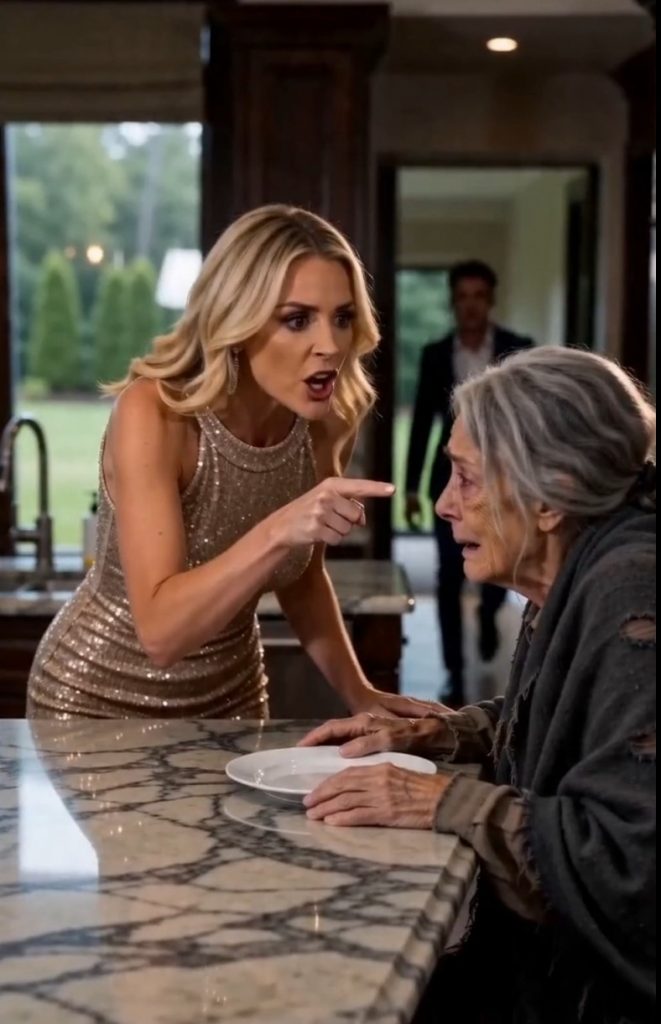
The old woman’s hands rested on either side of the empty plate as if even touching it too firmly would be considered theft.
The plate was white ceramic, perfectly clean, sitting in the center of a marble island veined with dark gray lines. Above it, pendant lights glowed over a kitchen built for magazine covers, not hunger. Dark wood cabinets. Polished steel appliances. A wide window looking out over a lawn so green it seemed almost unreal.
And across from her stood Vanessa.
Twenty-six years old, blonde, beautiful, and dressed in a gold sequined cocktail dress that flashed every time she moved. Her makeup was flawless. Her nails were sharp and pale. She looked like she belonged upstairs at a gala, surrounded by champagne and admiration.
Instead, she was leaning over the kitchen island, pointing a finger into an elderly woman’s face.
“You don’t deserve one bite,” Vanessa snapped. “Get out of my kitchen.”
The old woman recoiled slightly when Vanessa slammed her palm against the marble.
The sound cracked through the room.
Still, the old woman did not pull her hands away from the plate.
Her name was Rose Bennett, though Vanessa had never bothered to ask.
Rose wore a tattered dark gray shawl over a worn brown shirt. Her gray hair hung loose around her temples. Her face was lined deeply with age, sorrow, and the kind of exhaustion that comes from being turned away too many times in one day.
Her eyes were bloodshot.
Not from anger.
From hunger.
She lowered her head and whispered, “I’m sorry.”
Vanessa laughed once, coldly.
“You people are always sorry after you get caught.”
Rose’s fingers trembled against the rim of the plate.
“I didn’t come to steal.”
“No,” Vanessa said, leaning closer. “You came to beg. Which is worse.”
Behind them, the kitchen doorway darkened.
Ethan Bennett stepped inside wearing a navy suit and a white dress shirt, still carrying the scent of winter air and expensive cologne. He had come home early from a board dinner because he forgot the anniversary gift he planned to give his wife.
At first, he saw only Vanessa’s gold dress.
Then the empty plate.
Then the woman standing across the island with her head bowed.
His body stopped before his mind understood why.
“What are you doing?” he whispered.
Vanessa spun around.
Her face changed instantly from rage to startled innocence, the mask arriving too late.
“Ethan,” she said. “I was just handling something.”
The old woman lifted her eyes at the sound of his voice.
For one second, she looked afraid to hope.
Then Ethan saw her fully.
The gray hair.
The trembling mouth.
The small scar above her left eyebrow from the night he had broken a lamp at age seven and she had shielded him from the glass.
His hand rose to cover his mouth.
“No,” he breathed.
Vanessa frowned. “What?”
Ethan stepped forward, his eyes already wet, his face turning red with shock and fury.
“That,” he said, voice breaking as he pointed toward the woman Vanessa had just humiliated, “is my mother.”
The kitchen fell silent.
And the empty plate between them became an accusation no one could look away from.
Act II
Before Ethan Bennett became rich, he was a boy who knew how to sleep through hunger.
Not because it did not hurt.
Because his mother taught him to pretend it was a game.
“Close your eyes,” Rose would whisper, lying beside him in their one-bedroom apartment above the laundromat. “Tomorrow morning, we’ll make pancakes tall as the moon.”
There were rarely pancakes.
Sometimes there was toast.
Sometimes there was oatmeal thinned with too much water.
Sometimes Rose drank tea for dinner and told Ethan she had eaten at work, though he later learned she had been saving the last egg for him.
His father left when Ethan was five.
No goodbye. No child support. No photograph left behind except one Rose kept in a shoebox and never opened. From that day on, Rose worked wherever someone would pay her. Cleaning offices after midnight. Folding sheets in a hotel basement. Packing lunches in a school cafeteria. Scrubbing floors in houses owned by people who never learned her name.
Ethan remembered her hands most.
Always dry.
Always cracked.
Always warm when they touched his forehead.
She walked him to school every morning, even after a night shift, and told him the same thing at the gate.
“You are not what we lack. You are what we build.”
He believed her.
Because she believed it first.
At sixteen, Ethan started repairing computers for neighbors. At nineteen, he built an app in a community college lab because he could not afford software that did what he needed. At twenty-two, a local investor noticed him. At twenty-five, he sold his first company for more money than Rose had earned in her entire life.
The first thing he bought was not a car.
It was a house.
A modest one, with a porch and a kitchen large enough for Rose to make real pancakes whenever she wanted.
But Rose refused to move in permanently.
“You need your own life,” she told him.
“You are my life,” he said.
She smiled sadly. “That’s not the same thing.”
So Ethan bought her a small cottage three streets away. He hired someone to repair the roof. He set up automatic payments for everything. He put money in an account she could use any time.
For a while, it worked.
Rose came for Sunday dinners. Ethan drove her to doctor appointments. She cried the first time he took her to a restaurant where the waiter pulled out her chair.
Then Vanessa arrived.
She was stunning, ambitious, and skilled at making every room feel as if it had been waiting for her. Ethan met her at a charity auction for children’s literacy. She laughed at his awkward jokes. She told him she admired men who built something from nothing.
Rose tried to like her.
At the first dinner, Rose brought homemade apple pie in a covered dish. Vanessa thanked her with a smile that barely reached her eyes.
“How sweet,” she said. “So rustic.”
Ethan did not notice the insult.
He was in love.
Or he thought he was.
Vanessa knew how to study weakness. She noticed Ethan’s guilt about his childhood. She noticed his need to prove he could provide. She noticed the way he softened whenever Rose entered a room.
So she began carefully.
“Your mother seems lonely.”
“Your mother calls at strange times.”
“Your mother still treats you like a little boy.”
“Your mother doesn’t understand boundaries.”
Ethan pushed back at first.
Then Vanessa cried.
That was her gift. Not ordinary crying, but beautiful crying. Quiet tears. Trembling lips. A look of wounded patience, as if she were the only adult in a room full of unreasonable people.
“I just want us to have a marriage,” she said. “Not a marriage with your mother living in the middle of it.”
Ethan loved Rose.
But he was also tired of feeling poor in rich rooms.
Vanessa made him feel chosen by the world he had fought to enter.
So he called less.
Visited less.
Missed one Sunday dinner, then three, then too many to count.
Rose never complained.
That was how she had survived too much life.
She made excuses for people before they needed them.
Then, one autumn morning, her automatic payments stopped.
Not because Ethan canceled them.
Because Vanessa had quietly taken control of the household finances after their wedding.
“She’s proud,” Vanessa told him when he asked if Rose needed anything. “She said she wants to handle things herself.”
Rose had said no such thing.
By winter, her cottage roof leaked again. Her phone was disconnected. A medical bill swallowed the last of her savings. The bank froze her account after a fraud alert Vanessa had arranged under the excuse of “protecting family assets.”
Rose tried to reach Ethan.
Texts bounced.
Calls went unanswered.
At the gate of his mansion, security told her Mrs. Bennett had left strict instructions: no unannounced visitors.
Three days later, after sleeping in a church basement and walking nearly two miles in the rain, Rose came to the back door of the only house where she had once believed she would always be welcome.
She did not ask for money.
She asked for something to eat.
And Vanessa gave her an empty plate.
Act III
Ethan moved toward his mother as if crossing the kitchen required him to walk through every mistake he had made.
“Mom,” he whispered.
Rose’s face crumpled.
Not because he called her that.
Because for months she had feared she had lost the right to hear it.
He reached for her, but she stepped back instinctively, ashamed of her torn shawl, her dirty cuffs, the faint smell of rain and old shelter blankets clinging to her clothes.
That small step destroyed him.
“Don’t,” he said softly. “Please don’t move away from me.”
Vanessa recovered with terrifying speed.
“Ethan, you’re misunderstanding this.”
He did not look at her.
His eyes stayed on Rose’s hands.
On the swollen knuckles.
On the nails broken close.
On the way her fingers hovered near the empty plate as if she still needed permission to stand beside it.
“When did you last eat?” he asked.
Rose lowered her eyes.
“Mom.”
“This morning,” she said.
Vanessa exhaled sharply. “That’s not true. I offered her something.”
Ethan turned then.
The look on his face silenced her.
“What did you offer her?”
Vanessa lifted her chin. “I told her she could wait outside until you came home.”
“In December?”
“She came to the servants’ entrance looking like that. We’re hosting donors tonight.”
“Looking like what?”
Vanessa’s mouth closed.
Ethan stepped closer.
“Say it.”
She swallowed.
“Ethan, I did not know she was your mother.”
The excuse hung in the air, ugly and useless.
Rose flinched anyway, as if hearing herself reduced to a mistaken category hurt more than the hunger.
Ethan’s voice dropped.
“So if she had been someone else’s mother, this would be fine?”
Vanessa’s eyes darted to the doorway, to the polished cabinets, to every expensive surface that had once made her feel powerful.
“She was trespassing.”
“She was hungry.”
“She was manipulative.”
“She is my mother.”
“And I am your wife!” Vanessa snapped.
The words rang across the kitchen.
For one second, neither moved.
Then Rose whispered, “Please don’t fight because of me.”
That was Rose Bennett.
Humiliated, starving, and still trying to make herself less of a burden.
Ethan turned back to her with tears in his eyes.
“This is because of me,” he said. “Not you.”
Vanessa scoffed. “Oh, perfect. Now we’re doing guilt.”
Ethan ignored her.
He pulled out a chair at the kitchen island.
“Sit down, Mom.”
Rose hesitated.
Vanessa’s face twisted. “Ethan, the chair fabric—”
He slammed his hand on the counter so hard the empty plate jumped.
Vanessa went silent.
Ethan was not a loud man. Not usually. He had built his career on calm rooms, controlled negotiations, and the ability to make investors trust him before he spoke too much.
But this was not a boardroom.
This was the kitchen where his mother had been told she did not deserve one bite.
He opened the refrigerator with shaking hands. It was full. Of course it was full. Imported fruit. Trays from caterers. Champagne. Cheese wrapped in wax paper. Desserts waiting for guests who would pretend to care about charity over dinner.
He took out soup first.
Then bread.
Then roasted chicken.
Then butter, fruit, tea, anything he could reach.
Rose began crying before he put the bowl in front of her.
“I don’t need all that.”
“Yes,” he said. “You do.”
He warmed the soup himself.
Badly.
Too hot at first. Then too cold after he added water. His hands shook so much he dropped a spoon. Rose tried to pick it up. He stopped her gently.
“Please,” he said. “Let me.”
Vanessa watched from the opposite side of the island, her gold dress glittering like something obscene.
Then Ethan saw the bruise on Rose’s wrist.
His breathing changed.
“Who did that?”
Rose tucked her hand beneath the shawl.
No.
That movement answered before she did.
Ethan turned toward Vanessa.
Her face paled.
“I barely touched her.”
Act IV
The room became colder than the marble.
Ethan stared at his wife as if seeing a stranger who had been living inside his house wearing a familiar face.
“You touched my mother?”
Vanessa lifted both hands, defensive now. “She grabbed at the pantry door. I moved her.”
Rose whispered, “I was only trying to get the crackers.”
Ethan closed his eyes.
He saw himself at seven years old, standing in a grocery aisle while Rose counted coins in her palm. He had asked for crackers then too. Cheese crackers in a red box. Rose said no at first. Then she put back her tea and bought them for him.
He remembered eating them in bed that night while she told him stories about the house they would have one day.
Now she had come to his real house and been denied crackers by his wife.
He opened his eyes.
“Where is her phone?” he asked.
Vanessa frowned. “What?”
“Her phone. She’s been calling. I haven’t received anything. Where is it?”
Rose looked confused. “I thought you changed your number.”
Ethan turned slowly.
Vanessa’s silence cracked open another truth.
“You blocked her?”
“She was becoming dependent.”
“You blocked my mother?”
“She was always asking for things.”
Rose shook her head. “No. I only called because the heat went out. And then the bank said—”
“The bank?” Ethan said.
Vanessa’s eyes sharpened with panic.
Rose looked between them, suddenly realizing she had said something important.
“My card stopped working,” she said softly. “They said there was a fraud hold. I went to the branch, but they told me only the account administrator could clear it.”
Ethan’s voice was almost too calm now.
“What account administrator?”
Vanessa stepped back.
“Ethan, we should discuss this privately.”
He took out his phone.
“No. We’re discussing it with my attorney.”
“Don’t be dramatic.”
He looked at the empty plate.
Then at Rose’s trembling hands.
“I am years too late to be dramatic.”
The next hour dismantled Vanessa’s life piece by piece.
The attorney confirmed Ethan’s mother’s support account had been locked after a request filed through the Bennett family office. The request carried Vanessa’s electronic approval. Several payments for Rose’s cottage had been redirected. Notices from the bank had been sent to an email account Rose had never created.
Ethan checked the security system.
Three prior visits showed Rose at the gate.
One in rain.
One near sunset.
One in the morning with a small suitcase.
Each time, guards turned her away after speaking to Vanessa.
Rose sat silently at the island, both hands around the soup bowl, listening as the shape of her suffering became visible to everyone but her.
“I thought you were busy,” she said to Ethan.
The sentence was not accusation.
That made it worse.
He knelt beside her chair.
“I should have come.”
“You have a life.”
“You are the reason I have one.”
She reached for his cheek then, instinct stronger than hurt.
For a moment, he was a boy again.
Then Vanessa spoke.
“This is insane. Are we really pretending she is innocent? She knew exactly what she was doing coming here before the gala. She wanted to embarrass me.”
Ethan stood.
“No,” he said. “You were embarrassed because someone poor entered your kitchen.”
Vanessa’s mask slipped fully.
“Because this is not who we are anymore!”
Rose looked down.
Ethan turned toward his wife.
“What did you say?”
Vanessa’s eyes shone with angry tears. “You worked your whole life to escape this. The hunger, the dirty clothes, the sad little stories. And the second she walks in, you become that frightened poor boy again.”
The words landed with brutal precision.
For years, Ethan had feared exactly that.
That wealth was only a costume.
That one wrong smell, one old memory, one unpaid bill, and everyone would see the boy who once washed socks in a sink.
Vanessa knew that fear.
She had married it.
Used it.
Fed it.
Ethan looked at his mother, who had given up food so he could eat.
Then back at Vanessa, who thought poverty was contagious.
“No,” he said quietly. “The poor boy was the best part of me. You are what I should have escaped.”
Vanessa’s mouth fell open.
“Ethan.”
“Pack whatever belongs to you.”
“You can’t throw me out.”
“I can.”
Her eyes narrowed. “Half of this is mine.”
He looked around the kitchen.
The marble. The cabinets. The lawn beyond the window.
Then he looked at the empty plate.
“You can fight for the house,” he said. “But you will never again stand in a room with my mother.”
Act V
The gala was canceled before the first guest arrived.
Caterers were paid and sent home. Flowers were donated to a hospice. The champagne was returned unopened. The charity board received a brief message from Ethan Bennett’s office citing a family emergency.
For once, the phrase was true.
Rose slept that night in the guest room closest to Ethan’s.
Not because she asked.
Because he insisted.
Even then, she tried to make the bed in the morning, folding the blanket neatly with shaking hands until Ethan came in and gently took it from her.
“Mom.”
She looked embarrassed. “I don’t want to be trouble.”
He sat beside her on the edge of the bed.
“You are not trouble.”
Her mouth trembled.
“You have to stop saying that like you’re trying to convince yourself.”
He deserved that.
So he nodded.
“I know.”
The next weeks were not simple.
They were honest, which was harder.
Rose’s cottage was repaired, but Ethan asked her to stay with him until the work was done. She agreed for two weeks. Then a month. Then one morning she asked if she could plant herbs by the kitchen window, and Ethan cried in his office for ten minutes because it was the first time she had asked for something without apologizing.
The divorce became ugly.
Vanessa hired lawyers who called her actions misunderstood household management. They tried to paint Rose as confused, intrusive, emotionally manipulative. Then the security footage came out. The financial records. The blocked calls. The video from the kitchen camera showing Vanessa slamming her hand beside an empty plate and telling an elderly woman she did not deserve one bite.
Public opinion moved quickly.
Not because people became kinder overnight.
Because cruelty looks different when it is recorded in marble and gold.
Vanessa lost friends faster than she lost legal ground. Invitations stopped. Her charity contacts vanished. The women who once praised her style began speaking of her in careful whispers. She claimed she had been under stress, that marriage to a powerful man came with pressure no one understood.
Rose never commented publicly.
When a reporter appeared outside the gate and asked if she wanted an apology, Rose only said, “I want people to feed hungry mothers before they ask whose mothers they are.”
That sentence changed everything.
Ethan heard it on the news while standing in the same kitchen where it had all happened.
His mother was at the island, peeling potatoes with slow, careful hands. Her shawl had been replaced by a soft blue cardigan, but she still wore her old brown shirt underneath because comfort, she said, had nothing to do with price.
He watched her for a long moment.
Then he made a decision.
The Bennett Foundation had always supported education and entrepreneurship. Good causes. Clean causes. Causes that looked respectable on annual reports.
Ethan changed its mission.
The first Rose Bennett Kitchen opened six months later in the old neighborhood above the laundromat where Ethan had grown up. It was not a soup kitchen in the cold, shameful sense people often imagined. It was warm, bright, and built like a home. Long tables. Real plates. Coffee always ready. No questions before food.
Above the entrance hung Rose’s words:
Feed them first.
The opening ceremony was small because Rose threatened not to attend if Ethan made it fancy.
Still, people came.
Neighbors. Reporters. Former teachers. Women from shelters. Men from job sites. Children who kept asking if they could have seconds because no one had told them yet that seconds were allowed.
Rose stood near the stove wearing an apron too large for her.
Ethan watched as she placed a bowl of soup in front of a young mother with two little boys clinging to her coat.
The mother began to explain.
Rose shook her head gently.
“Eat first, dear.”
The young woman cried into the soup.
Ethan turned away, overwhelmed.
His attorney, who had become a friend by then, touched his shoulder.
“She built this before you did,” he said.
Ethan looked back at Rose.
“I know.”
One year after the night in the kitchen, Ethan hosted dinner at the mansion.
Not a gala.
A dinner.
Rose invited everyone: staff, neighbors, foundation volunteers, the woman from the first kitchen and her boys, the old security guard who had cried when he apologized for turning her away.
Ethan set the table himself.
Badly.
Rose corrected the fork placement three times and finally gave up.
The luxury kitchen looked different now. Not because the marble had changed, but because it no longer felt like an altar to wealth. There were herbs in the window. Flour on the counter. A child’s drawing stuck to the fridge with a magnet. A pot simmering on the stove.
And on the marble island, in the exact spot where Vanessa had placed the empty plate, Ethan set a framed photograph.
Rose at twenty-eight, holding baby Ethan in one arm and a grocery bag in the other, smiling like she had no idea how hard life would become.
After dinner, when everyone had gone to the dining room, Ethan found his mother standing alone beside the island.
She was looking at the photograph.
“You were so little,” she said.
“So were you.”
She smiled faintly.
“I was tired.”
“I know.”
“No,” she said softly. “You don’t. But you remember enough.”
Ethan stepped beside her.
For a while, neither spoke.
Then Rose touched the marble with her fingertips.
“I was afraid of this counter,” she admitted.
His throat tightened.
“I thought if I touched anything wrong, she would make me leave.”
Ethan closed his eyes.
“I am so sorry.”
“I know.”
“That’s not enough.”
“No,” Rose said. “But it’s a start.”
She looked at him then, and the grief in her eyes had softened into something stronger.
“I don’t want you to spend your life punishing yourself.”
He laughed once, painfully. “That might take some work.”
“Good,” she said. “You were never afraid of work.”
Then she placed a clean white plate on the counter between them.
Ethan looked at it.
Rose picked up a piece of bread from the basket and put it on the plate.
“Eat,” she said.
He smiled through tears.
“I’m not hungry.”
She raised an eyebrow.
He took the bread.
For the first time in years, he felt like her son without feeling like he had failed her.
Outside, the lawn disappeared into evening shadow. Inside, the kitchen glowed warm over plates, crumbs, laughter, and the quiet repair of two people learning how to belong to each other again.
The house still had marble.
Still had dark wood cabinets.
Still had wealth in every corner.
But it no longer belonged to pride.
It belonged to a mother who had once been told she did not deserve one bite.
And to a son who finally understood that the measure of a home was not what it displayed to guests.
It was who got fed when no one was watching.