Act I
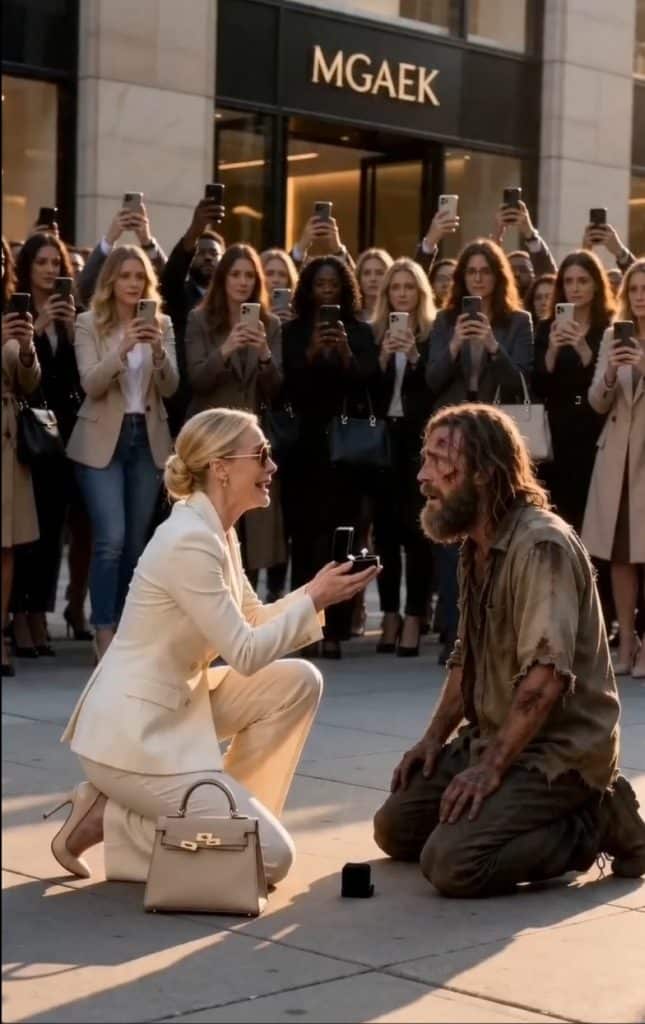
Madeline dropped to one knee in the middle of the sidewalk, and Fifth Avenue forgot how to move.
People stopped with shopping bags in their hands. A delivery cyclist braked so hard his tires screamed. Tourists lifted their phones. A woman in a fur coat whispered, “Is this a prank?” as the golden late-afternoon sun poured over the glass storefronts behind them.
Madeline did not hear any of it.
She was staring only at the man kneeling in front of her.
He was filthy, trembling, and barefoot inside shoes that barely held together. His olive-drab shirt hung from him in torn layers. Long matted brown hair framed a face almost hidden behind a thick beard, dirt, and old scars that cut across his forehead and cheek.
But his eyes.
Madeline knew those eyes.
Even bloodshot. Even terrified. Even emptied by years of sleeping under bridges and waking without a name.
She held out a black velvet ring box.
Inside, a diamond caught the sun and threw light across his ruined hands.
“Marry me,” she whispered. “Please.”
The crowd gasped.
Someone laughed nervously.
The homeless man stared at the ring as if she had offered him a piece of a dream he had once died inside.
His mouth opened.
No words came.
Madeline’s cream-colored pantsuit was pressed, expensive, and spotless against the dirty sidewalk. Her gold-rimmed sunglasses hid most of her eyes, but they could not hide the tear that slipped beneath one lens and ran down her cheek.
The man looked from the diamond to her face.
“Why me?” he whispered.
His voice was rough, almost broken from disuse.
Madeline’s chin trembled.
“Because it’s you.”
He flinched at the words.
Not away from her.
Into something.
A memory, perhaps. A sound. A name trying to rise through the fog.
She turned the box slightly.
The inside of the lid was engraved in gold cursive.
Jane & Alton.
His dirty finger lifted slowly toward the ring. The moment he touched the band, his breathing changed.
Madeline saw it.
So did the crowd, though they did not understand.
“Please,” she sobbed. “Remember me.”
A black Cadillac Escalade screeched to a stop at the curb.
The back window rolled down before the vehicle had fully settled.
An elderly man with silver hair leaned out, his face twisted with fury and panic.
“Madeline, stop!”
The crowd erupted in whispers.
Madeline did not turn.
But the homeless man did.
At the sound of the older man’s voice, his eyes snapped open wide. Sweat broke across his forehead. Fresh tears cut clean lines through the grime on his face.
The name inside the ring had opened a door.
The voice from the SUV had pushed him through it.
And suddenly, Alton Vale remembered the night he was supposed to die.
Act II
Seven years earlier, Madeline Whitaker was not the kind of woman who begged in public.
She was the daughter of Charles Whitaker, one of the most powerful men in New York finance. She had grown up in penthouses, private schools, and rooms where people never shouted because money had taught them quieter ways to destroy each other.
Her father loved control more than he loved anything else.
Including her.
To the world, Charles was dignified, generous, and brilliant. He donated hospital wings, chaired museum boards, and spoke about family values from podiums beneath chandeliers.
At home, he corrected Madeline’s laugh.
Her posture.
Her friendships.
Her dreams.
He called it guidance.
She called it air slowly leaving a room.
Then she met Alton Vale.
Not at a gala. Not through her father. Not in a room where anyone important was watching.
She met him in a repair shop in Queens after her vintage camera broke during a charity assignment she had taken only to annoy Charles. Alton was the man behind the counter, sleeves rolled up, hair falling into his eyes, hands steady over tiny screws and fragile glass.
He did not know who she was.
That was the first thing she loved.
He called her Jane because her full name, Madeline Jane Whitaker, was written on the repair form, and when he asked which name she preferred, she answered too honestly.
“No one calls me Jane.”
He smiled.
“Then I will.”
To everyone else, she was Madeline.
To Alton, she became Jane.
Jane wore sneakers. Jane ate dumplings from paper cartons. Jane rode the subway with her head on his shoulder. Jane laughed too loudly on rooftops and let Alton photograph her with wind in her hair and no diamonds anywhere.
Alton was not poor, though Charles liked to pretend he was.
He was building something.
A security technology company with two friends from college, a system designed to expose fraudulent shell transfers in real time. It was the kind of software no honest company feared and every dishonest one quietly hated.
Charles hated it before he knew Alton loved his daughter.
When Madeline brought Alton home, Charles smiled through dinner like a man studying a threat across the table.
Alton was polite.
Too polite.
He knew men like Charles. Men who shook your hand while measuring the price of your silence.
After dinner, Charles pulled Madeline aside.
“He is not for you.”
Madeline laughed because she still thought her father’s disapproval was only snobbery.
“You don’t know him.”
“I know enough.”
“No,” she said. “You know he doesn’t need you.”
That was the first time she saw fear behind her father’s anger.
Two months later, Alton proposed in the closed repair shop after midnight. No witnesses. No cameras. No family approval. Just rain at the window, a radio playing low, and a black velvet ring box with an inscription inside.
Jane & Alton.
Madeline said yes before he finished asking.
They planned to marry quietly, then tell Charles afterward.
But Alton found something first.
A hidden financial trail running through Whitaker Holdings. False charitable transfers. Offshore accounts. Deeds moved through shell names. Money that should have gone to housing projects and hospital funds redirected into private investments controlled by Charles.
Alton did not go to the police immediately.
He went to Madeline.
“I need you to know before anyone else does,” he told her.
She remembered the way his voice shook.
Not from fear.
From heartbreak on her behalf.
That night, they packed a folder, the ring, and a flash drive into his old leather messenger bag. They were going to meet a federal investigator in the morning.
They never made it.
On the road near the Hudson, a black SUV hit Alton’s car from behind.
Madeline woke in a hospital with a concussion, three broken ribs, and her father holding her hand.
Alton was gone.
Charles told her the car had gone into the river.
He told her divers searched for days.
He told her Alton’s body had not been found, but no one could survive that water.
Then he told her something worse.
“He was running,” Charles said softly. “From you. From the investigation. From what he did.”
Madeline did not believe him.
Not at first.
But grief is a room with no windows, and Charles controlled every door.
He controlled the doctors.
The lawyers.
The police contact.
The news.
Within weeks, Alton Vale became a disgraced entrepreneur presumed dead after fleeing fraud allegations connected to his own company.
Madeline became a tragic heiress.
And Jane, the woman Alton loved, disappeared under sedatives, black dresses, and her father’s careful lies.
But one thing Charles never found was the ring.
Act III
Madeline spent the first year after the crash trying to die quietly without ever saying those words.
She stopped eating enough. Stopped sleeping normally. Stopped answering friends. She wore her sunglasses indoors because light made headaches worse and pity made everything unbearable.
Charles kept her close.
Too close.
He moved her into his Fifth Avenue apartment “until she recovered.” He hired nurses who reported to him. He replaced her phone. He managed her appointments. He handled all legal questions connected to Alton.
Every time she asked for proof, he gave her grief instead.
“Why do you keep hurting yourself?” he would say. “He is gone.”
But Madeline knew the difference between gone and hidden.
The first crack came from a photograph.
Three years after the accident, a street photographer posted a series online called Forgotten Faces of the City. One image showed a homeless man sleeping outside a subway entrance, half his face shadowed, one scar crossing his forehead.
Madeline stared at it until morning.
The face was thinner.
Older.
Covered in beard and dirt.
But the hand visible near his chest had a crescent-shaped scar between the thumb and index finger.
Alton had gotten that scar fixing her camera.
She drove to the subway station before dawn.
He was gone.
After that, she searched.
Not like a heiress hiring professionals from a safe distance.
Like a woman digging through the ruins of her own life.
She visited shelters. Soup kitchens. Hospitals. Police precincts. Morgues. Underpasses. Train stations. Places where wealthy women in cream suits drew stares and suspicion.
She learned that a man matching Alton’s description had been found years earlier near the river with severe injuries and no identification. He had survived. Barely. He had no memory, no name, and no one looking for him under the right description because Charles had made sure the world believed Alton was dead or guilty.
The system called him John Doe.
The streets eventually called him Ghost.
Madeline found him six times before he looked at her.
Each time, he ran.
Not because he recognized her.
Because kindness frightened him.
The seventh time, outside a church basement in winter, she brought coffee and sat ten feet away without speaking. He watched her from behind a dumpster like a wounded animal measuring a trap.
She left the coffee.
The next week, he took it.
The week after that, he said, “Why do you keep coming?”
She almost told him everything.
Instead, she said, “Because someone should.”
For months, she built trust one silent offering at a time. Food. Socks. A clean coat he refused. A doctor he ran from. A photograph he would not touch.
Then one day, she showed him the ring box.
His whole body went still.
Not recognition.
Not yet.
But pain.
His hand shook so badly he dropped the coffee.
That was when Madeline understood memory was still inside him, buried beneath trauma, fear, and whatever damage the crash had left behind.
She needed a trigger strong enough to reach it.
So she chose the sidewalk in front of MGAEK, the luxury boutique Charles frequented every Friday at four. She chose the hour he would pass in his Escalade. She chose a crowd because Charles feared witnesses more than sin.
Then she knelt.
Not for spectacle.
For resurrection.
Now Alton stared at the ring while Charles shouted from the SUV, and the past began tearing through him in flashes.
Rain.
Headlights.
Madeline screaming his name.
Charles’s voice outside the wrecked car.
“Leave him. Take her.”
Alton gasped as if the memory had hands around his throat.
Madeline reached for him.
“Alton?”
His eyes locked on hers.
For one unbearable second, she saw him return.
Not fully.
But enough.
“Jane,” he whispered.
Madeline sobbed.
The crowd went silent.
Then Charles stepped out of the SUV.
Act IV
Charles Whitaker did not run.
Men like him rarely did.
They walked toward disaster with the confidence of people who had purchased exits before entering rooms.
Two private security men stepped out behind him. The crowd shifted backward, phones still raised. The late afternoon sun burned gold across the boutique windows, catching every face, every whisper, every lie about to collapse in public.
“Madeline,” Charles said, his voice low. “Get up.”
She did not move.
Alton was trembling now, one hand pressed to his scarred forehead, the other clutching the edge of the ring box like it was the only solid thing left in the world.
Charles looked at him.
Not with surprise.
With rage.
“You should have stayed gone,” he said.
The words were quiet.
But cameras caught them.
Madeline stood slowly.
“You knew,” she said.
Charles’s jaw tightened.
“You are emotional.”
“No.”
“You are confused.”
“No.”
“This man is unstable. Dangerous. He destroyed his company and nearly destroyed you with it.”
Alton looked up sharply.
Another memory flashed behind his eyes.
A hospital room.
A man leaning over him.
A needle.
A voice saying, “If he remembers, move him again.”
Alton staggered backward.
Madeline caught him before he fell.
The crowd murmured.
Charles reached for her arm. “Come with me.”
Alton moved first.
Weak, shaking, barely standing, he stepped between them.
“No,” he said.
One word.
Hoarse.
Unsteady.
But his.
Charles stared at him.
“You don’t even know who you are.”
Alton’s eyes filled.
“I know her.”
Madeline covered her mouth.
Charles lost control then, only for a second, but one second was enough.
“You know nothing,” he snapped. “You were nobody before I buried you, and you are less than nobody now.”
A woman in the crowd gasped.
Someone said, “Did he just say buried?”
Madeline reached into her handbag and pulled out a small recorder.
Charles saw it.
Too late.
“I knew you’d come if I used the ring,” she said. “I knew you wouldn’t be able to stand him remembering.”
Charles’s face drained.
The second blow came from inside the crowd.
A man in a dark coat stepped forward, holding a badge.
Federal investigator Aaron Price.
The same investigator Alton and Madeline had tried to meet seven years ago.
He had been waiting across the street since before Madeline knelt.
“Charles Whitaker,” he said, “we have a warrant.”
The crowd exploded.
Charles tried to retreat, but his security men hesitated. Cameras were everywhere. The entire sidewalk had become a witness stand.
Investigator Price opened a folder.
“Your former driver gave testimony this morning. We recovered medical transfers, offshore payment records, and sealed facility logs tied to an unidentified male patient moved under false names between 2017 and 2021.”
Alton swayed.
Madeline held him tighter.
Charles looked at his daughter with pure hatred now.
“You did this?”
Madeline took off her sunglasses.
Her eyes were red, but steady.
“No,” she said. “You did.”
The final piece came from Alton himself.
He looked at Charles, and the last door in his memory opened.
“The bridge,” he whispered.
Charles froze.
Alton’s voice broke, but he kept going.
“You were there after the crash. I heard her crying. I tried to move. You told them I was already dead.”
Madeline’s knees nearly gave way.
Alton turned to her, tears cutting through the dirt on his face.
“I tried to come back,” he said. “Jane, I tried.”
She touched his face.
“I know.”
Behind them, officers moved in.
Charles Whitaker, who had spent a lifetime deciding who belonged in which room, was handcuffed on a public sidewalk while strangers filmed every second.
And Alton Vale, the man he had erased, stood barefoot in the sun holding the ring that had brought his name back.
Act V
Alton did not marry Madeline that day.
Real life, Madeline later said, was kinder than that.
It did not demand that a broken man become a husband before he remembered how to sleep in a bed.
The proposal became famous anyway.
Not because of the diamond.
Because of what came after.
The video spread across the world by midnight: the beautiful woman on one knee, the homeless man touching the ring, the billionaire father shouting from the SUV, the moment Alton whispered “Jane” and an entire sidewalk seemed to hold its breath.
People called it romantic.
Madeline hated that at first.
There was nothing romantic about stolen years.
Nothing beautiful about memory loss, forged reports, hidden clinics, or the way the world stepped around a man because he looked poor enough to stop being real.
But Alton watched the video weeks later from a hospital recovery room and cried quietly.
“Why are they all watching?” he asked.
Madeline sat beside him.
“Because they missed you once,” she said. “Maybe now they’re trying to see.”
His recovery was not clean.
Some days he remembered her laugh but not her last name. Some days he could describe the repair shop perfectly, down to the crack in the green tile near the register, but panicked when a black SUV passed the window. Some days he woke convinced he was still beside the river, soaked and unable to move.
Madeline stayed.
Not as a savior.
As Jane.
She cut his hair only when he asked. She sat through therapy sessions in silence. She learned not to reach for him suddenly. She learned that love could be patient without being passive, fierce without being forceful.
Alton relearned his own signature before he relearned the full history of his company.
When he finally wrote Alton Vale in shaky black ink, Madeline kept the paper.
Charles’s empire did not fall in one dramatic crash.
It bled.
Investigators found the financial crimes Alton had uncovered seven years earlier. They found payments tied to the accident. They found private medical facilities that had accepted money to keep an unidentified patient sedated, moved, undocumented, and quiet. They found emails where Charles referred to Alton only as “the liability.”
At trial, Charles wore a perfect suit and claimed he had only tried to protect his daughter from a dangerous man.
Madeline testified for six hours.
She did not cry until the prosecutor showed the ring box.
Jane & Alton.
Then she looked at her father across the courtroom and said, “You did not protect me. You stole the person who knew me best.”
Alton testified the next day.
His memory had gaps. The defense tried to use them.
But truth does not always need to be complete to be undeniable.
He remembered Charles at the crash.
He remembered Madeline screaming.
He remembered being moved.
He remembered his name returning on a sidewalk because the woman he loved refused to let the world keep calling him no one.
Charles was convicted on fraud, conspiracy, unlawful confinement, and charges connected to the staged crash.
When the sentence was read, Madeline felt nothing at first.
No triumph.
No release.
Only a strange quiet where fear had lived for too long.
Alton reached for her hand.
She took it.
A year later, the repair shop in Queens reopened.
Not as it had been.
The old counter was replaced. The green tile remained cracked because Alton insisted some scars deserved honesty. Madeline hung photographs on the walls: cameras, bridges, street corners, hands, sunlight on ordinary faces.
In the back, they created a small legal aid office for unidentified patients, missing adults, and unhoused people whose names had been lost inside systems too tired or too careless to look harder.
They called it The Jane Fund.
Alton said it should be named after her.
Madeline said Jane had always belonged to both of them.
On the second anniversary of the sidewalk proposal, Alton took the black velvet ring box from the drawer where Madeline kept it wrapped in silk.
They were alone in the repair shop after closing.
Rain tapped softly against the window.
Madeline was sitting on the counter, shoes off, watching him with a tenderness still edged by caution. Love had returned, yes, but not as a fairy tale. It returned like someone recovering from a long illness: slowly, gratefully, with setbacks.
Alton knelt.
Madeline laughed through instant tears.
“You don’t have to do that.”
“I know.”
He opened the box.
The diamond caught the warm shop light.
“I remember pieces,” he said. “Not everything. Maybe I never get everything back.”
Madeline slid down from the counter, already crying.
“But I remember enough to know this ring was never about what we lost. It was about who I was when I gave it to you.”
His voice shook.
“And who I still want to be.”
Madeline covered her mouth.
Alton looked up at her.
“Jane,” he whispered, “will you marry me again?”
This time, there was no crowd.
No phones.
No father shouting from a black SUV.
No sidewalk holding its breath.
Only rain, old tools, a cracked tile, and two people who had crossed seven stolen years to find each other in the ruins.
Madeline knelt in front of him instead of making him stand.
“Yes,” she said. “But only if you marry all of me too.”
He smiled.
“Madeline?”
“Yes.”
“Jane?”
“Yes.”
“The woman who terrifies federal prosecutors?”
She laughed.
“Yes.”
“The woman who proposed to a homeless man in front of half of Manhattan?”
Her voice softened.
“The man I loved was still in there.”
Alton touched his forehead to hers.
“And you found me.”
Outside, the city kept moving.
People passed under umbrellas. Cars hissed through wet streets. Somewhere uptown, the boutique windows still glowed, and the sidewalk where Madeline had knelt looked ordinary again.
But people remembered.
They remembered the man everyone had stepped around.
They remembered the woman who looked closer.
They remembered the ring box with two names inside.
And sometimes, when someone sleeping under a scaffold or sitting alone near a subway entrance seemed too easy to ignore, a stranger would pause and wonder what name the world had failed to ask for.
That was the legacy Charles Whitaker never intended.
Not scandal.
Not shame.
Recognition.
Because Alton Vale had not been saved by diamonds, money, or public spectacle.
He had been saved by a woman who knew that love is not always finding someone unchanged.
Sometimes it is kneeling in front of what the world has done to them and saying, through tears and trembling hands:
Because it’s you.