Act I
Hannah Reeves found the ring before she found the truth.
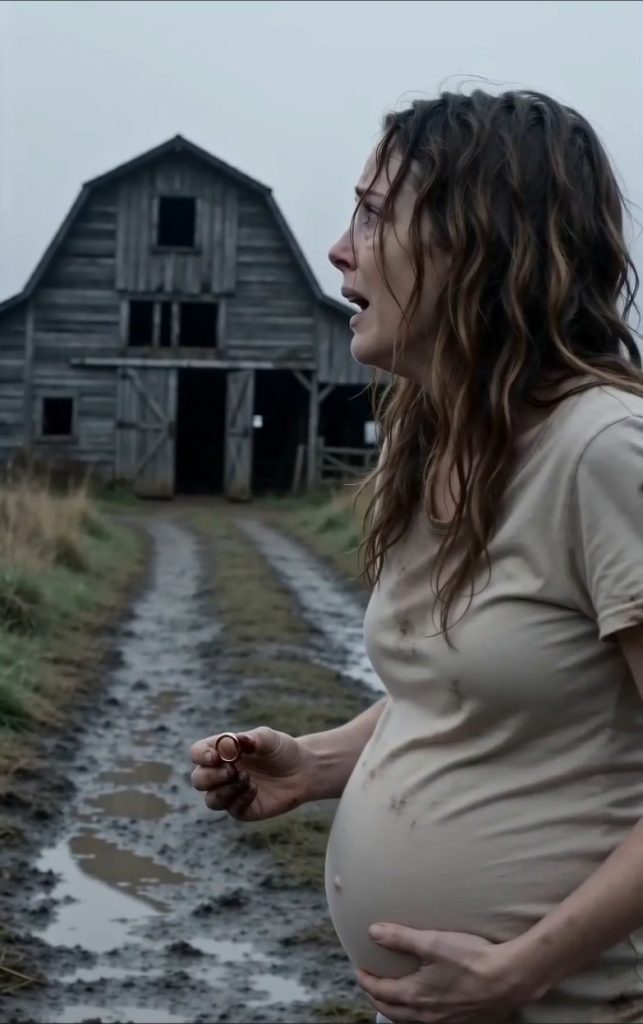
It lay half-buried in the mud on the dirt path behind the old barn, catching the grey afternoon light like a small, cruel signal. At first, she thought it was a bottle cap or a bent washer washed loose by the rain.
Then she saw the engraving.
M + H. Always.
Her breath stopped.
The gold band was streaked dark at the edge.
Fresh.
Hannah’s fingers shook as she lifted it from the mud. One hand went instantly to her belly, round and heavy beneath her beige T-shirt. The baby shifted under her palm, as if startled by the fear moving through her body.
“Mark?” she called.
The wind dragged her voice across the empty farmyard.
No answer came.
Only the barn.
The old wooden structure stood ahead under the overcast sky, its roof sagging, its boards split with age. The doors were slightly open, just wide enough to show a slice of black inside.
Hannah swallowed hard.
“Mark? Are you in there?”
For three days, her husband had been missing.
Three days of unanswered calls.
Three days of police saying adults had the right to leave.
Three days of Mark’s older brother, Calvin, telling her gently that grief and pregnancy were making her imagine danger where there was only abandonment.
“He’s under pressure,” Calvin had said. “Maybe he just needed to disappear.”
But Mark would never disappear.
Not from her.
Not from their baby.
A dull thumping sound came from inside the barn.
Slow.
Rhythmic.
Too deliberate to be the wind.
Hannah took one step forward.
Then another.
Mud sucked at the soles of her shoes. Pain tightened across her lower back, but she kept walking, the wedding ring clenched in one fist, her other hand guarding the child inside her.
At the barn doors, she hesitated only once.
Then she pulled.
The rusted hinges screamed.
A swarm of flies lifted from the darkness and scattered into the cold air.
Hannah’s stomach turned, but she did not step back.
Light spilled across the barn floor.
And something inside moved.
Her hand flew to her mouth.
The ring pressed cold against her lips.
“Oh my God,” she whispered. “What have you done?”
The shadow rushed toward her.
And before Hannah could scream, she heard her husband’s voice from the dark.
“Run.”
Act II
Mark Reeves had never liked that barn.
Even as a boy, he said it felt like the farm was holding its breath around it.
His father used to store broken machinery there, rusted plows, cracked feed bins, fence wire, things too useless to repair but too familiar to throw away. After the old man died, Mark locked the barn and let the grass grow wild around it.
Hannah used to tease him.
“You’re scared of a building?”
Mark would smile and kiss her forehead.
“No. I’m scared of what men hide when they think no one will look.”
She thought he meant his father.
Later, she learned he meant his brother.
Calvin Reeves had inherited charm the way some men inherit land. He could make a banker laugh, calm a sheriff with one handshake, and speak to grieving widows in a voice so soft they handed him paperwork before they realized what they had signed.
Mark inherited the farm.
That was the wound Calvin never forgave.
Their father left Mark the farmhouse, the fields, the barn, and the mineral rights beneath the north pasture. Calvin received money, equipment, and a smaller rental property in town. On paper, it was fair.
To Calvin, anything that did not make him owner was an insult.
For years, he hid his resentment under brotherly concern. He told Mark the farm was failing. He told Hannah the house was too old for a baby. He brought glossy brochures from a development company called Pritchard Land Group and spoke about “security” and “generational opportunity.”
Mark always said no.
Hannah thought it was because he loved the farm.
That was only half the truth.
The other half appeared one night when she found Mark at the kitchen table with a stack of old maps, legal documents, and a photograph of his father standing beside the barn.
He looked up too quickly.
“What are those?” Hannah asked.
“Nothing.”
Mark was a terrible liar.
Two weeks later, he told her enough to frighten her.
His father had suspected Calvin of using the barn to hide records tied to illegal land options, forged lease agreements, and secret payments from Pritchard Land Group. Nothing dramatic enough for television. Nothing loud.
Just paperwork.
The kind of crime that steals a farm without ever breaking a window.
Mark had found a clue inside an old tractor manual: a note from his father saying the real deed archive was hidden “where the walls still remember.”
He believed it meant the barn.
Then he vanished.
The morning he disappeared, Mark kissed Hannah beside the back door and placed one hand on her belly.
“I’ll be back before lunch,” he said.
“You’re going to the barn again?”
He hesitated.
“Just checking something.”
“Mark.”
His expression softened.
“If I find what Dad hid, Calvin can’t pressure us anymore.”
That was the last ordinary sentence he ever spoke to her.
By evening, his truck was gone from the driveway.
By night, Calvin was in her kitchen, telling her not to panic.
By the third day, Hannah no longer believed in coincidence.
She believed in the ring in her hand.
She believed in the thumping inside the barn.
And she believed, with the sudden clarity of a mother who knew danger had stepped too close, that Mark had never left willingly.
Act III
The shadow that rushed toward Hannah was not a man.
It was Bess.
Mark’s old black farm dog exploded from the barn darkness, thin rope trailing from her collar, her paws skidding across the dirt floor. She hit Hannah’s legs with a desperate whine, then turned immediately back toward the dark, barking once, sharp and urgent.
Hannah gasped.
“Bess?”
The dog had been missing too.
Calvin had said she ran off after Mark left.
Another lie.
Hannah stepped into the barn.
Her eyes adjusted slowly.
The air smelled of damp hay, rust, gasoline, and something old enough to make her skin crawl. A work light flickered near the back wall, powered by a small generator thudding in the corner.
That was the sound.
Not a heartbeat.
A machine.
Then she saw Mark.
He was sitting against a wooden support beam, wrists bound in front of him with heavy cord, face pale, shirt torn at the shoulder. There was blood at his hairline, but his eyes were open.
Alive.
Hannah nearly collapsed.
“Mark!”
He shook his head, frantic.
“Don’t come closer.”
Too late.
A voice came from behind the stall wall.
“She never was good at listening.”
Calvin stepped into the light.
He wore a dark jacket and clean boots, though mud streaked one cuff. In one hand, he held Mark’s phone. In the other, a folded document.
He looked almost disappointed.
“Hannah,” he said, “you should be at home resting.”
Hannah’s hand tightened around the wedding ring.
“What did you do to him?”
Calvin sighed.
“That depends on how dramatic you want to be.”
Mark strained against the cord.
“Leave her out of this.”
“I tried,” Calvin snapped. “I tried to do this cleanly. You were the one who kept digging.”
Hannah moved one step toward her husband.
Calvin lifted the document.
“Stop.”
She froze.
“Here is what happens now,” he said. “You sign the emergency sale authorization. Mark returns after a little breakdown no one needs to discuss. The farm transfers to Pritchard. You and the baby leave with enough money to start over somewhere sensible.”
Hannah stared at him.
“You think I’m signing anything after seeing this?”
Calvin’s expression hardened.
“I think you are heavily pregnant, frightened, and standing in a barn where your husband’s blood is already on the floor. I think you will do whatever keeps this from getting worse.”
Bess growled.
Calvin glanced at the dog with irritation.
“I should have dealt with that animal first.”
Mark’s voice was hoarse.
“Hannah, behind the east wall.”
Calvin turned sharply.
“Shut up.”
Mark looked at her with everything he had left.
“The wall. Dad’s archive.”
Calvin’s face changed.
That was when Hannah understood.
Mark had found it.
Not all of it.
Enough.
Enough for Calvin to panic.
Enough for him to drag his own brother into an abandoned barn and stage a disappearance.
The baby kicked hard beneath Hannah’s hand.
A strange calm moved through her.
Not peace.
Something colder.
“You were going to blame me,” she said.
Calvin smiled faintly.
“If necessary.”
Act IV
Hannah did not run.
That was the thing Calvin miscalculated.
He thought fear made people smaller. He thought pregnancy made her fragile. He thought love would turn her obedient if he threatened Mark enough.
But fear can do something else inside a woman who is protecting both her husband and her child.
It can sharpen.
Hannah looked past Calvin, toward the broken east wall Mark had mentioned. The wooden planks there were newer than the others, nailed over the original boards.
“Your father knew,” she said.
Calvin’s jaw tightened.
“My father was a bitter old man.”
“He knew what you were.”
“He knew Mark was weak,” Calvin said. “He knew this farm would rot under sentiment while men with vision built something useful.”
Mark laughed weakly.
“You mean profitable.”
“Same thing, if you’re not a fool.”
Calvin stepped closer to Hannah.
“Sign.”
He held out the document.
Hannah took it.
Then she tore it in half.
For one second, Calvin looked more shocked than angry.
Then his face darkened.
Bess lunged forward, barking.
Calvin stumbled back.
Mark used the distraction to twist hard against the cord around his wrists. Hannah moved fast, faster than she thought possible, grabbing a rusted hook from the wall and cutting through the knot with shaking hands.
Calvin reached for her.
The barn doors slammed open behind them.
“Sheriff’s department!”
Light burst across the floor.
Calvin froze.
Two deputies entered with weapons lowered but ready. Behind them stood Mrs. Larkin, the elderly neighbor who lived beyond the south fence, wearing rain boots, a cardigan, and the expression of a woman who had been waiting years to be underestimated.
Hannah burst into tears.
Mark sagged against the beam.
Calvin lifted both hands slowly.
“This is a family misunderstanding.”
Mrs. Larkin snorted.
“Funny. That’s what your father said you’d call it.”
A deputy moved toward Calvin.
Another cut Mark fully free.
Hannah reached him at last, falling to her knees beside him, both hands on his face.
“You’re alive,” she sobbed.
Mark pressed his forehead to hers.
“I’m sorry. I’m so sorry.”
Mrs. Larkin walked to the east wall and pulled a small envelope from inside her coat.
“Your father gave me this before he died,” she told Mark. “Said if you ever went missing near the barn, I was to call Sheriff Dana and bring this straight here.”
Calvin stared at her.
“You had that?”
“For six years,” Mrs. Larkin said. “And I enjoyed every day you didn’t know.”
Inside the envelope was a key.
The deputies pried open the east wall.
Behind it was not money.
It was worse for Calvin.
Records.
Deeds.
Original survey maps.
Copies of illegal land agreements.
Letters between Calvin and Pritchard Land Group.
And a signed statement from their father explaining everything he had discovered before his death.
Mark watched from the floor, one arm around Hannah.
Calvin said nothing now.
The barn that had held his secret for years had finally become a witness.
Then Hannah heard a sharp crack from above.
A beam shifted.
Everyone looked up.
The old barn, disturbed after years of decay, groaned in the wind.
The deputy shouted, “Out. Now.”
Mark tried to stand and nearly fell.
Hannah grabbed him.
“I’ve got you.”
He looked at her belly, terrified.
“No, I’ve got you.”
Together, with Bess circling their legs and deputies pulling them forward, they stumbled out into the grey light just as dust rolled from the barn doors behind them.
Calvin was led out last.
For the first time in his life, he looked back at the farm and saw something he could not own.
Consequences.
Act V
Mark spent two nights in the hospital.
Hannah spent both of them in the chair beside his bed, refusing to go home even after the nurse brought her blankets and stern warnings about rest.
The baby was fine.
That was the first miracle.
Mark was alive.
That was the second.
The third came a week later, when Sheriff Dana confirmed the documents from the barn were enough to freeze the sale, open a criminal investigation, and connect Calvin to years of forged filings.
Pritchard Land Group denied knowing anything.
Then emails surfaced.
Then payments.
Then a consultant named names faster than loyalty could stop him.
Calvin was charged with kidnapping, fraud, coercion, and assault. He blamed stress. He blamed inheritance. He blamed Mark. He blamed their father for loving one son more.
No one believed him for long.
The ring was cleaned and returned to Mark in a small evidence bag after photographs were taken. He held it for a long time before putting it back on.
Hannah watched him.
“You don’t have to wear it yet,” she said softly.
He looked at her.
“I do.”
She touched his hand.
“It’s okay if it hurts.”
His eyes filled.
“It reminds me I came back.”
The barn could not be saved.
After engineers inspected it, the structure was declared unsafe. Mark stood beside Hannah in the yard when the demolition crew arrived. The sky was clearer that day, pale blue behind the broken roofline.
He expected to feel grief.
Instead, he felt release.
As the old boards came down, the farm seemed to exhale.
Behind the east wall, they found one final thing the first search had missed: a coffee tin wrapped in oilcloth. Inside were letters from Mark’s father to both sons, written but never sent.
Mark read his alone first.
Then gave Hannah Calvin’s.
She did not open it.
“Are you sure?” Mark asked.
Hannah looked toward the road where the police cars had once stood.
“Some words belong to the person who refused to hear them.”
They gave the letter to Calvin’s attorney.
Whether he read it, they never knew.
Spring came slowly to the farm.
Hannah gave birth in April, during a thunderstorm that rattled the hospital windows and made Mark laugh through his fear because it reminded him of the night everything almost ended.
Their daughter was born healthy, furious, and loud.
They named her Clara.
After Mrs. Larkin, whose first name nobody had used in twenty years because she preferred being mysterious.
The old woman cried when she heard.
Then pretended she had allergies.
Months later, Mark built a new structure where the barn had stood.
Not another barn.
A workshop.
Bright windows. Solid beams. A wide door that opened toward the fields. On the east wall, he placed a framed copy of his father’s statement, not as a shrine to betrayal, but as a warning.
Secrets rot what they are stored inside.
Hannah added something beneath it.
A small hook.
On it hung the torn hospital bracelet from Clara’s birth and the cleaned wedding ring Mark had nearly lost in the mud.
Bess slept by the workshop door every afternoon, old and proud, as if guarding the place she had helped save.
Sometimes Hannah still woke from dreams of the barn.
In the dreams, the doors opened and something rushed toward her from the dark.
For a while, she thought it was Calvin.
Then one night she realized it was not.
It was truth.
Terrifying at first.
Fast.
Unstoppable.
But coming to rescue them.
On Clara’s first birthday, they held a small picnic behind the farmhouse. Mrs. Larkin brought a pie. Sheriff Dana brought a wooden rocking horse. Mark carried Clara on his shoulders while Hannah watched from a blanket, sunlight warm on her face.
The dirt path behind the house had been repaired.
Grass grew where the mud had swallowed Mark’s ring.
The barn was gone.
But the memory remained, changed now by survival.
Hannah thought of the woman she had been that day: barefoot in fear, heavily pregnant, clutching a bloody ring and walking toward the worst thing she could imagine because love left her no other choice.
She had thought she was going into the barn to find out whether her husband was dead.
Instead, she found the truth that saved their family.
Mark sat beside her and took her hand.
“Do you ever wish we left?” he asked.
She looked across the fields.
Once, the farm had felt haunted.
Now it felt awake.
“No,” she said. “I wish none of it happened. But I don’t wish we left.”
Clara laughed from Mrs. Larkin’s lap, reaching for Bess’s tail.
Mark smiled.
Hannah leaned against him.
The road, the ring, the scream of rusted hinges — those things would always live somewhere inside her. But they no longer owned her.
Calvin had tried to bury a family in that barn.
Instead, he buried himself.
And the woman he thought fear would silence had opened the door.