Act I
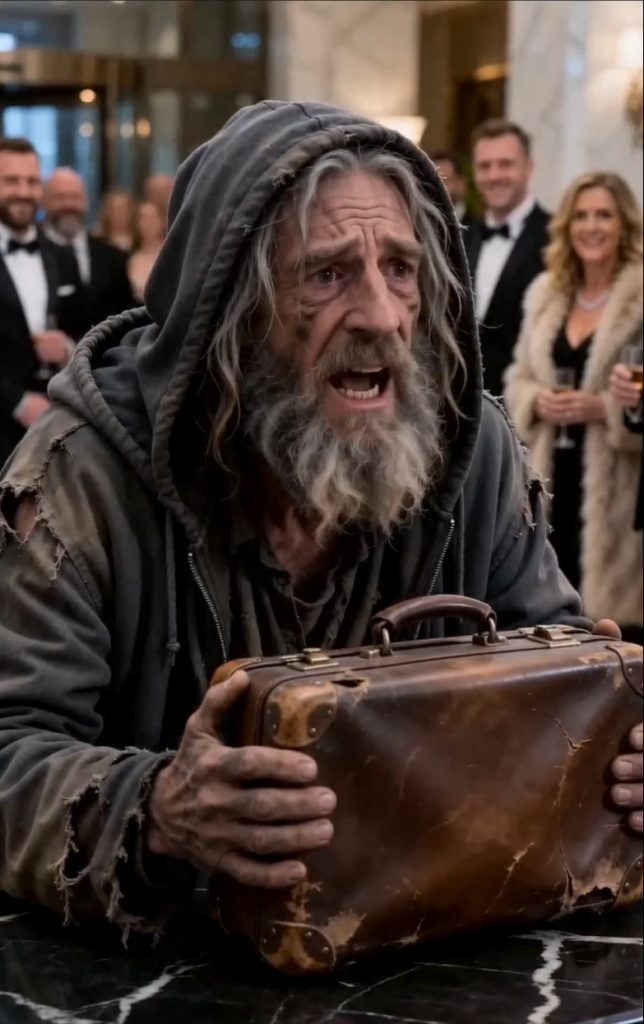
The old man came into the hotel dripping rain onto marble that had never known mud.
Every head in the lobby turned.
Not because he was loud.
Because he did not belong.
The Grand Aurelia Hotel was built for people who arrived in black cars and stepped out beneath umbrellas held by someone else. Crystal lights glowed over polished floors. White lilies towered in glass vases. Guests in evening gowns and tuxedos moved through the lobby like wealth had trained them to glide.
Then there was him.
Long gray hair stuck to his face. His beard was tangled and wet. His dark hooded jacket hung from his shoulders in torn, filthy layers. Both hands clutched an old brown leather suitcase so tightly his knuckles had gone pale.
He reached the dark marble reception desk and leaned forward.
The young receptionist behind it looked at him as if the rain had dragged him in from the gutter and left him there as an insult.
Her name tag read Claudia.
“Please,” the man whispered. “I only need the room.”
Claudia’s blonde hair was pulled into a perfect bun. Her navy suit looked pressed by someone who had never had to choose between food and laundry. She glanced past the old man, toward the guests watching with half-hidden amusement.
“What room?” she asked coldly.
His breath shook. “The room on the seventeenth floor. The corner suite.”
A man in a tuxedo laughed into his drink.
Claudia’s mouth tightened.
“The Aurelia Suite?”
The old man nodded.
“I need to get inside before midnight.”
Now several guests were openly staring.
Claudia leaned forward just enough for him to hear the contempt in her voice.
“This hotel is not a shelter.”
The old man’s face crumpled, but he did not step back.
“I’m not asking for charity.”
“You smell like you need a bath, not a suite.”
He looked toward the elevators, panic rising in his eyes.
“Please. There’s something in that room. Something I left there a long time ago.”
Claudia lifted one hand.
Two security guards moved instantly.
The old man tightened his grip on the suitcase.
“No,” he said, suddenly desperate. “Wait. I can prove—”
They grabbed him by the arms.
He struggled, not against them exactly, but toward the desk, toward the suitcase, toward the only thing in that glittering lobby that seemed to matter to him.
“My case!” he shouted. “Please, my case!”
The guards dragged him across the marble.
The guests watched.
Some with disgust.
Some with curiosity.
None with shame.
The glass doors opened to a roar of rain and thunder. One guard shoved him outside. The old man stumbled, hit the wet pavement, and rolled onto his side beneath the hotel awning.
Still, he reached toward the lobby.
“My case,” he gasped.
Inside, Claudia looked down at the suitcase he had left on the counter.
It was battered, old, and soaked at the seams. One corner had been repaired with black tape. The brass latches were scratched almost smooth.
She should have called security to remove it.
Instead, curiosity won.
With two careful fingers, she clicked open the latches.
The lid lifted.
Claudia looked inside.
Her face went white.
“Oh my God,” she whispered.
Because the old suitcase did not contain trash, stolen clothes, or scraps of a life gone wrong.
It contained the deed to the hotel.
Act II
Thirty-eight years earlier, the Grand Aurelia had not been called grand by anyone.
It was the Aurelia Motor Inn then, a tired brick building wedged between a bus station and a theater that had already lost its lights. The lobby smelled of coffee, carpet cleaner, and cigarette smoke. The elevator worked only when it felt respected. The sign outside flickered so badly that half the time it read AUR LIA.
But to Henry Vale, it was the most beautiful building in the city.
He bought it with borrowed money, borrowed courage, and the last of his late father’s savings. People told him he was foolish. The neighborhood was failing. The hotel was outdated. The big chains would swallow him alive.
Henry only smiled.
“People still need doors that open,” he said.
His wife, Miriam, believed him.
She ran the front desk in dresses she sewed herself and kept a bell beside the register for children to ring when they were bored. Henry fixed pipes, painted walls, carried luggage, and once drove an elderly guest three states away because her son had forgotten to pick her up after surgery.
The Aurelia became known for strange mercy.
A musician short on rent might sleep in Room 212 and pay later by playing piano in the lounge. A woman escaping a bad marriage might be placed in the back room near the stairs, where Henry could hear if anyone came looking for trouble. Families stranded by winter storms found soup waiting in the lobby before they found paperwork.
Then came money.
The theater district revived. Developers arrived. Buildings that had once been laughed at became valuable overnight. Men in tailored suits came to Henry with offers that grew larger every year.
Henry refused them all.
“This place is not a number,” he told Miriam. “It’s a promise.”
But promises are expensive.
Miriam got sick first.
The kind of sickness that stole small things before it stole breath. Her strength. Her hair. Her laugh. Henry poured everything into saving her, then into keeping her comfortable, then into burying her beneath a white stone she would have said was too fancy.
After Miriam died, the Aurelia felt too quiet.
That was when Henry’s younger brother, Victor, came back.
Victor had always been better at charm than loyalty. He arrived with investors, lawyers, and ideas. He said Henry was grieving. He said the hotel needed modernization. He said Miriam would have wanted the Aurelia to survive.
That last lie worked.
Henry signed papers.
Not because he trusted Victor completely.
Because loneliness makes people want to trust somebody.
The renovation transformed everything. Marble replaced carpet. Crystal replaced brass. The old sign came down. The Grand Aurelia was born, gleaming and impossible, rising from the bones of Henry and Miriam’s little inn.
At first, Henry remained owner in name.
Then minority partner.
Then consultant.
Then nothing anyone looked at directly.
Victor told staff Henry had become unstable after Miriam’s death. Forgetful. Erratic. Difficult with guests. Henry was quietly moved out of the corner suite on the seventeenth floor, the same suite where he and Miriam had lived above the hotel for twenty years.
One morning, his keycard no longer worked.
Victor met him in the lobby.
“You need rest,” he said.
Henry laughed, confused. “This is my hotel.”
Victor put a hand on his shoulder for the security cameras.
“Not anymore.”
Henry fought.
For a while.
But lawsuits cost money. Lawyers stopped returning calls. Documents disappeared. Friends became uncomfortable. People who had once eaten Miriam’s soup in the lobby crossed the street when they saw him.
The world does not simply forget a man.
It rehearses forgetting him until it feels natural.
Henry lost his apartment next. Then his storage unit. Then his phone. Then the clean lines of his own name.
But he kept one thing.
The suitcase.
Miriam’s suitcase.
Inside it, wrapped beneath a false lining she had sewn herself, were the original ownership documents, handwritten letters, trust papers, and a key to a small wall safe hidden behind the old rose mural in the Aurelia Suite.
Victor had never known about the safe.
Neither had the lawyers.
And every year, on the anniversary of Miriam’s death, Henry returned to the hotel and tried to get upstairs.
Every year, someone turned him away.
Until the night he came in from the rain and found Claudia behind the desk.
And this time, the wrong person opened the suitcase.
Act III
Claudia stared at the papers as if they were alive.
The top document bore the old hotel name.
The Aurelia Motor Inn.
Beneath it was Henry Vale’s signature, strong and slanted, dated nearly four decades earlier. There were trust agreements, title records, photographs, and a faded picture of a younger Henry standing beside a woman in a floral dress beneath the broken old sign.
On the back, written in blue ink:
Our doors stay open. Always. — Miriam
Claudia’s fingers began to shake.
A guest leaned closer. “What is it?”
She slammed the suitcase shut.
Not quickly enough.
The night manager, a pale man named Russell, had seen the deed.
“What did he bring?” he asked.
Claudia did not answer.
Outside, thunder cracked.
The old man was still on the pavement, trying to push himself up with one trembling hand.
For the first time since he walked in, Claudia actually looked at him.
Not at his torn jacket.
Not at his wet hair.
Him.
There was something in his face beneath the grime. Something ruined but not erased. A bone-deep dignity that did not match the way they had treated him.
Russell stepped closer.
“Give me that case.”
Claudia tightened her grip on the handle.
“Why?”
His expression changed.
Just slightly.
But enough.
“Because it belongs to hotel security now.”
“No,” Claudia said slowly. “It belongs to him.”
Russell smiled, but it had no warmth in it.
“Claudia, don’t be stupid.”
That was the first time she realized this was not a misunderstanding.
One of the security guards came back inside, wiping rain from his sleeve.
“The old guy won’t leave,” he said. “Keeps asking for the suitcase.”
Russell looked at him.
“Remove him from the property.”
Claudia stepped out from behind the desk.
“No.”
The word startled even her.
Russell turned. “Excuse me?”
She lifted the suitcase.
“I’m giving this back to him.”
His face hardened. “You’re risking your job over a vagrant?”
Claudia looked at the marble lobby, the lilies, the guests pretending not to listen, the gold letters spelling Grand Aurelia behind the desk.
Then she looked at the photo she had glimpsed inside the suitcase.
The young woman’s handwritten promise.
Our doors stay open. Always.
“Yes,” she said. “Apparently I am.”
She walked toward the glass doors.
Russell grabbed her arm.
The whole lobby froze.
“Put it down,” he said.
Before Claudia could respond, an elderly woman in a white fur coat spoke from near the lilies.
“Take your hand off her.”
Everyone turned.
The woman stepped forward with a cane in one hand and diamonds at her throat. She had been standing silently for the entire scene, watching with the stillness of someone remembering something terrible.
Her name was Beatrice Langford.
She owned three newspapers, two foundations, and enough influence to ruin a man before dessert.
But that was not why Russell paled.
He knew her as one of the hotel’s oldest clients.
Beatrice looked past him, toward the doors.
“That man gave me a room here in 1987,” she said. “I had two children, a black eye, and fourteen dollars in my purse. His wife fed my daughters pancakes at midnight.”
The lobby went completely silent.
Beatrice pointed her cane at the suitcase.
“If Henry Vale says that is his case, then you will treat it like it contains the crown jewels.”
Claudia pulled her arm free.
This time, no one stopped her.
She ran into the rain with the suitcase.
Henry looked up from the pavement, drenched and shaking.
When he saw the case in her hands, his whole face broke.
“Thank you,” he whispered.
Claudia knelt beside him.
“I’m sorry.”
Henry looked through the glass doors at the lobby that had once been his home.
“Don’t be sorry yet,” he said. “We still have to get upstairs.”
Act IV
The police arrived before midnight.
So did Beatrice Langford’s attorney.
So did the hotel’s corporate counsel, looking furious and underdressed.
Henry sat in the lobby wrapped in a towel from housekeeping, refusing to go to the hospital until someone took him to the seventeenth floor. Claudia stood beside him, still soaked from the rain, no longer behind the desk but no longer willing to hide behind it either.
Russell had disappeared into the back office.
That only made him look guiltier.
The elevator ride to the Aurelia Suite felt endless.
Henry held the suitcase on his lap like a child.
When the doors opened, he stopped breathing.
The suite was almost unrecognizable.
Modern art. Black furniture. A glass bar. Nothing of Miriam remained except the view from the corner windows, where the city lights blurred through rain.
Henry walked slowly to the east wall.
“There was a mural here,” he whispered.
“Painted over,” Claudia said softly.
“Roses,” he said. “She painted roses because she said hotels needed something that didn’t charge by the hour.”
His hand moved along the wall.
Once.
Twice.
Then he stopped.
“There.”
The attorney called for maintenance.
Henry shook his head and reached into the suitcase.
From beneath the false lining, he removed a small brass key and an old photograph. The photo showed Miriam standing in front of the rose mural, one hand on the wall, laughing.
Behind her hand, almost invisible, was a seam.
Maintenance cut carefully through layers of paint and plaster.
The safe was still there.
Small.
Dusty.
Forgotten behind someone else’s version of luxury.
Henry’s fingers trembled as he inserted the key.
The safe opened.
Inside were documents Victor had never found.
Not just deeds.
A recorded ownership trust.
A letter from Miriam naming Henry sole controlling owner if fraud was suspected.
Bank statements proving Victor had moved renovation loans through shell companies.
And a signed confession.
Not from Victor.
From Russell.
Claudia stared at it.
Russell had been young then, an assistant manager under Victor. He had witnessed the false transfer. He had helped remove Henry’s files. In exchange, he had been promised permanent executive placement in the new hotel company.
The confession had been written years later and mailed to Henry.
It never reached him.
Miriam had anticipated that too.
At the bottom of the safe lay a bundle of unopened letters.
All addressed to Henry.
All intercepted.
All tied with hotel stationery.
One letter sat apart from the others.
Henry recognized the handwriting and collapsed into the nearest chair.
Miriam.
The attorney opened it only when Henry nodded.
My dearest Henry,
If you are reading this, then the house of our life has turned against you. I am sorry I am not there to stand beside you. I know Victor. I know what greed sounds like when it borrows the language of family.
Do not let them tell you that you are broken because you are grieving.
Do not let them call you unstable because you loved something too honestly.
The Aurelia was never marble, chandeliers, or rich people calling kindness service.
It was you opening the door.
It was us making coffee at three in the morning.
It was every person who arrived with nowhere to go and left believing the world still had one decent room left in it.
If they take the building, keep the truth.
Truth waits longer than thieves.
Henry pressed the letter to his chest.
No one spoke.
Even Claudia cried.
Downstairs, Russell was found in the back office shredding old employee records.
He was arrested before dawn.
Victor was dead by then, beyond earthly punishment, but his estate was not. The corporate structure he had built began collapsing as soon as Beatrice Langford’s lawyers filed an emergency injunction. The Grand Aurelia, the glittering hotel that had thrown its true owner into the rain, was frozen under court order.
And Henry Vale, whom everyone had mistaken for a nuisance, became the most important man in the building before breakfast.
Act V
The story hit the city by noon.
Not the polished version the hotel’s public relations team tried to release.
The real one.
A homeless elderly man dragged from a luxury lobby.
A suitcase left on marble.
A receptionist who opened it and found a buried empire.
A hotel built on stolen ownership and a widow’s hidden proof.
Claudia’s name appeared in headlines, but she refused interviews at first. She said she had not been brave. She had been late.
Henry understood that.
When reporters asked him what he wanted, everyone expected revenge.
He surprised them.
“I want my room back,” he said.
The court process took months.
It always does when rich people discover the locks have changed. Victor’s heirs fought. Corporate lawyers argued. Investors complained. But paper, the same weapon once used against Henry, had finally turned in his favor.
The trust held.
The forged transfer failed.
The hidden safe became the heart of the case.
Henry Vale was restored as owner of the Grand Aurelia.
He did not move into the seventeenth floor immediately.
First, he closed the hotel for three days.
Guests were relocated. Staff were paid. Contractors came in. The black modern furniture was removed from the Aurelia Suite. The painted-over wall was stripped by hand until the remains of Miriam’s rose mural emerged, faded but alive.
Henry stood before it for a long time.
Then he touched the wall with two fingers and whispered, “I came back.”
The changes began quietly.
The lilies stayed.
The marble stayed.
Henry said beauty was not the enemy.
Cruelty was.
The reception desk was lowered on one side so guests did not have to look up while asking for help. A small sitting room near the lobby was converted into an emergency hospitality office for stranded travelers, domestic crisis referrals, and people who needed one safe night without being humiliated first.
Above its doorway, Henry placed Miriam’s words:
Our doors stay open. Always.
Claudia expected to be fired.
Instead, Henry called her into the restored Aurelia Suite.
She stood near the door, unable to meet his eyes.
“I treated you terribly,” she said.
“Yes,” Henry replied.
She flinched.
“I judged you before you spoke.”
“Yes.”
“I’m ashamed.”
“Good,” he said. “Shame can become useful if you don’t decorate it.”
She looked up.
Henry handed her a new name badge.
Claudia Bennett
Director of Guest Dignity
She stared at it. “I don’t deserve this.”
“No,” Henry said. “Earn it.”
So she did.
At first, the staff resented the new training. Some rolled their eyes at policies about treating every guest as human before evaluating payment. Some privately joked that the Aurelia had become a shelter.
Claudia heard one of them.
She did not yell.
She took them to the restored wall safe and showed them Miriam’s letter.
Then she showed them the security footage from the night Henry was thrown into the rain.
“Decide which side of the desk you want history to remember you on,” she said.
No one joked after that.
Beatrice Langford became a regular again.
Not because she liked luxury. She had plenty of that elsewhere.
She came every Thursday for coffee in the lobby where Miriam had once fed her daughters pancakes. Sometimes she and Henry sat by the lilies, two old survivors surrounded by people finally learning how little clothing proves.
“You could sell this place for a fortune,” Beatrice told him once.
Henry smiled.
“I already lost it once to people who thought that way.”
A year after his return, Henry held a small ceremony in the lobby.
No ribbon.
No champagne tower.
Just staff, former guests, old employees who had known the motor inn, and a few people who came because the emergency hospitality office had helped them through the worst night of their lives.
The old brown suitcase was placed in a glass case near the front desk.
Not as decoration.
As warning.
Beside it was a plaque:
This suitcase carried the truth when no one would carry the man.
Claudia read that line every morning before her shift.
Sometimes it hurt.
It was supposed to.
One stormy night, long after the lawsuits ended, a young mother entered the lobby with two children and no reservation. Her coat was soaked. Her face was bruised by exhaustion and fear, though she tried to hide both.
The new receptionist hesitated for half a second.
Claudia saw it from across the lobby.
Then the receptionist looked at the suitcase in the glass case.
She stepped out from behind the desk.
“Come inside,” she said gently. “You’re safe here tonight.”
Henry was sitting near the lilies.
He heard.
He closed his eyes.
For the first time in decades, the Grand Aurelia sounded like home again.
Rain struck the glass doors, but no one was pushed back into it.
The marble still shone.
The chandeliers still burned.
The guests still arrived in tuxedos and fur coats.
But beneath all that wealth, something older had returned.
A promise made in a broken motor inn.
A woman’s hidden letter.
A man who refused to let thieves outlive the truth.
And an old suitcase that taught an entire hotel the difference between opening doors and merely owning them.