Act I
The courtroom was so quiet the defendant’s breathing sounded like testimony.
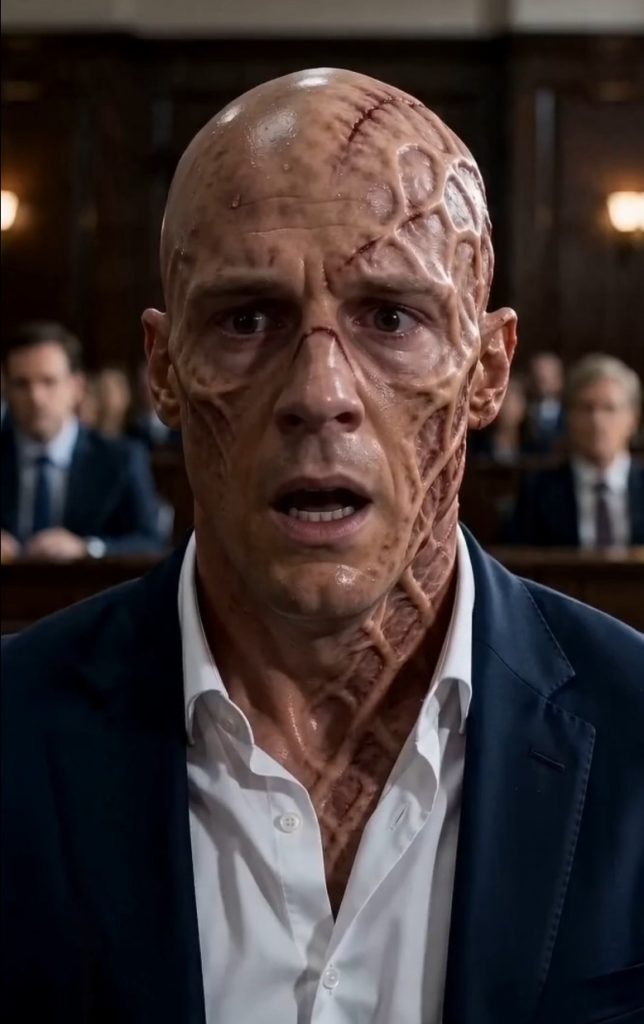
Elias Ward stood at the defense table with both hands flat against the wood, his shoulders rising and falling too fast. Sweat shone along the deep scars that crossed his face and scalp, catching the hard courtroom lights until every mark seemed cruelly visible.
He looked terrifying to people who did not know him.
To the children at Maple House, he had once looked like safety.
The judge lifted his gavel.
Elias’s attorney, Nathan Reed, closed his eyes as if he already knew mercy had left the room. Behind them, the gallery sat packed with reporters, townspeople, and people who had decided Elias was guilty long before the jury did.
Judge Harold Bennett looked down from the bench.
“Elias Ward,” he said, voice heavy and final, “this court sentences you to life in prison.”
The gavel struck once.
Then again.
The sound cracked through the room.
Elias’s mouth opened, but no words came out. A tear gathered in the corner of one scarred eye and slid slowly down his cheek. He did not wipe it away. Maybe he could not. Maybe, after months of begging people to believe him, there was simply nothing left to defend.
Then the courtroom doors flew open.
A boy staggered inside.
He was small, no older than eight, drenched from head to toe. Mud covered his jacket, his hands, his face. Wet brown hair stuck to his forehead. He looked like he had crawled out of the earth itself and run straight into judgment.
A deputy moved to stop him.
The boy slipped past.
“Your Honor!” he screamed.
Every head turned.
The boy stumbled into the center aisle, shaking so hard his knees nearly buckled.
“He’s innocent!” he cried. “I saw who really did it!”
The judge froze with one hand still on the gavel.
The gallery erupted.
Nathan Reed shot to his feet.
Elias turned slowly toward the voice.
The moment he saw the boy, something impossible happened to his face. The terror did not disappear, but hope broke through it so suddenly it seemed almost painful.
The boy pointed a trembling finger toward the back of the courtroom.
And the man he pointed at stopped breathing.
Act II
Before the fire, Elias Ward had been the quietest man in Briar County.
He fixed doors that would not close. Repaired leaking pipes. Drove children to school when the shelter van failed again. He lived in a small room behind Maple House, a converted children’s home on the edge of town, and never asked for more than coffee, work, and the right to be useful.
The scars had come years earlier.
A factory fire. A trapped night crew. A rescue that made headlines for three days before the world moved on. Elias had survived, but the fire left its signature across his skin.
Some people called him a hero.
More people stared.
Children, however, were different. They asked honest questions, then accepted honest answers. One little girl at Maple House once told him his face looked like “a map from a dragon country,” and after that the nickname stuck.
Mr. Dragon.
Elias pretended to hate it.
He never did.
Maple House was not perfect, but it was warm. Dr. Clara Voss, the director, fought the county for every repair, every meal plan, every social worker, every winter coat. She was fierce, plainspoken, and far too stubborn for the men who wanted the property sold.
The land beneath Maple House had become valuable.
A resort developer had quietly purchased everything around it, but Clara refused to sell. She said children were not obstacles to be moved for rich men’s views.
Three weeks before the fire, she found something.
Elias did not know exactly what. He only knew she had started locking her office, making copies late at night, and looking over her shoulder when cars slowed outside the gate.
The night Maple House burned, Elias had been in the workshop behind the building.
He smelled smoke before the alarms fully sounded.
He ran toward the house.
By the time police arrived, Elias was outside with two children wrapped in blankets and another child clinging to his neck. He kept trying to go back in for Clara, but deputies held him down on the grass.
The next morning, everything changed.
Investigators said the fire started near the maintenance room. They said Elias had access. They said fuel traces were found on his work gloves. They said Clara had argued with him over missing funds.
None of it was true.
But Elias was scarred, quiet, poor, and easy to turn into a monster.
The real problem was the missing boy.
His name was Milo Grant.
Eight years old. Brown hair. Bad at spelling. Good at lying about vegetables. He had followed Elias everywhere, carrying a plastic flashlight and asking if dragons needed assistants.
Milo disappeared the night of the fire.
The prosecution said Elias had harmed him to hide the truth.
Elias said Milo had run toward the woods after seeing someone near Clara’s office.
No one believed him.
No one found the boy.
Until the courtroom doors opened.
Act III
Milo stood in the aisle with water dripping from his sleeves.
The judge leaned forward, stunned.
“Son,” he said, his voice no longer booming, “what is your name?”
The boy swallowed.
“Milo Grant.”
A woman in the gallery screamed.
The sound ripped through the courtroom.
Milo’s foster mother, who had spent months believing him dead, tried to run to him, but Nathan Reed raised both hands.
“Your Honor, we need the child sworn in. We need the record preserved. Now.”
The prosecutor, Lydia Cross, stood so quickly her chair scraped the floor.
“This is outrageous. We have no verification that this child—”
“It’s him,” Elias whispered.
Everyone turned.
Elias had barely spoken during the trial. His voice had become a rumor by then, something the jury heard only when required. But now he stared at Milo like a man looking at dawn after years underground.
“It’s Milo,” he said. “He has a scar under his chin from the swing set.”
Milo touched his chin and began crying harder.
Judge Bennett looked toward the deputies.
“Bring that child a chair.”
“No,” Milo said.
The word came out cracked but firm.
“I have to say it now. Before he leaves.”
His eyes moved past Elias.
Toward the back row.
Toward Deputy Fire Marshal Owen Pike.
Pike had testified for the prosecution. He was polished, respected, and calm in the way official men become when nobody questions their certainty. He had explained burn patterns, evidence collection, motive, opportunity.
The jury had trusted him.
Now an eight-year-old boy stared at him with pure terror.
“He was there,” Milo whispered.
The courtroom shifted.
Pike’s expression did not change, but one hand tightened around the edge of the bench in front of him.
Judge Bennett followed the boy’s gaze.
“Who?”
Milo lifted his shaking hand.
“Him.”
Pike gave a small, offended laugh.
“Your Honor, this child is frightened and confused.”
Milo shook his head violently.
“No. I saw you by Dr. Clara’s office. You had the silver lighter.”
Nathan Reed turned sharply.
“Silver lighter?”
Milo nodded, tears mixing with mud on his face.
“It had a bird on it. An eagle. He dropped it when she yelled at him.”
Pike’s jaw tightened.
The prosecutor went pale.
During the trial, the defense had asked about a melted metal object found near Clara’s office. Pike said it was debris from a desk drawer. No photograph had been entered. No inventory tag had survived.
Milo reached inside his torn jacket.
A deputy stepped forward, but Judge Bennett raised a hand.
Slowly, Milo pulled out a small plastic pouch, dirty but sealed.
Inside was a warped silver lighter.
Even from the bench, the eagle engraving was visible.
The courtroom went silent in a way no gavel could command.
Milo looked at Elias.
“Mr. Dragon told me to run,” he said. “But I hid. I saw the man come back. I saw him put something in your shed.”
Elias closed his eyes.
The gloves.
The fuel trace.
The evidence that had destroyed him.
Milo looked at the judge again.
“I tried to tell. But he found me.”
Act IV
The courtroom became a living thing.
Whispers rose, then broke into shouts. Reporters stood. Deputies moved toward Pike. The prosecutor gripped the table as if the floor had shifted beneath her.
Judge Bennett struck the gavel once.
“Order!”
This time, the word carried fear.
Nathan Reed stepped into the aisle, his voice controlled but shaking with outrage.
“Your Honor, I move to vacate the sentence immediately and reopen evidentiary proceedings. I also request that Deputy Fire Marshal Pike be detained pending investigation.”
Pike stood.
“This is madness.”
Milo backed away so fast he nearly fell.
Elias moved without thinking.
The bailiff caught his arm, but Elias was not trying to run. He was reaching toward the boy.
“Don’t touch him,” Elias said, voice low and raw.
Pike looked at him with sudden hatred.
For one moment, the mask slipped.
And everyone saw it.
Not guilt proven in law yet.
But guilt frightened by daylight.
Judge Bennett turned to the sheriff at the side wall.
“Secure Mr. Pike.”
Pike laughed sharply. “You’re making a mistake.”
The sheriff stepped forward.
“No,” the judge said. “I believe I may already have made one.”
That sentence changed the room.
Pike’s face drained.
Milo began to shake harder. A paramedic was called in. His foster mother was allowed to wrap him in a blanket, but he refused to leave until he finished.
He told them everything in pieces.
After the fire, he ran into the woods and hid near the creek. Pike found him before dawn. Told him Elias had died. Told him nobody would believe a shelter kid over an officer. Then Pike took him to a hunting cabin beyond the quarry and kept him there under threat and fear.
Milo escaped that morning after a storm washed part of the access road out.
He crawled through a drainage ditch.
He followed the river.
A truck driver found him near the courthouse and, when Milo screamed Elias’s name, brought him straight to the front steps.
Nathan Reed asked the question everyone feared.
“Why would Pike do this?”
Milo looked down.
“Because Dr. Clara had papers.”
The defense attorney went still.
“What papers?”
Milo reached into the pouch again.
Behind the lighter was a folded memory card wrapped in tape.
“She gave it to me,” he said. “She said if anything happened, give it to Mr. Ward. She said he’d know how to keep us safe.”
Elias stared at the card.
He had not known.
That hurt almost as much as the frame-up.
The judge ordered a laptop brought in under seal. The courtroom watched as a clerk loaded the files.
Photos appeared.
Bank transfers.
County emails.
Inspection reports falsified to declare Maple House unsafe.
Payments routed through shell companies.
And one video, shot from Clara’s office camera.
Pike stood in the doorway with a man in a tailored coat.
The man was Warren Bellamy, the developer who had been trying to buy Maple House for two years.
His voice came through the courtroom speakers, tinny but clear.
“Burn the office. Blame the maintenance man. The county already thinks he’s unstable.”
Then Pike answered.
“What about the kids?”
Bellamy said, “They’ll be moved by morning if the alarm goes off fast enough.”
Clara’s voice cut in from somewhere off-camera.
“You won’t get the chance.”
The video shook as she grabbed the device.
Then it ended.
No one moved.
Not even the judge.
Milo’s small voice broke the silence.
“She tried to stop them.”
Elias lowered his head.
The tears came then. Quietly. Fully. Not for himself. For Clara. For the children. For the months spent being called a murderer while the real men sat in clean shirts and watched him drown.
Judge Bennett removed his glasses.
When he spoke, his voice had lost every trace of cold authority.
“Mr. Ward,” he said, “this court has failed you.”
Act V
Elias Ward did not leave prison that day.
The law, after taking nearly everything from him, still insisted on paperwork before returning his life.
But he did not go back the same man.
The deputies removed his cuffs in the holding room. Nathan Reed stayed with him until the emergency hearing was filed. Milo was taken to the hospital under protective guard, wrapped in three blankets and refusing to sleep until someone promised Elias knew he had told the truth.
By sunrise, Warren Bellamy had been arrested at a private airfield.
Pike was taken into custody before midnight.
The prosecutor’s office announced a review, then tried to call the case an isolated failure. The public did not accept that. Not after seeing the footage. Not after learning how many warnings had been buried because the defendant looked easier to believe as a villain than as a victim.
Two weeks later, Elias walked out of Briar County Detention Center into cold afternoon light.
No cameras were allowed near him at Nathan’s request.
But Milo was there.
So was his foster mother.
The boy stood beside the courthouse steps wearing a clean tan jacket two sizes too big. His hair was combed badly, probably by himself. In his hands, he held a small plastic dragon toy with one wing missing.
Elias stopped when he saw him.
Milo ran.
This time, no bailiff stopped them.
The boy crashed into Elias’s arms, and Elias folded around him carefully, as if afraid hope might bruise.
“I told them,” Milo sobbed.
“I know,” Elias whispered.
“I came back.”
Elias closed his eyes.
“You did.”
Judge Bennett resigned before the year ended.
At his final public statement, he did not defend himself with procedure or blame the jury. He said the justice system had punished a man partly because the world mistook disfigurement for danger and poverty for guilt.
It was not enough.
But it was true.
Maple House was rebuilt with money seized from Bellamy’s company. Clara Voss’s name was placed above the front door, not in marble, but carved into warm oak where children could touch it when they walked inside.
Elias refused to become its director.
He accepted the job of groundskeeper again.
People called it humility. Nathan called it stubbornness. Milo called it stupid because “groundskeepers don’t get the good office.”
But Elias liked fixing things.
Doors. Windows. Broken railings. Small bikes. Nightmares that woke children at two in the morning. Trust, when it cracked.
That was harder.
Milo came back to Maple House after months of counseling and court dates. He did not sleep well at first. He kept a flashlight under his pillow and checked windows twice. Some nights, he sat on the hallway floor outside Elias’s room without knocking.
Elias always opened the door anyway.
Neither of them talked much on those nights.
They did not need to.
Years later, people would remember the case because of the boy bursting through the courtroom doors. They would talk about the mud, the lighter, the video, the judge frozen behind the bench.
But Elias remembered something else.
He remembered the moment after the sentence, before Milo arrived, when he truly believed his life had ended in a room full of people who never bothered to see him.
And he remembered the sound of one child’s voice refusing to let that be the end.
On the first anniversary of Clara’s death, Maple House held a small ceremony in the garden.
No reporters.
No speeches from officials.
Just children, staff, Nathan Reed, Milo’s foster mother, and Elias standing beneath a young maple tree planted near the front steps.
Milo stepped forward with a folded paper.
He had written something himself.
His hands shook, but he read it anyway.
“Dr. Clara said the truth is not fragile. She said people are. So we have to protect people until truth catches up.”
Elias looked away, his eyes burning.
Milo continued.
“Mr. Ward protected me. Then I protected him.”
He folded the paper and shoved it into his pocket, embarrassed by the sudden quiet.
Then he walked over to Elias and took his hand.
The scars were still there.
They would always be there.
But the children at Maple House did not stare the way adults did. To them, Elias was not the man from the trial photo, not the defendant, not the face on the news.
He was the man who checked the locks.
The man who fixed the swings.
The man who came when someone cried.
The man a drenched, mud-covered boy had run through a courthouse to save.
And every evening, when the lights came on inside Maple House and the windows glowed against the dark, Elias stood on the porch long enough to make sure every child was safely inside.
Not because he was afraid of fire.
Because he knew how long truth could take.
And he knew some doors only opened because someone, somewhere, refused to arrive too late.