Act I
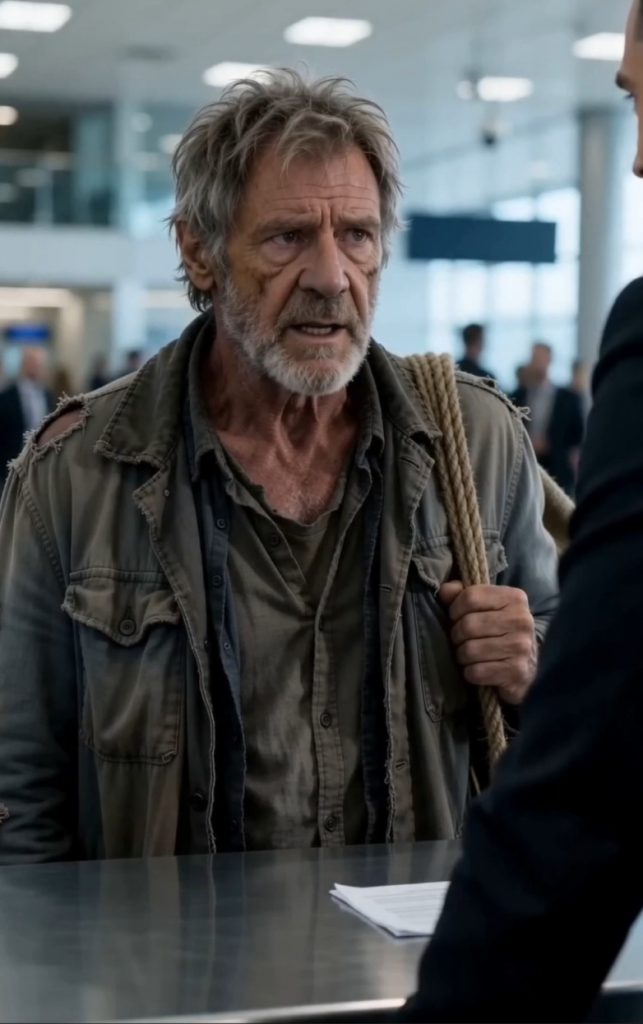
The old man walked through the airport like someone the world had already decided not to see.
His gray jacket was torn at the elbows. One boot dragged slightly against the polished floor. Over his shoulder, he carried a burlap sack so old and heavy that travelers turned their suitcases away from it, afraid it might brush against their designer coats.
Announcements echoed above him.
Boarding calls. Gate changes. Final warnings for passengers who had someplace important to be.
He moved slowly through all of it.
At the first-class ticketing counter, the young agent looked up and immediately stopped smiling.
The old man set the burlap sack down by his feet.
“I wanna buy a ticket,” he said.
His voice was rough, worn by cold mornings and too many years of swallowing what other people said to him.
The agent leaned forward on the counter.
He was young, clean-shaven, dressed in a sharp black suit with a polished name tag and the kind of confidence that came from standing behind a desk rather than in front of one.
“A ticket?” he asked.
“Yes.”
“To where?”
“Zurich.”
A few people in line glanced over.
The agent’s mouth twitched.
“Zurich,” he repeated, as if the word itself became ridiculous when spoken by a man in torn clothes. “Do you even have money? Flying is expensive.”
Behind the old man, a woman laughed.
It was bright, loud, cruel.
She wore a black dress, a pearl necklace, and red lipstick that did not move when she smiled. Beside her stood a well-dressed man with one hand at her lower back, laughing because she laughed, as if mockery were part of their relationship.
“Oh, this is too much,” the woman said. “He thinks this is a bus station.”
Her lover chuckled. “Maybe he wants to pay with potatoes.”
The agent smirked.
The old man did not move.
For a moment, he looked at the agent. Then he looked at the woman. Then at the polished marble floor, where his reflection looked like a ghost standing inside a palace.
Slowly, he bent and opened the burlap sack.
The woman laughed again.
Then the old man reached both hands inside and pulled out two thick stacks of hundred-dollar bills.
The laughter died.
The stacks were bound with neat rubber bands, crisp and real, heavy enough to make a sound when he placed them on the counter.
The agent’s smile vanished.
But the old man was not finished.
He reached inside the sack again.
More money.
Then again.
More.
Gasps moved through the line.
The old man lifted two stacks in both hands and, with one hard sweep of his arms, threw them into the air.
Hundred-dollar bills exploded above the ticket counter, spinning through the airport lights, falling over the agent’s shoulders, sliding across the counter, scattering at the feet of the woman in pearls.
No one spoke.
The old man stood beneath the raining money, his face stone-calm.
Then he said, “Is that enough for one seat?”
Act II
The agent’s name was Preston Vale, and until that moment, he had never been truly afraid of a customer.
Annoyed, yes.
Impatient, often.
Afraid, never.
He worked the international first-class counter at Northbridge International, where wealth arrived in expensive luggage and spoke through assistants. He knew how to recognize money. Watches. Shoes. Passport covers. The quiet arrogance of people who did not ask prices before handing over a card.
This old man had none of that.
So Preston had made the mistake of thinking he had nothing.
Now hundred-dollar bills lay across his keyboard.
One had landed against his tie.
Another floated down onto the counter between them.
The woman in pearls stared at the money near her heels as though it had insulted her personally.
Her lover stepped back.
The old man looked at Preston.
“I asked for a ticket.”
Preston swallowed.
“Sir, I… I can process that.”
“No,” the old man said. “Now you can.”
The words landed harder than a shout.
A supervisor hurried over, face pale, radio pressed to one ear. Two airport security officers approached, but slowed when they saw the money, the crowd, and the old man standing still in the center of it all.
“Sir,” the supervisor said carefully, “is there a problem?”
The old man looked around the terminal.
Travelers had stopped pretending not to watch. Phones were lifted now. The scene had become something worth recording because humiliation only becomes interesting to strangers once power changes direction.
The old man’s eyes returned to Preston.
“This boy asked if I had money.”
Preston flushed. “I didn’t mean—”
“You meant it.”
The supervisor’s expression tightened.
The woman in pearls tried to recover her dignity. She lifted her chin and gave a brittle laugh.
“Well, carrying cash in a sack doesn’t make someone civilized.”
The old man turned to her.
For the first time, something like recognition flickered across his weathered face.
Not recognition of her.
Recognition of the type.
A woman who mistook polish for worth. A woman who believed cruelty sounded clever when spoken in a wealthy accent. A woman who had never imagined the person she mocked might have once owned more than she could spend.
“What’s your name?” he asked.
She blinked, offended.
“Excuse me?”
“Your name.”
The man beside her stiffened. “You don’t speak to her like that.”
The old man’s gaze shifted to him.
“And you are?”
The man straightened. “Victor Lang.”
A murmur moved through the crowd.
Victor Lang was not famous to everyone, but in certain circles, his name carried weight. He was a private banker, a dealmaker, a man who moved money for people who preferred not to explain where it had been.
The woman placed a manicured hand on his arm.
“Don’t engage,” she said. “He’s clearly disturbed.”
The old man’s face did not change.
But his hand slipped into the inner pocket of his torn jacket and touched something hidden there.
A folded photograph.
A boarding pass from twenty-one years ago.
And a letter that had brought him to this airport with more cash than dignity demanded, because dignity had stopped mattering the moment he learned who had stolen his life.
His flight was not just to Zurich.
It was to the bank vault where the truth had been waiting.
And Victor Lang had just given him the final name.
Act III
Before anyone called him a vagrant, his name had been Arthur Bell.
Not Mr. Bell from a shelter form.
Arthur Bell of Bell Meridian Holdings.
He had built ports, freight lines, hotels, and one of the most profitable private aviation companies in Europe before selling it for a fortune that made newspapers call him “the quiet American billionaire.”
Quiet was the only part they got right.
Arthur had never liked cameras. He preferred warehouses to boardrooms, workers to advisers, and contracts simple enough that no lawyer could hide a knife inside them.
Then his wife died.
After that, the knives found him anyway.
Her name had been Elise. She was French, sharp-tongued, beautiful, and the only person who could make Arthur laugh in rooms full of men trying to impress him. They had one daughter, Clara, who played piano badly, hated shoes, and used to fall asleep on Arthur’s office couch while he finished calls.
When Elise passed, grief opened a door in him.
His partners walked through it.
The man Arthur trusted most was Malcolm Greer, his chief financial officer and childhood friend. Malcolm handled the banks. The lawyers. The offshore structures. The papers Arthur signed without reading because grief made the world blurry and old friendship made betrayal impossible to imagine.
Then Clara disappeared.
She was sixteen.
Arthur had been told she ran away after a fight. There was a note on her bed. A bank withdrawal. A witness who claimed to see her board a train alone.
Arthur never believed it.
His daughter had left angry before, but never without her mother’s necklace. Never without the small leather journal she kept under her pillow. Never without saying goodbye to the stable dog she had loved more than most humans.
He searched for her until his company called him unstable.
Until Malcolm convinced the board to remove him.
Until doctors signed reports.
Until newspapers began writing the word breakdown.
Arthur lost control of his company, then his house, then his name.
The money did not vanish all at once. Men like Malcolm did not steal with bags. They stole with signatures, medical declarations, trusts, and family offices. By the time Arthur understood, the world had already been told he was unwell.
He disappeared after that.
Not by choice.
By survival.
For years, he lived between cheap motels, work camps, shelter beds, and old farms where nobody cared who he had been as long as he could lift timber and stay quiet. He kept only one thing untouched: a burlap sack with emergency cash Elise had once forced him to hide.
“Rich men trust banks too much,” she had told him.
He had laughed then.
He was not laughing now.
Three weeks earlier, a woman named Maribel from a legal aid office had found him sleeping near a bus depot in Ohio.
She had not recognized him.
She had recognized the name Clara Bell from a sealed adoption file that had crossed her desk years before.
Clara had not run away.
She had been hidden.
Moved through private channels.
Renamed.
Eventually taken overseas.
The trail led to Zurich.
To a vault.
To financial records signed by Malcolm Greer.
And to the banker who had opened the original accounts.
Victor Lang.
Arthur had come to the airport to buy a ticket with the only money no one had managed to steal from him.
He had not expected to find Victor laughing behind him.
But fate, he had learned, enjoyed ugly timing.
And now, standing in a bright terminal beneath falling bills, Arthur Bell turned fully toward the man who had helped erase his daughter.
Act IV
Victor Lang knew before Arthur said another word.
It was visible in the way his face changed.
Not much. Not enough for most people to catch. But Arthur had spent years studying men who lied for a living. The tiny pause. The swallowed breath. The sudden stillness of someone recognizing a grave he thought had stayed closed.
Arthur stepped closer.
“You opened the Zurich accounts.”
Victor’s lover looked at him. “What is he talking about?”
Victor forced a laugh.
“I have no idea.”
Arthur reached into his jacket and removed the folded photograph.
It was creased and stained from years of travel. He opened it with careful hands.
A teenage girl smiled from the picture, standing beside a chestnut horse, her hair loose in the wind. Around her neck hung a gold necklace with a tiny bell charm.
Arthur held it up.
“My daughter.”
The woman in pearls looked at the photo, then at Victor.
Victor’s face remained tight.
“Sir, I don’t know you.”
Arthur nodded slowly.
“You knew Malcolm Greer.”
This time, Victor did not answer quickly enough.
The supervisor stepped forward. “Sir, perhaps we should take this somewhere private.”
“No,” Arthur said.
The word echoed across the counter.
“For twenty-one years, everything was private. Private doctors. Private accounts. Private courts. Private men deciding my daughter’s life behind private doors.”
He looked at Victor.
“I want public.”
Airport security stood frozen now, uncertain whether they were dealing with a disturbance, a crime, or something far larger than either.
Arthur pulled out the letter.
It shook in his hand, but his voice did not.
“Clara Bell was placed under a false identity using funds routed through Helvetia Crown Bank, Zurich. Authorizing officer: Victor Lang.”
The woman beside Victor stepped away from him.
“Victor?”
He hissed, “Stay quiet.”
That was when she understood he had not denied it to her.
Only to everyone else.
Preston stood behind the counter, pale and motionless, money still scattered around his shoes.
Arthur looked at him briefly.
“You asked if flying was expensive.”
Preston lowered his eyes.
Arthur turned back to Victor.
“Losing a child is expensive. Losing your name is expensive. Sleeping outside buildings you used to own is expensive. Being called crazy while sane men spend your fortune is expensive.”
Victor’s polished confidence cracked.
“You can’t prove any of this.”
A voice came from behind the crowd.
“Yes, he can.”
Everyone turned.
A woman in a charcoal coat walked toward the counter, holding a leather briefcase. She was in her early forties, with dark hair cut at her jaw and eyes that had learned to trust documents more than promises.
Arthur’s breath caught.
He had seen her picture.
Older now.
Changed.
But the face was Elise’s around the mouth.
His daughter stopped a few feet away.
“Hello, Dad,” she said.
Arthur did not move.
For twenty-one years, hope had been a dangerous animal. He had fed it scraps, chained it, cursed it, prayed to it, and hated it for staying alive.
Now it stood in front of him wearing a charcoal coat.
“Clara?” he whispered.
Her eyes filled.
“They told me you were dead.”
The terminal blurred around him.
Arthur reached for her, then stopped, afraid to touch the miracle too quickly.
Clara closed the distance herself.
She wrapped her arms around him, burlap dust, torn jacket, trembling bones and all.
The old man who had thrown money into the air made no sound.
He simply held his daughter while the airport watched a dead family come back to life.
Act V
Victor tried to leave during the embrace.
He made it four steps.
Airport police stopped him near the priority lane, where he stood beneath a sign for first-class passengers with his face white and his mouth opening and closing around excuses no one cared to hear.
Clara had not come alone.
Neither had Maribel from legal aid.
By the time Arthur lifted his face from his daughter’s shoulder, two federal agents were entering the terminal with sealed warrants tied to a financial investigation that had been moving quietly for months.
Malcolm Greer had been arrested that morning in Connecticut.
Victor Lang had been the next name.
The airport had not been an accident after all.
Clara had known Arthur might come there. She had known he would resist private jets, private escorts, private anything. He had always believed a man should pay his own fare unless he was too proud to accept love.
So she waited near security with the agents.
She saw the old man at the counter.
She saw the laughter.
She saw him open the sack.
And she let the world witness what it had helped create.
Preston finally stepped out from behind the counter.
His face was flushed with shame.
“Mr. Bell,” he said quietly. “I’m sorry.”
Arthur looked at him.
The young agent seemed smaller now without his smirk.
“You should be,” Arthur said.
Preston nodded.
No defense.
No explanation.
Arthur respected that more than he expected to.
The wealthy woman in pearls stood alone now. Victor had been taken aside. Her lover, her protector, her proof of status, was suddenly just a man in handcuffs answering questions from people who did not care about his suit.
She looked at Arthur, then at Clara.
“I didn’t know,” she said.
Arthur’s eyes were tired.
“No one ever does, until knowing costs them.”
She lowered her head.
For once, she had nothing clever to say.
The ticket to Zurich was never purchased.
Arthur did not need it anymore.
Clara had already brought the Zurich records with her: vault statements, forged guardianship papers, payments to doctors, transfers from Bell Meridian Holdings, and a small envelope containing the necklace she had worn the day she vanished.
The gold bell charm had been found in Malcolm Greer’s safe.
He had kept it like a trophy.
Arthur held it in his palm at the airport police office, staring at it until Clara gently closed his fingers around it.
“I don’t remember everything,” she told him.
He looked up.
“They changed my name. Moved me through boarding schools. Told me you killed yourself after Mom died. I believed them because I was a child, and adults with papers sounded like truth.”
Arthur’s face twisted.
“I looked for you.”
“I know that now.”
“I should have found you.”
Clara took his hand.
“You did.”
Weeks later, Arthur Bell returned to Bell Meridian Tower.
Not in a limousine.
In Clara’s old blue pickup truck, because she said limousines made her carsick and Arthur laughed for the first time in so long that both of them went quiet afterward.
The board had gathered in the top-floor conference room, expecting lawyers.
They got Arthur.
Clean-shaven now, hair trimmed, still wearing the same repaired gray jacket because he refused to let anyone dress him like a man pretending nothing had happened.
He walked to the head of the table and placed the burlap sack on it.
Some directors stared at it.
Others looked away.
Clara stood beside him with the files.
Maribel sat across from them, legal pad open, eyes sharp.
Arthur did not give a long speech.
Men who had been stripped of everything did not need many words when the proof had finally learned how to speak.
“You took my company while I was grieving,” he said. “You took my daughter while she was a child. You took my name and fed it to newspapers.”
He rested one hand on the sack.
“But you did not take what mattered.”
By the end of the month, resignations became prosecutions.
By the end of the year, Bell Meridian Holdings had been restructured under a trust Clara controlled with full transparency, independent oversight, and a legal aid fund for families destroyed by fraudulent guardianships and financial abuse.
Arthur refused the title of chairman.
He accepted an office only because Clara put a small couch in it and said she needed somewhere to nap when meetings bored her.
Some afternoons, he sat there while she worked, watching sunlight move across the floor, listening to her argue with lawyers in the same sharp tone her mother once used on hotel managers and dishonest jewelers.
He had missed her childhood.
Nothing could repair that.
But he did not miss the rest.
As for Preston, he was transferred out of first-class service and placed in customer assistance for passengers with special needs, lost documents, missed flights, and nowhere to go. It was supposed to be disciplinary.
Strangely, it changed him.
One winter evening, Arthur saw him helping an old woman rebook a canceled flight with such patience that Clara smiled.
“People can learn,” she said.
Arthur watched Preston kneel to zip the woman’s broken suitcase.
“Some can.”
The woman in pearls disappeared from social pages for a while. When she returned, she was quieter. No one knew whether shame had softened her or merely taught her better timing.
Arthur did not care much either way.
He cared about Sundays.
On Sundays, Clara came to his small house outside the city, where he had planted apple trees because Elise had always wanted them. They made terrible coffee, burned toast, and argued about whether the old dog Clara adopted was intelligent or just manipulative.
Arthur kept the burlap sack by the front door.
Empty now.
Clara once asked why.
He touched the rough fabric and smiled faintly.
“Reminder.”
“Of what?”
“That money can shock people,” he said. “But it can’t tell them who a man is.”
Clara leaned against the doorway.
“What does?”
Arthur looked at his daughter, alive in the afternoon light.
“What he refuses to stop looking for.”
Years after the airport video stopped circulating online, people still recognized Arthur sometimes. They remembered the old man who threw cash at a ticket counter. They repeated the story like it was about wealth.
But they were wrong.
It had never been about the money.
The money only made the room quiet enough for the truth to be heard.
And on the day the airport laughed at a man with a sack, the truth walked in wearing worn-out boots, bought no ticket, and still found its way home.