Act I
The first-class cabin was quiet until Caroline Wexler decided someone had made a mistake.
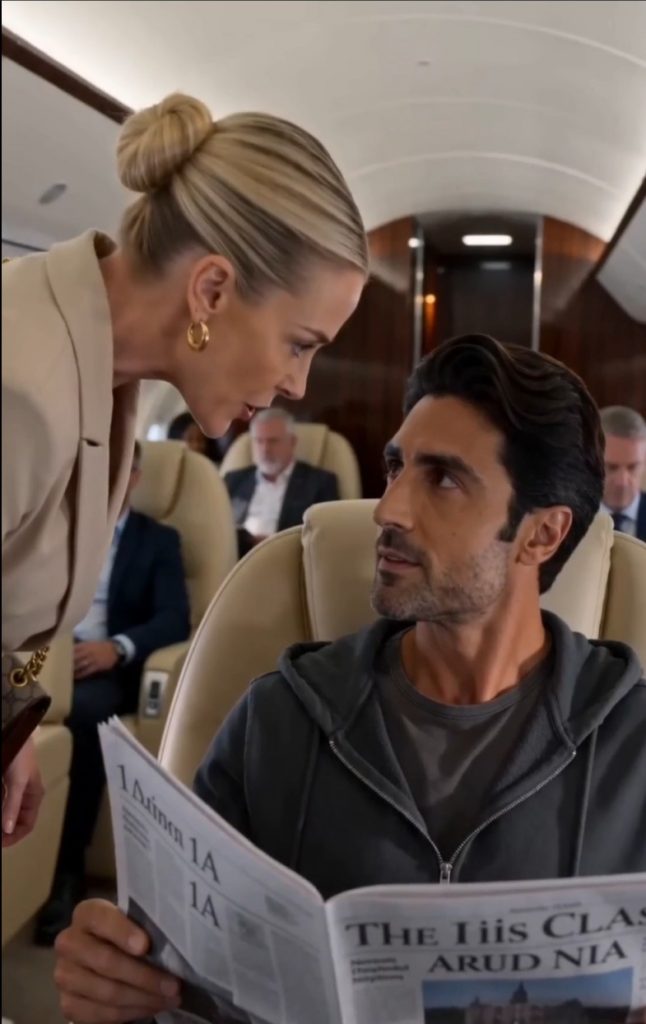
She stopped beside seat 1A with one hand wrapped around the gold chain of her designer handbag, her beige blazer pressed sharp enough to look like armor. Around her, cream leather seats curved beneath soft amber lighting, and the polished wood dividers gleamed like they belonged in a private club instead of a commercial aircraft.
The man in 1A looked up from his newspaper.
He was handsome in a careless way, with dark hair, faint stubble, and a dark gray hoodie zipped halfway over a plain T-shirt. He did not look nervous. He did not look impressed.
That irritated her first.
“I think you’re in the wrong seat,” Caroline said.
The man held her gaze.
“I don’t believe I am.”
A passenger across the aisle lowered his champagne.
Caroline gave the man a slow, deliberate look from his hoodie to his sneakers, as if his entire existence had offended the cabin.
“This is first class,” she said. “Seat 1A.”
“I can read.”
Her mouth tightened.
Behind her, a flight attendant named Nina stepped closer, already sensing the kind of trouble that starts quietly and then expects everyone else to clean up the mess.
“Ma’am,” Nina said gently, “I can help check your boarding pass.”
Caroline did not turn.
She leaned closer to the man in 1A, lowering her voice into something cold and sharp.
“You clearly don’t belong here.”
The cabin went still.
It was not the loudest insult anyone had ever heard. It was worse because of how comfortable she sounded saying it. Like she had said some version of it before in hotel lobbies, restaurants, private lounges, anywhere money taught people to confuse clothing with worth.
The man folded his newspaper slowly.
Not angrily.
Not hurriedly.
Calmly, as if the entire plane had been waiting for him to decide whether this moment deserved his attention.
Then he looked up at Caroline.
“I’m exactly where I’m supposed to be,” he said. “This airline belongs to me.”
Caroline reeled back.
Her mouth opened, but nothing came out.
The man reached into the pocket of his hoodie and pulled out his boarding pass. Nina’s eyes dropped to the name printed at the top.
Julian Cross.
Founder. Majority owner. Chairman of Sovereign Air.
The woman who had just accused him of not belonging in first class suddenly looked as if the floor beneath the cabin had disappeared.
And Julian Cross had not even begun to explain why he was really on that flight.
Act II
Julian Cross hated suits on airplanes.
He owned more of them than he cared to count. Tailors flew to his office. Magazine editors called his style understated, which was just a polite way of saying he had enough money not to prove it every morning.
But when he flew, he wore hoodies.
It had started years earlier, before Sovereign Air had lounges with marble walls and menus designed by celebrity chefs. Before reporters called him the man who saved a dying airline. Before investors learned to stop asking why he cared so much about ordinary passengers when first class paid the bills.
Julian had once been the ordinary passenger.
Worse than that, he had been the kid standing beside his mother while a gate agent told her she could not board because her ticket looked “suspicious.”
His mother had cleaned office buildings at night. She had saved for fourteen months to buy two tickets so she could take Julian to see his father in Denver after a warehouse accident. She wore her best coat to the airport, but the lining was torn, and her hands were rough from chemicals.
The agent looked at her and decided she did not belong.
By the time the mistake was corrected, the plane had left.
His father died before they reached him.
Julian never forgot the sound his mother made in that terminal. It was not dramatic. It was small. Almost quiet. The sound of a woman realizing that rules bend faster for people who look expensive.
Years later, when Julian made his fortune in logistics software and Sovereign Air collapsed under debt, he bought it.
Everyone thought he wanted prestige.
He did not.
He wanted control of the kind of room where his mother had once been humiliated.
That was why he flew anonymously several times a year. No entourage. No special announcement. No executive greeting at the gate. Just a ticket, a seat, and a chance to see what his airline became when nobody knew power was watching.
The reports had been getting worse.
First-class staff complained about passengers bullying crew. Economy passengers said they were ignored when premium clients demanded attention. One elderly man was mocked for asking how to use the entertainment screen. A teenage scholarship student was questioned three times in the lounge because someone assumed he had wandered in.
Then came the internal proposal.
A consulting firm hired by a senior executive had submitted a “premium cabin refinement strategy.” The language was polished, but Julian knew what it meant.
Make first class feel more exclusive.
Screen the atmosphere.
Protect the brand from visual inconsistency.
He read the document twice and felt his mother’s old terminal grief return like a hand around his throat.
The lead consultant was Caroline Wexler.
She was on Flight 218 that morning because the board wanted her in London for the final presentation. Julian had chosen the same flight after seeing her name on the passenger manifest.
He wanted to observe her before she entered a conference room and told his executives how to define value.
He had not expected her to walk directly up to him and prove her philosophy before takeoff.
Now Caroline stood frozen in the aisle, clutching her handbag like it could drag her dignity back into place.
Nina, the flight attendant, looked from Julian to Caroline, then back again.
“Mr. Cross,” she said carefully, “I apologize. I didn’t realize you were aboard.”
“That was the point,” Julian said.
Caroline blinked rapidly.
“You’re Julian Cross?”
He said nothing.
That was worse.
A man in the second row lifted his phone slightly, then thought better of it when Julian’s eyes moved toward him.
Caroline forced a laugh.
It sounded terrible.
“There must be some misunderstanding,” she said. “I was only trying to confirm my seat.”
Nina looked at the boarding pass in Caroline’s hand.
“Ms. Wexler,” she said, “you’re in 2A.”
The silence deepened.
Julian looked at Caroline.
“You walked past your seat.”
Color rose in her face.
For the first time since entering the cabin, she seemed smaller than the jewelry she wore.
But the plane had already heard enough.
And one person in that cabin had heard far more than Caroline realized.
Act III
Nina knew women like Caroline.
Not personally. Not by name.
By tone.
She had served enough first-class cabins to recognize the ones who smiled at pilots, ignored flight attendants, and treated anyone in comfortable clothes as a problem to be corrected.
Nina had been with Sovereign Air for eight years. She had worked red-eyes, medical emergencies, mechanical delays, crying toddlers, angry executives, and honeymooners who drank too much champagne before wheels left the ground.
She could handle all of that.
What exhausted her were the passengers who believed kindness was a service tier.
So when Caroline said, “You clearly don’t belong here,” Nina felt something old and tired move through her.
Not surprise.
Recognition.
Julian noticed her expression.
“Ms. Wexler,” he said, still seated, still calm, “what made you assume I was in the wrong seat?”
Caroline opened her mouth, then closed it.
Every possible answer condemned her.
“My boarding pass said—”
“No,” Nina interrupted gently but firmly. “It doesn’t.”
Caroline shot her a look.
Julian saw that too.
He stood.
The cabin seemed to shrink around him.
He was not loud. He did not need to be. Some men demand attention by raising their voices. Julian Cross had built his life so that silence did the work for him.
“Ms. Wexler,” he said, “you are scheduled to present a customer experience strategy to my board tomorrow.”
Caroline’s eyes widened.
The passenger in 1B muttered, “Oh.”
Julian continued.
“I read your proposal. I found the language interesting. Especially the part about preserving premium cabin standards.”
Caroline swallowed.
“That phrase refers to service consistency.”
“Does it?”
“Yes,” she said quickly. “Absolutely. It has nothing to do with—”
“With deciding who looks like they belong?”
Her face stiffened.
Nina looked down, hiding the flicker of satisfaction in her eyes.
Caroline tried to recover with the practiced speed of someone who had talked her way out of consequences before.
“Mr. Cross, I apologize if my words came across poorly. I’ve been traveling all morning. I thought there had been a seat duplication issue. Surely you understand that first class passengers expect order.”
Julian nodded once.
“They do.”
Relief touched her face.
Then he added, “So do flight attendants. So do gate agents. So do passengers in row thirty-two. Order is not a privilege. Dignity is not an upgrade.”
Caroline’s relief vanished.
From the galley, the purser had stepped into view. Other crew members were listening now. So were the passengers, though they pretended to study menus, seat controls, clouds beyond the windows.
Julian turned to Nina.
“Was Ms. Wexler rude to you before boarding?”
Nina hesitated.
Caroline immediately snapped, “That is inappropriate.”
Julian did not look at her.
“Nina?”
The flight attendant drew a breath.
“She was upset that her coat wasn’t hung immediately because we were assisting a passenger with mobility needs.”
Caroline’s jaw tightened.
“That is not what happened.”
Nina’s voice stayed steady.
“She said first-class service was declining because we were prioritizing people who should have boarded later.”
A ripple moved through the cabin.
Julian’s face remained still.
But something in his eyes changed.
Caroline understood then that the hoodie had never been carelessness.
It had been a test.
And she had failed before the aircraft door even closed.
Act IV
The captain stepped out from the cockpit after the purser quietly called him.
He was a silver-haired man named Captain Reeves, one of Sovereign Air’s most respected pilots. He had flown military transports, rescue routes, and commercial aircraft across four continents. He also knew Julian Cross well enough to understand when the chairman’s calm meant trouble.
“Mr. Cross,” he said, “is everything all right?”
Julian looked at Caroline.
“That depends.”
Caroline laughed sharply, panic bleeding through now.
“Surely we are not delaying an international flight over a seating misunderstanding.”
“No,” Julian said. “We are not.”
She exhaled.
“But you are not flying to London on this aircraft.”
Her face went blank.
“You can’t remove me.”
Captain Reeves spoke then.
“Any passenger creating a disturbance before departure may be denied transport.”
“I did not create a disturbance,” Caroline said, her voice rising. “I asked a question.”
Julian picked up his newspaper from the seat.
“You humiliated a stranger because you believed he lacked the appearance required to sit near you.”
“I didn’t know who you were.”
“That is exactly the problem.”
The words landed quietly, but they broke something open.
Caroline looked around, searching for sympathy in faces that had become very interested in not meeting her eyes.
Then she made her worst mistake.
She pointed at Nina.
“This is because she exaggerated. I want her name. I’ll be filing a complaint.”
Nina’s face tightened.
Julian stepped into the aisle.
“No,” he said.
Caroline froze.
“You will not threaten my crew because your own behavior embarrassed you.”
The purser moved toward the cabin phone. The gate agent was called back. Within minutes, the aircraft door reopened with a heavy mechanical sound that seemed to seal Caroline’s fate before anyone touched her luggage.
A ground supervisor appeared, breathless and confused.
When he saw Julian, his posture straightened instantly.
“Mr. Cross.”
Caroline’s eyes flicked from one uniformed employee to the next.
For the first time, she seemed to understand that power did not always announce itself with a tailored suit.
Julian turned to the supervisor.
“Ms. Wexler will be rebooked on another carrier at her own expense. Sovereign Air will not transport her today.”
Caroline’s lips parted.
“And her firm’s presentation tomorrow is canceled.”
That was when she truly went pale.
“Mr. Cross, please. My team has worked on that account for months.”
Julian’s voice did not change.
“Then they should have sent someone who understood the product.”
“The product is luxury travel.”
“No,” he said. “The product is trust at thirty-eight thousand feet.”
Caroline had no answer.
Her designer bag looked suddenly heavy on her shoulder. Her gold hoops flashed under the cabin lights as she lowered her head, not from humility, but from the crushing awareness that everyone was watching her downfall.
As the supervisor escorted her toward the door, Caroline stopped beside Julian.
“I made one comment,” she whispered.
He looked at her for a long moment.
“My mother missed her last chance to say goodbye to my father because someone made one judgment.”
Caroline’s expression changed.
For once, she did not try to speak.
Julian stepped back, allowing her to pass.
The cabin remained silent until she disappeared through the aircraft door.
Only then did a child seated with his father in row three whisper loudly, “Does he really own the plane?”
A few passengers laughed softly, the tension breaking at last.
Julian sat back down in 1A.
But Nina noticed his hands.
They were steady.
His eyes were not.
Act V
The flight left seventeen minutes late.
No one complained.
For the first hour, the cabin behaved like a room recovering from a storm. Passengers spoke softly. Crew moved carefully. Julian returned to his newspaper, though he did not turn a page for nearly twenty minutes.
Nina served coffee after the meal.
When she reached 1A, she placed the cup on his tray and hesitated.
“Thank you,” she said.
Julian looked up.
“For the coffee?”
“For saying it.”
He understood.
Nina’s professionalism held, but there was something fragile beneath it now. Not weakness. Relief. The kind that comes when someone finally says out loud what others have been swallowing for years.
Julian set the newspaper aside.
“How often does that happen?”
Nina’s smile was small and tired.
“Which part?”
He did not answer because they both knew.
She glanced toward the aisle.
“Most passengers are kind. Or at least normal. But some people board first and think that means they matter more. Not just more than other passengers. More than us.”
Julian looked toward the window.
Sunlight spread over the wing, bright and indifferent.
“My mother was treated that way once,” he said.
Nina said nothing.
“She saved for over a year for a ticket. Someone decided she didn’t look like she could have paid for it. By the time they fixed the mistake, it was too late.”
“I’m sorry,” Nina said softly.
Julian nodded.
“I bought this airline thinking I could prevent that from happening again.”
Nina looked at him carefully.
“You can’t be on every flight.”
“No,” he said. “But I can decide what kind of people we reward.”
By the time Flight 218 crossed the Atlantic, Julian had written three notes in the margin of Caroline Wexler’s printed proposal.
Cancel contract.
Review premium culture training.
Promote Nina Morris to cabin standards advisory panel.
When the plane landed in London, the story had already begun traveling faster than the aircraft. Someone in first class had posted a vague account online without names. A woman kicked off a luxury flight after insulting the airline owner in a hoodie. By the time passengers reached immigration, business blogs were already guessing.
Julian ignored all of it.
He went straight to the board meeting.
The executives expected a presentation from Caroline’s firm. Instead, Julian walked into the conference room wearing the same hoodie from the flight and placed her proposal on the table.
“We are not adopting this,” he said.
A senior vice president shifted in his chair.
“Julian, the premium cabin is our strongest revenue segment.”
“I know.”
“Then we have to protect the brand.”
Julian looked around the room.
“We are the brand.”
No one spoke.
“Not the champagne. Not the leather. Not the lounge lighting. Us. How we treat people when we think they have nothing to give us. How we protect our staff when wealthy passengers behave badly. How we respond when someone walks in wearing the wrong jacket and carrying the right ticket.”
The room stayed silent.
This was why some executives feared him.
Not because he shouted.
Because when Julian Cross made a decision, he made it like a door closing.
Within a month, Sovereign Air changed.
The policy updates were not flashy, though the media tried to make them so. Crew gained stronger authority to deny transport to abusive passengers. Complaint systems were redesigned so staff did not have to fear retaliation from premium clients. First-class training shifted away from “exclusive service” and toward “equal dignity, elevated comfort.”
Nina joined the advisory panel.
She tried to decline at first, saying she was just a flight attendant.
Julian corrected her.
“You’re the one who knows what happens when executives aren’t watching.”
Six months later, Sovereign Air launched a scholarship for young people entering aviation from working-class families. Julian named it after his mother.
The Rosa Cross Fellowship.
At the small announcement ceremony, he did not mention Caroline Wexler. He did not need to. People like her were never the whole story. They were symptoms of a sickness older than one insult in one cabin.
After the event, Julian walked alone through the terminal.
He passed luxury storefronts, airline lounges, families rushing for gates, business travelers balancing laptops and coffee. Near Gate 14, he stopped.
It was not the same airport where his mother had been humiliated years ago.
But for a moment, it felt close enough.
He could almost see her there, standing in her best coat, holding a paper ticket in both hands, trying to convince a stranger that she had the right to go where love required her to be.
Julian closed his eyes.
Then a voice interrupted him.
“Excuse me, sir?”
He turned.
A teenage boy in an oversized blazer stood nearby, holding a boarding pass so tightly it had creased. His mother stood behind him, nervous and proud.
“Is this the line for the aviation fellowship group?” the boy asked. “They told us to meet someone from Sovereign Air.”
Julian looked at the boy’s scuffed shoes, the careful blazer, the hope he was trying not to show too openly.
Then he smiled.
“Yes,” he said. “You’re exactly where you’re supposed to be.”
The boy’s shoulders loosened.
His mother whispered, “Thank you.”
Julian led them toward the gate, walking not ahead of them, but beside them.
Behind the glass, a Sovereign Air jet waited in the morning light.
Inside it, seat 1A would remain wide, polished, and expensive. People would still pay fortunes to sit there. Champagne would still be poured. The cabin would still glow with quiet luxury above the clouds.
But after that day, everyone at Sovereign Air understood something Caroline Wexler had learned too late.
First class was a seat.
It was never proof of worth.