Act I
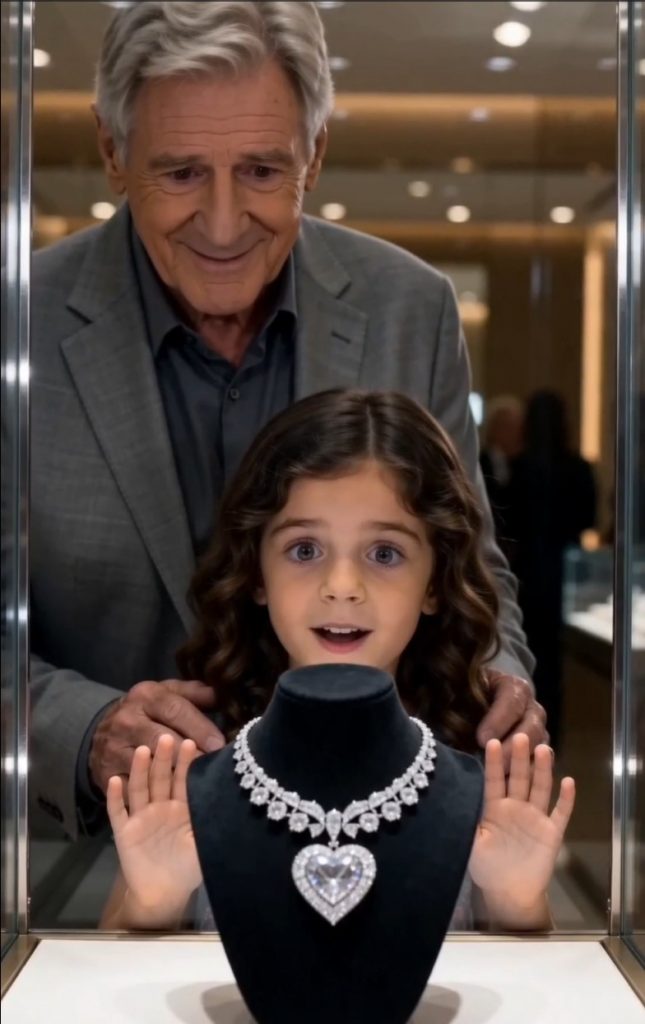
The little girl pressed both hands against the glass like the necklace inside was magic.
The boutique was quiet enough that every small sound seemed expensive. Soft lights glowed over velvet displays. Diamond bracelets rested on black silk. Gold-framed oil paintings watched over wealthy patrons who spoke in low voices and lifted champagne flutes without looking at the price tags.
But Sophie Whitaker saw only the heart.
It was small compared to the grand necklaces beside it. A diamond pendant shaped like a delicate heart, suspended on a thin chain, glowing under the spotlight as if someone had trapped a star inside it.
She leaned closer, breath fogging the polished display.
“Grandpa,” she whispered, “if one day we have enough… can I have the little heart one?”
Behind her, Arthur Whitaker smiled.
He was seventy-two, with short gray hair, tired eyes, and a modest blazer that looked out of place among tuxedos and evening gowns. His hands rested gently on Sophie’s shoulders. They were workman’s hands, thick at the knuckles, marked by old burns, small scars, and decades of careful labor.
He looked at the necklace.
Then at the child.
“One day,” he said softly.
Sophie turned, her eyes shining. “Really?”
Arthur nodded, but the smile cost him more than she knew.
Because the little heart in the case had not been made for strangers.
It had once belonged to his family.
Before Sophie could ask another question, a woman in an ivory blazer stepped between them and the display.
Her hair was pulled into a severe bun. Pearl earrings hung at her ears. Her posture was sharp enough to cut glass.
“This is not a place for beggars to dream,” she said. “Move away from the glass.”
The boutique fell silent.
Sophie’s hands dropped from the display.
Arthur’s smile vanished.
For a moment, he looked confused, as if the insult had reached him slowly and he was still hoping he had misunderstood.
“She was only looking,” he said.
His voice was low.
Not angry.
Wounded.
The employee’s lip curled.
“Then look from outside.”
A few patrons turned their heads. Someone near the champagne table whispered. No one stepped forward.
Sophie moved closer to her grandfather’s leg, her small fingers clutching the side of his blazer.
“Grandpa,” she whispered, “did I do something bad?”
That question broke him more than the insult.
Arthur swallowed and gently placed a hand over hers.
“No, sweetheart.”
The employee pointed toward the door.
“Leave before I call security.”
Arthur lowered his eyes.
He had survived poverty, war, loss, betrayal, and loneliness. But there was a special cruelty in being humiliated in front of a child who believed you could still give her the world.
He took one step back.
Then a voice cut through the room.
“Who told you to speak to him like that?”
The man who entered wore a perfectly tailored black suit and a white pocket square. He was tall, broad-shouldered, and carried the kind of authority that did not ask permission to exist.
The employee turned.
Her face went pale.
“Mr. Langford…”
The man stopped inches from her.
His eyes were cold.
“I asked you a question.”
Arthur looked up slowly.
And the man in the black suit was not staring at the employee anymore.
He was staring at Arthur as if he had found someone the whole city had been pretending was gone.
Act II
The man’s name was Julian Langford.
Everyone in the boutique knew him.
He was not merely a wealthy customer. He owned the building, chaired the board, and had taken control of Langford & Vale Jewelers after his father’s sudden death. In a room full of people trained to recognize money by the cut of a suit and the weight of a watch, Julian made even rich men stand straighter.
The employee, Vanessa, tried to recover.
“Sir, I was only maintaining the store’s standards.”
Julian’s expression did not change.
“The store’s standards?”
Her eyes flicked toward Arthur’s worn shoes, then back to Julian. “We have high-value merchandise on display. I thought—”
“No,” Julian said. “You didn’t think. You judged.”
The words landed cleanly.
Sophie hid halfway behind Arthur’s leg, looking from the angry woman to the powerful man.
Arthur gently brushed her hair back.
“It’s all right,” he said. “We can go.”
Julian turned to him.
“No, sir. You cannot.”
Arthur froze.
For one painful second, he looked like he expected another insult. That was what humiliation did to a person. It made kindness sound suspicious.
Julian softened his voice.
“Mr. Whitaker, please don’t leave.”
A murmur passed through the boutique.
Vanessa blinked.
“You know him?”
Julian looked at her with open disbelief.
“You work in this house and you don’t?”
Arthur’s face tightened.
“Julian.”
The name came out like a warning.
But Julian had already seen too much.
He had seen the little girl’s tears. He had seen Arthur step back like a man struck by memories deeper than this one moment. He had seen an employee of his family’s company treat the person who made their name legendary as if he were dirt tracked in from the street.
Julian turned toward the crowd.
“This man,” he said, voice carrying through the boutique, “designed the Whitaker Heart.”
Vanessa’s mouth opened.
The wealthy patrons looked toward the display.
The diamond heart pendant glittered under the spotlight, suddenly heavier with meaning.
Arthur closed his eyes.
Sophie looked up at him. “Grandpa?”
Arthur did not answer.
He was no longer in the boutique.
He was somewhere forty years earlier, in a workshop no bigger than a garage, sitting beneath a flickering lamp with a soldering torch in one hand and a sketch in the other.
Back then, Arthur Whitaker had not been an old man in a modest blazer.
He had been the most gifted bench jeweler in New England.
He made pieces other craftsmen could not imagine, let alone execute. He understood diamonds the way musicians understood silence. He could look at a stone and know exactly where light wanted to go.
But the Whitaker Heart had not begun as a product.
It began as a promise.
Arthur designed it for his wife, Elise, after their daughter, Madeline, was born. A small diamond heart, simple enough for everyday wear, brilliant enough to feel eternal. On the back of the original pendant, he engraved three words.
For my girls.
Elise wore it every day.
Even after Arthur partnered with Edward Langford, a charming businessman who knew how to sell beauty better than he knew how to respect the hands that made it. Together, they built a jewelry house from nothing. Arthur created. Edward negotiated. Their first boutique opened with Arthur’s designs in every case.
Then Elise died.
Cancer took her quickly.
Arthur broke in a quiet way. He kept working because Madeline needed school shoes, meals, dentist visits, bedtime stories told by a father who could barely breathe through grief. The Whitaker Heart became the company’s signature piece after Edward pushed it into production.
Arthur never cared about fame.
That made him easy to rob.
One contract.
One false valuation.
One signature placed in front of him the week after his wife’s funeral.
By the time Arthur understood what he had signed, Edward Langford owned the brand, the inventory, the stores, and the rights to every design Arthur had ever drawn.
Including the heart.
Arthur walked away with his tools in a cardboard box.
Years later, Madeline died too, leaving behind a little girl with dark curls and Elise’s eyes.
Sophie.
The last person in the world Arthur could still call his.
And now she was standing in the store built on his work, being told she did not belong near a necklace born from her grandmother’s love.
Julian knew part of the story.
But not all of it.
Not yet.
Act III
Vanessa stepped back from the display case as if it had become dangerous.
“I didn’t know,” she whispered.
Arthur looked at her.
“That never stopped you.”
The sentence was quiet, but it struck harder than shouting.
Julian turned to the security guard near the entrance.
“Lock the front door.”
A ripple moved through the boutique.
One of the patrons stiffened. “Excuse me?”
Julian did not look away from Vanessa.
“No one is leaving until I understand why an employee felt comfortable insulting a child in my store.”
Vanessa’s face flushed. “Sir, this is unnecessary.”
“It became necessary when you pointed to the door.”
The security guard locked it.
Sophie gripped Arthur’s hand tighter.
“Are we in trouble?”
Julian crouched slightly, bringing himself closer to her eye level.
“No,” he said. “You are the only person in this room who asked an honest question.”
Sophie looked toward the pendant.
“I just liked the little heart.”
Arthur’s throat worked.
Julian stood again.
“Bring it out.”
Vanessa stared at him. “Sir?”
“The Whitaker Heart. Remove it from the case.”
Her hands trembled as she unlocked the display. The room watched her lift the diamond heart from its velvet stand and place it on a black tray.
Up close, the pendant was even more delicate. Tiny stones curved around the heart in a pattern that seemed effortless until one understood how impossible effortlessness was.
Arthur stared at it.
Then his eyes narrowed.
He leaned closer.
Julian noticed.
“What is it?”
Arthur reached for the pendant, then stopped just before touching it.
“The setting is wrong.”
Vanessa gave a nervous laugh. “That’s impossible. This is part of the heritage collection.”
Arthur’s voice sharpened.
“I said the setting is wrong.”
Julian gestured to the tray. “Please.”
Arthur picked up the pendant.
His old hands changed the moment they touched the piece. The wounded grandfather disappeared, and the craftsman returned. He held the heart under the light, tilted it once, then again.
“No,” he said softly. “This isn’t one of mine.”
Vanessa swallowed.
Julian’s face darkened. “Explain.”
Arthur turned the pendant over.
The back was smooth.
No inscription.
No maker’s mark.
“The original Whitaker Heart had a hidden brace beneath the lower curve,” Arthur said. “That’s what kept the stones from shifting over time. This one doesn’t. It’s lighter. Cheaper.”
The word cheaper moved through the room like a crack in crystal.
Julian looked at Vanessa.
She shook her head quickly. “I don’t handle procurement.”
“No,” Arthur said, still studying the pendant. “But someone does.”
Julian turned toward the back office.
“Get Mr. Vale.”
The boutique manager, Charles Vale, appeared within seconds, a thin man with silver glasses and a nervous mouth. He must have been listening from behind the office door the entire time.
“Julian,” Charles said, forcing a smile. “I can explain the misunderstanding.”
Julian held up the pendant.
“Start with this.”
Charles looked at it.
Something flickered behind his eyes.
Arthur saw it.
So did Julian.
Charles cleared his throat. “The heritage line was adjusted for modern efficiency. Customers prefer lighter pieces now.”
Arthur gave a sad smile.
“Customers prefer truth when they know they’re being lied to.”
Charles’s face hardened.
“You haven’t been part of this company for decades, Mr. Whitaker.”
“No,” Arthur said. “But my name is still on the collection.”
Julian turned slowly toward Charles.
“My father told me Whitaker left willingly.”
Arthur laughed once.
It was a broken sound.
“Edward Langford told many beautiful lies.”
Charles shifted.
Julian noticed that too.
“What do you know?” Julian asked him.
Charles’s silence became too long.
Then Sophie, still standing beside Arthur, spoke in a small voice.
“Grandpa, is that the same heart Grandma wore in the picture?”
Arthur looked down.
“No, sweetheart.”
She frowned. “Then where is the real one?”
Arthur did not answer.
Because the real one had vanished the night his wife died.
He had always believed it was buried with her.
But Charles Vale had gone pale.
And suddenly, Arthur understood that Elise’s necklace had not gone into the grave.
It had gone into someone’s safe.
Act IV
Julian ordered the office opened.
Charles protested until Julian looked at him with the cold patience of a man deciding whether to ruin someone slowly or immediately.
The safe sat behind a framed certificate in the manager’s office.
Charles claimed he had forgotten the code.
Vanessa claimed she had never seen the safe.
Julian called corporate security, then his attorney, then the retired auditor who had investigated irregular inventory transfers after his father’s death. Within twenty minutes, the boutique had become something very different from a luxury showroom.
It had become a crime scene with diamond lighting.
Arthur sat with Sophie near the consultation desk, his shoulders heavy, one hand still holding hers.
“You okay?” he asked her.
Sophie nodded, but her eyes were too wide.
“That lady was mean.”
“Yes,” Arthur said.
“Is she mean because we don’t have enough money?”
Arthur’s face tightened.
“No, sweetheart. People aren’t mean because you’re poor. They’re mean because something inside them is small and they don’t know how to fix it.”
Sophie thought about that.
Then she whispered, “But you made the heart.”
Arthur looked toward the display case.
“A long time ago.”
“Then why did she act like you couldn’t look at it?”
He had no easy answer.
So he gave her the true one.
“Because some people forget that beautiful things can come from tired hands.”
Across the room, Julian heard him.
The words stayed with him as the safe technician arrived and opened the manager’s safe under legal supervision.
Inside were documents.
Loose diamonds.
Private invoices.
And a small blue velvet box with faded edges.
Arthur stood before anyone called him.
He knew that box.
His knees nearly failed him.
Julian lifted it carefully and brought it over.
“Mr. Whitaker?”
Arthur took the box with both hands.
For a moment, he did not open it.
He was afraid of being wrong.
Afraid of being right.
Then Sophie put her little hand over his.
“It’s okay, Grandpa.”
Arthur opened the box.
Inside lay the original Whitaker Heart.
Not the showroom copy. Not the lighter modern version. The original. The one he had made under a flickering workshop lamp while Elise hummed in the kitchen and baby Madeline slept in a basket near his bench.
The back of the pendant was worn from years against skin.
Arthur turned it over.
The engraving was still there.
For my girls.
His face crumpled.
The boutique blurred around him.
He touched the words with one shaking fingertip, and for the first time that day, the room saw what had truly been stolen. Not intellectual property. Not money. Not even jewelry.
Memory.
A piece of love had been taken, hidden, and used as leverage by people who saw beauty only as inventory.
Charles Vale tried to speak.
Julian cut him off.
“How did this get in your safe?”
Charles adjusted his glasses.
“It was part of company archives.”
Arthur’s voice trembled. “It was my wife’s.”
Charles looked away.
Julian stepped closer.
“How did it get in your safe?”
The manager’s mouth tightened.
“Your father acquired it.”
Arthur’s eyes closed.
There it was.
Edward Langford had not only taken the design. He had taken the original from Elise’s belongings after her death, probably under the pretense of valuation, insurance, paperwork.
Julian looked sick.
“My father stole it.”
Charles said nothing.
That silence was enough.
Vanessa began crying quietly near the display, though no one was paying attention to her now. The patrons who had watched the humiliation from a safe distance stood frozen among diamonds and champagne, forced to witness the ugliness beneath the luxury they had come to admire.
Julian turned to Arthur.
“I’m sorry.”
Arthur looked at him.
The old man’s eyes were wet, but steady.
“You didn’t do it.”
“No,” Julian said. “But I profited from it.”
The sentence changed the room more than any apology could have.
Julian faced everyone.
“Effective immediately, every piece in the Whitaker collection is removed from sale pending review. Mr. Charles Vale is suspended. Vanessa Brooks is terminated.”
Vanessa let out a small gasp.
Julian did not turn to her.
“And this boutique will issue a public statement naming Arthur Whitaker as the original designer of the Whitaker Heart and acknowledging the company’s misuse of his work.”
Charles looked horrified.
“You’ll destroy the brand.”
Julian looked at the velvet box in Arthur’s hands.
“No,” he said. “My father already did. I’m deciding whether it deserves to become something better.”
Sophie tugged Arthur’s sleeve.
“Grandpa?”
He looked down.
She pointed to the original pendant.
“Was that Grandma’s?”
Arthur nodded.
“Can you tell me about her?”
Arthur pressed the necklace gently into his palm.
And the whole boutique went quiet as an old man finally spoke the name that had been buried beneath diamonds for too long.
Act V
Her name was Elise.
Arthur told Sophie that first.
Not in a speech. Not for the patrons. Not for the employees or the lawyers or Julian Langford, who stood nearby with his head lowered like a man attending a funeral he had arrived at thirty years late.
He told Sophie because she had asked.
“Elise loved yellow roses,” Arthur said, holding the pendant. “She burned toast every morning because she got distracted singing. She hated fancy restaurants because the plates were too big and the food was too small.”
Sophie smiled.
“Was she funny?”
“The funniest person I ever knew.”
“Did she wear the heart?”
“Every day.”
Sophie touched the edge of the box. “Even when she slept?”
Arthur laughed through tears.
“No. She kept it on the nightstand. But she put it on before her feet touched the floor.”
The room listened.
The rich patrons, who had come to buy sparkle, stood silent before something rarer.
A love story that had survived theft.
By the end of the week, the story was everywhere.
Not because Arthur wanted fame. He refused interviews at first. But someone had recorded Vanessa’s insult. Someone else recorded Julian naming Arthur as the designer. The video spread fast, carried by public anger and private shame.
The headline wrote itself.
Jewelry Boutique Calls Legendary Designer a Beggar in Front of Granddaughter.
But the deeper story followed.
Old contracts were reopened. Archives were searched. Former craftsmen came forward to say Arthur Whitaker had designed half the early Langford catalog and been erased from all of it. Edward Langford’s reputation, carefully polished for decades, began to crack.
Julian did not fight the truth.
That surprised everyone most.
He created a restitution fund for retired artisans whose designs had been absorbed without credit. He renamed the heritage collection after Arthur. He sold three company cars and one private property to cover the first payments, which made shareholders furious and customers more loyal than any advertisement ever had.
Arthur did not ask for the company back.
He did not want boardrooms.
He wanted his granddaughter to grow up knowing her name had not always been poor, not always been pushed aside, not always been told to look from outside.
A month later, Julian invited Arthur and Sophie back to the boutique.
Sophie hesitated at the entrance.
Arthur noticed.
“You don’t have to go in,” he said.
She looked through the glass at the glowing cases.
“Will the mean lady be there?”
“No.”
“Will people stare?”
“Maybe.”
She thought about that, then took his hand.
“That’s okay. I’ll stare back.”
Arthur smiled.
“That’s my girl.”
Inside, the boutique had changed.
The display where the heart once sat now held a framed photograph of a younger Arthur at his workbench, sleeves rolled up, loupe in one eye, a half-finished necklace beneath his hands. Beside it was a photograph of Elise wearing the original pendant, smiling like she knew something no one else did.
Under the photos was a simple plaque.
The Whitaker Heart
Designed by Arthur Whitaker
For Elise and Madeline
A love no theft could erase
Arthur stopped in front of it.
Sophie read the words slowly.
“Madeline is Mommy,” she said.
“Yes.”
“And Elise is Grandma.”
“Yes.”
“And you made it for your girls.”
Arthur nodded, unable to speak.
Julian approached quietly.
In his hand was a small velvet box.
Arthur stiffened. “Julian—”
“It’s not the original,” Julian said. “That belongs with you.”
He opened the box.
Inside was a new heart pendant.
Smaller. Gentle. Made for a child.
Not overloaded with diamonds. Not designed to impress strangers. It was simple, bright, and warm, with a tiny hidden brace beneath the curve exactly where Arthur had always placed it.
Sophie gasped.
Julian looked at her.
“This was made from your grandfather’s original drawings. With his permission.”
Sophie looked up at Arthur.
“Grandpa?”
Arthur took the box.
On the back of the little pendant was an engraving.
For Sophie — who never had to dream from outside.
Arthur’s mouth trembled.
Julian’s voice softened.
“No charge. No publicity. No ceremony. Just what should have happened the first time she saw it.”
Arthur looked at the man whose father had taken so much.
Then he nodded.
Not forgiveness.
Not yet.
But something like respect.
He knelt in front of Sophie and fastened the necklace around her neck. Her hair brushed his hands. The little heart settled against her shirt, shining softly under the boutique lights.
“Is it too much?” she whispered.
Arthur shook his head.
“No, sweetheart. It’s just enough.”
She touched it carefully.
Then she turned toward the display glass where she had once been told not to dream.
This time, her reflection looked back wearing the heart.
Vanessa wrote a letter months later.
Arthur read it at his kitchen table while Sophie colored beside him. It was an apology. A real one, maybe. She wrote that she had grown up wanting rooms like that boutique to accept her, and somewhere along the way, she had learned to guard the door instead of opening it.
Arthur folded the letter.
Sophie looked up. “Who’s it from?”
“Someone who was unkind.”
“Did she say sorry?”
“Yes.”
“Do you forgive her?”
Arthur looked out the window at the small apartment he shared with his granddaughter, at the plant Sophie kept forgetting to water, at the cheap curtains Elise would have hated and Madeline would have called charming.
“I hope she becomes better,” he said. “That’s not always the same thing.”
Sophie nodded as if this made perfect sense.
Maybe it did.
Years had taught Arthur that not every wound needed revenge. Some needed witness. Some needed truth. Some needed a little girl to ask for a heart in a room built by men who forgot where it came from.
The original Whitaker Heart no longer sat in any boutique.
Arthur placed it in a shadow box beside photographs of Elise and Madeline. Every morning, Sophie passed it on her way to breakfast. Sometimes she touched the glass. Sometimes she asked for another story.
Arthur always gave her one.
About Elise burning toast.
About Madeline dancing barefoot in the workshop.
About diamonds, and how they only became beautiful after surviving pressure in the dark.
One evening, Sophie climbed into his lap and held her own tiny pendant between two fingers.
“Grandpa?”
“Yes?”
“When I grow up, can I make pretty things too?”
Arthur looked at her small hands.
They were clean now, soft, still innocent.
He imagined them one day holding tools, pencils, books, anything she wanted.
“You can make anything,” he said.
She leaned against him.
“Even hearts?”
Arthur kissed the top of her head.
“Especially hearts.”
Outside, the city moved in its usual hurry. People passed glittering windows, judging what they could afford and what they could not. But inside the little apartment, beneath the soft light of an old lamp, Arthur Whitaker held his granddaughter close and listened as she dreamed without asking permission.
This time, no one told her to look from outside.