Act I
The boy came out of the autumn trees like a warning.
Daniel Mercer was sitting on a park bench with his six-year-old daughter on his lap, trying to convince himself the bright October afternoon was normal. Leaves burned orange and yellow above the path. Sunlight flashed across the pavement. Somewhere behind them, children laughed near the playground as if the world had not become smaller and darker inside Daniel’s house.
Mia sat quietly against his chest.
Her beige sweater was soft under his hand. Her large dark sunglasses covered half her face. She had not asked to play, had not pointed at squirrels, had not reached for the leaves drifting past her knees.
She almost never reached anymore.
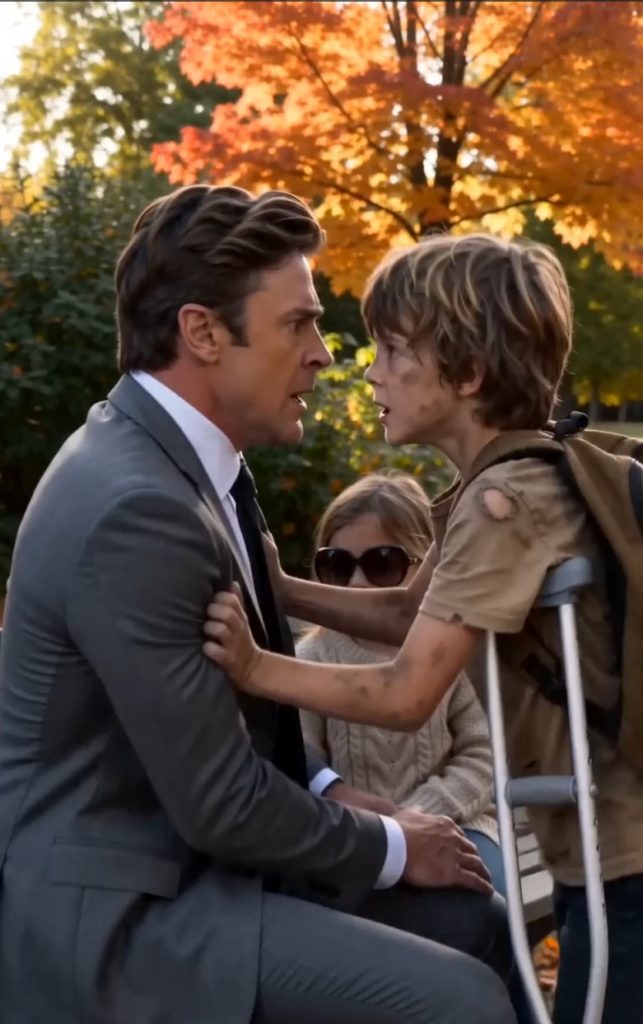
Daniel was brushing a leaf from her sleeve when the boy grabbed his arm.
He was about Mia’s age, maybe a year older, with messy brown hair, dirt on his cheeks, and a ragged tan shirt too thin for the weather. A huge brown backpack hung from one shoulder. In his other hand, he carried a white folding cane.
Not gently.
Like evidence.
Daniel stiffened. “What did you just say?”
The boy’s fingers dug into his suit sleeve.
His eyes were wild, but not confused.
“Your daughter isn’t blind.”
Mia did not move.
Daniel’s first instinct was anger. A strange child had run up to him in a public park, grabbed him, and said the one sentence no father of a sick child could hear calmly.
But something in the boy’s voice held him still.
“What?”
The boy leaned closer.
“I saw her look.”
Daniel glanced down at Mia. Her face remained turned toward the path, blank behind the dark lenses.
“How do you know this?” he asked, his voice low.
The boy swallowed.
“I sleep near your house.”
Daniel’s blood went cold.
“What did you see?”
The boy released his arm and pointed down the path.
A woman jogged in the distance, dark hair tied back, black athletic clothes moving smoothly through the gold light.
Daniel recognized her instantly.
His wife.
Natalie.
The boy’s voice dropped until it was almost lost beneath the leaves.
“It’s her,” he said. “She puts something in Mia’s food.”
Daniel stared at Natalie as she ran farther away, ponytail swinging, healthy and graceful and completely unaware that a filthy child with a stolen cane had just split Daniel’s life in half.
Then Mia’s small hand tightened around his wrist.
And for the first time in months, beneath the sunglasses, his daughter turned her face toward him.
Act II
Daniel Mercer had once believed money could protect a child.
He had learned, very slowly and very painfully, that money only built taller walls. It did not tell you who had keys.
Mia had been born into loss. Her mother, Rachel, died when Mia was two, leaving Daniel with a toddler who still reached for a woman who would never come through the nursery door again. For the first year after Rachel’s death, Daniel lived like a man underwater.
He went to work because people expected him to. He signed papers. He attended meetings. He wore expensive suits and answered questions while part of him stayed home, sitting beside Mia’s crib, listening to her breathe.
Then Natalie arrived.
She was Rachel’s old college friend, or so she said. Elegant, warm, patient. She brought soup when Daniel forgot to eat. She remembered Mia’s favorite stuffed rabbit. She knew how to make the little girl laugh on mornings when Daniel could not even make himself speak.
People called Natalie a blessing.
Daniel married her eighteen months later because grief had made him grateful to anyone who knew where the light switches were.
At first, Mia loved her.
She followed Natalie around the house with picture books. She wore the yellow hair ribbons Natalie bought her. She called her “Mama Nat” one night at dinner, and Daniel cried in the pantry where nobody could see.
Then came the accident.
A fall down the back stairs. Natalie said she had been in the kitchen when she heard the sound. Mia was found crying at the bottom, trembling, frightened, but without any visible injury that explained what came next.
Within weeks, she began bumping into furniture.
Then she stopped recognizing colors.
Then came the dark glasses, the doctors, the specialists, the words Daniel could barely hear.
Trauma response.
Visual processing disorder.
Possible progressive impairment.
Natalie handled everything.
She scheduled appointments. Managed medications. Spoke to doctors with perfect composure while Daniel sat beside Mia holding her hand, ashamed of how helpless he felt. When Daniel questioned a diagnosis, Natalie gently told him grief made him suspicious.
“You almost lost her,” she would say. “Your mind is looking for someone to blame.”
So Daniel blamed himself.
He blamed work. He blamed absence. He blamed the call he had taken upstairs the day Mia fell.
And all the while, Mia disappeared behind sunglasses.
She stopped drawing. Stopped dancing in front of the hallway mirror. Stopped running toward Daniel when he came home. Natalie said it was depression. The doctors said children adapted slowly.
But Daniel sometimes woke at night with the terrible sense that Mia was not adapting.
She was waiting.
The boy in the park said his name was Owen.
He spoke quickly, eyes darting toward the path where Natalie had gone.
He had been sleeping behind the garden wall of Daniel’s townhouse for nearly two weeks. Not because he wanted trouble. Because the warm vent near the garage kept him from freezing at night, and the hedge hid him from security cameras.
“I didn’t watch on purpose,” Owen said. “At first.”
Daniel pulled Mia closer. “What did you see?”
Owen looked at the little girl.
Mia’s fingers twisted into Daniel’s jacket.
“I saw her take off the glasses when your wife left the room,” Owen said. “She looked right at the window. Right at me.”
Daniel’s throat tightened.
“That doesn’t mean—”
“She put her finger to her mouth,” Owen interrupted. “Like this.”
He lifted one finger in front of his lips.
Mia began to shake.
Daniel felt it through her sweater.
Owen’s face changed. The urgency softened into something protective.
“She’s scared,” he whispered. “She knows.”
Daniel looked down.
“Mia?”
His daughter did not answer.
Owen lifted the white cane.
“She threw this out yesterday,” he said. “In the trash behind your garage. I took it because I thought maybe someone would believe me if I had it.”
Daniel stared at the cane.
It was Mia’s.
Her name was written near the handle in Natalie’s perfect black marker.
Mia Mercer.
Daniel’s voice came out rough.
“Why would she throw it away?”
Owen looked past him again, toward the path.
“Because it had a camera in it.”
Daniel went still.
The park seemed suddenly too bright, too open, too full of strangers who could not see the trap closing around them.
Then Natalie turned at the far end of the path and began jogging back.
Act III
Daniel did not run.
Every instinct in his body told him to carry Mia to the car and disappear. But Natalie was watching now. Even from a distance, he could feel the precision in her gaze.
She had always been good at reading rooms.
That was why he had mistaken control for care.
Owen stepped back. “She can’t see me with you.”
Daniel caught his sleeve.
“Don’t leave.”
The boy looked startled.
Adults, Daniel realized, had probably spent years telling him to leave.
“I know more,” Owen whispered.
“Then tell me.”
Owen hesitated, then reached into his backpack and pulled out a small plastic sandwich bag. Inside were folded papers, a broken memory card, and a prescription label peeled from something.
Daniel did not touch it.
He did not need to know the details yet. He only needed to know the pattern.
“She puts drops in Mia’s applesauce,” Owen said. “Sometimes juice. Mia spits it into napkins when she can. Your wife checks.”
Mia made a tiny sound against Daniel’s chest.
Not a cry.
A confession.
Daniel’s hand moved gently to the side of her face.
“Baby,” he whispered, “can you see me?”
The silence nearly killed him.
Then Mia nodded once.
Barely.
The world did not explode.
It narrowed to the weight of his daughter on his lap and the horrifying fact that she had been hiding her own sight from the man who loved her most.
“Why didn’t you tell me?” Daniel asked.
Mia’s lips trembled.
“Mama Nat said you’d go away too.”
Daniel closed his eyes.
Rachel had gone away.
That was the knife Natalie had used.
Owen’s voice became urgent again.
“She said if Mia told, you’d think Mia was broken and send her to the hospital forever. I heard it through the window.”
Daniel looked at Natalie. She was closer now, slowing her pace, smiling as if nothing in the world was wrong.
“What else?” Daniel asked.
Owen swallowed.
“She talks on the phone in the garden. She said the trust changes when Mia turns seven. She said if Mia is declared dependent, she can control it longer.”
Daniel felt the final piece slide into place.
Rachel’s trust.
He had barely thought of it in years because it had always been Mia’s, protected by Rachel’s father, untouchable until Mia came of age. But there were medical clauses. Dependency clauses. Guardianship provisions designed for tragedy.
Natalie had found them.
Of course she had.
“She’s not just making people believe Mia can’t see,” Owen said. “She’s making Mia believe no one will save her.”
Daniel’s jaw tightened.
Natalie reached them with a bright, breathless smile.
“There you are,” she said. “I turned around and thought I’d lost you two.”
Her eyes moved to Owen.
The smile stayed.
The warmth left.
“Who is this?”
Daniel looked up at his wife, seeing for the first time how carefully her concern arranged itself on her face.
“A boy who needed help.”
Natalie’s gaze dropped to the cane in Owen’s hand.
For half a second, her expression cracked.
Then she laughed softly.
“Mia, sweetheart, why does he have your cane?”
Mia went rigid.
Daniel felt it.
Owen saw it.
Natalie reached for the cane, but Daniel stood, lifting Mia with him.
“Don’t.”
The word was quiet.
Natalie stopped.
Her eyes flicked across his face, measuring what he knew.
“Daniel,” she said gently, “you’re frightening her.”
“No,” Daniel replied. “You are.”
Natalie’s face changed again.
This time, only Daniel could see it.
The mask did not fall.
It sharpened.
And Mia whispered the sentence that made Natalie’s smile disappear completely.
“She told me to pretend, Daddy.”
Act IV
The park did not go silent.
That was the strangest part.
Leaves still moved. Joggers still passed. A dog barked near the fountain. Somewhere, a child begged for one more turn on the swings.
But Daniel’s world had stopped.
Natalie stared at Mia.
“What did you say, sweetheart?”
Mia buried her face in Daniel’s shoulder.
Natalie stepped closer, lowering her voice into that soft, dangerous tone Daniel had heard in hospital rooms and court offices and late-night arguments he once blamed on stress.
“Mia is confused. She has been through a lot. Daniel, you know this.”
Owen lifted the cane.
“She’s not confused.”
Natalie’s eyes cut to him.
“You need to leave.”
“No,” Daniel said.
Natalie’s attention snapped back to her husband.
For the first time since he had known her, Daniel saw anger before she had time to perfume it.
“You are going to believe a homeless child over your wife?”
Daniel looked at Owen.
The boy stood in a torn shirt, clutching a dirty backpack and a cane no one had believed was evidence. He looked terrified.
But he had stayed.
“Yes,” Daniel said. “I am.”
Natalie laughed once.
It was sharp and ugly.
“You have no idea what you’re doing.”
“I’m starting to.”
She reached for Mia.
Daniel turned away.
Natalie’s face went pale with fury.
“That is my daughter.”
Mia lifted her head.
“No, I’m not.”
The words were small, but they landed with devastating force.
Natalie froze.
Daniel stared at Mia.
His daughter’s lips trembled, but she kept going.
“You said I had to call you Mom because Daddy was sad. You said if I didn’t love you, he’d leave like Mommy Rachel.”
Daniel’s eyes burned.
Natalie inhaled sharply.
“Mia, stop.”
But the child did not stop.
Maybe because Owen had spoken first.
Maybe because the autumn light was bright enough to remind her the world still had color.
Maybe because her father was finally holding her like he could hear.
“You made me wear the glasses,” Mia whispered. “You said if I looked at things, the doctors would know I was bad.”
Daniel pressed his cheek to her hair.
“You were never bad.”
Owen opened the plastic bag and handed Daniel the memory card.
“I took it from the cane before she threw it out,” he said. “It records sometimes. I think she forgot.”
Natalie lunged.
Not at Owen.
At the bag.
Daniel stepped back, and a passing man stopped near the path.
“Everything okay here?” he asked.
Natalie instantly changed.
Tears filled her eyes on command.
“My husband is having some kind of episode,” she said. “Our daughter is medically fragile, and this boy has been stalking our home.”
The man hesitated.
It was a believable performance.
Daniel knew because he had believed it for years.
Then Owen raised his voice.
“She keeps medicine hidden in a blue lunchbox in the garage freezer!”
Natalie turned white.
The man’s expression shifted.
Daniel saw it and understood the power of one specific detail. Lies float. Truth lands.
He took out his phone and called his attorney first.
Then Mia’s pediatric specialist.
Then the police.
Natalie stood very still through the calls, her face smoothing into something unreadable.
“You’ll regret this,” she said quietly.
Daniel looked at her.
“I already do.”
Her eyes flashed.
“I gave up my life for that child.”
Daniel’s voice hardened.
“No. You built one around her.”
A police cruiser arrived twelve minutes later.
Natalie greeted the officers with trembling hands and perfect tears. She spoke about Daniel’s grief, Owen’s instability, Mia’s fragile condition. She used every word that had worked before.
Then Mia removed her sunglasses.
Her eyes squinted against the afternoon light.
She looked directly at the female officer and whispered, “I can see your badge.”
The officer knelt.
Natalie stopped crying.
And for the first time, nobody looked at Daniel’s wife when she began explaining.
They looked at Mia.
Act V
The investigation did not end in the park.
It began there.
That was the part Daniel would remember later, when people asked how he missed it, how a father could live inside the same house and not see what was happening to his own child.
He would remember the leaves.
The golden path.
The dirty boy gripping his sleeve.
The awful truth that evil did not always enter a home looking like danger. Sometimes it came with soup after a funeral, with gentle hands, with a voice that said, Let me help.
Mia was taken to the hospital that afternoon.
Not the hospital Natalie had chosen. A different one, with different doctors, different records, and a child advocate who spoke to Mia without Natalie in the room.
By midnight, Daniel learned enough to feel sick.
Mia’s vision was not gone.
It had been interfered with, frightened, blurred, and buried beneath fear. Some symptoms had been chemically induced. Others had been trained into her through months of threats, isolation, and rewards for obedience.
The doctors used careful language.
Daniel did not.
His wife had harmed his daughter.
Natalie was arrested two days later after investigators searched the house. They found the blue lunchbox where Owen said it would be. They found altered medical notes. They found emails to a private evaluator about declaring Mia permanently dependent before her seventh birthday.
They found deleted footage from the cane’s hidden camera.
Not all of it was gone.
One clip showed Mia alone in her room, lifting her sunglasses and reading the title of a picture book under her blanket.
Another showed Natalie entering, smiling, and taking the book away.
The worst evidence was not loud.
It was ordinary.
A child learning to hide sight in her own bedroom.
Owen disappeared the night after the park.
Daniel looked for him.
Police looked too, but lightly, the way systems often look for children no one has claimed. Daniel did not accept that. He printed flyers. Walked under bridges. Checked shelters. Returned to the vent near his own garage and found a flattened patch of cardboard, a granola wrapper, and a pencil worn down to nothing.
Mia was the one who found the clue.
Three weeks after the hospital, she sat beside Daniel in the kitchen, wearing no sunglasses, slowly coloring a tree with orange leaves. Her hand still shook sometimes when Natalie’s name was mentioned, but she was looking.
Looking at everything.
“Daddy,” she said.
Daniel turned.
She pointed to the corner of the drawing.
There, in tiny letters, Owen had written a name on the back of a paper he must have left in the yard.
Owen Bell. St. Mark’s shelter. Ask for Ruth.
Daniel found him the next morning.
Owen was sitting on the steps behind the shelter, backpack beside him, trying to look as if he had not been waiting.
“You shouldn’t be here,” Owen said.
Daniel sat next to him.
“You saved my daughter.”
Owen stared at the pavement.
“I just told you what I saw.”
“That is not a small thing.”
The boy shrugged, but his eyes filled.
“She looked at me through the window,” he said. “One time. Like she wanted to ask for help but couldn’t. I know what that feels like.”
Daniel did not push for more.
Children who have lived too long in survival do not hand over their pain just because an adult finally asks politely.
But Ruth at the shelter told him enough.
Owen’s mother had died the year before. His father was unknown. He ran from a group home after older boys kept taking his things and staff kept calling it adjustment. He had been sleeping wherever warmth could be found.
A vent.
A laundry room.
A park bathroom if it stayed unlocked.
Daniel filed the paperwork within the week.
Not adoption. Not immediately. Life was not a movie where trauma became family because adults felt grateful. But emergency foster placement was possible, then kinship-style guardianship, then something slower and more honest.
Owen moved into the guest room before Thanksgiving.
The first night, he slept on top of the covers with his backpack still on.
Daniel did not force him under the blanket.
The second night, Mia left a flashlight outside his door.
The third, he asked if the window locked.
By Christmas, he was sitting at the kitchen table eating pancakes while Mia read aloud from a book with large print, not because she needed it, but because it made her feel brave to choose the words herself.
Natalie’s case dragged on.
Her lawyers argued stress, grief, misunderstanding, medical confusion. But the evidence was too heavy, and Mia’s voice, once freed, became steadier each time she used it.
In court, Daniel sat behind his daughter while she answered questions with a support dog sleeping at her feet.
When asked why she had pretended not to see, Mia looked at the judge.
“Because I thought if I told the truth, nobody would want me.”
Daniel lowered his head.
Owen, sitting beside him in a clean sweater that still looked strange on his thin shoulders, whispered, “They want you.”
Mia heard him.
She smiled.
Small.
Real.
The judge removed Natalie from any legal claim over Mia and ordered a full review of every doctor, evaluator, and financial document she had touched. Rachel’s trust was locked down under independent supervision. Daniel resigned from two boards and cut his work hours in half.
People called it a sacrifice.
Daniel knew better.
A father does not sacrifice time with his child.
He returns what was stolen.
One year later, the park looked almost the same.
Orange leaves. Yellow trees. Bright path. Benches dusted with autumn.
But Mia was not sitting still on Daniel’s lap anymore.
She was running ahead, laughing as Owen tried to catch falling leaves before they touched the ground. She wore no sunglasses. Her beige sweater had been replaced by a red coat she had chosen because, as she told everyone, red was impossible to ignore.
Daniel watched from the same bench.
A white folding cane rested beside him.
They had kept it.
Not as a symbol of blindness.
As proof that someone had looked closely enough to see what was wrong.
Owen dropped onto the bench, breathless.
“Mia cheats,” he said.
Mia spun around. “Leaves don’t have rules.”
Daniel laughed before he could stop himself.
It surprised him, that laugh.
For a long time, joy had felt like a room he was not allowed to enter until every wound healed. But children know better. They leave the door open and run in anyway.
Mia came back and climbed onto the bench beside him.
Not his lap anymore.
Beside him.
That mattered too.
She picked up the cane and ran her fingers over her name still written near the handle.
“Can we give this to Owen?” she asked.
Owen blinked.
“Why me?”
“Because you carried it when nobody listened.”
The boy looked down.
Daniel saw him fighting tears with the fierce embarrassment of a child who had learned tenderness could be dangerous.
Finally, Owen took the cane.
“I didn’t know if he’d believe me,” he said quietly.
Daniel looked at him.
“I almost didn’t.”
Owen nodded.
“But you did.”
Daniel thought of Natalie jogging under the golden trees. The smile. The lies. His own blindness, made not by darkness but by trust placed in the wrong hands.
Then he looked at Mia, watching a leaf spiral from the branch above them.
“Yes,” he said. “Because you saw what I couldn’t.”
Mia reached for her father’s hand.
Owen leaned the cane against the bench between them.
Around them, autumn kept falling gently, covering the path not like an ending, but like the world making room for something new.
And this time, when Mia looked toward the light, no one told her to pretend she couldn’t see.