Act I
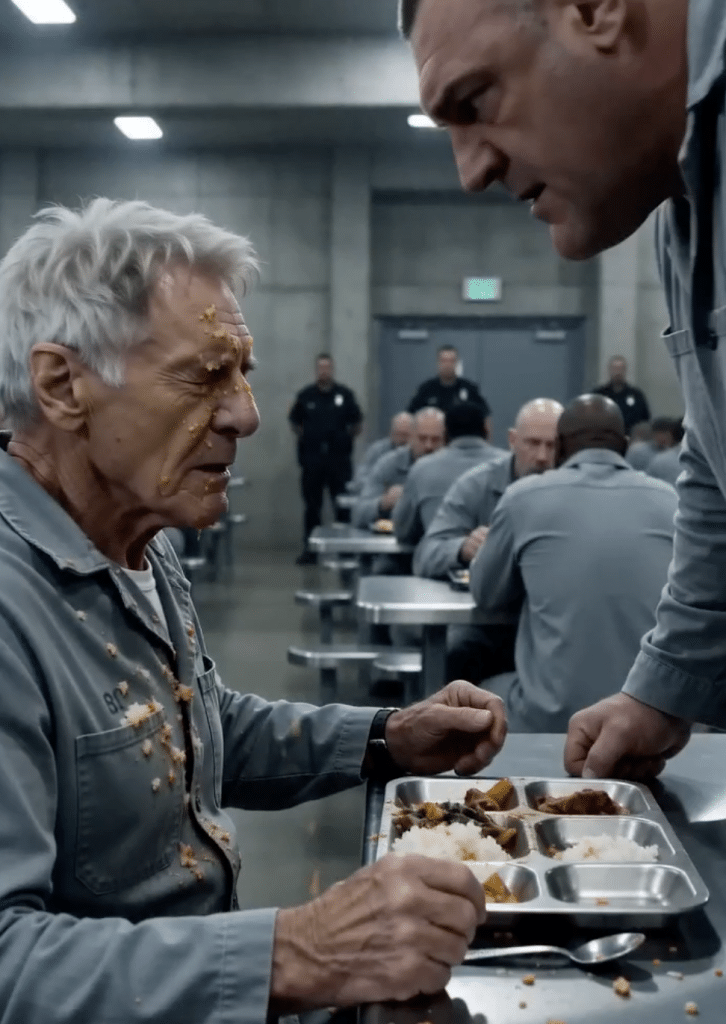
The tray hit the metal table so hard the sound cracked through the cafeteria.
Mashed potatoes slid across the steel surface. Gravy splattered onto the old man’s prison jumpsuit. A chunk of bread bounced off his shoulder and dropped into his lap.
For one long second, nobody breathed.
Then the big inmate smiled.
He was built like a wall, bald-headed and thick-bearded, with arms that strained against the sleeves of his gray uniform. The other prisoners called him Briggs. Not because it was his real name, but because nobody cared what his real name was after he broke a man’s jaw during his first week inside.
He leaned over the elderly inmate, casting a shadow across the table.
“Dinner’s over.”
The old man did not flinch.
He sat with his back straight, shoulders narrow beneath the loose prison fabric, thinning gray hair catching the cold fluorescent light. His inmate number, 0133, was stitched across his chest.
Food dripped from his cheek.
Slowly, calmly, he raised one wrinkled hand and wiped his eyes.
The room waited for fear.
It did not come.
The old man blinked once, looked up at Briggs, and asked, “Finished?”
A few inmates turned away, expecting the explosion.
Briggs’s smile vanished.
He slammed his hand down and grabbed the old man’s wrist, pinning it to the table with enough force to rattle the plastic cups nearby.
“No way.”
The old man looked at the hand around his wrist.
Then at Briggs.
His expression changed so slightly that most men missed it. But the lifers noticed. Men who had spent decades reading the smallest shifts in a room felt something move beneath the old man’s stillness.
He was not trapped.
He was measuring.
“You asked twice,” the old man said. “That was polite enough.”
Briggs tightened his grip.
A vein rose in his neck. His teeth clenched. He leaned his entire weight down, trying to bend the old man’s wrist flat against the table.
Nothing happened.
The old inmate’s arm did not shake. His breathing did not change.
Briggs pushed harder.
Still nothing.
The cafeteria grew quieter, table by table, until even the spoons stopped scraping against trays.
Then the old man stood.
He did not twist Briggs’s arm. He did not swing. He did not shout for a guard.
He simply rose from the bench with slow, disciplined control, and somehow the larger man stepped back before anyone understood why.
A guard rushed from the wall, one hand near his radio.
“Break it up!”
Then he saw the old man’s face.
His boots stopped dead against the concrete.
His eyes widened.
The guard straightened without meaning to, as if some forgotten command had passed through his spine.
And in a voice half shock, half reverence, he whispered, “Warden Kane?”
The words moved through the cafeteria faster than any alarm.
Warden Kane.
Briggs took one step back.
Then another.
Because even men who had never met him had heard stories about Elias Kane.
And every story ended the same way.
You did not survive Blackridge by crossing the man who once controlled its keys.
Act II
Elias Kane had not always worn gray.
For twenty-three years, he wore a pressed black suit, polished shoes, and a silver badge clipped neatly to his belt. He walked the halls of Blackridge Correctional Facility like the building itself recognized his footsteps.
Back then, guards lowered their voices when he passed.
Inmates stood straighter.
Not because Kane was cruel. Cruel wardens were common enough. They lasted a while, made enemies, and eventually learned that fear is expensive to maintain.
Kane was different.
He was fair.
That made him far more dangerous.
He remembered names. He read every incident report. He knew which guards smuggled contraband, which inmates were being used, which kitchen workers watered down soup, and which young men were one humiliation away from doing something they could never undo.
He believed prison was punishment, not a hunting ground.
That belief made him hated by people on both sides of the bars.
To the inmates, he was the man who saw too much.
To the crooked officers, he was a locked door.
And to Deputy Warden Malcolm Voss, he was an obstacle.
Voss had spent years smiling beside Kane in photographs, shaking hands with county officials, praising reform programs he secretly tried to sabotage. He understood the prison in a way Kane refused to accept. To Voss, every desperate man inside Blackridge was a business opportunity.
Protection could be sold.
Silence could be sold.
Medical access could be sold.
Violence could be arranged, then blamed on the natural order of prison life.
Kane suspected him.
Then he proved it.
One winter night, after months of quiet investigation, Kane found the ledger.
Names. Dates. Payments. Guard badge numbers. Transfers approved for inmates who were inconvenient. Reports rewritten before reaching the state office.
But the last page was what changed everything.
It listed judges.
Sheriff’s deputies.
A state senator.
Blackridge was not corrupt around the edges.
It was rotten through the foundation.
Kane made one mistake.
He told one person he trusted that he was going to testify.
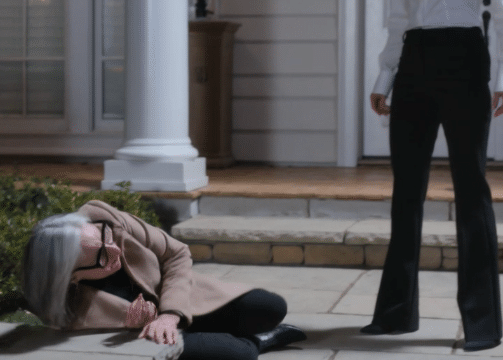
Three days later, a guard was found dead in a maintenance corridor, and the murder weapon was discovered inside Kane’s office safe.
The ledger vanished.
The cameras failed.
Witnesses remembered things they had not seen.
By sunrise, Elias Kane was no longer the warden of Blackridge.
He was inmate 0133.
At trial, Voss sat behind the prosecution with wet eyes and a black tie, playing the grieving public servant. He called Kane a mentor. A friend. A man he never imagined capable of such betrayal.
The jury took six hours.
Kane received life.
His wife, Margaret, died before his first appeal was denied. His daughter, Claire, stopped visiting after the third year, not because she stopped loving him, but because every visit left her shaking in the parking lot afterward.
Kane told her not to come back until she had something worth risking.
She cried behind the glass.
He placed his palm against it.
“Live,” he told her. “That’s an order.”
So she did.
She became an attorney.
Then a prosecutor.
Then the kind of woman who read old case files the way her father used to read incident reports, looking for the lie hiding between the clean sentences.
And for seventeen years, Kane waited.
Not passively.
Never passively.
He learned the prison from the other side. He watched which guards still worked under Voss’s influence. He memorized routines, favors, debts, quiet alliances. He protected younger inmates when he could, stopped conflicts before they became headlines, and never once asked to be treated like the man he used to be.
That restraint became its own legend.
Some called him Old Man 0133.
Some called him the Ghost Warden.
Some said he had lost everything.
They were wrong.
He had kept one thing.
The truth.
And on the day Briggs dumped food across his face, Kane already knew the cafeteria confrontation was not random.
It was a message.
Because Malcolm Voss had just returned to Blackridge.
Not as deputy warden.
As the new state commissioner.
And Kane knew why.
The missing ledger had finally resurfaced.
Act III
Briggs had been paid in cigarettes, extra meat, and promises.
He was not smart enough to understand the whole game, but he understood orders. Make the old man react. Make him swing first. Make him look unstable in front of cameras. Get him moved to isolation before tomorrow morning.
Tomorrow was the parole review.
Not for release.
Kane had stopped believing in mercy from the system that buried him.
Tomorrow’s hearing was different. It was a judicial evidence review, triggered by a sealed filing from the state attorney’s office. Claire Kane had found a witness who had been missing for sixteen years.
A former guard named Daniel Mercer.
Mercer had been young when Kane was framed. Too young, too scared, too deep in Voss’s pocket to admit what he knew. He signed a false statement, took the transfer, and disappeared into another county with enough money to start over.
But guilt is patient.
It does not always scream. Sometimes it waits until a man has children of his own and realizes he cannot teach them honesty while living off a lie.
Mercer contacted Claire in secret.
He had proof.
Not the original ledger, but something almost as powerful: a copy of a copy, saved on an old drive and hidden inside a hollowed-out Bible in his mother’s attic.
It showed payments tied to Voss.
It showed guard assignments altered before the murder.
And it showed that the weapon found in Kane’s safe had been logged in evidence storage two hours after Kane was already in state custody.
The timeline was impossible.
Someone had planted it after the arrest.
Claire moved fast.
Too fast for Voss to stop the filing, but not too fast for him to send a warning.
That warning was Briggs.
Now Briggs stood in the cafeteria, no longer smiling, while the guard who recognized Kane kept staring like he had seen a ghost step out of a photograph.
The guard’s name was Adam Pike.
Kane remembered him as a boy in a wrinkled uniform, nervous on his first day, standing outside the west gate while rain soaked through his cap. Kane had told him to go home if he wanted power and stay if he wanted responsibility.
Pike had stayed.
He had risen through the ranks without ever becoming loud.
And now he looked at Kane with the kind of respect that made the room even more uneasy.
“Sir,” Pike said before he could stop himself.
A murmur ran through the inmates.
Sir.
No one called inmates sir.
Kane wiped gravy from his sleeve with a napkin and glanced at Briggs.
“Sit down,” he said.
Briggs hesitated.
Kane did not raise his voice.
“Now.”
The big man sat.
The inmates stared.
Pike reached for his radio, but Kane gave the smallest shake of his head.
Not yet.
That was when Briggs made his second mistake.
He muttered, “Voss said you were just an old fraud.”
The name hit the room like a dropped blade.
Pike heard it.
So did two other guards.
So did half the cafeteria.
Kane turned slowly.
“What did Commissioner Voss say?”
Briggs realized too late that fear had made him speak out of turn.
His mouth opened, then closed.
Kane leaned closer, calm as winter.
“You came to this table because someone sent you,” he said. “You thought age made me weak. You thought silence meant surrender.”
Briggs’s face tightened.
Kane looked toward the cameras in the ceiling.
“Remember this, Mr. Briggs. The men who use you will not protect you. They never do.”
Pike stepped closer.
“Kane,” he said quietly, no longer using the old title. “What’s happening?”
Kane looked at him.
For the first time all day, his eyes showed something deeper than discipline.
Urgency.
“Lock down the evidence room,” Kane said. “Right now.”
Pike’s face changed.
“Why?”
“Because if Voss is inside this building, he is not here for me.”
A siren chirped once in the distance.
Then stopped.
The cafeteria doors opened.
Commissioner Malcolm Voss entered with three suited officials, two guards, and the same polished smile he had worn at Kane’s trial.
He looked older now. Softer at the jaw. Richer in the suit.
But his eyes were unchanged.
He glanced at the spilled food, the silent inmates, Briggs sitting pale at the table, and Kane standing with inmate number 0133 on his chest.
Voss smiled.
“Elias,” he said warmly. “Still causing trouble in my prison?”
Kane did not answer.
Because behind Voss, a young woman in a dark legal suit stepped into the cafeteria.
Claire Kane.
His daughter.
And she was holding the file that could finally tear Blackridge open.
Act IV
Claire had her father’s eyes.
That was the first thing the cafeteria noticed.
The second was that she was not afraid of Malcolm Voss.
She walked past the guards, past the suited officials, past the inmates pretending not to stare, and stopped ten feet from her father.
For seventeen years, she had imagined this moment.
In some versions, she ran to him.
In others, she broke down.
In the worst versions, she arrived too late and found another locked door, another excuse, another signed paper saying the truth would have to wait.
But standing there under the fluorescent lights, with food still drying on his prison uniform, Elias Kane gave her the smallest nod.
Not as a prisoner.
As her father.
As if to say: steady.
So Claire steadied.
“Commissioner Voss,” she said, “I’m here with a court order.”
Voss smiled without warmth.
“For what?”
“To preserve all surveillance footage, movement logs, medical records, disciplinary reports, and evidence-room access records connected to inmate 0133.”
The cafeteria went silent again.
Voss chuckled.
“You came all this way for paperwork?”
“No,” Claire said. “I came because Daniel Mercer gave sworn testimony at 9:12 this morning.”
Voss’s smile remained.
His eyes did not.
Claire opened the file.
“He admitted he falsified his statement in my father’s case under direct pressure from you. He also produced records showing payments routed through a private corrections consulting firm you controlled.”
One of the suited officials shifted uncomfortably.
Voss lowered his voice.
“You should be very careful.”
Claire stepped closer.
“I have been careful for seventeen years.”
Kane watched his daughter, and something proud and painful moved across his face.
He had missed her high school graduation. Her first courtroom argument. Her wedding that never happened because she said she could not celebrate under her father’s shadow while pretending the shadow was not there.
He had missed so much.
But he had not missed this.
Voss turned to Pike.
“Remove her.”
Pike did not move.
The commissioner’s expression hardened.
“Captain Pike, that was an order.”
Pike looked at Kane.
Then at Claire.
Then at Briggs, whose face had gone gray with the realization that the man who sent him had walked into the room and might leave him behind.
“No, sir,” Pike said.
The words were quiet.
They cracked the room open.
Voss stared at him. “Excuse me?”
Pike straightened.
“I said no, Commissioner.”
Other guards looked at him, stunned. One by one, two of them lowered their hands from their belts. Not dramatically. Not heroically. Just enough to show they were no longer sure whose orders mattered.
Voss saw control slipping.
So he did what men like him do when power stops obeying.
He reached for fear.
“Every inmate in this room will return to their cells immediately,” he shouted. “Any refusal will be treated as a security threat.”
Nobody moved.
Not because they were brave.
Because Elias Kane raised one hand.
A simple gesture.
Stop.
And the prison listened.
Voss saw it. The guards saw it. Claire saw it.
The former warden in inmate gray still held more authority in Blackridge than the commissioner in a tailored suit.
Kane turned to Briggs.
“Tell them who sent you.”
Briggs’s throat bobbed.
Voss snapped, “Quiet.”
Kane did not look away from Briggs.
“No one here can protect you from the truth,” he said. “But the truth may protect you from him.”
Briggs stared at the table.
Then, in a voice rough with panic, he said, “Voss’s man came last night. Guard named Halpern. Said if I got Kane sent to isolation, my next transfer would disappear. Said I’d get privileges. Said the old man just needed to look violent before the hearing.”
Voss laughed.
It sounded thin now.
“A desperate inmate inventing stories.”
Claire lifted her phone.
“Recorded,” she said.
Then Captain Pike spoke.
“So is the cafeteria audio.”
Voss turned on him.
Pike’s face was pale, but set.
“Kane upgraded the system years ago,” he said. “Every table within thirty feet of a conflict zone has directional audio. You approved the budget last month without reading the original specs.”
For the first time, Kane almost smiled.
Voss’s carefully groomed composure cracked.
Claire stepped aside as two state investigators entered the cafeteria.
Not prison guards.
Not men Voss commanded.
Investigators.
One of them approached Pike and handed him a document.
“Captain, by emergency order, Commissioner Voss is suspended pending inquiry. We’ll need access to the administration wing.”
Voss backed away.
“This is political theater.”
Kane finally spoke to him.
“No, Malcolm. This is procedure.”
That word landed hardest of all.
Procedure had been Kane’s weapon when he was warden. Not cruelty. Not rage. Not revenge.
Procedure.
The kind of patient, documented truth that corrupt men mocked until it closed around them.
Voss looked at the inmates, searching for fear.
He found witnesses.
He looked at the guards, searching for obedience.
He found shame.
He looked at Kane, searching for the broken old man he had tried to manufacture for seventeen years.
He found the warden.
The investigators escorted Voss toward the doors.
As he passed Kane, he leaned close enough to whisper.
“You think this gives you back your life?”
Kane looked at Claire.
Then back at Voss.
“No,” he said. “But it gives my daughter back her father’s name.”
Voss had no answer.
And when the cafeteria doors shut behind him, the room did something no one expected.
It stayed silent.
Not out of fear.
Out of respect.
Act V
Elias Kane did not walk out of Blackridge that day.
Justice, he knew better than most, rarely moved at the speed pain deserved.
There were hearings. Motions. Reviews. Emergency depositions. Old boxes taken from storage. Former officers called back from retirement. Men who had once lied under oath suddenly remembering that memory could become negotiable when prison time was attached.
But the first door had opened.
And this time, Voss could not lock it again.
Three weeks later, a judge vacated Kane’s conviction pending a full review. Two months after that, the charges were dismissed with prejudice. The state issued a formal statement written in careful language, the kind that tried to sound responsible without admitting how many people had looked away.
Claire read it once, then threw it in the trash.
Her father found that amusing.
“You wanted an apology,” he said.
“I wanted honesty.”
Kane looked out the window of the small apartment where he was staying while the world argued about compensation, lawsuits, pensions, and public disgrace.
“Honesty is usually shorter,” he said.
Claire stood beside him.
Outside, morning light touched the street. Ordinary people walked dogs, carried coffee, loaded groceries into cars. The simple freedom of it seemed almost indecent after seventeen years of walls.
Kane had been offered a hotel suite by the state.
He refused.
He had been offered a press conference.
He refused that too.
The only thing he asked for was a quiet breakfast with his daughter.
They went to a diner two towns away, where no one knew his face and the waitress called him honey without recognizing history sitting in booth four.
Claire ordered pancakes because she remembered he used to make them badly on Sundays.
Kane ordered black coffee and eggs.
For a while, neither of them said much.
Then Claire reached into her bag and placed something on the table.
A badge.
His old warden’s badge.
The real one.
Not the ceremonial replacement the department wanted to give him. This was the one Margaret had kept hidden after his arrest, wrapped in a scarf at the back of a closet. Claire had found it after her mother died and kept it through every appeal.
Kane stared at it.
His hand did not move.
“I don’t know if you want it,” Claire said.
He picked it up slowly.
The metal was dull now. Scratched at the edges. Smaller than it had felt when he wore it.
For years, he had imagined that seeing it again would hurt.
It did.
But not in the way he expected.
It hurt because Margaret had kept it.
Because Claire had carried it.
Because a life can be stolen by liars and still leave behind people stubborn enough to guard the pieces.
He closed his fingers around the badge.
“Thank you,” he said.
Claire’s eyes filled, but she smiled.
“You’re welcome, Warden.”
He looked up.
For the first time in years, the title did not sound like a wound.
Back at Blackridge, the cafeteria changed after that day.
Not completely. Prisons do not become gentle because one truth survives. But something shifted.
Captain Pike became acting warden during the investigation. He reopened cases Kane had flagged years earlier. He removed guards tied to Voss. He restored programs that had been cut for profit and called security risks by men who profited from chaos.
And above the entrance to the mess hall, he placed a small plaque.
Not with Kane’s name.
Kane refused that.
Instead, it read:
Authority without integrity is just another locked door.
Briggs was transferred before he could become a target. He testified against Halpern and Voss’s network. He did not become noble overnight. Men do not transform that easily. But before he left, he asked to speak to Kane.
They met in a monitored room with Captain Pike present.
Briggs sat across from the old man, shoulders hunched, beard trimmed short now, all that cafeteria arrogance gone.
“I thought you were just some old guy,” he muttered.
Kane looked at him.
“I was.”
Briggs frowned.
Kane leaned back.
“That was enough.”
Briggs looked down at his hands.
“I’m sorry about the tray.”
Kane studied him for a moment.
Then nodded once.
“Be sorry about being useful to cruel men. The tray was just gravy.”
It was the closest thing to forgiveness Briggs received.
It was also more than he expected.
Months later, the official review concluded what Claire had already known. Elias Kane had been framed. Malcolm Voss had orchestrated the cover-up. The dead guard’s case was reopened, and the state began tracing the corruption that had spread through Blackridge like mold behind a painted wall.
Voss lost his office first.
Then his allies.
Then his freedom.
When reporters asked Kane what punishment he wanted for the man who stole seventeen years from him, he gave the only answer that sounded like him.
“I want the record complete.”
Not revenge.
Record.
Because revenge burns hot and fades.
A record remains.
On the day Elias Kane returned to Blackridge for the final time, he did not enter as an inmate.
He wore a simple dark suit. No badge. No title. Just an old man with careful posture and his daughter walking beside him.
Captain Pike met them at the gate.
For a second, both men stood quietly.
Then Pike straightened.
“Warden Kane.”
Kane gave him a tired look.
“Captain.”
But he did not correct him.
They walked to the cafeteria.
The tables were clean. The fluorescent lights still hummed. Men in gray still sat with their trays, voices low beneath the watchful presence of guards.
At one table, near the center, Kane stopped.
The same table.
The place where food had slid across metal, where a bully had mistaken calm for weakness, where one guard’s shocked whisper had pulled a buried name back into the light.
Claire stood beside him.
“Are you all right?” she asked.
Kane looked around the room.
He saw what he had lost.
He saw what had survived.
Then he placed his hand gently on the table.
“I spent years thinking this place took my life,” he said. “But it only held it for a while.”
Claire slipped her arm through his.
“And now?”
Kane looked toward the door, where sunlight waited beyond the last checkpoint.
“Now I’m finished.”
They walked out together.
No applause followed them. Kane would have hated that. No speeches. No cameras. No dramatic goodbye from the men at the tables.
Only silence.
But this silence was different from the one that filled the cafeteria when Briggs slammed down the tray.
That silence had been fear.
This one was recognition.
At the gate, Kane paused and looked back once at the concrete walls, the razor wire, the place that had tried to turn him into a number.
For seventeen years, that number had been stitched across his chest.
But it had never reached his name.
Claire opened the car door for him.
Kane gave her a look.
“I can open my own door.”
She smiled.
“I know.”
He got in anyway.
As they drove away from Blackridge, the prison grew smaller in the rearview mirror until it became just another hard shape against the horizon.
Claire glanced at him.
“What do you want to do first?”
Kane looked at his daughter, at the road, at the impossible brightness of an ordinary afternoon.
For once, no procedure waited.
No report needed signing.
No corrupt man required watching.
No locked door stood between him and the rest of his life.
“Breakfast,” he said.
Claire laughed.
“You already ate.”
Kane looked out the window, almost smiling.
“Then we’ll call it dinner.”
And somewhere behind them, in a cafeteria where men still whispered about the day the old inmate stood up, the story had already begun changing.
Not into a legend of violence.
But into something rarer.
A story about a man who lost power, lost freedom, lost years, and still kept the one thing no prison could confiscate.
Command of himself.