Act I
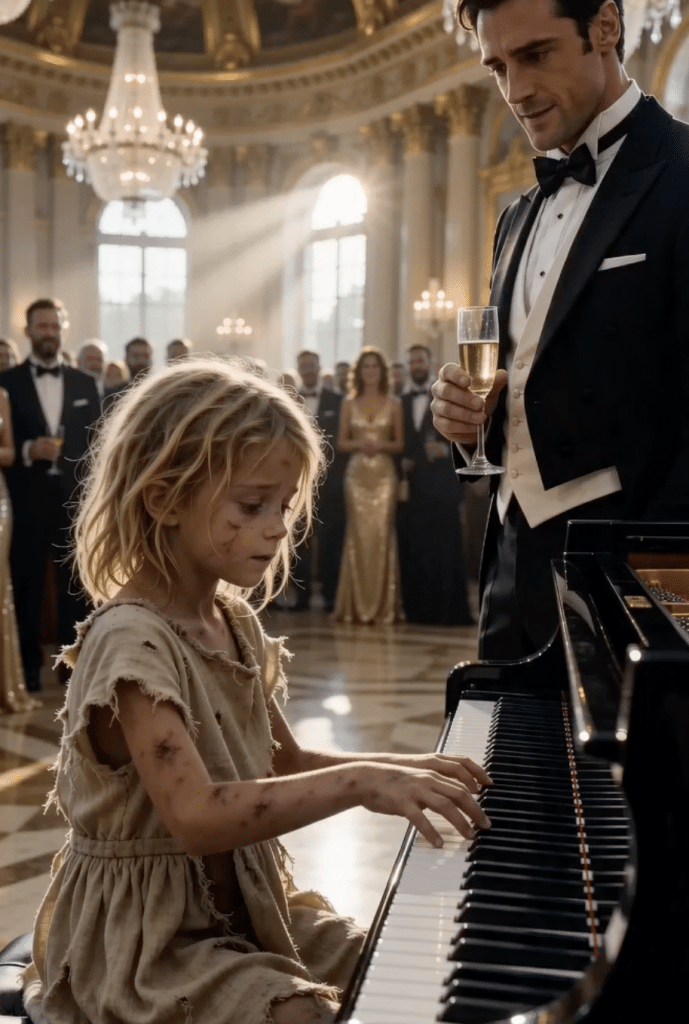
The little girl’s feet did not touch the pedals.
That was the first thing Sebastian Vale noticed.
Not the torn dress. Not the dirt on her cheeks. Not the way the ballroom guests laughed when she climbed onto the piano bench as if she belonged beneath chandeliers and gold molding.
Her feet.
Bare, small, and cold against the polished marble floor.
The black grand piano stood at the center of the palace hall, gleaming under crystal light. Around it, women in gold sequined gowns held champagne flutes and men in tuxedos watched with the amused cruelty of people who believed poverty was entertainment when it wandered too close to luxury.
The child looked up at Sebastian.
“Can I play for a plate of food?”
The laughter came quickly.
A woman near the staircase covered her mouth with jeweled fingers. An older man chuckled into his glass. Someone whispered, “Where did she even come from?”
Sebastian Vale stood beside the piano in a black tuxedo and white waistcoat, one hand wrapped around a glass of champagne he had barely touched. He was thirty-six, handsome, powerful, and used to rooms becoming quiet when he entered them.
But this room was laughing at a hungry child.
And somehow, he laughed with them.
Not loudly.
Just enough.
“This isn’t a shelter,” he said.
The girl flinched.
Only for a second.
Then she placed both dirty hands on the keys.
The guests laughed harder.
Sebastian turned away, already bored by the interruption.
Then the first note sounded.
It was soft.
Too soft for the size of the ballroom.
But it moved through the hall like a candle being lit in a tomb.
The laughter stopped.
The girl played with her head bowed, messy blonde hair falling around her face. Her fingers were thin, almost fragile, but they knew the keys with impossible certainty. The melody began like a lullaby, then opened into something aching and grand, a waltz that seemed to remember joy only because it had lost it.
Sebastian’s glass slipped slightly in his hand.
He knew that song.
No.
He had written part of that song.
Years ago.
For a woman no one in that ballroom was allowed to mention anymore.
The girl reached the bridge, and Sebastian’s face drained of color.
Because that bridge had never been written down.
Only one person had ever known it.
He stepped toward the piano.
“Wait.”
The girl kept playing.
Sebastian’s voice broke through the music.
“Who taught you that song?”
Her fingers stopped.
The final note trembled under the chandeliers, fading into a silence so complete even the champagne glasses seemed afraid to clink.
The girl looked up at him.
Her eyes were blue.
Exactly the same blue.
“My mother,” she said. “She said she played it here.”
Sebastian gripped the edge of the piano.
The ballroom around him blurred.
“What is your mother’s name?”
The girl swallowed.
“Clara Moreau.”
A woman in gold gasped.
Someone dropped a glass.
And Sebastian Vale realized the starving child at his piano had just spoken the name of the woman his family had buried alive in scandal eight years ago.
Act II
Clara Moreau had arrived at Vale House with one suitcase and a recommendation letter folded into fourths.
She was nineteen then, hired as a junior accompanist for the winter music program Sebastian’s mother used to host in the ballroom. The Vale family collected artists the way other families collected paintings: beautifully, publicly, and with just enough distance to make sure everyone remembered who owned the walls.
Clara was not like the others.
She did not flatter donors. She did not laugh too loudly at rich men’s jokes. She played as if every note had a spine.
Sebastian noticed her on the third evening.
He had wandered into the ballroom after a board dinner, half-drunk on boredom and expensive wine, and found her alone at the piano. She was playing barefoot, her shoes abandoned under the bench, her dark dress plain against the black lacquer.
“You’re not supposed to play that one,” he said.
She did not stop.
“Then you should lock the piano.”
He smiled despite himself.
The song she played was unfinished. His song. A private composition he had started after his mother died and never had the courage to complete. He had left the sheet music in the piano bench, certain no one would care enough to read it.
Clara cared.
Worse, she understood it.
“You stop before the turn,” she said when she finished.
“What turn?”
“The part where grief either becomes beautiful or starts lying.”
No one had spoken to Sebastian like that in years.
By spring, he was in love with her.
Not publicly. The Vale family did nothing honestly if it could first be filtered through reputation. Sebastian’s father, Malcolm Vale, was still alive then, and Malcolm believed music was useful only when it raised money.
“A pianist is not a partner,” he said when he found out. “She is atmosphere.”
Sebastian argued.
Then weakened.
That was his first sin.
Clara vanished three months later.
The story was clean enough for newspapers and dirty enough for society to enjoy. A missing emerald necklace. A forged check. A servant’s daughter with “ambition beyond her station.” Malcolm Vale paid to make the matter disappear quietly, which meant Clara disappeared loudly enough for everyone important to hear but not loudly enough for anyone to question.
Sebastian found a note in his room.
It said only:
You believed him faster than you believed me.
He told himself she had written it in anger.
He told himself she would come back.
He told himself many things men tell themselves when cowardice wants to dress as confusion.
She never returned.
The unfinished waltz remained in the piano bench for one week after she left. Then Sebastian burned it.
Or thought he did.
Now, eight years later, her daughter sat at the same piano playing the bridge Clara had invented in secret.
The girl’s name was Elise.
She said it softly, as if names were things that could be taken.
“Elise Moreau.”
Sebastian stared at her, trying not to calculate years in front of a room full of guests.
Eight years.
The same blue eyes.
The same slight tilt of the chin.
The same refusal to beg even while starving.
A cold thought entered him and would not leave.
“Where is Clara?” he asked.
Elise looked down at the keys.
“At the clinic near the river.”
“Is she sick?”
The child nodded.
“She said if I couldn’t wake her, I should come here. She said to play the song.”
Sebastian’s chest tightened.
Around them, the guests had stopped pretending not to listen.
His cousin Lydia stepped forward in a gold gown, her smile sharp and controlled.
“Sebastian,” she said quietly, “this is clearly some kind of trick.”
Elise turned at the sound of Lydia’s voice.
Her whole body went rigid.
Sebastian saw it.
So did Lydia.
The child whispered, “That’s the woman from the letters.”
Lydia’s smile disappeared.
Sebastian looked at her.
“What letters?”
Elise reached into the torn pocket of her dress and pulled out a bundle tied with a faded black ribbon.
The top envelope was addressed in Clara Moreau’s handwriting.
To Sebastian, if he finally listens.
Act III
Sebastian did not open the letter at the piano.
He should have.
Instead, some last rotten instinct of upbringing made him glance around at the guests, at the chandeliers, at the investors, at the cameras waiting near the ballroom doors for his charity speech.
Lydia saw that hesitation and moved quickly.
“Not here,” she said. “We should take the child somewhere private.”
Elise stepped back.
“No.”
Her voice was small, but the word carried.
Sebastian looked down at her.
“What did my mother tell you about this place?” he asked.
Elise’s fingers tightened around the letters.
“She said pretty rooms are where ugly things hide best.”
The sentence cut him open.
Because Clara would have said that.
Sebastian opened the first envelope.
The paper was worn soft, creased from being read and folded too many times.
Sebastian,
If Elise is standing in front of you, it means I failed to keep her safe from the people who failed me. I did not steal your mother’s emeralds. I did not forge your name. And I did not leave because I wanted money.
I left because I was pregnant, and your father told me you had chosen the family over the child.
The words blurred.
Sebastian stopped breathing.
The ballroom seemed to tilt beneath him.
Elise watched his face carefully, not with hope, but with a tired caution that made him ashamed.
He forced himself to continue.
Your cousin Lydia brought the necklace to my room. Your father’s driver brought the papers. I signed nothing. I stole nothing. I waited three nights for you near the old conservatory gate. You never came.
Sebastian looked at Lydia.
Her face had gone pale under the gold light.
He remembered those three nights.
Or rather, he remembered being told Clara had already left the city.
His father had said she was clever.
His cousin had said she was cruel.
Sebastian had believed them because belief was easier than disobedience.
Elise pulled a second item from her pocket.
A small ivory button.
Sebastian recognized it before he touched it.
It had come from his old dinner jacket, the one he wore the night Clara disappeared. One button had been missing when he woke the next morning.
“I don’t understand,” he whispered.
“My mother said you gave it to her at the gate,” Elise said. “She said you came.”
Sebastian’s blood turned cold.
“No. I didn’t.”
Lydia turned toward the exit.
Sebastian’s voice cracked like a whip.
“Stop.”
The room froze.
Lydia’s eyes flashed. “You are humiliating yourself over a street child.”
Elise flinched again.
That was enough.
Sebastian looked at his cousin not as family, not as the woman who had stood beside him after Clara vanished, not as the trusted keeper of Vale House.
As a liar standing too close to a hungry child.
“You went to the gate,” he said.
Lydia’s jaw tightened.
The silence answered.
Then the oldest man in the room stepped forward.
Maestro Alden, the former conductor of the Vale winter concerts, leaned heavily on a cane. He had been near the orchestra balcony all evening, quiet and ignored.
“I saw her,” he said.
Lydia turned sharply. “Don’t.”
But the old man was already looking at Sebastian.
“I saw Miss Lydia wearing your black coat that night. From behind, in the rain, anyone would have thought she was you.”
Sebastian felt the room close around him.
A cruel little performance, staged in darkness.
A pregnant woman waiting at a gate.
A cousin in his coat.
A father’s lie.
And a child growing up hungry because he had not asked one more question.
Elise opened the final envelope.
Inside was a photograph.
Clara in a narrow bed, thinner than memory, holding a baby wrapped in a blue blanket.
On the back, in Clara’s handwriting, were three words.
She is yours.
Act IV
Sebastian reached for the piano bench because his legs nearly gave.
The guests did not speak.
No one laughed now. No one whispered about shelters or dirty feet. The wealthy crowd that had mocked Elise minutes earlier stood trapped inside the ugliness of its own reflection.
Lydia recovered first.
She always did.
“This is absurd,” she said. “Even if Clara had a child, there is no proof—”
“There is,” said Elise.
She lifted the black ribbon from the letters.
Attached to it was a tiny silver key.
“My mother said it opens the room behind the stage.”
Sebastian looked toward the far wall.
Behind the velvet drapes was an old musicians’ chamber that had been locked since his mother’s death. Malcolm Vale had ordered it sealed after Clara’s scandal, claiming the room needed renovation.
No one had asked why it remained locked for eight years.
Sebastian took the key.
This time, he did not hesitate.
“Open it,” he told the footman.
Lydia stepped in front of him.
“You are not thinking clearly.”
Sebastian looked down at her hand on his arm.
“Take your hand off me.”
She did.
The musicians’ chamber smelled of dust, varnish, and old roses. A covered harp stood in the corner. Sheet music curled in a cabinet. Beneath the window, where moonlight fell across the floor, sat a small trunk.
The key fit.
Inside were Clara’s missing things.
Her music notebook.
The emerald necklace.
Unsigned legal documents.
And a sealed audio recorder with a label in Malcolm Vale’s handwriting.
For Lydia only.
Sebastian pressed play.
His father’s voice filled the little room first.
“She is pregnant?”
Then Lydia.
“Yes.”
A long silence.
Malcolm again.
“Then we give her a crime larger than her condition.”
Sebastian closed his eyes.
The recording continued.
Lydia’s voice, younger and sharper.
“And Sebastian?”
“He will believe what grief teaches him to believe. That love costs too much.”
Elise stood near the doorway, holding the edge of her torn dress.
She did not understand every legal implication.
But she understood enough.
“Did they hurt Mama?” she whispered.
Sebastian turned off the recorder.
He wanted to say no.
He wanted to protect her from the weight of what adults had done before she was born.
But Elise had already lived under that weight. A softer lie would not free her from it.
“Yes,” he said. “And I let them.”
Her eyes filled.
“You didn’t know.”
“I didn’t ask.”
That answer mattered.
The first honest thing he had given her.
They returned to the ballroom with the trunk.
Lydia tried to leave.
Security stopped her.
Not roughly. Not dramatically. Just firmly enough that her guests, her donors, her admirers, and every person who had once feared her influence could see power change hands.
Sebastian placed the emerald necklace on the piano.
Gasps rippled through the room.
“This,” he said, “was the necklace Clara Moreau was accused of stealing.”
He placed the recorder beside it.
“And this is why she was accused.”
Lydia’s face hardened into hatred.
“You think they’ll forgive you because you make yourself tragic?”
Sebastian looked at Elise.
“No. I think forgiveness is far beyond what I deserve tonight.”
Then he turned to the guests.
“The gala is over. The charity auction is canceled. Every donation pledged tonight will be redirected to the Moreau Clinic and to the legal fund for workers harmed by this family’s private settlements.”
A board member sputtered. “Sebastian, you can’t simply—”
“I can,” he said. “It is my house.”
He looked at the piano.
“No. That is not true.”
His voice softened.
“It was never just my house.”
Then he knelt in front of Elise, heedless of his tuxedo on the dusty floor.
“Take me to your mother.”
Act V
Clara did not wake when Sebastian first entered the clinic room.
That was almost mercy.
He was not ready for her eyes.
The clinic near the river smelled of antiseptic, boiled vegetables, and old heating pipes. It was clean, but barely. Clara lay beneath a thin blanket, her hair dark against the pillow, her face drawn by illness and years that should have been kinder.
Sebastian stood at the foot of the bed and saw the woman he loved.
Not as memory had preserved her.
As life had wounded her.
Elise climbed onto the chair beside the bed and took her mother’s hand.
“I played it,” she whispered. “He came.”
Clara’s eyelids fluttered.
When she saw Sebastian, her face did not fill with joy.
It filled with pain.
That hurt him.
It should have.
“Clara,” he said.
Her voice was faint. “You’re late.”
He nodded, tears already burning his eyes.
“Yes.”
There were a hundred things he could have said. Explanations. Grief. His father. Lydia. The recording. The necklace. The letter. The years.
But all of them stood behind one truth.
“I failed you.”
Clara looked at him for a long time.
Then her eyes moved to Elise.
“You fed her?”
The question broke him.
He had arrived in a clinic with money, lawyers, security, and shame.
Clara asked only whether the child had eaten.
“Yes,” he said. “She ate.”
Clara closed her eyes.
“Good.”
The legal storm began the next morning.
Lydia was arrested after investigators reviewed the recorder, the planted necklace, and the forged documents. Malcolm Vale had been dead for three years, but his estate was not spared. Old settlements were reopened. Former staff came forward. Musicians, maids, drivers, assistants—people paid to disappear quietly—finally found a room willing to hear them.
Sebastian did not fight the scandal.
He signed statements.
He released funds.
He gave testimony that made him look weak, complicit, foolish, and rich in the worst ways.
Good.
Let the truth have all of him.
Clara’s recovery took longer.
There was no instant reunion, no easy family portrait, no scene where love erased hunger. Clara allowed Sebastian to pay for the clinic only after the funds were placed through a trust she controlled. She allowed him to visit Elise only when Elise asked. She allowed apologies, but not excuses.
Once, weeks later, he brought flowers.
Clara looked at them.
“Do you remember what I said about pretty rooms?”
Sebastian placed the flowers outside the door.
“Yes.”
She almost smiled.
That was enough for one day.
Elise adjusted faster to food than to softness.
She hid rolls under pillows. She wore shoes only when threatened with cold pavement. She sat at every piano she passed but asked permission before touching the keys, as if music still had to be earned.
Sebastian bought her a piano.
Clara made him return it.
“She needs lessons,” Clara said. “Not monuments.”
So Elise took lessons from Maestro Alden in a small studio with cracked walls and excellent light. Sebastian sat outside in the hallway during the first lesson because Elise did not want him inside yet.
He listened to the song through the door.
The waltz.
Clara’s bridge.
His unfinished grief made whole by the woman he had failed and the daughter he had not known existed.
Months later, Clara returned to Vale House.
Not to live.
To stand in the ballroom.
She walked slowly, one hand on Elise’s shoulder, the other holding a cane she hated but used because pride had already cost her enough. The chandeliers glowed above them. The piano waited in the center of the polished floor.
The room looked the same.
That was the cruelest part.
Beautiful rooms rarely show what they have allowed.
Sebastian stood near the entrance, silent.
Clara looked at the piano bench.
“This is where she asked for food?”
“Yes.”
Clara’s face tightened.
Elise looked up quickly. “I got food after.”
Clara knelt with effort and touched her daughter’s cheek.
“You should have been fed before you ever had to be brave.”
No one spoke after that.
Eventually, Elise sat at the piano.
This time, her feet wore soft black shoes. This time, her hair was brushed but still wild at the ends. This time, no one laughed.
She played the waltz from beginning to end.
When she reached the bridge, Clara sat down beside her and added the lower harmony with one hand.
Sebastian covered his mouth and turned away.
Not because the music was sad.
Because it was alive.
A year later, the ballroom opened again.
Not for a gala.
For the Moreau School of Music, a free conservatory for children who had been told art belonged to other people. The gold room filled with battered violins, secondhand shoes, nervous parents, and students who stared at the chandeliers with the same disbelief Elise once had.
Above the piano, Clara placed a small plaque.
No child plays for food here.
On opening night, Elise performed the waltz.
Sebastian sat in the front row. Clara sat beside him, not holding his hand, but not moving away when their shoulders touched. That was what healing looked like sometimes.
Not forgiveness wrapped in light.
Just two people sitting close enough to hear the same song without running.
After the performance, a little boy approached the refreshment table and asked if he was allowed to take two sandwiches.
Elise overheard.
She picked up the whole tray and handed it to him.
“Take three,” she said. “Music makes you hungry.”
Clara laughed.
Sebastian did too, though his eyes filled.
Later, when the room emptied, Elise climbed onto the piano bench one last time and looked around the ballroom.
“Do you think Mama really played it here?” she asked.
Sebastian looked at Clara.
Clara looked at the keys.
“Yes,” she said. “But I think you played it better.”
Elise smiled.
Outside, the city moved on, as cities do, careless and loud.
Inside, beneath chandeliers that had once lit cruelty and now lit lessons, a barefoot child’s song had changed the meaning of the room.
Not because she was secretly rich.
Not because the crowd finally approved of her.
Because she had walked into a palace hungry, sat at a piano nobody thought she deserved to touch, and played the truth so beautifully that every lie in the room forgot how to breathe.