Act I: The Tray in Front of Her
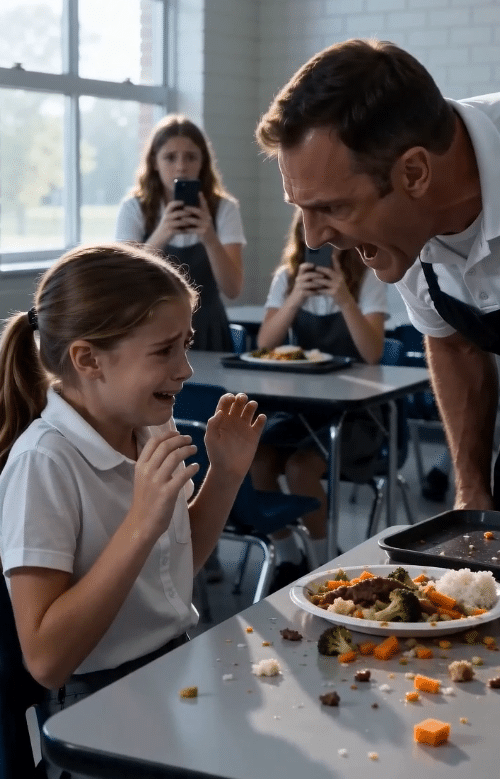
By the time I pushed through the cafeteria doors, my daughter was already crying into her hands.
The room was brighter than it should have been for something so ugly. White brick walls. Folding tables. Partitioned lunch trays lined up in neat rows. Natural light coming through the side windows, touching everything with the sort of innocence institutions like to borrow when they want their failures to look accidental.
Nothing about this was accidental.
A cafeteria worker in a white short-sleeved shirt stood over her, leaning so close his face was nearly level with hers. His finger was aimed at the tray in front of her as though a child’s lunch were evidence in a trial only he had the right to conduct.
“You didn’t pay for this! Give it back!”
My daughter, Emily, flinched so hard the plastic fork on her tray slid into the peas. She was nine years old, small for her age, still wearing her navy school vest and blue bow tie from morning assembly. Her hands were up near her face in that awful instinct children have when they do not know whether what is coming next will be words or something worse.
Behind her, two girls in the same uniform were holding up their phones.
Recording.
That detail burned through me first.
Not because children are cruel in new ways. They are often cruel in very old ones. But because if two students were already filming, then this confrontation had lasted longer than any adult in that room should have allowed.
The worker turned when he heard the doors slam behind me.
He looked annoyed before he looked afraid.
That told me everything.
Men who believe they are justified always wear surprise the same way when a real witness arrives. Not shame. Not guilt. Irritation that someone has interrupted the version of the story they were in the middle of writing.
I crossed the room in six strides.
“What is wrong with you?” I said.
I didn’t remember grabbing him, but my hands were on his shoulders before the sentence finished leaving my mouth. I shoved him back hard enough that his hip hit the edge of the next table and rattled the trays.
“Get out.”
His face changed instantly. Not because he recognized me as Emily’s father. Because he recognized me, period.
That happened more than I liked in the city. My face had been in enough trade journals and fundraising photos for people to know where they had seen me even if they couldn’t place it fast enough. Tall man. Navy suit. Maroon tie. Too expensive to argue with casually.
The room had gone silent now.
Even the students filming had lowered their phones slightly, caught between the thrill of spectacle and the sudden awareness that the scene had turned against them. A second cafeteria worker stood frozen near the milk cooler, one hand still holding a tray cart handle she seemed to have forgotten belonged to her.
The man in white stammered something about policy.
I ignored him.
I knelt beside my daughter, slid one arm around her shaking shoulders, and kissed her forehead. Her skin was cold with panic. She looked up at me with wet lashes and the raw relief of a child who had been trying not to break until the right person arrived.
“It’s okay,” I said. “I’m here.”
She collapsed into me then.
Not dramatically. Just all at once, the way frightened children let go when they believe the danger has moved one inch farther away. I held her tighter and looked over her shoulder at the tray.
Chicken.
Green beans.
Bread roll.
Apple slices.
Chocolate milk.
A standard lunch.
Nothing on it explained the scene.
Then I noticed the little keypad by the register at the far end of the room.
The lunch account system.
And I remembered the voicemail I’d ignored fifteen minutes earlier because I was still in a board meeting across town.
It had come from the school.
Marked urgent.
I looked back at the cafeteria worker, and for the first time I saw what was hiding under his fear.
Not confusion.
Expectation.
As if he had been waiting all morning to see whether I would come.
That was when I knew Emily had not been humiliated over a lunch tray.
She had been used to get me into that building before noon.
Act II: The Call I Should Have Answered
My name is Daniel Mercer, and for most of my adult life, people have mistaken speed for control.
I built Mercer Civic Group from a tiny redevelopment advisory firm into a portfolio big enough to make city councils nervous and local charities eager. Housing, public-private infrastructure, scholarship foundations, restoration contracts, school grants. The sort of work politicians praise in microphones and curse in private when you don’t donate quietly enough.
Three weeks before the cafeteria incident, I had made the worst kind of enemy.
Not a loud one.
A polished one.
Saint Catherine’s Academy, where Emily attended on full tuition after her mother’s death, stood on twelve acres of old property just north of downtown. The school board had quietly entered into negotiations to sell the underused east athletic field and adjoining maintenance lot to Calder Development Partners. The plan sounded harmless in brochure language: a mixed-use educational enhancement initiative with retail frontage, parking optimization, and long-term fiscal sustainability.
I killed the deal in one meeting.
Not because I enjoyed humiliating the board. Because the site sat atop the only remaining green easement in that district, and Calder’s traffic study had been massaged so badly it read like fiction with footnotes. I funded an independent review, handed the numbers to three parents on the board, and publicly warned that the project would choke the neighborhood in school-hour congestion while lining exactly four private pockets.
One of those pockets belonged to Peter Garrison, board treasurer.
Another, I later learned, belonged unofficially to his brother-in-law.
The vote collapsed forty-eight hours later.
Garrison shook my hand afterward and told me he respected my passion for community stewardship. He said it with a smile so clean I almost missed the threat under it.
“People who interfere with school stability,” he said, “sometimes forget where their children spend the day.”
I should have heard it for what it was.
Instead, I treated it like the familiar bitterness of men who lose profitable votes.
That was my mistake.
At 11:32 a.m., while I was speaking to a room full of investors about municipal bond sequencing and long-range district equity, Saint Catherine’s left me a voicemail marked urgent. My assistant flashed the call across my tablet and whispered that it appeared to concern Emily.
I silenced it.
Five minutes later, one of the mothers on the board texted only six words.
Go to the cafeteria. Now. Don’t call first.
By the time I reached the school, the worker was already standing over my daughter.
As Emily’s breathing began to steady against my chest, I asked the question every parent asks first when rage has not yet organized itself into strategy.
“What happened?”
She swallowed hard.
“I had my code,” she said. “It said insufficient balance.”
The words came out broken but clear.
That made no sense.
I prepaid the lunch account quarterly. Always had. Not because we couldn’t simply replace one tray’s worth of food. Because routine protects children from the little humiliations adults underestimate. Emily had lost her mother at seven. She did not need the added indignity of being singled out at a lunch register over ten dollars and forty cents.
“I told him it must be wrong,” she whispered. “He said I was lying.”
I looked toward the register.
The keypad screen still glowed faintly.
Behind it, clipped to the side of the monitor where students wouldn’t see, was a printed memo sheet. Half-covered by a stack of napkins, but visible enough.
ACCOUNT HOLD — STUDENT FLAG
DO NOT RELEASE MEAL WITHOUT ADMIN CLEARANCE
My pulse turned to iron.
The cafeteria worker followed my eyes and stepped backward.
“Sir, I just follow what’s in the system.”
“Who put the hold on her account?”
He didn’t answer.
Which was answer enough.
There are many ways institutions hurt children. Most are quiet. A changed code. A withheld lunch. A “clerical issue” left unresolved in exactly the right public place so a child learns, without any adult having to say it plainly, that her safety in the room depends on how quickly she can become smaller.
I stood, keeping one hand on Emily’s shoulder.
“Get the head of school,” I said.
The second cafeteria worker moved this time. Fast.
The man in white stayed still, and for one brief second his face betrayed something I did not yet have language for.
Not merely fear of losing his job.
Fear of disappointing whoever had told him to do this.
That was when one of the girls filming, the smaller one with braids and a trembling lower lip, spoke up from behind the table.
“He said her dad thinks he runs everything.”
I turned slowly.
The girl looked terrified she had spoken at all.
But now the words were out.
And every adult in the room knew the lunch tray was only the surface.
Act III: The Head of School Who Smiled Too Carefully
Dr. Helena Rowe arrived in under two minutes.
That alone told me she had been close enough to intervene from the start.
She wore a dove-gray suit and an expression of polished concern, the kind administrators cultivate so carefully it can survive almost any scandal. If you had no context, you might have mistaken her for a woman responding swiftly to a regrettable misunderstanding.
I had context.
She walked straight toward Emily first, which was smart. Compassion is always more convincing when it lands before explanation.
“Sweetheart, I am so sorry,” she said.
Emily pressed closer to my side.
Helena noticed.
Then she looked at me.
“Mr. Mercer,” she said, “there appears to have been a systems error.”
I almost laughed.
Not because it was funny. Because wealthy institutions have exactly three favorite words when caught harming the innocent: regrettable, confusion, and error. They rely on the idea that if no one seems intentionally cruel, then outrage itself begins to look excessive.
I pointed at the printed hold memo still clipped beside the register.
“That doesn’t look like an error.”
Her eyes flicked toward it and back.
For the first time, the polish on her face slipped.
Only slightly.
“Internal notes are sometimes generated automatically when account irregularities occur.”
“Generated by whom?”
She said nothing.
The silence stretched long enough that even the students understood what it meant. One of the girls lowered her phone completely now. The other kept filming, but with the stunned seriousness of someone realizing this wasn’t just a viral lunchroom clip anymore. It was an adult problem, and adults were starting to lie in public.
Emily tugged my sleeve.
I looked down.
“He told me,” she whispered, glancing at the cafeteria worker, “that kids whose fathers make trouble don’t get special treatment.”
The room changed.
Not dramatically.
No one gasped.
But the atmosphere shifted with the unmistakable force of plain language cutting through institutional varnish. The second worker at the back counter shut her eyes briefly. The head of school inhaled once and did not exhale fast enough.
I turned to Helena.
“Did you authorize that?”
“No.”
Too fast.
Then she corrected herself.
“Not in those terms.”
There it was.
Not denial.
Admission with tailoring.
The cafeteria worker started speaking over her, panicked now that the approved script was falling apart.
“Mr. Garrison said we were to hold all courtesy privileges linked to the Mercer family until the board resolved—”
Helena snapped around.
“That is enough.”
But enough had already arrived too late.
I knew Peter Garrison’s name would be somewhere in this.
Of course it was.
Men like Garrison never dirty their hands personally if a lower-paid employee can be taught the language of policy and made to mistake obedience for job security. They call it procedure. They call it fairness. They call it depersonalization. Then they choose a nine-year-old girl as the place to rehearse their grievance against her father.
I picked up the tray from the table.
Chicken, bread, apple slices, milk.
A child’s meal.
Then I carried it to the head of school and set it down in front of her on the serving ledge.
“This,” I said quietly, “is what all this was over.”
Helena looked at the tray as if it might indict her personally.
Maybe it did.
Because institutions often reveal their soul in small humiliations before the large scandals ever arrive. Anyone can issue statements about inclusion and student well-being. The real question is what happens when a board treasurer wants to punish a man and the easiest available body belongs to his child.
The answer, I was beginning to see, was standing in a white apron and hiding behind an account system.
But the account hold wasn’t the thing that frightened me most anymore.
It was the timing.
Go to the cafeteria. Now. Don’t call first.
Someone on the board had wanted me to witness this in progress.
Which meant someone else wanted the humiliation visible before it could be cleaned up.
And in institutions like Saint Catherine’s, internal civil war is rarely about one lunch tray.
It is about what else people are willing to reveal once the first lie breaks open.
Act IV: The File in the Blue Folder
Helena tried to move the conversation to her office.
I refused.
We stayed in the cafeteria with the students still present, the phones still in evidence, and the tray still on the counter between us like a small altar of shame. Witnesses matter. They matter especially when an institution hopes to reframe memory as misunderstanding the moment a door closes.
A woman in navy slacks appeared at the side entrance then, carrying a blue folder and moving with the rigid speed of someone who had chosen a side but not yet a strategy. I recognized her after a second: Marcy Levin, assistant bursar. The kind of employee private schools expect to remain invisible until money gets strange.
Her face was pale.
“Dr. Rowe,” she said, not taking her eyes off me, “you need to see this now.”
Helena took the folder.
Read one page.
Then another.
Whatever blood she had left in her face disappeared.
I held out my hand.
For one second, I thought she might refuse.
Then Marcy stepped around her and gave me the file directly.
That told me the building had already split.
Inside the folder were printouts from the school’s internal accounting system. Tuition flags. Donation holds. Discretionary ledger notes. And on the final page, an email thread from Peter Garrison to Helena Rowe and the business office marked confidential.
The subject line was unbearable in its neatness.
Leverage Options — Mercer
Garrison had proposed temporary “family inconvenience measures” after the development vote collapsed. Nothing legally obvious. Nothing that would survive scrutiny as retaliation if handled with care. Administrative delays. Courtesy suspensions. Invitation omissions. Scholarship review pressure for other families aligned with my coalition. And, astonishingly, this line highlighted in yellow by Marcy:
Lunch account disruptions create message without exposure. Child embarrassment preferable to adult confrontation.
I read it twice.
Not because I needed to confirm the words.
Because my body refused to accept that any adult had typed them and still considered himself fit to sit on a school board.
Helena closed her eyes.
“I never approved implementation,” she said.
“You didn’t stop it either.”
That landed.
Good.
Because leadership is often just the distance between what you personally sign and what you quietly allow subordinates to enforce for you. Her silence in that email thread was not innocence. It was outsourced consent.
The students behind us had gone completely still.
One of the girls filming started crying without making a sound.
Emily looked up at me, confused, as children always are when they realize the adults around them are not simply mistaken but rotten in systematic ways. She did not understand leverage options or discretionary inconvenience measures. She only knew grown people with titles had decided her hunger could carry a message to me.
Marcy spoke then, voice shaking.
“There’s more.”
Of course there was.
There is always more once the first drawer opens.
The cafeteria account hold wasn’t unique. Garrison had tested similar “pressure procedures” on two scholarship families who objected to the development plan. One child’s field trip payment was mysteriously lost. Another family’s transportation waiver disappeared for four days until the mother stopped emailing the board. Each incident had been small enough to explain away individually.
Together, they formed a method.
Not financial mismanagement.
Social coercion through children.
I looked at Helena.
“You run a school,” I said. “And you let a board member turn it into a pressure machine.”
She had no defense left that would not sound exactly like what it was.
The phones were still recording.
The staff were still watching.
And somewhere in the building, Peter Garrison had no idea the file marked confidential had just been opened in the cafeteria while his target stood beside his daughter under full fluorescent truth.
I took out my phone and called the one parent on the board I still trusted.
When she answered, I said only, “Get everyone back to campus. Now.”
Then I turned to Helena and the worker in white.
“No one deletes anything,” I said. “No one touches the account system. And if Peter Garrison tries to enter this room before the other board members arrive, security can explain to him why he is not welcome near my child.”
The cafeteria worker looked like he might faint.
Good.
He should have.
Because fear, finally pointed in the right direction, was the least any of them deserved.
Act V: The Meal She Finished
Peter Garrison never made it to the cafeteria.
Two board parents intercepted him in the front office after Marcy sent the internal accounting records to four personal emails she had wisely maintained outside the school server. By the time he realized the file had escaped containment, the building was no longer his. Not socially. Not procedurally. Not morally.
People like Peter always imagine power as something vertical.
Board seat.
Donor money.
Private calls.
Controlled language.
What they forget is that institutions can turn sideways in an hour if enough decent people stop waiting for permission at once.
He resigned that evening.
Not out of shame. Out of timing. Men like him rarely discover conscience; they discover legal counsel. The official statement referenced inappropriate administrative overreach and regrettable process failures. It did not mention children. It did not mention the sentence about lunch accounts and embarrassment. It did not mention my daughter at all.
I made sure the local paper got the full email.
Helena Rowe lasted two more weeks before the board placed her on leave.
The cafeteria worker was terminated by sunset, though that part did not bring me much satisfaction. He was cruel, yes. But he was also the sort of man institutions manufacture when they teach lower-paid staff to fear powerful patrons more than they fear themselves. He learned quickly enough who mattered. He just chose wrong on the day my daughter had the right witnesses.
At 1:04 p.m., after the last adults had been moved into offices and meetings and legal postures, I sat back down at the long white table beside Emily.
Her lunch tray was still there.
The apple slices had browned slightly at the edges. The milk was warm. The chicken was beginning to lose whatever dignity cafeteria chicken ever has. It looked small now, almost absurd, after everything it had revealed.
Emily stared at it a moment.
Then at me.
“Can I still eat it?” she asked.
The question nearly destroyed me.
Not because it was dramatic. Because it was practical. Children return to practical things after horror much faster than adults do. Their bodies keep asking the world simple questions: Am I safe now? Can I eat? Am I in trouble? Will you still be here if I look away for a second?
“Yes,” I said.
She picked up her fork.
Her hand trembled once.
Then steadied.
I opened the chocolate milk for her because the foil always annoyed her and because I needed to do something with my hands that wasn’t shaking another grown man by the throat. She took one sip, leaned into my side, and kept eating in tiny careful bites while the cafeteria around us slowly remembered how to behave like a room built for children.
One of the girls who had recorded the confrontation came over after a minute.
“I’m sorry,” she whispered to Emily.
My daughter nodded but didn’t say anything.
That was fine. Forgiveness does not need to perform on command either.
When she finished half the tray, Emily looked up at me with that solemn, searching expression children sometimes wear when they’re deciding whether the truth you gave them can be trusted.
“Did I do something wrong?”
“No.”
The answer came so fast it startled even me.
“No, sweetheart. You sat down to eat lunch.”
She thought about that.
Then she nodded once and returned to the apple slices like the matter had been settled in the only way that counted.
Later, after lawyers and statements and board calls and too many adults saying the word regrettable with their mouths shaped into concern, I walked back into the empty cafeteria alone. Her tray was gone. The table was wiped clean. The register screen had been reset. If you hadn’t been there, the room might have looked untouched.
That is the danger of polished institutions.
They are very good at erasing the visible signs of what they do to children.
But I have the video.
The emails.
The account hold.
The line about embarrassment.
And more than any of that, I have the memory of my daughter asking if she could still eat the lunch adults tried to turn into a weapon.
That is the part I don’t think Peter Garrison understood when he typed his little sentence about leverage.
Children do not experience cruelty as strategy.
They experience it as truth.
The grown-up in front of me is scaring me.
The room is watching.
My tray is no longer mine.
Something about me must have made this possible.
It takes a long time to unteach that.
So I’m going to be careful with her now.
Careful in the ways that matter.
Not with pity.
Not with expensive apologies.
With repetition.
You did nothing wrong.
You deserve your place at the table.
And no one gets to use your hunger to send messages to me ever again.