Act I
“Please, I haven’t eaten today.”
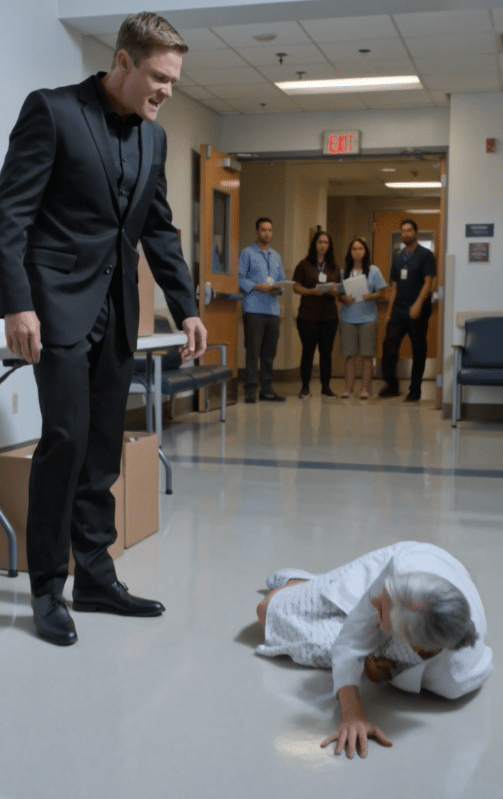
The elderly woman held the sealed meal box against her chest with both trembling hands. Before she could take another step away from the charity table, a man in an expensive black suit snatched it from her grasp.
She was seventy-two years old, dressed in a thin hospital jacket over her patient gown, with soft slippers and a plastic wristband circling her frail wrist. Her face was pale beneath the hospital’s cold white lights, and exhaustion had settled into the lines around her eyes.
The man standing in front of her looked as though he had never missed a meal in his life.
His silver tie was perfectly straight. A gold watch gleamed beneath his cuff, and his polished leather shoes reflected the fluorescent lights shining across the hospital lobby.
He had money, expensive clothes, and every opportunity to buy himself something to eat.
Yet he had just stolen the last free meal intended for someone who had none of those advantages.
The volunteer behind the table stared at him in disbelief.
“Sir, that box was for her.”
The man barely glanced in the volunteer’s direction.
“And now it’s for me.”
The elderly woman reached out hesitantly, her trembling fingers hovering near the box. She wasn’t trying to grab it back. She seemed afraid that even asking again might provoke him.
“Please,” she whispered. “I haven’t eaten today.”
The man looked down at her.
“Trash. You can eat anything.”
The words traveled farther than he intended.
A nurse walking past the waiting room slowed to a stop. An exhausted father holding a sleeping child turned his head. Two patients seated near the wall exchanged horrified glances, while the volunteer’s hand remained frozen above the empty table.
The woman swallowed hard.
“My doctor said I should try to eat something.”
“Then ask your doctor to feed you.”
“I was told this was for patients who needed help.”
“And I need lunch.”
He said it with such casual arrogance that, for a moment, the absurdity of the situation seemed to silence everyone.
This was a hospital charity program. Volunteers had spent the morning preparing sealed meal boxes for patients and caregivers who could not afford food while dealing with illness, medical bills, and long hours in the waiting room.
The boxes were free because someone had decided that hardship should not mean going hungry.
There had been enough for everyone earlier.
Now there was only one left.
And the man holding it had no intention of giving it back.
The elderly woman lowered her gaze. Her fingers trembled at her sides, and she seemed to shrink beneath the weight of his contempt.
She could have shouted. She could have demanded that someone call security.
But she was tired, frightened, and painfully aware that she had little strength left to fight anyone.
“Please,” she tried once more. “I’m not asking for anything else.”
The man’s expression hardened.
He stepped directly in front of her, blocking her path away from the table.
Then, without warning, he drove a forceful kick into her chest.
The elderly woman fell backward beside the charity table, her slippers sliding across the polished floor. The sealed meal box dropped and landed nearby, its plastic lid still intact.
A sharp gasp swept through the lobby.
She tried to catch herself with one arm, scraping her forearm against the floor. A thin trace of blood appeared along the skin, but the pain in her chest was what made her curl inward and struggle to breathe comfortably.
The man looked down at her.
Not with regret.
Not with alarm.
With irritation.
She reached weakly toward the meal box.
He stepped closer and kicked her again, striking her back and side as she curled protectively around herself. Then came the second follow-up kick.
Exactly three blows had brought a frail elderly patient to the floor.
The crowd stood frozen.
The volunteer covered her mouth. A nurse took one step forward, then hesitated as the man turned sharply toward the people watching him. Several patients recoiled in their chairs, afraid that drawing attention to themselves might make them the next target.
The woman remained beside the table, breathing unevenly, her trembling hand stretched toward the food she had been given.
The man leaned over her.
“Stay down and wait for scraps.”
For a moment, nobody moved.
Then a door at the far end of the lobby flew open.
A man in a navy suit and open white medical coat strode out of the executive corridor, two doctors hurrying behind him. A director’s badge caught the overhead light on his chest.
He took in the scene in a single glance.
The elderly woman on the floor.
The untouched meal box.
The man standing over her.
His expression changed.
He rushed forward and delivered one forceful punch to the bully’s face, sending the man staggering backward. Then he planted himself between the attacker and the woman, shielding her from further harm.
The entire lobby fell silent.
The director looked at the man in the black suit and spoke with a coldness that made even the doctors behind him stop moving.
“That last meal just showed me who should never walk this hallway again.”
The bully clutched his face, his anger collapsing into confusion as he noticed the badge on the stranger’s coat.
“Who are you?”
He had no idea that the stolen meal had just exposed something far more serious than his cruelty.
And the director was only beginning to discover how much damage one selfish act could reveal.
Act II
The elderly woman’s name was Margaret Ellis.
For most of her seventy-two years, she had been the sort of person who gave away more than she kept.
She had raised two children in a modest house outside the city, working for years as a school cafeteria assistant before eventually retiring. She knew how to stretch a grocery budget, make a meal from whatever remained in the refrigerator, and recognize when a neighbor was pretending not to be hungry.
When her husband, Thomas, was alive, they had rarely had much money.
But they had always managed to put something on the table.
Thomas had repaired appliances for a living, and Margaret had often helped him keep track of invoices at their kitchen table. Their house was small, their furniture old, and their vacations usually limited to visits with relatives.
Still, they had built a life in which kindness was ordinary.
If a neighbor lost a job, Margaret brought over soup. If a child at school forgot lunch money, she found a way to make sure the child ate. When the local food pantry asked for volunteers, she showed up with a handwritten list of what was needed most.
She never thought of herself as generous.
She simply believed that a person should not have to earn the right to be treated decently.
Then Thomas died.
The funeral expenses consumed much of their remaining savings, and the bills that followed seemed to arrive faster than Margaret could open them. A few years later, a fall and a series of worsening medical problems left her struggling to manage daily tasks on her own.
Her children had their own families and financial responsibilities. They helped when they could, but the cost of living kept climbing, and Margaret refused to tell them every time she was frightened.
She sold some furniture. She cut back on heating. She stopped buying the little luxuries that had once made her house feel like home.
Eventually, even ordinary groceries became a calculation.
An appointment at the hospital could mean a choice between paying for transportation and buying enough food for the next day.
That morning, Margaret had arrived early for a series of medical assessments. She had eaten nothing since the previous evening, partly because she had run out of food and partly because she was worried about the money she would need for the trip home.
When a volunteer announced that free meal boxes were available for patients who needed them, Margaret had hesitated.
She wasn’t accustomed to asking for help.
But the volunteer had smiled and told her that the food was there for exactly that reason.
So Margaret had accepted the final box.
It was a simple meal, sealed inside a plastic container. Nothing luxurious. Nothing anyone would photograph for a restaurant review.
But to Margaret, it represented lunch, a little energy, and one less thing to worry about until she could get home.
Then Richard Vance had taken it from her.
Richard was forty-five, a successful financial consultant who specialized in advising wealthy clients on property investments and business acquisitions. He had arrived at the hospital to visit an older relative who was recovering from surgery.
His own refrigerator was stocked. His bank accounts were healthy. He could have ordered lunch from any number of restaurants within a few minutes of the hospital.
Instead, he had noticed the charity table and decided that a free meal would save him the inconvenience of finding something else.
When the volunteer explained that the last box had already been given to Margaret, Richard took it anyway.
To him, the woman was simply an obstacle.
He saw the hospital gown, the cheap slippers, the trembling hands. He saw someone who looked too weak to challenge him.
He assumed that her poverty made her insignificant.
And when she asked for the meal back, he treated her need as an insult to his authority.
Richard had not always possessed the polished confidence he displayed now. He had grown up in a middle-class family and worked hard to build his career, but success had gradually become the measure by which he judged everyone around him.
He began to believe that people who struggled financially had simply failed to make the right decisions.
He stopped asking what circumstances had brought someone to a difficult place.
Instead, he looked for signs of status.
The cut of a suit. The brand of a watch. The size of a home. The people who returned phone calls.
Over time, he became especially contemptuous of anyone who needed assistance. He regarded charity as something for other people, something that existed because the world was full of people who couldn’t manage their own lives.
Yet he had no problem taking advantage of it when doing so suited him.
That morning, the meal box had been convenient.
The elderly woman asking for it back had become inconvenient.
And in Richard’s mind, that was enough to justify whatever came next.
What he had failed to understand was that the hospital was not merely a place where patients came to be treated.
It was also a workplace filled with people who had dedicated their lives to protecting the vulnerable.
One of those people had just witnessed him attack a woman old enough to be his mother.
His name was Dr. Daniel Brooks, the hospital’s fifty-eight-year-old director.
Daniel had spent more than three decades in medicine, first as an emergency physician and later in hospital leadership. He had seen people arrive in emergency rooms with every kind of injury, from accidents that changed lives in seconds to illnesses that developed silently over decades.
He had learned to recognize fear beneath anger, shame beneath silence, and the particular stillness that sometimes settled over a person who believed nobody would come to help.
He had also learned that institutions revealed their true character in the way they treated people who had no power to demand better.
That was why Daniel had insisted that the hospital maintain its free meal program.
He had seen caregivers skip meals to pay for prescriptions. He had watched patients leave appointments hungry because their transportation costs had consumed what little money they had. He knew that medical care did not end at the examination room door.
The program wasn’t designed to solve poverty.
It was designed to ensure that, at least for one meal, someone in a hospital crisis would not have to choose between dignity and hunger.
Daniel had been walking back from an executive meeting when he heard raised voices in the lobby.
He had expected an argument.
He had not expected to see an elderly patient lying beside a charity table while a wealthy visitor stood over her.
And the sight had awakened a fury he rarely allowed himself to show.
But Daniel’s decision to intervene was about to create a second crisis.
Because Richard Vance was not just an entitled visitor.
He was connected to a business arrangement that could place the hospital’s leadership under intense scrutiny.
And the director knew that once he acted, he would have to prove that he could protect the patient without allowing anger to replace due process.
Act III
“Get a medical team here immediately.”
Daniel’s voice cut through the silence.
One of the doctors hurried to Margaret’s side while a nurse called for additional assistance. They asked her where she felt pain and instructed her not to try to stand until they had assessed her injuries.
Margaret’s eyes remained fixed on the sealed meal box lying a few feet away.
“I’m sorry,” she whispered.
The nurse leaned closer.
“You have nothing to apologize for.”
Margaret swallowed.
“I didn’t want to cause trouble.”
Daniel heard her.
He turned toward the woman, and the anger in his expression softened into something more painful.
“Ma’am, you haven’t caused any trouble. You were hurt. We’re going to take care of you.”
Margaret looked at him uncertainly.
She had spent years learning how to avoid being a burden. Even now, after being attacked in a hospital lobby, she seemed more concerned about inconveniencing the people trying to help her than about the man who had kicked her.
Daniel crouched beside her, careful not to interfere with the medical team.
“My name is Daniel Brooks,” he said. “I’m the hospital director.”
Margaret’s eyes flicked toward his badge.
“Oh,” she whispered.
“You don’t need to worry about anything except getting checked by the doctors.”
Behind him, Richard Vance was still clutching his face.
He had recovered enough from the punch to become angry again, but his anger now carried a note of uncertainty.
“You just assaulted me!” he shouted.
Daniel rose slowly.
“And you attacked a seventy-two-year-old patient.”
“She tried to take my food!”
The volunteer stared at him.
“You took it from her,” she said.
Richard turned sharply.
“Stay out of this.”
“No,” the volunteer replied, her voice trembling but firm. “I gave her that box. It was the last one.”
Richard looked toward Daniel, expecting the director to dismiss the volunteer’s statement as irrelevant.
Instead, Daniel asked her to explain exactly what had happened.
She did.
She described how she had handed Margaret the meal box, how Richard had snatched it away, and how the elderly woman had repeatedly asked for it back. She recounted the insults and the sudden violence, pausing several times to steady her breathing.
Other witnesses began to speak.
A nurse confirmed that she had seen Richard kick Margaret after she fell. A patient waiting for a prescription described the same sequence of events. Another witness said the entire confrontation had unfolded in front of the charity table, with no indication that Margaret had threatened the man.
The story Richard had been trying to construct collapsed under the weight of people who had seen what actually happened.
Daniel looked toward the hospital’s security supervisor.
“Preserve the available camera footage. Document the witnesses’ accounts, and contact the police. I want this handled properly.”
Richard’s face hardened.
“You cannot do this to me.”
Daniel held his gaze.
“I haven’t done anything to you. I’m making sure the incident is documented.”
“You know who I am?”
“I know your name. That isn’t the same as knowing your character.”
The words struck a nerve.
Richard had spent years cultivating relationships with people who treated his name as an introduction and his wealth as a reason to listen. He was accustomed to watching people become more polite when they discovered who he was.
Daniel did not become more polite.
He became more precise.
“Your actions will be reviewed according to the evidence,” he continued. “The police will determine what needs to happen next. Our responsibility is to protect our patient and preserve an accurate record of what occurred.”
Richard straightened his tie with an unsteady hand.
“You’re going to regret embarrassing me.”
Daniel glanced toward Margaret, who was now receiving medical attention.
“You should be more concerned about what you did to her.”
The bully looked around the lobby.
The audience that had once seemed frozen by his confidence was beginning to find its voice. The volunteer had moved closer to the medical team. The witnesses were giving their names to security. A nurse stood between Richard and the area where Margaret was being treated.
Nobody was applauding him.
Nobody was rushing to explain that he had probably been having a difficult day.
For the first time, Richard was not the person everyone was trying to accommodate.
He was the person everyone was watching.
Then he noticed the two doctors standing behind Daniel.
One of them had been speaking quietly with the security supervisor. The other had moved toward the executive corridor to contact the hospital’s administrative team.
Richard recognized the older physician.
Dr. Michael Harris was the hospital’s chief medical officer, a man Richard had met at a private fundraising dinner several months earlier.
At that dinner, Richard had spoken at length about his commitment to supporting healthcare initiatives. He had praised the hospital’s work, discussed the importance of community partnerships, and promised that his professional network could help attract additional investment.
He had enjoyed being seen as a generous man.
Now Dr. Harris was looking at him with unmistakable disappointment.
“Richard,” the physician said quietly.
Richard seized the opportunity.
“Michael, thank goodness. Explain to your director who I am and why this is getting out of hand.”
Dr. Harris didn’t answer immediately.
He looked toward Margaret.
Then at the volunteer.
Finally, he turned back to Richard.
“I know who you are,” he said. “That is precisely why this is so disappointing.”
Richard’s face tightened.
“You’re taking her side?”
“I’m listening to the people who witnessed what happened.”
“You weren’t even here!”
“Neither were you, apparently, when you decided to consider the consequences of your actions.”
The remark landed with uncomfortable force.
Daniel raised a hand slightly, signaling that the discussion should remain focused on the incident rather than turn into an argument among hospital staff.
He asked the security supervisor to confirm that the footage was being preserved.
Then he turned to Richard.
“I want you to understand something. That meal program exists for people who are struggling. It is not an opportunity for visitors to take whatever they want simply because they don’t feel like paying for lunch.”
Richard scoffed.
“It was a box of food.”
“Yes,” Daniel replied. “And she had nothing else to eat today.”
The director paused.
“That’s what made your decision so revealing.”
Richard looked away.
For a few seconds, he appeared almost embarrassed. Then the expression vanished, replaced by the familiar insistence that he had been wronged.
“You’re acting like I committed some terrible crime.”
Daniel’s voice became colder.
“I am acting like a hospital director who watched a vulnerable patient get attacked in his own lobby.”
He glanced at the charity table.
The final meal box was still there, untouched.
Then he turned back toward Richard.
“And this isn’t the first time I’ve heard concerns about the way you’ve treated people in this building.”
Richard went still.
“What does that mean?”
Daniel did not answer immediately.
Because the incident had just exposed a question that had been waiting for an answer long before Margaret walked up to the charity table.
And when Daniel explained what the hospital would now be reviewing, Richard would discover that his behavior had put more than his reputation at risk.
Act IV
Daniel Brooks had no intention of turning the hospital lobby into a courtroom.
He was not a police officer, and he was not going to declare Richard guilty of every allegation anyone might make against him. The assault had to be investigated properly, and the hospital had to preserve the distinction between verified facts and unproven claims.
But Daniel was responsible for the safety of the people who came through the hospital’s doors.
That responsibility did not end when the person causing trouble wore a designer suit.
He asked the administrative team to review the incident under the hospital’s visitor safety policies. Security was instructed to preserve the available footage, identify witnesses, and coordinate with the police.
Richard’s name would be included in the report.
So would the names of everyone who had witnessed the attack.
The hospital would document the fact that Margaret had received the meal from a volunteer, that Richard had taken it, and that the confrontation had escalated into physical violence.
Nothing would be omitted because someone threatened a lawsuit.
Nothing would be exaggerated to satisfy the director’s anger.
The evidence would speak for itself.
Richard seemed unable to understand why Daniel wasn’t willing to settle the matter with a private conversation.
“You could simply ask me to leave,” he said. “There is no reason to make this into a major incident.”
Daniel looked at him.
“An elderly patient was kicked to the floor.”
“She was being difficult.”
“She asked you for her meal back.”
“She was disrespectful.”
“She told you she hadn’t eaten.”
Richard’s mouth tightened.
Daniel let the silence remain.
Sometimes, the most revealing thing a person could do was keep talking after everyone else had given them the opportunity to stop.
Richard had already demonstrated what he believed about poverty. Now he was demonstrating what he believed about accountability.
And he appeared to believe that if he found the right words, he could make the entire lobby forget what it had seen.
Then Daniel asked the hospital’s chief medical officer about the existing visitor incident reports.
Dr. Harris nodded.
“There have been several complaints involving aggressive behavior toward staff and people in the waiting areas. Some were resolved informally. Others were referred to administration.”
Richard immediately interrupted.
“Those were misunderstandings.”
“Some may have been,” Daniel replied. “That’s why they’re reviewed individually.”
He took a breath.
“But this incident has multiple witnesses, and the available footage may establish what happened.”
Richard glanced toward the security supervisor.
“May establish?”
“We’re preserving the recording,” the supervisor answered. “The police can review it as part of their investigation.”
Richard turned back to Daniel.
“You cannot ban me from a public hospital because you don’t like me.”
Daniel nodded once.
“Correct. I cannot make that decision arbitrarily.”
The answer seemed to reassure Richard.
Then Daniel continued.
“But the hospital can take appropriate safety measures when there is credible evidence of violence. Any restrictions must be based on policy, the circumstances, and the needs of the people receiving care. If there are concerns about a particular visitor, those concerns will be reviewed through the proper channels.”
Richard’s relief disappeared.
The director wasn’t promising a dramatic punishment.
He was explaining that Richard would no longer be allowed to decide for himself that his behavior didn’t matter.
The hospital could review whether he posed a risk to patients or staff. Security could document any further incidents. The administration could consider proportionate restrictions under its policies, while ensuring that patients’ access to necessary care was not improperly disrupted.
The police would handle the assault investigation.
And Richard would have to answer for what he had done.
The wealthy man looked toward Dr. Harris again.
“You know my family has supported this hospital.”
Dr. Harris’s expression did not change.
“I know you attended a fundraising dinner.”
“I made a substantial contribution.”
“You discussed a contribution,” the physician corrected. “That is not the same as making one.”
The distinction silenced Richard.
Daniel looked at his colleague, then back at the man in the black suit.
There was another detail he needed to clarify.
Several months earlier, Richard had approached the hospital about sponsoring a new community outreach initiative. He had spoken enthusiastically about his business connections and expressed interest in helping vulnerable patients.
The proposal had never been finalized.
No money had been accepted in exchange for influence, and no hospital policy gave Richard any special authority over patients, staff, or charity resources.
But Richard had behaved as if the possibility of becoming a donor entitled him to special treatment.
It did not.
Daniel turned toward the administrative director, who had just arrived.
“Make sure the incident review is independent of any fundraising discussions. No one should be making decisions about this case based on whether a person has donated money or might donate money in the future.”
The administrator nodded.
Richard stared at him.
“You’re seriously going to throw away a relationship with someone who could help this place?”
Daniel’s answer was immediate.
“A hospital that treats people according to their wealth is not the hospital I intend to lead.”
The words spread through the lobby with quiet finality.
A few patients lowered their eyes, visibly moved. The volunteer pressed her lips together, trying to hold back tears.
Daniel did not look at them for approval.
He was looking at Richard.
“You came here as a visitor,” he said. “You were not entitled to take food intended for someone else. You were not entitled to insult her. And you were certainly not entitled to hurt her.”
Richard’s face flushed.
“You’re going to destroy my life over a meal?”
Daniel shook his head.
“No. Your decisions are your responsibility. My responsibility is to make sure this hospital responds appropriately.”
For the first time, Richard seemed to realize that the director was not interested in bargaining.
There would be no private apology designed to make the witnesses disappear. No promise of a donation that would erase the recording. No agreement to keep the incident quiet in exchange for money.
The hospital would follow its procedures.
The police would conduct their investigation.
Margaret would receive medical care.
And the people who had watched the attack would be permitted to tell the truth.
Richard’s eyes shifted toward the sealed meal box.
It lay on a small counter beside the charity table, having been recovered after the fall. A volunteer had set it aside while the medical team attended to Margaret.
Such a small object.
Such an ordinary thing.
Yet it had become the center of a scene that Richard could not control.
He had taken the meal because he believed he deserved it more than a poor elderly woman did.
He had insulted her because he believed she was too insignificant to challenge him.
He had kicked her because he believed nobody would dare intervene.
Now, surrounded by witnesses, he was discovering how fragile those beliefs had been.
Daniel turned toward the security supervisor.
“Once the medical team has finished assessing Mrs. Ellis, make sure she has whatever assistance she needs. I also want the volunteer program coordinator notified so the remaining distribution can continue safely.”
Then he faced Richard one last time.
“That last meal just showed me who should never walk this hallway again.”
The words were no longer a threat delivered in anger.
They were a statement about responsibility.
Richard looked at the director’s badge again.
He wanted to demand an explanation, to insist that his connections entitled him to a different outcome, to find a phrase powerful enough to make Daniel retreat.
But his confidence had begun to fracture.
The people around him were no longer looking at his watch or his suit.
They were looking at the man who had kicked an elderly woman for the sake of a free lunch.
And the question that escaped his lips was smaller than anything he had said before.
“Who are you?”
Act V
Margaret was taken for a medical assessment while the hospital staff continued documenting what had happened.
The doctors checked her injuries carefully, paying particular attention to her chest, back, and side after the assault. Her forearm required attention for the scrape she had suffered during the fall, and her pain needed to be evaluated before anyone could determine the extent of her injuries.
She remained conscious, frightened, and exhausted.
But she was no longer alone.
A nurse stayed close while the medical team examined her. The volunteer who had given her the meal came to check on her when she was able, and Daniel made sure that the appropriate staff members were available to answer her questions.
The director did not promise that everything would be easy.
He promised that she would be treated with care.
When Margaret learned that the police had been contacted, she became visibly anxious.
“I don’t want anyone getting into trouble because of me,” she said.
The nurse pulled a chair closer.
“You didn’t do anything wrong.”
Margaret stared at her hands.
“He looked so angry.”
“That wasn’t your fault.”
The elderly woman tried to smile, but her lips trembled.
“I only wanted something to eat.”
The nurse took her hand.
“And you deserved to eat.”
Those words finally broke through the wall Margaret had built around her fear.
She began to cry quietly.
Not because she wanted revenge.
Not because she wanted to see Richard punished.
She cried because, for a few terrible minutes, she had been treated as though her hunger made her less human. And even after the violence, some part of her had worried that asking for help was what had caused the trouble.
Now, surrounded by people who were taking her pain seriously, she could finally admit how frightened she had been.
Daniel visited her after the initial assessment.
He did not bring a camera or ask her to tell her story for publicity. He simply introduced himself properly, asked whether she needed anything, and apologized that she had been hurt in a place where she should have been safe.
Margaret looked at his medical coat.
“Are you the man who stopped him?”
“Yes, ma’am.”
She hesitated.
“I heard you say something about the meal.”
Daniel pulled a chair beside her bed.
“I said it showed us something about his character.”
Margaret lowered her eyes.
“I don’t like thinking badly of people.”
“Neither do I,” Daniel replied. “But being kind doesn’t mean pretending that cruelty didn’t happen.”
She considered that for a moment.
Then she nodded.
For the first time since the attack, she seemed able to breathe without feeling that she needed to apologize for taking up space.
The hospital completed its internal review of the incident and preserved the relevant records for the authorities. Witness statements were collected, and the available footage was made available through the appropriate process.
Richard’s assault investigation proceeded separately from the hospital’s administrative review. The final legal consequences would depend on the evidence, the authorities’ decisions, and any subsequent proceedings.
There was no instant courtroom verdict.
No miraculous confession that resolved every question.
But the facts that mattered most were no longer hidden behind Richard’s reputation.
He had taken the meal.
He had insulted Margaret.
He had kicked her.
And multiple witnesses were prepared to say so.
The hospital also reviewed the circumstances surrounding the charity program. The staff confirmed that the meal had been distributed according to its intended purpose and discussed ways to ensure that volunteers could continue serving vulnerable patients without being exposed to intimidation.
Daniel insisted that the response remain focused on the people the program was designed to help.
The following morning, additional meal boxes were delivered to the lobby.
The volunteer who had handed Margaret the last box stood behind the table again. This time, the supplies had been organized so that staff could quickly direct patients and caregivers to available meals.
A handwritten sign explained the program’s purpose in simple terms.
Food was available for people who needed help.
No one was required to explain their poverty before being treated with respect.
Daniel stopped by briefly on his way to a meeting.
He thanked the volunteers, asked whether they had everything they needed, and reminded the staff that security should be contacted immediately if anyone threatened or harassed them.
Then he continued down the corridor.
He had no intention of making himself the hero of the story.
The hospital’s responsibility had been to protect a patient, document the incident, and respond appropriately. His own intervention would also be subject to scrutiny, and he understood that his position did not place him above the rules.
But he had no regrets about stepping between Margaret and the man who had attacked her.
He had seen too many people become invisible when they were poor, elderly, frightened, or alone.
He had spent his career fighting that invisibility.
And he would not accept it in his own hospital.
Several days later, Margaret was ready to leave the hospital after her care team determined that she could safely return home with the appropriate follow-up arrangements.
Before she left, the volunteer visited her with a small bag containing a meal and some additional food from the program.
Margaret looked inside.
“You don’t have to do this.”
The volunteer smiled.
“I know.”
Margaret touched the top of the bag, her eyes filling again.
“Thank you.”
This time, she did not apologize for needing help.
She accepted it.
Outside the hospital, the city continued moving at its usual pace. Cars passed. People hurried to appointments. Cafés filled with customers ordering meals they had never needed to worry about affording.
Richard’s world continued, too, but not quite as he had expected.
He had to deal with the investigation, the possibility of legal consequences, and questions from people who had seen the recording or heard accounts from witnesses. Any restrictions on his future access to the hospital would have to follow the institution’s policies and account for legitimate patient-care needs.
His professional relationships were also under pressure.
Some people distanced themselves from him. Others waited for the formal findings. He could dispute the allegations, seek legal advice, and respond through the proper channels.
What he could no longer do was insist that the incident had never happened.
He had once believed that wealth made him the person who decided what mattered.
Now, when people heard his name, some remembered the suit, the gold watch, and the polished shoes.
But others remembered an elderly woman on the floor beside a charity table, reaching for a meal she had been given.
And they remembered the hospital director who stepped between them.
Richard had asked, “Who are you?” because he thought the answer would tell him whether he needed to be afraid.
Daniel Brooks had answered with something far more important than his title.
He had shown him what authority was supposed to mean.
Not the right to take from someone weaker.
Not the privilege of escaping consequences.
Not the ability to silence a person who had nothing.
Authority meant accepting responsibility when everyone else was tempted to look away.
And the final meal had revealed the difference between a man who possessed wealth and a man who understood its limits.
Margaret had not needed a fortune.
She had needed lunch.
She had not needed a powerful friend.
She had needed someone to recognize that her life mattered.
For a few terrible moments, the hospital lobby had failed her.
Then one person refused to let that failure stand.
The meal box had been ordinary. Its contents had cost very little. It was the kind of thing most people would forget by the following afternoon.
But for Margaret, it had represented the difference between going hungry and making it through another difficult day.
For Richard, it had become a mirror.
And for Daniel, it had become a reminder of the promise every hospital should make to the people who enter its doors: that illness, age, and poverty will never make a person less deserving of dignity.
In the end, the most revealing thing about that morning was not that a wealthy man had stolen a free meal.
It was that he had looked at a hungry elderly woman and believed he had more right to it than she did.
He had assumed that her weakness made her disposable.
He had mistaken her politeness for permission.
And he had counted on the world remaining silent.
He was wrong.
Because the woman on the floor had never been trash.
She had been someone’s mother, someone’s neighbor, someone’s friend. She had spent decades feeding children, helping neighbors, and giving what she could to people who needed it.
Her bank account could not measure those things.
Neither could her hospital gown.
And neither could the expensive suit of the man who tried to humiliate her.
That morning, the hospital director had not needed to ask how much money Richard possessed.
He had already seen what Richard was willing to do for the price of a free lunch.
And that was the answer that would follow him long after the lobby returned to normal.
Not the gold watch.
Not the black suit.
Not the name he had expected everyone to respect.
Just the memory of a hungry woman reaching for the last meal—and a room full of people finally realizing who had truly behaved without dignity.