Act I
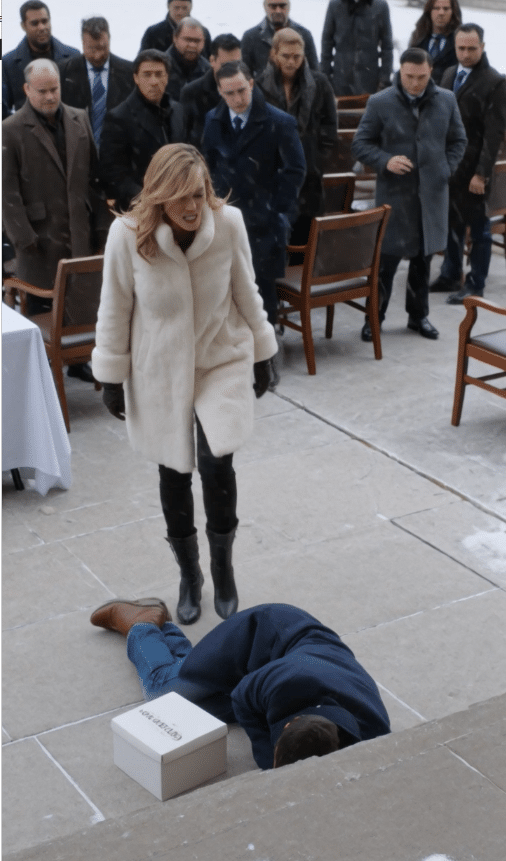
The last white cake box had barely settled into the boy’s hands when a woman in a white fur coat snatched it away.
“Hey!” the volunteer behind the charity table exclaimed.
The twelve-year-old boy stood on the church steps, his thin blue coat buttoned against the falling snow. His fingers were red from the cold, and a crumpled cake voucher trembled in his other hand. He had waited since early morning for the church’s winter food distribution, watching families leave with groceries, bread, and small boxes of cake.
Now, finally, there was something for him.
The woman held the box against her expensive coat as though it had always belonged to her.
“That one is mine, ma’am,” the boy said quietly.
She looked down at him.
“Trash. My child wants it.”
Beside her stood a little girl in a pink winter coat, perhaps seven years old. She looked from her mother to the boy, confused by the sudden confrontation. The woman, however, seemed entirely comfortable with it.
She wore leather gloves, designer boots, and the kind of expression that suggested the world had disappointed her simply by failing to obey.
“The volunteer gave it to me,” the boy explained. “I have the voucher.”
He held up the paper.
The woman barely glanced at it.
“Then get another one.”
“There aren’t any more.”
“That’s not my problem.”
The volunteer stepped around the table. “Ma’am, that was the last box. He was next in line, and his voucher was already checked.”
The woman turned toward her with open irritation.
“Do you know who I am?”
“No, ma’am,” the volunteer replied. “But I know who was given that box.”
A few people standing nearby exchanged uneasy looks. Snow gathered on the shoulders of their coats. Behind them, the church doors remained closed, and the charity table was nearly empty.
The boy swallowed hard.
“Please,” he said. “I’ve been waiting all morning.”
The woman gave a short, disbelieving laugh.
“And I’ve been dealing with a child who wants a particular flavor of cake. Do you expect me to tell her she can’t have it?”
The little girl lowered her eyes.
“But Mom,” she murmured, “he had it first.”
Her mother ignored her.
“Poor kids don’t choose first,” the woman announced.
The words landed harder than the winter wind.
The boy’s face reddened. He wasn’t sure what hurt more: being called trash by a stranger or hearing her speak as if poverty had somehow made him less deserving of kindness.
“My mom said I could bring one home,” he whispered.
For the first time, the woman seemed to register that he was not asking for a treat for himself alone. Someone was waiting for him somewhere. Someone had sent him with a voucher and the hope that he would return carrying something small and sweet.
But rather than soften, she tightened her grip on the box.
“Your mother should teach you not to argue with adults.”
“I’m not arguing. I just want my cake.”
The woman stepped toward him.
The boy took a half-step back, instinctively clutching the voucher.
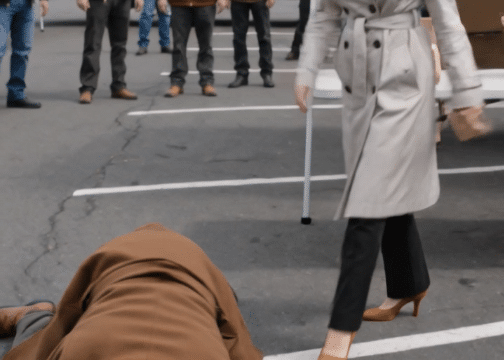
Then she drove a forceful kick into his chest.
He fell onto the stone steps, twisting as he tried to catch himself. The cake box slipped from her hand and landed beside his shoulder. His palm scraped against the rough stone, leaving a thin trace of blood.
A sharp gasp escaped the crowd.
Before anyone could react, the woman stepped closer and kicked him once in the back and side. Then she delivered a second follow-up kick as he reached painfully toward the fallen box.
The boy curled inward, stunned and frightened.
The woman looked down at him with cold contempt.
“Poor kids don’t choose first.”
Around them, churchgoers covered their mouths. A volunteer stood frozen behind the table. Other children stared, their parents pulling them closer as though they were afraid the woman’s anger might suddenly turn toward them.
The boy blinked back tears and tried to sit up.
He wasn’t thinking about revenge. He wasn’t wondering who might be powerful enough to punish her.
He was thinking about the cake box.
It had fallen open at one corner, and he was afraid the cake inside might be ruined.
Then the church doors swung wide.
A tall man in an elegant black overcoat came down the steps, followed closely by the head pastor. His eyes moved from the fallen boy to the woman holding herself rigidly above him.
The man’s expression changed.
He hurried forward, stepped between the woman and the child, and delivered one forceful slap across her face. She stumbled back, raising a gloved hand to her cheek, stunned by the sudden interruption.
“That box was the test you just failed in front of everyone,” he said.
The woman stared at him.
A thin trace of blood showed at the corner of her mouth. Behind the man, the pastor looked from the boy on the steps to the woman in the white fur coat.
For the first time that afternoon, she seemed uncertain of herself.
“A test?” she whispered.
She had thought the only thing at stake was a cake box. She had no idea that the man standing between her and the boy was the person whose decision could change the future of the entire charity program.
Act II
The boy’s name was Daniel Brooks.
He lived with his mother, Rebecca, in a small rented apartment on the other side of town. His father had left years earlier, and Rebecca had been working irregular shifts at a neighborhood laundry while trying to keep their household afloat.
Some months were manageable.
Others required calculations that Daniel had learned not to ask about.
He knew which lights his mother turned off first when the electric bill arrived. He knew that she sometimes claimed not to be hungry when there was only enough food for one proper meal. And he knew that when she smiled and said everything would be fine, it usually meant she was working hard to make sure he never saw how worried she really was.
The church’s winter charity program had become a small source of relief.
It provided groceries, warm clothing, and holiday treats donated by local businesses. The cake boxes were particularly popular because they gave families something to celebrate during a season when many of them were struggling just to keep the heating on.
Rebecca had given Daniel the voucher that morning.
“Take your time,” she’d told him, straightening the collar of his old blue coat. “Wait your turn, say thank you, and come straight home.”
He had promised.
When he reached the church, a long line had already formed. He waited patiently while volunteers checked vouchers and handed out the remaining supplies. By the time he reached the table, only one cake box remained.
The volunteer checked his paper, smiled, and passed it to him.
“Here you go, Daniel. Hope you and your mom enjoy it.”
For one brief moment, Daniel felt rich.
Not because the cake was expensive or because it would last more than a day, but because he had something to take home that his mother had not needed to sacrifice for. He imagined setting the box on their kitchen table and watching her face brighten.
Then the woman took it.
Her name was Vanessa Whitmore, and she had spent most of her adult life surrounded by people who made room for her.
At thirty-nine, Vanessa was married to a successful property developer. She lived in a large home in an affluent neighborhood, had a household staff, and rarely encountered a problem that could not be solved by making a phone call or paying someone to handle it.
Her daughter, Sophie, was accustomed to getting what she wanted.
That afternoon, Sophie had asked for a particular kind of cake after seeing a picture of it in a bakery window. Vanessa had promised to find one. When the bakery was sold out, she had driven past the church’s charity distribution and noticed the table outside.
She had not come because her family lacked food.
She had come because she wanted to satisfy her daughter’s request without making another stop.
At first, she assumed the cake boxes were being handed out indiscriminately. When a volunteer explained that the final box had already been allocated to Daniel, she took the refusal personally.
In Vanessa’s mind, the situation had become a contest.
And she had never been good at losing.
The slap from the stranger left her furious, but the man’s presence unsettled her more than the pain. He was dressed elegantly, yet he carried none of the anxious deference she expected from people who encountered her social class.
“Who do you think you are?” she demanded.
He didn’t answer her.
Instead, he turned toward Daniel and crouched beside him.
“Son, can you hear me?”
Daniel nodded, wincing as he moved his arm.
“What’s your name?”
“Daniel.”
“I’m sorry this happened to you, Daniel. We’re going to get someone to check you over.”
The pastor immediately signaled to a volunteer to call for medical assistance. Another volunteer gently moved the cake box away from the edge of the steps so nobody would accidentally crush it.
Daniel glanced at the man.
“Am I in trouble?”
The question stopped him cold.
“No,” he replied. “You haven’t done anything wrong.”
Daniel looked toward Vanessa, who was still holding her cheek and staring in disbelief.
“She said I shouldn’t have asked for it.”
The man glanced at the voucher lying beside Daniel’s hand.
“You were given that box fairly. You had every right to ask for it back.”
He rose and faced Vanessa.
“You attacked a child over donated cake.”
“She was rude to me,” Vanessa snapped, pointing toward the volunteer.
“The volunteer told you the box had already been allocated.”
“And I was supposed to accept that?”
“Yes,” he said. “You were.”
Vanessa gave a bitter laugh.
“You have no idea who you’re talking to.”
The man looked at the white fur coat, the expensive boots, and the designer handbag hanging from her wrist.
“I know exactly what I saw.”
She opened her mouth, then shut it again.
Behind him, the pastor finally stepped forward.
“Vanessa,” he said quietly, “this is Thomas Ellison.”
Her expression shifted.
Thomas Ellison was a well-known philanthropist and the principal donor behind the church’s winter relief program. His foundation funded the food distributions, paid for emergency heating assistance, and helped families avoid eviction during the coldest months of the year.
Vanessa had seen his photograph in the local business pages.
She had never met him, but she knew his reputation. His charitable foundation was respected across the region, and his annual winter program was one of the largest privately funded relief efforts in the county.
Thomas was not merely a wealthy man who had happened upon a disturbance.
He was the person who had made the charity table possible.
Vanessa’s anger faltered, replaced by a careful attempt at composure.
“Mr. Ellison,” she said, smoothing the front of her coat. “I’m sure we can discuss this sensibly.”
Thomas glanced down at Daniel, who was still sitting on the steps with one hand pressed against his scraped palm.
“We can discuss it after the boy receives medical attention and the authorities have been notified.”
Vanessa stared at him.
“You’re calling the police over a misunderstanding?”
“No,” Thomas replied. “I’m calling for help because a child has been assaulted.”
The pastor stood beside him, his face grave.
For the first time, Vanessa noticed that nobody around her was looking away anymore. The volunteers were no longer frozen. The witnesses had begun speaking to one another, quietly confirming what they had seen.
Her status had not disappeared.
But it was no longer protecting her.
And when Thomas asked the pastor to bring him the records from the charity program, Vanessa discovered that the cake box was only the beginning of a much larger problem.
Act III
Thomas Ellison had built his fortune in commercial real estate, but his charitable work began long before his name appeared on donation plaques.
When he was seventeen, his father lost his job after the factory where he worked closed without warning. The family went from comfortable to frightened almost overnight. Bills accumulated, savings disappeared, and Thomas watched his mother quietly return gifts because she could no longer afford the things she had purchased for the holidays.
One December, their church provided groceries and a small box of pastries.
Thomas remembered his mother setting the food on the kitchen table and standing silently beside it. She had been trying not to cry all afternoon, and the sight of something given without judgment finally broke through her composure.
She did not remember the brand of pastries years later.
She remembered the feeling of being treated like a person rather than a problem.
That memory shaped Thomas’s approach to giving.
He funded the church’s winter program because he believed relief should be delivered with dignity. The vouchers were designed to prevent confusion and favoritism. Volunteers checked the allocations carefully, and the last box of any item was never supposed to be handed out on the basis of appearance, influence, or who could make the loudest demand.
Every eligible recipient deserved a fair chance.
Thomas had also insisted that the church maintain records of its distributions and the donations that supported them. He did not want the program to depend entirely on his personal judgment. He wanted a system that could survive even if he were no longer involved.
Now he stood in the snow beside the charity table, watching the consequences of what happened when someone decided the rules applied only to other people.
“Pastor,” he said, “please preserve the voucher records and any available camera footage. I want the incident documented properly.”
The pastor nodded.
“We have a camera covering the entrance and steps. It should have recorded the entire confrontation.”
Vanessa’s head snapped toward him.
“You have cameras outside a church?”
“For safety,” the pastor replied.
“That’s outrageous.”
Thomas looked at her.
“What’s outrageous is that a child was attacked while asking for something a volunteer had already given him.”
Vanessa’s face flushed.
“You don’t know the whole story.”
“Then tell it.”
She hesitated.
The hesitation was brief, but several people noticed it.
Vanessa glanced at Sophie, who stood a few feet away with tears gathering in her eyes. The little girl looked frightened by her mother’s behavior and embarrassed by the attention.
“Mom,” Sophie whispered, “I don’t want the cake anymore.”
Vanessa’s expression tightened.
“Don’t start.”
“But he had it first.”
“Be quiet.”
Sophie fell silent.
Thomas watched the exchange without interrupting. The little girl was not responsible for her mother’s choices, and he had no intention of turning her into another target in the confrontation.
He turned toward the pastor.
“Make sure Sophie has someone with her while this is being handled.”
The pastor signaled to a trusted volunteer, who approached the child gently and asked whether she would like to wait inside the church.
Vanessa immediately objected.
“She is my daughter.”
“Yes,” Thomas said. “And she has just watched you hurt another child. She deserves a calm adult who can help her understand what happened.”
“You have no right to tell me how to raise my child.”
“I am not trying to raise her. I am making sure she is safe while the adults deal with what happened here.”
The distinction only made Vanessa angrier.
She looked around at the gathered churchgoers, searching for someone who would affirm her version of events. She had expected the crowd to be impressed by her clothes, intimidated by her confidence, or embarrassed enough to pretend they had seen nothing.
Instead, an elderly man stepped forward.
“I watched you take the box,” he said.
A woman holding a grocery bag nodded.
“So did I.”
The volunteer who had handed Daniel the cake spoke next.
“I checked his voucher. The box was his.”
Vanessa pointed at her.
“You should have given it to my daughter. She was standing right there.”
The volunteer’s voice trembled, but she did not back down.
“Your daughter wasn’t next in line.”
Vanessa turned toward Thomas.
“Are you going to let your staff speak to me like this?”
Thomas answered without raising his voice.
“They are telling you what happened.”
The pastor returned from the church office carrying a folder. Inside were the distribution records, including the voucher numbers for the final boxes. Daniel’s voucher had been checked and marked as fulfilled when the volunteer handed him the cake.
The record confirmed what the witnesses had already said.
There had been no mistake.
Vanessa had not been confused about the allocation. She had been told the box belonged to Daniel, and she had taken it anyway.
Thomas closed the folder.
“Please give this to the appropriate authorities when they arrive.”
Vanessa stared at him.
“You’re making this sound criminal.”
“The authorities will decide how to handle it.”
“Because I took a cake box?”
“Because you took something that had been allocated to a child, and then you attacked him when he asked for it back.”
She looked as though she wanted to argue, but there was nowhere left to place the blame. The voucher record, the witnesses, and the camera footage all pointed in the same direction.
Her eyes moved toward Thomas’s overcoat.
“You have a foundation,” she said suddenly. “A major one. Surely you understand that people make mistakes. My family could be very helpful to your organization.”
Thomas studied her.
“Are you offering to make a donation?”
“I’m saying we could work together. My husband knows several people who would be interested in supporting your program.”
“Donations are welcome,” Thomas replied. “But they do not buy permission to hurt people.”
Vanessa’s mouth tightened.
“You’re willing to turn away a major contribution over one incident?”
“I am not turning away a contribution. I am refusing to trade a child’s dignity for it.”
The answer left her silent.
Thomas turned toward Daniel again. The boy was speaking with a paramedic who had arrived to assess him. His coat was dusty from the stone steps, and his face had gone pale from the shock.
The cake box sat nearby, its lid slightly bent.
Thomas felt a quiet anger settle inside him.
Not because the box was expensive. It wasn’t.
Not because the woman had insulted him. She hadn’t even known who he was when she began.
He was angry because Daniel had been made to feel that his poverty gave someone else permission to hurt him.
That was the exact kind of humiliation his mother’s memory had taught him to reject.
And he intended to make sure the incident was handled without allowing money, status, or public pressure to interfere.
But Vanessa still believed she could escape the consequences with a few carefully chosen words—and the person who finally challenged that belief was the little girl whose wishes she had claimed to be defending.
Act IV
The police arrived while the paramedics were checking Daniel.
Thomas gave his account of what he had witnessed, including his own physical intervention. He did not attempt to conceal the slap or insist that his position as a donor made him exempt from scrutiny.
He told the officers what had happened and agreed to cooperate with their review.
The pastor provided the voucher record, identified the available security footage, and gave the names of witnesses who were willing to speak. Several churchgoers offered statements describing the assault and the woman’s remarks.
Vanessa immediately demanded to speak with a lawyer.
She was entitled to do so, and the officers explained the next steps without promising any particular outcome. They separated the witnesses, documented the scene, and began collecting the evidence needed to assess the incident.
Vanessa continued to insist that the confrontation had been exaggerated.
“He was disrespectful,” she said. “I was trying to get the cake for my daughter.”
One of the officers asked whether she had taken the box from Daniel.
Vanessa hesitated.
“I picked it up.”
“Did he ask you to return it?”
“He complained.”
“Did you kick him?”
Her expression hardened.
“I was trying to make him back away.”
The officer wrote something down.
“That isn’t what the witnesses have described.”
Vanessa looked toward Thomas, expecting him to interrupt.
He did not.
The pastor stood beside the charity table, holding the folder of distribution records. The volunteer who had given Daniel the box remained nearby, prepared to answer questions. No one was trying to humiliate Vanessa in return. They were simply refusing to pretend that the incident had been something other than what they had witnessed.
Sophie stood with the volunteer inside the church entrance.
Her eyes were red, and she held the sleeves of her pink coat in both hands. When Vanessa noticed her, she called out sharply.
“Sophie, come here.”
The girl did not move.
“Now.”
Sophie looked at the volunteer, who crouched beside her and quietly reminded her that she could speak when she was ready.
Then the child took a small step forward.
“Mom,” she said, “why did you kick him?”
Vanessa stared at her.
“Don’t ask questions like that.”
“But he didn’t do anything.”
“He was being difficult.”
“He just wanted the cake.”
Vanessa’s face went rigid.
Thomas turned away slightly, giving the child space to speak without feeling that she was performing for the crowd.
Sophie looked at the box lying beside the table.
“I told you I didn’t need it that much.”
Vanessa opened her mouth, but no answer came.
For all her insistence that she had acted for her daughter, she had never asked Sophie what she actually wanted once the confrontation began. The child had become an excuse—a convenient justification for taking something that belonged to someone else.
Sophie wiped her nose with the back of her glove.
“I’m sorry he got hurt,” she said.
Daniel heard her from where he sat with the paramedic. He looked toward her, still shaken, and gave a small nod.
The moment was quiet, almost lost beneath the movement of the officers and the falling snow.
But it changed something in the crowd.
The adults had watched Vanessa insist that money and status gave her a right to take what she wanted. Now her own daughter had said, in the simplest possible terms, that none of it had been necessary.
Vanessa’s composure finally cracked.
“You’re making me look like a monster,” she said to Thomas.
“No,” he replied. “We’re documenting what happened.”
“You could stop all of this. You could tell them we’re going to make a donation.”
“That’s not how this works.”
“My husband will hear about this.”
“Then he can hear the truth.”
Vanessa looked around at the witnesses again. Her eyes were bright with anger, but the confidence she had carried down the church steps was gone.
For years, she had treated social embarrassment as the worst thing that could happen to her. She could endure losing money if she could keep her reputation. She could tolerate criticism if she could make it private.
But she could not control what the people who had seen the incident would say, and she could not turn their memories into something else by offering a donation.
The officers continued their investigation. The church preserved the footage, and the pastor arranged for the records to be made available through the proper process. Thomas’s own conduct would be reviewed separately, as it should be.
He did not demand that the police punish Vanessa to prove that he was powerful. He did not threaten to destroy her family or make claims about consequences he could not guarantee.
He simply refused to interfere with the truth.
As the paramedics prepared to take Daniel for further medical evaluation, Thomas crouched beside him.
“Your mother knows where you are?”
Daniel nodded.
“I was supposed to bring her the cake.”
His voice was so small that Thomas had to lean closer to hear him.
“We’ll help make sure she knows what happened,” Thomas said. “And we’ll make sure you get home safely when the medical team says it’s okay.”
Daniel glanced toward the box.
“Is it ruined?”
Thomas followed his gaze.
The lid was bent, and one corner had opened. The cake was still inside, though some of the frosting had shifted.
“We’ll see what we can do,” Thomas replied.
Daniel looked embarrassed.
“I’m sorry.”
Thomas’s face softened.
“You don’t have to apologize for that either.”
The boy looked down at his scraped palm.
For a moment, Thomas could see how deeply the incident had unsettled him. Daniel had arrived expecting to carry home a small gift for his mother. Instead, he had been attacked in public and made to wonder whether he had done something wrong by asking for what was rightfully his.
Thomas knew that a few reassuring words would not erase that memory.
But they could begin to replace one painful lesson with a better one.
When Daniel finally reached for the cake box, Thomas made a decision that would ensure the boy remembered something more important than the woman who had knocked him down.
Act V
Daniel was examined by the medical team, who assessed his injuries and made sure he could receive appropriate care. He remained conscious and responsive, though the fall and assault had left him shaken and sore.
Thomas waited until the immediate medical concerns had been addressed before asking whether Daniel’s mother could be contacted.
Rebecca arrived at the church shortly afterward, breathless and frightened. She had been waiting at home, expecting her son to return with the cake box, when a volunteer called to explain that there had been an incident.
The moment she saw him, she hurried forward and wrapped her arms around him.
“Daniel!”
“I’m okay, Mom,” he whispered, though his voice trembled.
She held him tighter, then pulled back to look at his face and hands.
“What happened?”
Daniel struggled to answer.
A volunteer explained the incident gently, leaving out unnecessary details while making clear that Daniel had been attacked and had received medical attention. Rebecca listened without interrupting, her face growing pale.
When she learned that the woman had taken the cake and kicked him after he asked for it back, she closed her eyes.
“He was only bringing something home,” she whispered.
Thomas stood nearby, allowing her a moment before introducing himself.
“I’m Thomas Ellison. I’m one of the people who funds this program. I’m sorry your son was hurt here.”
Rebecca looked at him, then at the church steps.
“Was it because he was poor?”
Thomas did not offer an easy answer.
“I can’t tell you everything that was in that woman’s mind,” he said. “But I can tell you that your son had every right to receive the box he was given, and nothing about your circumstances made what happened acceptable.”
Rebecca looked down at Daniel.
He had begun to cry quietly, trying to hide his face against her coat.
That broke her composure more than anything else.
She gathered him close and let him cry.
Thomas watched without speaking. He had seen families arrive at the food bank embarrassed by their circumstances and leave relieved that someone had treated them with kindness. He had seen people struggle to ask for help, then apologize for the size of their need.
But watching Rebecca comfort her son reminded him that a charity could distribute all the food in the world and still fail its purpose if the people who came through its doors were not safe.
He made sure Rebecca received the contact information for the staff handling the incident. He explained that the church would preserve the relevant records and cooperate with the authorities. He did not promise a particular legal result or ask the family to speak publicly about what had happened.
Then he turned toward the charity table.
The remaining supplies had been packed away while the investigation proceeded. Volunteers had begun clearing the steps, gathering empty boxes, and brushing snow from the tablecloth.
Thomas asked them to bring out a fresh cake box from the reserve supplies kept inside the church.
The volunteer lead hesitated.
“We were holding those for tomorrow’s distribution.”
“Then we’ll record one box as used today and replenish it from the foundation’s emergency fund.”
He looked toward Daniel.
“This one is for you, if you still want it.”
Daniel stared at the new box.
“Really?”
“Really.”
The boy accepted it carefully with both hands. He didn’t smile immediately. His face still carried the confusion of someone who had learned, in a few terrible minutes, that adults could behave in ways he had never expected.
Then he looked at his mother.
“We can share it when we get home.”
Rebecca nodded, tears shining in her eyes.
“Yes, sweetheart. We can share it.”
Thomas watched them hold the box between them.
It was a small moment, but it mattered.
Daniel had come to the church wanting to bring home something kind. The woman had tried to turn that simple wish into a lesson about who deserved more and who deserved less. Now he would leave with the cake, his mother’s hand in his, and the knowledge that the people around him had not all accepted her cruelty as normal.
The investigation continued in the days that followed. The witnesses’ accounts and available footage were reviewed, and the authorities determined the appropriate next steps. Thomas cooperated with any review of his own actions, while the church ensured that its records remained intact.
Vanessa faced scrutiny from people who had previously accepted her public image without question. Her husband’s business associates asked what had happened, and the incident became a difficult subject within her social circle. Her future legal and personal consequences were not decided by Thomas, and he made no attempt to dictate them.
He did, however, make a decision about the charity program.
The foundation would expand its winter distribution so that the final few families in line would not face the same uncertainty over essential supplies. Volunteers would receive clearer guidance for responding to confrontations, and the church would strengthen its procedures for recording incidents and requesting assistance.
Thomas also asked the pastor to review how children were treated during distributions.
“Every child who comes here should leave knowing they were welcome,” he said. “Not that they had to compete with someone richer or louder.”
The pastor agreed.
Over the next few weeks, donations arrived from local businesses and residents who wanted to help replenish the program’s supplies. Thomas accepted the contributions, but he insisted that the foundation’s message remain simple: families would receive assistance according to the program’s rules, not according to their social status or ability to attract attention.
No photograph of Daniel was placed on a fundraising poster. No one asked Rebecca to recount the assault for a room full of donors. The family was allowed to recover without becoming a symbol for someone else’s reputation.
A few weeks later, Daniel returned to the church with his mother.
The snow had mostly melted, leaving the steps damp and dark. The charity table was stocked again with groceries, bread, and boxes of cake. Volunteers greeted the families as they arrived, checking vouchers and handing out supplies.
Daniel paused when he reached the table.
The volunteer who had given him the original cake box recognized him.
“It’s good to see you again,” she said gently.
He nodded.
“It’s good to be here.”
She checked his voucher and handed him a box.
This time, nobody tried to take it.
Daniel held it against his coat and looked toward his mother, who smiled back at him. It wasn’t a grand celebration. There were no speeches, no cameras, and no announcement from the church doors.
Just a boy receiving what he had been promised.
As he turned to leave, Thomas came down the steps.
“How are you doing, Daniel?”
“Better,” the boy replied.
Thomas nodded toward the box.
“What’s the plan for that one?”
Daniel’s smile finally appeared.
“I’m taking it home. Mom says we’ll have a slice after dinner.”
“Sounds like a good plan.”
Daniel hesitated.
“Mr. Ellison?”
“Yes?”
“Why did you help me?”
Thomas considered the question.
“Because you needed help.”
Daniel frowned slightly, as though he had expected something more complicated.
“But you didn’t even know me.”
“I didn’t need to know you.”
Thomas glanced at the charity table, where another volunteer was checking a voucher for an older woman.
“You don’t have to be somebody important to deserve kindness. You don’t have to be rich, either. You just have to be a person.”
Daniel looked down at the box, absorbing the words.
Then he nodded and followed his mother down the steps.
Thomas remained outside for a while after they left. He watched families collect their supplies and head into the winter afternoon. Some carried heavy grocery bags. Others held small boxes or warm coats. Many were quiet, focused on getting home before the weather turned.
He knew the program would never be able to solve every problem they faced. There would always be more needs than supplies, more families waiting than volunteers could serve at once, and more difficult decisions when donations ran low.
But scarcity did not have to become an excuse for cruelty.
The last cake box had exposed what Vanessa believed about the world: that wealth should place her first, that a poor child should know his place, and that anyone who challenged her could be made to regret it.
Thomas could not control what she believed tomorrow.
He could control what the church taught through its actions.
That a voucher mattered. That a child’s dignity mattered. That charity was not a favor granted by the powerful to the fortunate few, but a promise that people in difficult circumstances would not be treated as less human.
And when Daniel carried his cake home that afternoon, he carried something more meaningful than frosting and cardboard.
He carried proof that the woman who had tried to humiliate him did not get to decide his worth.
The cake box was never a test of whether Daniel deserved kindness. It was a test of whether the adults around him understood that kindness should never depend on how much money a person has.