Act I
“Trash. Do not hand garbage to people like me.”
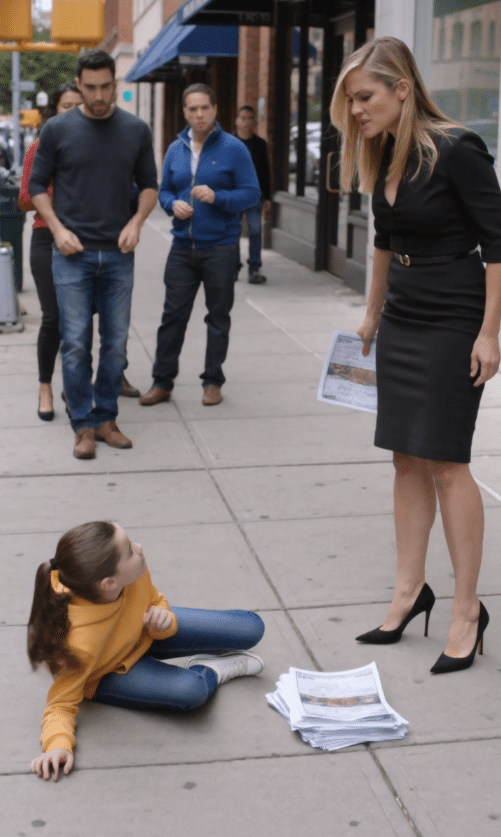
The woman’s voice cut through the lunchtime noise just as the little yellow flyer slipped from twelve-year-old Emily Carter’s fingers and fluttered onto the sidewalk.
Emily froze.
“I’m sorry. It is just a lunch coupon.”
She stood outside a small family restaurant wearing an old yellow hoodie, faded jeans, and sneakers whose white soles had turned gray from months of use. A stack of coupon flyers rested beside her feet, held together with a rubber band that had already begun to snap.
The woman in front of her looked as though she had stepped out of a corporate magazine. Her black pencil skirt was immaculate, her white blouse perfectly pressed, and her designer handbag hung from her arm as casually as if it were an extension of her body.
Her name was Vanessa Whitmore.
At thirty-two, Vanessa was a rising executive at a luxury property development firm. She attended expensive charity dinners, had a downtown apartment with floor-to-ceiling windows, and believed that the way people dressed told her almost everything she needed to know about them.
Emily, in Vanessa’s eyes, was exactly the kind of person she had spent her life avoiding.
Poor.
Unimportant.
Inconvenient.
The flyer had barely brushed Vanessa’s hand when she snatched it away and held it between two fingers as though it were contaminated.
“Do you have any idea how much this costs?” Vanessa demanded, gesturing toward her handbag.
Emily shook her head.
“No, ma’am.”
“More than your entire outfit, probably.”
A few pedestrians slowed down.
Emily felt their attention settle on her, but she kept her eyes on the fallen flyers. She had promised her father she would hand out every last one before the lunch rush ended.
Their restaurant, Carter’s Kitchen, had been struggling for months.
It wasn’t fashionable. It didn’t have marble countertops or celebrity chefs posing beside carefully arranged plates. It had scratched wooden tables, mismatched chairs, an old chalkboard menu, and a kitchen that smelled of roasted garlic, simmering tomatoes, and fresh bread.
But the food was good.
It was the kind of place where construction workers ate beside nurses finishing night shifts. Where a retired teacher could sit for an hour over a bowl of soup without being hurried. Where a customer who was short three dollars could still leave with a full meal.
Emily loved it.
She had grown up doing homework at the corner table, listening to her parents argue affectionately over recipes and watching her father slip extra bread into bags for customers who looked as though they needed it.
Now the restaurant was in danger of closing.
A rent increase had arrived just as the cost of ingredients climbed. Two regular customers had moved away, a nearby office building had switched its lunch arrangements, and a burst pipe had forced the family to close for several days.
Emily’s parents had cut their own spending before cutting anyone else’s hours.
Her father, Daniel, had even stopped replacing his worn work shoes.
So Emily had come up with an idea.
She designed a lunch coupon offering a free homemade dessert with any entrée. Her mother printed the flyers at the cheapest local copy shop, and Emily volunteered to distribute them before and after school.
She knew the coupons wouldn’t solve every problem.
But perhaps they would bring a few more customers through the door.
Perhaps those customers would return.
Perhaps, if enough people remembered Carter’s Kitchen, her father wouldn’t have to tell the landlord they could no longer afford the rent.
Vanessa knew none of this.
She saw only a child standing on a busy sidewalk, holding cheap paper and blocking her path.
“I’m trying to help my parents bring in customers,” Emily explained quietly. “You might like the food. We have homemade chicken pot pie today.”
Vanessa stared at her.
“You think I’m going to eat here?”
Emily’s cheeks burned.
“I just thought—”
“That’s your problem. You think people want what you’re selling.”
Vanessa dropped the flyer onto the sidewalk.
Then she stepped forward and kicked Emily hard in the chest.
Emily fell beside the stack of coupons, landing awkwardly on one hand. Pain shot through her as her palm scraped against the pavement, leaving a thin red mark.
For a second, the street seemed to lose its sound.
A delivery cyclist stopped near the curb.
A woman carrying a coffee covered her mouth.
Two office workers stared from several feet away, neither one moving.
Emily struggled to catch her breath.
She looked up at Vanessa, bewildered, as if she were still waiting for someone to explain how a simple apology had turned into this.
Vanessa stepped closer.
Then she delivered two more forceful kicks, one toward Emily’s back and another toward her side.
The flyers scattered across the sidewalk.
A few drifted beneath a parked car. Others landed near the restaurant window, where the words SUPPORT YOUR LOCAL FAMILY RESTAURANT were printed in bright red letters.
Emily curled inward, trying to protect herself.
Vanessa straightened and brushed imaginary dust from her skirt.
“Advertise where no one has taste.”
Nobody answered.
The pedestrians who had stopped to watch stood frozen, their faces caught between horror and uncertainty. Some looked toward the restaurant. Others looked away, as though refusing to witness the scene might somehow make it less real.
Then a black rideshare car pulled to the curb.
The rear door opened.
A man in a gray suit and dark overcoat stepped out, holding a leather portfolio in one hand. He was in his mid-fifties, with silver beginning to show at his temples and the composed expression of someone accustomed to being listened to.
He had been reading a message on his phone.
Then he heard the impact, looked up, and saw a little girl on the pavement surrounded by scattered lunch coupons.
His expression changed instantly.
He crossed the sidewalk in several quick strides.
Before Vanessa could turn away, he stepped between her and Emily and struck Vanessa once across the face with an open hand.
The sound cracked through the street.
Vanessa stumbled backward, one hand flying to her cheek.
“Have you lost your mind?” she shouted.
The man ignored her.
He bent down, picked up one of the flyers, and studied it for a moment.
Then he looked at the restaurant behind Emily.
“That paper may save the best kitchen you were too blind to see.”
Vanessa stared at him.
“Best kitchen?”
For the first time all afternoon, she had no idea what was happening.
And the man standing in front of her was about to explain why a cheap coupon from a struggling family restaurant mattered more than she could possibly imagine.
Act II
His name was Marcus Hale.
To the average person walking down the street, he might have looked like another well-dressed businessman heading to lunch.
To anyone who followed the American restaurant industry, however, Marcus was a familiar name.
For nearly twenty years, he had been one of the country’s most influential food critics. His reviews could transform an unknown restaurant into a destination or expose an establishment that relied on beautiful décor to disguise mediocre food.
He had also become a restaurant investor, backing small independent kitchens with exceptional food and promising owners who lacked the money or connections to compete with larger chains.
Marcus had built his reputation on a belief that sounded simple but was surprisingly rare.
A restaurant should be judged by what comes out of its kitchen, not by the price of its chairs.
He had eaten in palaces where every plate arrived beneath a silver dome and the food tasted like an afterthought.
He had also eaten in roadside diners where a cook remembered every customer’s name and turned inexpensive ingredients into something unforgettable.
The latter had stayed with him longer.
Years earlier, Marcus had published a review of a struggling neighborhood restaurant that had no advertising budget and almost no online presence. His article had brought in so many customers that the owners had been able to pay their overdue bills and keep their doors open.
Since then, he had quietly made it his mission to discover restaurants that deserved to survive but lacked the resources to be noticed.
That was why he had come to Carter’s Kitchen.
Three weeks earlier, an editor at a regional food magazine had mentioned a family restaurant that had been serving the downtown neighborhood for more than two decades. The owner reportedly made an extraordinary chicken pot pie, the kind with a buttery crust that shattered under a fork and a filling seasoned slowly rather than hurriedly.
A former customer had described the restaurant as the place that fed her entire nursing shift during a winter storm.
Another had said the owner’s wife once stayed open two hours late because a group of stranded travelers had nowhere else to go.
Marcus had heard dozens of stories like those.
Most were exaggerated.
Some were not.
He had planned to visit Carter’s Kitchen anonymously, eat lunch, and decide for himself.
The rideshare driver had dropped him outside just as Vanessa began attacking Emily.
Now Marcus stood with a crumpled flyer in his hand, looking from the injured child to the woman who had hurt her.
“Someone should call for medical help,” he told the people nearby. “And please preserve any video of what happened.”
A man near the curb immediately reached for his phone.
Another pedestrian finally stepped forward, offering to gather the scattered flyers.
Marcus turned toward Vanessa.
“Step away from the child.”
Vanessa’s eyes flashed.
“You have absolutely no right to touch me.”
“You’re right,” Marcus said. “I shouldn’t have struck you. That was wrong, and I’ll answer for it.”
His calm acknowledgment seemed to catch her off guard.
“But what you did to her is still going to be documented.”
Vanessa looked around for support.
She was accustomed to people taking her side, or at least pretending not to notice when she crossed a line. In business meetings, she could silence junior employees with a glance. At social events, people laughed at her jokes even when they weren’t funny.
Here, nobody laughed.
The pedestrians had seen what happened.
They had watched a twelve-year-old girl offer a coupon and apologize when the paper brushed someone’s hand.
They had watched an adult respond with violence.
And now they were looking at Vanessa as if her expensive clothes had become a costume.
Marcus crouched beside Emily without touching her unnecessarily.
“What’s your name?”
“Emily,” she whispered.
“I’m Marcus. Help is coming. Can you tell me if you’re having trouble breathing?”
Emily shook her head slightly, though she was frightened and clearly in pain.
Marcus stayed beside her while another bystander called emergency services. He asked someone to bring Emily’s parents from inside the restaurant.
Then he glanced at the flyer again.
The coupon was printed on inexpensive paper. The ink had smudged slightly where it had landed on the sidewalk, and one corner was bent.
But the message was simple.
A family restaurant.
A homemade dessert.
An invitation to give a small business a chance.
Marcus looked through the restaurant window.
Inside, a woman in an apron stood behind the counter, staring at the scene outside with one hand pressed to her mouth. A man emerged from the kitchen, still wearing a white chef’s coat, his face drained of color when he saw his daughter on the pavement.
He ran toward the door.
“Emily!”
Daniel Carter reached his daughter in seconds and dropped to his knees beside her.
His wife, Rachel, followed close behind.
“Oh, sweetheart. What happened?”
Emily began to cry when she heard her mother’s voice.
“I was just giving her a coupon.”
Rachel wrapped an arm around her daughter as carefully as she could.
Daniel looked up at Marcus, then at Vanessa.
“What did you do?”
Vanessa immediately raised her chin.
“She got in my way. I barely touched her.”
Several people reacted at once.
“You kicked her,” one witness said.
“We all saw it,” another added.
Vanessa’s face tightened.
“This is ridiculous. Do you know who I am?”
Marcus slowly stood.
“Yes,” he said. “I know exactly the kind of person you chose to be today.”
Vanessa stared at him, but before she could answer, Marcus turned toward Daniel.
“I was coming in to have lunch. I heard the commotion and saw what happened.”
He held up the flyer.
“And now I’d like to understand why this restaurant is trying so hard to bring people through its doors.”
Daniel looked at the paper, confused.
Rachel was still holding Emily’s hand.
For the moment, they had only one concern: getting their daughter medical attention and making sure she was safe.
But Marcus could already see something in the family’s faces that he recognized.
They were frightened, exhausted, and worried about what would happen next.
And beneath all of it was a quiet embarrassment, as though they somehow felt responsible for the trouble that had come to their doorstep.
Marcus knew that feeling.
He had seen it in countless small business owners who had worked themselves to the bone, only to be told that they were not polished enough, connected enough, or wealthy enough to deserve a chance.
He looked down at the coupon again.
Then he made a decision.
He was going to eat at Carter’s Kitchen.
Not out of pity.
Not because a little girl had been hurt.
He was going to eat there because the restaurant deserved to be judged on its own merits.
And if the food was as good as people had told him, Vanessa Whitmore was about to discover that the paper she had treated like garbage might be worth far more than the designer handbag hanging from her arm.
Act III
The paramedics arrived within minutes.
They examined Emily, asked her questions, and recommended that she be taken for further evaluation because of the force of the assault and the pain she was experiencing. Rachel accompanied her, while Daniel stayed long enough to provide the witnesses with his contact information before following them.
Emily was frightened, but she was conscious and able to speak.
Before she left, she looked back toward the scattered coupons.
“Dad, I’m sorry.”
Daniel stared at her.
“Sorry for what, sweetheart?”
“I didn’t finish handing them out.”
For a moment, he couldn’t answer.
Then he leaned down and kissed her forehead.
“You don’t have to finish anything today. You just have to get better.”
He watched the ambulance pull away before turning toward the restaurant.
Vanessa remained on the sidewalk, furious that the afternoon had become something she could not control.
She had already begun composing an explanation in her head.
The girl had approached her aggressively.
The man in the gray suit had assaulted her.
The crowd had misunderstood.
If she presented the situation confidently enough, perhaps people would accept her version.
That strategy had worked for her before.
She had built a career in commercial property development by making difficult conversations sound like misunderstandings and bad decisions sound like calculated risks. When a junior colleague challenged her, she could frame the disagreement as incompetence. When a contractor complained about a late payment, she could remind him how fortunate he was to have the contract.
She rarely considered herself cruel.
In her own mind, she was simply someone who refused to waste time on people who couldn’t keep up.
Emily’s mistake, as Vanessa saw it, was not offering a coupon.
It was assuming that Vanessa might be interested.
The idea that the child had been working to help her family had barely registered.
Marcus, however, was paying attention.
He asked the restaurant’s manager to preserve any available security footage and requested the contact details of witnesses who were willing to provide statements. He made no promise about what the police would do, and he did not pretend that his reputation placed him above the law.
He also made a call to his office.
“I’m at Carter’s Kitchen downtown,” he said. “I need the notes from the original recommendation. The full file, including the customer’s letter.”
He listened.
“Yes, that one.”
A pause.
“Send it over.”
Vanessa caught the name of the publication Marcus mentioned and suddenly looked more closely at him.
She had seen his face before.
Not in person, perhaps, but in newspaper profiles and restaurant-industry interviews. She remembered a photograph of a silver-haired critic standing outside a celebrated New York restaurant. She remembered an article about a small-town chef whose business had been rescued after Marcus praised his food.
Her expression changed.
“You’re Marcus Hale?”
He looked at her.
“Yes.”
Vanessa straightened.
The anger in her face gave way to something more calculating.
“I think there has been a misunderstanding.”
Marcus glanced at the flyer in his hand.
“Which part?”
“The child approached me. The situation escalated.”
“You kicked her.”
“I was startled.”
“So was she.”
Vanessa pressed her lips together.
Then she tried a different approach.
“I’m sure we can settle this privately. I’m a major client of several restaurants in this city. I know people who would be interested in what happened to you just now.”
Marcus studied her for a moment.
“You’re concerned about my reputation?”
“I’m concerned about fairness.”
“Then you should have considered fairness before you attacked a child.”
Vanessa’s jaw tightened.
Marcus turned toward the restaurant window.
“I’m going inside.”
He did not invite Vanessa to follow him.
He did not threaten her with his contacts or promise that he would destroy her career.
He simply walked through the restaurant door.
A small bell rang overhead.
Inside, the dining room was modest but immaculate. Sunlight fell across wooden tables, and the smell of fresh bread drifted from the kitchen. A handwritten menu hung beside the counter, listing soups, sandwiches, pies, and daily specials.
Marcus took a seat near the window.
Daniel came out from the kitchen, his face still strained.
“I’m sorry,” he said. “This is not how we wanted your visit to go.”
Marcus looked up.
“You have nothing to apologize for.”
“I should have been outside with her.”
“You were working.”
Daniel lowered his eyes.
“I should have noticed sooner.”
Marcus recognized the guilt immediately.
It was the kind parents often carried after something terrible happened to their children, even when they had done nothing to cause it.
“Your daughter was trying to help you,” Marcus said. “That isn’t something you should feel guilty about.”
Daniel nodded, but the worry remained.
He explained that Carter’s Kitchen had been in the family for twenty-three years. His father had opened it with a handful of borrowed tables and a secondhand stove. Daniel had taken over when his father became ill, and he and Rachel had spent most of their marriage trying to keep the restaurant alive.
They had survived a recession, a road construction project that cut off their parking lot, and a year when a major nearby employer closed its local office.
They had always found a way.
This time, however, the numbers were becoming frightening.
Their lease renewal included a substantial rent increase. Food costs had risen, and a new chain restaurant had opened two blocks away with a marketing budget larger than Carter’s Kitchen’s annual profit.
Daniel had considered taking out another loan.
Rachel had suggested cutting the menu.
Neither wanted to close.
Marcus listened without interrupting.
Then he asked for the chicken pot pie.
Daniel looked surprised.
“You’re sure?”
“That’s what brought me here.”
A few minutes later, Daniel returned with a plate.
The crust was golden brown, the filling rich without being heavy, and the vegetables still held their texture. The seasoning was restrained. Nothing on the plate seemed designed to impress someone taking photographs.
It was simply good food.
Marcus took one bite.
Then another.
He set down his fork and looked toward the kitchen.
“Who developed this recipe?”
“My father,” Daniel said. “I changed a few things over the years, but the foundation is his.”
Marcus took another bite, slower this time.
He recognized the balance of flavors, the care in the preparation, and the confidence of a cook who understood that a dish didn’t need expensive ingredients to be memorable.
He had tasted technically perfect food that left him cold.
This did not.
The pie reminded him of a meal he had eaten decades earlier at a family-owned restaurant in Pennsylvania, when he was a young reporter with little money and no connections. The owner had served him dinner after the kitchen had closed because she noticed he had been working through the evening.
That meal had helped him understand what food could do.
It could nourish.
It could comfort.
It could make a stranger feel welcome when the world had offered them little kindness.
Marcus looked at the coupon again.
Then he asked Daniel to bring him the rest of the day’s menu.
He wanted to know what else the kitchen could do.
Because the chicken pot pie had confirmed something important.
Carter’s Kitchen wasn’t a restaurant that needed to pretend to be something else.
It was a restaurant that needed people to discover what it already was.
Act IV
By late afternoon, the sidewalk outside Carter’s Kitchen had become the center of a story that was spreading faster than Vanessa could control.
Witnesses had contacted the authorities. At least two people had recorded portions of the incident, and several others had provided statements describing what they saw.
The videos did not show every second of the confrontation, but they contradicted Vanessa’s claim that she had barely touched Emily.
One clip showed the flyer brushing her hand.
Another captured her insulting the girl moments before the assault.
The recordings were turned over to the appropriate authorities, and the incident was handled through the proper process.
Marcus was careful not to interfere with that process.
He had no intention of using his professional influence to decide what consequences Vanessa should face. The evidence, the investigation, and the law would determine that.
But he could decide where he spent his own money.
And he could decide which restaurant he would recommend to his readers.
Over the next two days, Marcus returned to Carter’s Kitchen twice.
The first time, he sampled the homemade tomato soup and a roast chicken sandwich. The second time, he ordered the pot pie again and spoke with Rachel about the family recipes.
He watched how the staff treated customers.
He noticed that Daniel remembered the preferences of regulars and that Rachel quietly checked whether an elderly customer needed help carrying a tray. He saw a construction worker share his lunch with a colleague who had forgotten his wallet.
Nobody appeared to be performing for Marcus.
They were simply running the restaurant the way they always had.
That mattered to him.
He also noticed the empty tables.
At lunch, the restaurant should have been busier. Instead, a handful of customers sat scattered across the dining room, while the staff moved with the careful efficiency of people who knew every wasted minute mattered.
Daniel never complained.
He greeted each customer warmly, refilled coffee, and returned to the kitchen to prepare orders.
But Marcus could see the strain in his face.
One evening, he asked Daniel a question that made the owner stop wiping the counter.
“If you had enough money to stabilize this business for the next year, what would you do?”
Daniel looked at him cautiously.
“Pay the rent. Replace the refrigerator that’s been failing. Catch up on the bills we’ve been stretching out.”
“And after that?”
Daniel thought for a moment.
“I’d hire another cook. Give my staff more predictable hours. Maybe reopen the breakfast menu.”
He gave a small, embarrassed laugh.
“I’ve got a lot of plans for a man who spends most of his time worrying about next month’s rent.”
Marcus nodded.
“Plans are useful.”
He did not offer Daniel a check on the spot.
He did not promise that a famous review would solve every problem.
Instead, he asked for the restaurant’s financial records, current lease terms, and a breakdown of its operating costs. He explained that if he considered an investment, he would want to understand the business properly.
Daniel agreed.
The following week, Marcus’s team reviewed the numbers.
Carter’s Kitchen had loyal customers, manageable food costs, and a menu that could support modest expansion. Its biggest problem was visibility. The restaurant was known among longtime residents but had almost disappeared from the attention of the newer downtown crowd.
The family had never had the money to run a serious advertising campaign.
Emily’s coupon idea had been one of their few attempts to reach beyond their regular customer base.
It was a small gesture.
But it had revealed how much the restaurant meant to the people who knew it.
Marcus decided to write about Carter’s Kitchen.
His review did not mention Vanessa by name. He did not use the assault to manufacture a dramatic headline, and he did not pretend that one good meal made a restaurant perfect.
He wrote about the food.
He described the chicken pot pie, the homemade soup, and the care behind the recipes. He explained that the restaurant offered something increasingly rare in a city crowded with carefully designed dining rooms: food made to be enjoyed rather than photographed.
He also wrote about the family’s history and the neighborhood that had supported them for more than two decades.
The review was published on a Friday morning.
By ten o’clock, Carter’s Kitchen’s phone had begun ringing.
By eleven, customers were gathering outside.
At noon, every table was occupied.
Daniel stood behind the counter, staring at the line stretching toward the door.
Rachel moved between tables with tears in her eyes, trying to greet customers while keeping up with the orders.
A woman who had not visited in years came in with her adult daughter. A group of nurses arrived from a nearby hospital. A construction crew ordered enough food to fill two long tables.
And tucked among the customers were people who had read the review that morning and decided to try the restaurant for themselves.
One of them carried a folded coupon.
Emily’s coupon.
The woman placed it on the counter and smiled at Daniel.
“Your daughter gave this to me last week. I didn’t have time to come in then.”
She looked around the crowded dining room.
“I wish I’d come sooner.”
Daniel could not speak for a moment.
He looked at the coupon, then toward the kitchen where his staff was working at full speed.
The restaurant had not been saved by a glamorous advertising campaign.
It had not been rescued by an anonymous billionaire dropping a fortune on the counter.
It had been noticed.
Its food had been tasted, its story had been heard, and its value had finally reached people who had never known it existed.
Later that afternoon, Marcus met with Daniel and Rachel to discuss a potential investment.
He proposed helping them stabilize the business in exchange for a minority ownership stake, with the details subject to a formal agreement. He wanted the restaurant to remain family-run, and he had no interest in turning it into an expensive concept that would abandon its original customers.
Daniel listened carefully.
Then he asked the question that mattered most.
“Would you want to change the menu?”
Marcus smiled.
“I’d want to protect what makes people come here. We can improve the business without pretending it needs to become something else.”
For the first time in months, Daniel allowed himself to imagine a future beyond survival.
But while Carter’s Kitchen was beginning a new chapter, Vanessa was facing a reality she had never expected.
Her behavior had been documented.
The people who witnessed the incident were cooperating with the investigation.
And the story was no longer something she could dismiss as a private disagreement.
Her employer learned of the incident through the public attention surrounding it. The company began its own review, focusing on her conduct and the evidence available. Clients and colleagues who had previously accepted her version of events were now asking questions she could not answer with a confident smile.
Marcus did not demand that she lose her job.
He did not call her employer to threaten her.
He did not need to.
The choices Vanessa had made on the sidewalk were hers, and the consequences were no longer under her control.
For the first time, she understood what it felt like to have other people judge her by what she had actually done rather than by the image she had carefully constructed.
And the most humiliating part was not that a famous food critic had seen her at her worst.
It was that the little girl she had dismissed as worthless had been trying to save something valuable.
Something Vanessa had never bothered to understand.
Act V
Three months later, Carter’s Kitchen was busier than it had been in years.
The family had used part of the new investment to repair the failing refrigerator, address overdue expenses, and hire an additional cook. They expanded the breakfast menu and introduced a rotating dessert special based on Rachel’s recipes.
Daniel still arrived early.
Rachel still checked on regular customers.
The restaurant’s chairs were still mismatched, the chalkboard menu still carried handwritten changes, and the kitchen still smelled of fresh bread before the first customers arrived.
Marcus had insisted on keeping those things.
He believed that a business could grow without erasing the character that made it worth saving.
The restaurant was not suddenly perfect. It still faced rising costs, staffing challenges, and the ordinary uncertainty of running a small business.
But the family was no longer making every decision under the threat of immediate closure.
They had room to plan.
And Emily had returned to school with something she had not possessed before the incident.
Confidence that her effort mattered.
The first few days after the assault had been difficult. She had been frightened by sudden movements and embarrassed whenever someone recognized her from the circulating video clips.
Her parents had made sure she received appropriate medical care and emotional support. They also reminded her that the incident was not her fault, no matter how many times she replayed it in her mind.
Eventually, Emily began helping at the restaurant again.
She didn’t return to the sidewalk immediately.
Instead, she helped prepare dessert menus and organize the new coupon campaign from inside the restaurant. When she felt ready, she volunteered to distribute flyers again, this time with a parent or another staff member nearby.
The new flyers looked much like the old ones.
Cheap paper.
Bright red letters.
A simple offer for anyone willing to try a family-owned restaurant.
But now, people recognized the name.
One Saturday afternoon, Emily stood near the restaurant window, arranging a fresh stack of coupons on a small table.
A young couple approached.
“Are you the girl who made these?” the woman asked.
Emily hesitated.
“I helped design them.”
The woman smiled.
“My husband and I came because of the review. The chicken pot pie was incredible.”
Emily’s face brightened.
“Thank you.”
“We brought our parents last weekend,” the man added. “They’re coming again next month.”
Emily watched them walk inside.
Then she looked down at the coupons.
For weeks, she had believed that the flyers had failed because one person had treated them like garbage.
Now she understood that the paper had never been the problem.
It had simply needed to reach people willing to look beyond its appearance.
Vanessa’s situation had also changed.
The investigation into the assault proceeded through the appropriate legal channels. The available evidence and witness statements were considered, and Vanessa faced the consequences determined through that process.
Her professional life became more complicated as her employer reviewed her conduct. Some colleagues distanced themselves. Others who had once admired her confidence began to question whether it had ever been confidence at all.
She had built her reputation around being the person who recognized value before anyone else.
But on that sidewalk, she had failed to recognize it when it was standing directly in front of her.
She had seen a poor child in an old yellow hoodie and assumed there was nothing worth respecting.
She had seen an inexpensive coupon and decided it was worthless.
She had seen a small family restaurant and believed it belonged to people who could never matter to someone like her.
Every assumption had been wrong.
One afternoon, several months after the incident, Vanessa found herself walking down the same downtown street.
She had a meeting nearby and had chosen the route out of habit.
As she approached Carter’s Kitchen, she slowed.
The windows were bright. Customers filled the tables. A handwritten sign announced the day’s dessert special, and people stood near the entrance waiting for a table.
Through the glass, Vanessa could see Daniel carrying a tray and Rachel speaking with a customer.
Then she saw Emily.
The girl was standing near the counter, laughing as she helped an older customer gather a few wrapped desserts.
She looked healthier now.
More relaxed.
The old yellow hoodie was gone, replaced by a simple blue sweater. Her ponytail was slightly crooked, and a smear of flour marked one sleeve.
She looked like an ordinary twelve-year-old helping her family.
Vanessa stopped outside.
For a moment, she considered going in.
She imagined offering an apology, explaining that she had been under stress, admitting that she had lost control.
But every version of the speech seemed to begin with an excuse.
She had been busy.
She had been startled.
She had been having a difficult day.
None of those things changed what she had done.
And none of them explained why she had chosen to hurt a child who had apologized to her.
Through the window, Emily looked toward the street.
Their eyes met.
Vanessa stood motionless.
Emily recognized her.
The girl’s smile faded, and for one quiet second, Vanessa saw the memory return to her face.
There was no triumphant expression.
No mocking laughter.
Emily did not point at her or call the other customers over.
She simply turned away and continued helping the person in front of her.
That was all.
And somehow, it was worse than being shouted at.
Vanessa had wanted to believe that she was the important person in that encounter, the one whose time and dignity mattered most.
But Emily had continued living.
Her family had continued working.
Their restaurant had survived.
The world had not stopped because Vanessa had entered it and demanded to be treated as someone superior.
For the first time, Vanessa began to understand that the humiliation she feared most was not public embarrassment.
It was the possibility that people might remember her accurately.
Not as the successful executive with the expensive handbag.
Not as the woman who attended exclusive dinners and spoke confidently in boardrooms.
But as the adult who had hurt a child because a piece of paper brushed her hand.
Inside the restaurant, Emily returned to the counter.
Daniel called her over to help arrange a tray of freshly baked desserts.
She hurried toward him, smiling again.
Marcus Hale happened to be seated near the window, reviewing a menu for another restaurant he was considering. He watched Emily pass and then glanced outside, where Vanessa had finally continued down the sidewalk.
He did not call after her.
He did not need to.
He turned back to his meal.
The chicken pot pie was as good as it had been on his first visit, and the restaurant was full of people who had come because someone had given it a chance.
On the counter beside the register sat a framed copy of Emily’s original coupon.
The paper was inexpensive.
The printing was imperfect.
One corner had been folded, and the red letters were beginning to fade.
Daniel had placed it there because he wanted to remember the moment his daughter tried to help the family in the only way she knew how.
Emily had once believed that the coupon needed to be perfect to persuade people to enter the restaurant.
Now she knew better.
It only needed to reach someone willing to look.
And that was the lesson Vanessa had learned too late.
She had mistaken wealth for worth, appearance for quality, and a child’s poverty for proof that the child had nothing to offer.
But the girl in the yellow hoodie had helped save a restaurant that served an entire neighborhood.
The paper Vanessa had called garbage had carried an invitation that brought new customers through the door.
And the family she had dismissed as insignificant had built something she could never purchase with a designer handbag or a prestigious job title.
A place where people mattered more than appearances.
A place where a child could help her parents and still be treated with dignity.
A place where good food was judged by the care behind it, not the price of the plate.
By the end of the year, Carter’s Kitchen had become one of the downtown neighborhood’s busiest lunch spots. Emily’s coupon campaign continued, now printed in larger batches and distributed by several local students who wanted to help small businesses in their community.
The family never forgot how close they had come to losing everything.
They also never forgot the strangers who had finally stepped forward, provided statements, visited the restaurant, or simply ordered lunch when the tables were empty.
Their success did not erase what had happened.
But it gave the family something powerful in return.
A future they could build together.
And every time a customer walked through the door holding one of those little coupons, Emily remembered that an ordinary piece of paper could carry an extraordinary possibility.
Vanessa had looked at that paper and seen garbage.
Marcus had looked at it and seen a restaurant worth discovering.
Emily had looked at it and seen a chance to help her family.
Only one of them had understood its true value.
Because the worth of something is not determined by the person who looks down on it. Sometimes, the smallest invitation can open the door to something extraordinary—and the person who refuses to see its value is the one who loses the most.
Make Marcus’s intervention legally believableReduce repeated moral explanations