Act I
“Trash. Serve people with money first.”
The insult rang across the county fair, cutting through the cheerful music, the sizzling sound of grilled corn, and the laughter of families gathered beneath the warm lights.
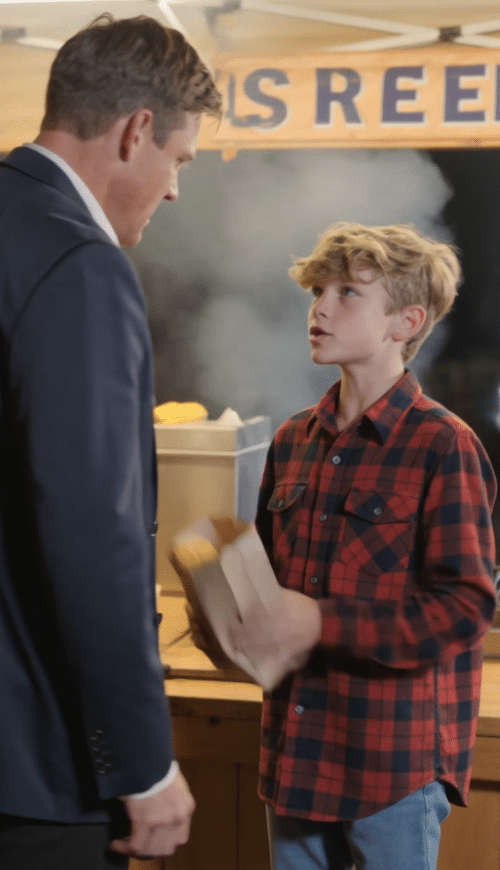
Fourteen-year-old Noah Bennett stood behind a small food stand, clutching an empty paper bag in one hand. His red flannel shirt was rolled up at the sleeves, his jeans were stained from a long day of work, and a small apron hung loosely around his waist.
He looked up at the man towering over him.
“I did serve you,” Noah said quietly. “He ordered first. Yours is next.”
The man stared at him as though the boy had just committed an unforgivable offense.
His name was Grant Holloway, a thirty-nine-year-old businessman wearing a navy blazer, an immaculate white shirt, and a luxury watch that caught the fairground lights whenever he moved his wrist. He had arrived expecting everything to happen on his schedule, and the sight of another customer receiving a bag of fresh grilled corn before him had become an insult he couldn’t tolerate.
Behind Noah, a fresh batch of corn rested near the grill, its golden kernels glistening with butter. A handful of customers waited patiently, exchanging smiles and chatting with the elderly woman who managed the stand.
It was an ordinary evening.
Until Grant decided that a fourteen-year-old boy needed to be taught his place.
“Do you have any idea who you’re talking to?” Grant demanded.
Noah shook his head.
“No, sir.”
“Then perhaps you should learn some manners before you start serving people.”
“I wasn’t trying to be rude.”
“Clearly, you don’t understand how business works.”
Noah glanced toward the first customer, an older man who had been waiting patiently for several minutes. He had ordered before Grant arrived, and Noah had handed him the first bag as soon as it was ready.
That was all.
No cheating. No favoritism. No disrespect.
Just a boy keeping his promise to serve people in the order they had arrived.
“My grandma always says we should treat everybody the same,” Noah explained. “I’m sorry you had to wait.”
Grant’s expression darkened.
“Your grandma?”
The way he said it made the word sound like an insult.
Noah lowered his eyes, hoping the argument would end. His grandmother, Margaret Bennett, had taught him that there was no shame in honest work, no matter how small the job appeared to other people.
She had also taught him never to mistake someone’s expensive clothes for good character.
But Noah was fourteen, tired from standing beside the hot grill, and painfully aware that the man in front of him could buy more in an afternoon than his family earned in months.
He wanted the confrontation to disappear.
He reached for another paper bag.
Grant moved first.
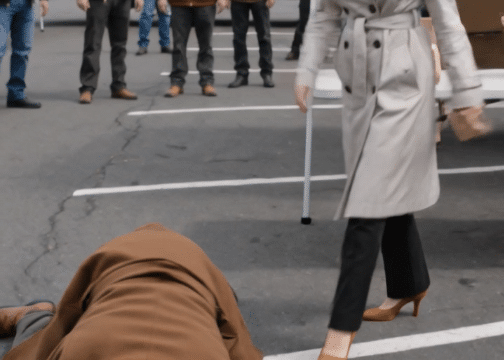
His foot struck Noah in the chest with sudden force, sending the boy crashing beside the food stand. The impact knocked him away from the counter, and his forearm scraped against the ground as he tried to catch himself.
The paper bags scattered.
One rolled beneath the counter. Another landed beside a customer’s shoe.
For a moment, Noah could only stare upward, stunned by what had happened.
He had never imagined that a simple mistake in serving food could make an adult attack him.
Grant stepped around the counter’s side and delivered two more forceful kicks as Noah struggled to protect himself.
A woman in line gasped and covered her mouth.
A father pulled his young daughter closer. Two workers froze beside the grill, their faces drained of color.
Nobody had expected violence at a county fair.
And nobody seemed to know what to do when it arrived.
Noah curled inward, one arm pressed against his body. A thin trace of blood marked his scraped forearm, but he barely noticed it. His attention remained fixed on Grant, whose expression suggested that the assault had somehow been justified.
“Learn business from the dirt,” Grant said contemptuously.
He straightened his blazer and glanced toward the line.
“Maybe now the rest of you understand how things are supposed to work.”
The fairground music continued playing.
The lights still glowed overhead.
But the little crowd around the corn stand had fallen silent.
Then a door opened inside the nearby fair office tent.
A man in a dark uniform jacket stepped out, his badge catching the light.
He saw the boy on the ground.
He saw the scattered bags of corn.
And he saw Grant standing over a child who had done nothing more than honor the order of a line.
The man’s expression changed instantly.
Because Grant Holloway had just made the worst mistake of his life.
And he had no idea whose family he had chosen to humiliate.
Act II
Noah Bennett had never been embarrassed by his family’s food stand.
In fact, it was one of the few places where he felt genuinely proud of what he could do.
Every summer, his grandmother Margaret brought her small grilled-corn business to the county fair. She had been doing it for more than thirty years, arriving before sunrise to prepare the grill, organize the supplies, and arrange the paper bags beneath the counter.
Her stand wasn’t fancy.
It had no digital ordering system, no polished advertising campaign, and no expensive decorations. A hand-painted sign hung above the counter, its lettering faded by years of summer sun and autumn rain.
But people returned every year.
Some came because Margaret’s corn was delicious. Others came because she remembered their names, asked about their children, and sometimes slipped an extra ear of corn into a bag for a family struggling to afford dinner.
To Margaret, the stand was never just a business.
It was a promise.
When Noah’s father died in a highway accident three years earlier, Margaret had helped Noah and his mother, Claire, survive the months that followed. She watched Noah after school, helped Claire keep their small house, and made sure the boy never felt that his father’s absence meant the family had lost everything.
Money remained tight.
Claire worked long shifts at a local nursing home, often returning after Noah had already finished his homework. Margaret’s pension covered some expenses, but medical bills and the rising cost of groceries left little room for emergencies.
Noah had started helping at the stand because he wanted to contribute.
At first, Margaret let him carry supplies and fold paper bags. Later, she taught him how to prepare the corn, keep track of orders, and calculate change without relying on a calculator.
She never treated him like a servant.
She treated him like a young person learning responsibility.
And she always insisted on one rule.
“First come, first served,” she would tell him. “The person standing in front of you is just as important as the person who might spend twice as much.”
Noah had asked her once why she cared so much about something so simple.
Margaret had looked at him for a long moment before answering.
“Because people show you who they are when they think someone else doesn’t matter.”
He hadn’t fully understood the lesson then.
He understood it now.
Grant Holloway, meanwhile, had spent most of his adult life believing the opposite.
He had built a successful regional real estate business by purchasing commercial properties, negotiating favorable contracts, and surrounding himself with people who rarely challenged him.
He was accustomed to having assistants arrange his appointments, staff members anticipate his preferences, and business partners compete for his approval.
When something went wrong, he expected someone else to fix it.
When someone disagreed with him, he assumed they had misunderstood the situation.
And when a person with little money or influence stood in his way, he often treated that person as though their objections were irrelevant.
Grant considered this confidence.
His employees called it something else when he wasn’t around.
At the fair, his irritation had begun long before he reached Noah’s stand.
A traffic delay had made him late for a dinner meeting. The parking lot was crowded, the food vendors were busy, and the entire event seemed determined to inconvenience him.
He had purchased a drink at another booth and complained when it wasn’t cold enough. He had snapped at a volunteer who directed him toward a longer line. By the time he reached the corn stand, he had already decided that the evening was beneath him.
Then he watched Noah hand a bag of corn to another customer.
Grant interpreted the ordinary transaction as a deliberate insult.
The boy’s modest clothes, small apron, and quiet manner made him appear powerless. Grant assumed he could intimidate him without consequences.
What Grant didn’t know was that Margaret Bennett had become one of the most respected people in the county.
She had never sought political influence. She had never advertised her charitable work or asked anyone to praise her.
But for decades, she had quietly helped families in need.
When a local factory closed, she delivered food to households whose parents had suddenly lost their jobs. When a storm damaged several homes, she used her savings to help buy supplies. When the county fair struggled financially, she donated part of her earnings to keep the event affordable for local families.
She knew the names of the volunteers, the maintenance workers, the firefighters, and the farmers who supplied the fair.
More importantly, she had earned their trust.
The county sheriff, Daniel Brooks, had known Margaret for nearly twenty years. He had seen her deliver meals to emergency crews during severe weather and had watched her refuse payment when a struggling family couldn’t afford food.
He was fifty-seven years old and had served in law enforcement for most of his adult life. In addition to being sheriff, he chaired the county fair board, a volunteer position he took seriously because the fair supported local businesses, agricultural programs, and scholarships for young people.
Daniel was at the fair that evening to review preparations for the following day’s agricultural awards ceremony.
He had not been looking for trouble.
But when he stepped out of the office tent and saw Noah on the ground, the decision about what to do required no thought at all.
He hurried toward the stand.
Grant turned just as Daniel reached him.
“What happened here?” the sheriff demanded.
Grant looked at the badge.
Then at the man wearing it.
For the first time that evening, his expression became uncertain.
But he still believed that a few carefully chosen words would allow him to control the situation.
He was about to discover how wrong he was.
Act III
Daniel Brooks reached the corn stand just as Grant began to speak.
“This kid got aggressive with me,” Grant said quickly. “He was rude, and I had to defend myself.”
Daniel looked at Noah.
The boy was lying beside the stand, trying to sit up without aggravating his injuries. A worker had finally moved closer, kneeling beside him and asking whether he could hear her.
Daniel’s eyes returned to Grant.
“You’re telling me the boy attacked you?”
“He disrespected me.”
“That wasn’t my question.”
Grant straightened his shoulders.
“I don’t appreciate being treated like I’m nobody. I was waiting for my food, and he decided someone else mattered more.”
Daniel stared at him.
“So you kicked him?”
Grant’s mouth tightened.
“He needed to learn a lesson.”
The sheriff’s expression hardened.
Before Grant could say anything else, Daniel stepped between him and Noah. When Grant attempted to move past him, still gesturing angrily toward the boy, Daniel delivered one straight punch to Grant’s face, stopping his advance.
Grant stumbled backward, stunned.
The crowd recoiled.
Daniel immediately positioned himself between the businessman and Noah, ordering Grant to keep his distance while signaling to a fair worker to call for medical assistance.
Then he turned toward the boy.
“Stay where you are, son. Help is coming.”
Noah nodded faintly.
Daniel crouched nearby, careful not to move him unnecessarily.
“Can you tell me your name?”
“Noah,” the boy whispered.
“Noah Bennett?”
The boy looked surprised.
“Yes, sir.”
Daniel recognized the name.
Not because Noah was famous, wealthy, or connected to an influential political family.
He recognized it because he knew Margaret Bennett.
He had eaten at her stand during dozens of county fairs. He had watched her work through rainstorms, heat waves, and years when the event struggled to attract enough visitors. He knew how much she had sacrificed to keep the business running and how fiercely she protected her family.
But the fact that Noah was Margaret’s grandson wasn’t what made Daniel intervene.
He would have done the same for any child.
The connection mattered for another reason.
Daniel knew what Margaret had done for the county, and he knew that the people who benefited from her generosity would never forget the sight of someone attacking her grandson in front of her food stand.
Grant, however, was too busy being angry to understand the situation.
“Are you going to arrest me?” he demanded. “Because if you are, I can have my attorney here before you finish writing the paperwork.”
Daniel rose slowly.
“You can contact your attorney.”
“Good. Because this is going to be a problem for you.”
Daniel looked at him without flinching.
“You assaulted a fourteen-year-old boy in front of multiple witnesses. We are going to document what happened, preserve any available footage, and conduct the appropriate investigation.”
Grant scoffed.
“He gave food to another customer first.”
“He told you that customer had ordered first.”
“He should have known better.”
“Known better than what?”
Grant hesitated.
Daniel took one step closer, his badge visible beneath the warm lights.
“Known better than to follow the rules? Known better than to treat people fairly? Or known better than to assume a man with an expensive watch deserves more respect than a child?”
Several people in the crowd lowered their eyes.
Others watched Grant with open disbelief.
The businessman glanced around, searching for someone who might validate his position. He found no one.
The woman who had been standing first in line stepped forward. She explained that Noah had served her in the correct order and had remained polite throughout the exchange.
A fair volunteer confirmed that Grant had kicked the boy.
Another witness said she had seen the two follow-up kicks.
The facts were becoming impossible to deny.
Grant’s face reddened.
“You people are making this into something it isn’t.”
Daniel turned toward the stand, where Noah was now being examined by a member of the fair’s medical team.
Then he faced Grant again.
“Do you know why this line came back for his family?”
Grant blinked.
“What?”
Daniel’s voice was quiet, but the surrounding crowd had become so still that everyone could hear him.
“This line came back for his family, not for men like you.”
Grant frowned.
He glanced at the customers, the workers, and the sheriff’s badge, struggling to understand why the conversation had suddenly shifted away from his own importance.
“His family?”
For the first time, Grant sounded genuinely confused.
Daniel didn’t answer immediately.
Instead, he asked a nearby fair volunteer to locate Margaret Bennett and notify Noah’s mother.
Then he turned back to Grant.
“You thought you could walk up to a child, insult him, and hurt him because you believed he had no power to make you answer for it.”
Grant’s jaw tightened.
“That is not what happened.”
“Then the witnesses will have an opportunity to explain what they saw.”
Daniel gestured toward the people gathered around the stand.
“You see a boy selling corn. I see a child whose family has spent years helping this community. And I see a man who believes money gives him the right to decide whose dignity matters.”
Grant’s eyes narrowed.
He had heard of Daniel Brooks before. Everyone in the county knew the sheriff, and Grant understood that arguing with him in public would be a mistake.
But he still couldn’t understand why Daniel had mentioned the family.
What made the Bennetts so important?
Why had the sheriff’s expression changed when he heard Noah’s name?
And why were people in the crowd beginning to look at Grant as though he had insulted the entire county rather than a single boy?
The answer was approaching from the far side of the fairground.
And when Margaret Bennett arrived, Grant would finally understand that the family he had dismissed was connected to something he had spent years trying to buy.
Act IV
Margaret Bennett appeared beside the corn stand with Noah’s mother, Claire, close behind her.
She had been helping a neighboring vendor organize supplies when someone told her there had been an incident at the stand.
At first, she thought Noah had burned himself on the grill or dropped a container of hot corn.
Then she saw the crowd.
She saw the overturned paper bags.
And she saw her grandson sitting beside the stand while a medical worker examined his arm.
“Noah!”
Margaret hurried toward him.
Claire reached him first, dropping to her knees and wrapping her arms around his shoulders as carefully as she could.
“What happened?” she whispered. “Are you hurt?”
Noah tried to answer, but his voice caught.
“I just gave the first bag to the man who ordered first.”
Claire looked at the scattered bags.
Then at the businessman standing several feet away.
Her expression changed.
Margaret knelt beside Noah and took his hand.
“You did nothing wrong,” she told him.
The boy’s eyes filled with tears.
“I was going to give him his corn.”
“I know.”
“He got angry because he had to wait.”
Margaret squeezed his hand.
“Then he should have waited.”
She didn’t shout.
She didn’t curse.
She didn’t ask Daniel to punish Grant because of who the family was.
She simply stayed beside Noah until the medical worker had finished checking him.
That quiet response made the scene more difficult for Grant to dismiss.
He had expected tears to look like weakness and anger to look like guilt. Instead, Margaret’s composure made his own behavior seem even uglier.
Daniel approached her after confirming that the medical team was arranging further evaluation for Noah.
“Margaret, I’m sorry this happened at the fair.”
She shook her head.
“You didn’t cause it, Daniel.”
“We’ll make sure the incident is handled properly.”
“That’s all I ask.”
Grant watched the exchange with growing irritation.
He had expected the sheriff to become distracted by paperwork or to move him away from the crowd. Instead, Daniel continued speaking to witnesses and ensuring that the evidence was preserved.
Finally, Grant stepped forward.
“This is ridiculous. I didn’t come here to be treated like a criminal.”
Margaret looked up at him.
For several seconds, she said nothing.
Then she asked, “Did my grandson give your order to someone else?”
Grant hesitated.
“He gave the first bag to another customer.”
“Because that customer ordered first?”
Grant’s jaw tightened.
“Yes.”
“And you kicked him?”
“I was angry.”
Margaret looked at Noah, then back at Grant.
“So was he,” she said. “But he didn’t hurt you.”
Grant looked away.
For years, he had believed that admitting a mistake was the same as surrendering. He had built his reputation by refusing to back down, even when the facts were against him.
Now he tried to regain control by invoking the language of business.
“I run a successful company. I employ hundreds of people. I contribute to the local economy. You can’t seriously believe one incident should erase all of that.”
Margaret’s expression remained calm.
“Your employees may depend on your business. That doesn’t make them your property.”
The words struck harder than Grant expected.
He glanced toward Daniel, hoping the sheriff might dismiss her response as an emotional outburst.
Instead, Daniel nodded once.
“She’s right.”
Grant let out a frustrated breath.
Then he made the mistake of mentioning the fair itself.
“Do you know how much money people like me spend at events like this? Without business owners, half these vendors wouldn’t have a place to sell anything.”
Margaret slowly stood.
“People like you?”
She looked around the fairground.
At the farmers who had driven their produce into town before sunrise.
At the volunteers who had spent weeks preparing the grounds.
At the workers who maintained the rides, cleaned the walkways, and stayed late so families could enjoy an evening together.
At the customers who had returned to her stand year after year.
“This fair wasn’t built by people who thought they were better than everyone else,” she said. “It was built by people who showed up, worked hard, and helped each other when times were difficult.”
Grant’s face darkened.
Margaret continued.
“My husband helped organize this fair when it was little more than a few folding tables and a livestock exhibition. After he died, people here helped me keep our family business going. When my daughter struggled to pay her bills, neighbors brought meals. When families lost their homes in the storm, people from this fair donated what they could.”
She paused.
“We never asked whether those people were wealthy enough to deserve help.”
The crowd had gone completely quiet.
Grant looked around, noticing that several people seemed to know the story she was telling.
He had attended events where important people were introduced by their titles, where donations were announced beneath bright lights, and where generosity came with photographs and carefully prepared speeches.
Margaret’s reputation was different.
People knew her because she had helped them when nobody was watching.
Daniel turned toward Grant.
“This is what I meant when I said the line came back for his family.”
Grant frowned.
“What does that have to do with me?”
Daniel’s expression hardened.
“Everything you have said tonight suggests that you believe money determines who deserves respect. But the people who built this community know better.”
He gestured toward Margaret.
“She has spent decades helping families who couldn’t pay her back. Her grandson is working here because his family believes honest work matters. And you attacked him because he followed the same rule she has followed for years.”
Grant opened his mouth, then closed it.
Daniel continued.
“You wanted special treatment because you believed your money made you more important than everyone else in the line.”
He paused.
“But the people in this community remember who stood beside them when they needed help. They remember who showed up, who kept their promises, and who treated them with dignity.”
Grant glanced at the crowd again.
The customers he had dismissed as ordinary fairgoers were no longer looking at him with fear.
They were looking at him with disappointment.
And disappointment was something his money had never taught him how to overcome.
Then Daniel revealed the final piece of the story.
Margaret’s food stand was not merely a familiar attraction at the fair. It was one of the businesses that had helped keep the event alive during its most difficult years.
When funding had nearly disappeared a decade earlier, she had organized a community food drive and donated a portion of her earnings to support youth agricultural programs. She had never demanded recognition, but the fair board had recorded her contributions and established a small annual scholarship in her late husband’s name.
The scholarship helped local students pursue vocational training, agriculture, and other practical careers.
Noah had grown up watching his grandmother give to that program, even when the family could barely afford to replace their old grill.
The fair had come back for the Bennett family because the Bennetts had helped keep it alive.
And Daniel, as sheriff and chair of the fair board, had spent years watching that legacy continue.
Grant had mistaken modesty for insignificance.
Now the entire crowd knew the difference.
Daniel turned toward him.
“The investigation will proceed based on the evidence. Your money, your business, and your connections won’t change what the witnesses saw.”
He paused.
“And the fair board will review your conduct under its vendor and event policies. No one who threatens the safety of a child should expect special treatment here.”
Grant stared at him.
He had spent years building a life in which doors opened because of his name, his money, and the people who owed him favors.
But there was no negotiation that could make the witnesses unsee what they had watched.
No business deal could turn the boy on the ground into the aggressor.
And no expensive watch could measure the value of the person he had tried to humiliate.
Grant finally understood that the sheriff wasn’t simply protecting a child.
He was defending a community’s most basic rule.
Nobody stood above it.
Act V
By the time the medical team finished examining Noah, the crowd had begun to disperse.
The fair continued around them, but the atmosphere near the corn stand had changed. People spoke more quietly, and several customers remained nearby to offer their contact information as witnesses.
Claire stayed beside her son while Margaret gathered the scattered paper bags from the ground.
Noah watched her for a moment.
“Grandma, I’m sorry about the stand.”
Margaret stopped.
“Why are you sorry?”
“I messed everything up.”
She set the bags down and knelt beside him.
“Noah, look at me.”
He lifted his eyes.
“You served a customer who had been waiting longer. You told the truth when someone got angry. And you tried to do your job without being cruel to anyone.”
Her voice softened.
“Those are not things you should apologize for.”
Noah’s eyes filled again.
“I thought if I did everything right, people wouldn’t get mad.”
Margaret brushed a hand over his messy blond hair.
“Some people get angry when the world doesn’t put them first. You can’t control that. You can only decide what kind of person you want to be when it happens.”
Claire pulled him close.
For a long moment, the three of them remained together beside the little stand that had supported their family through years of uncertainty.
Daniel approached after speaking with the fair’s security staff.
He confirmed that the witnesses had provided their accounts and that the incident would be referred for appropriate legal review. He also made arrangements for the family to receive the information they needed to follow up on the report.
He did not promise a particular outcome.
He did not tell Margaret that the matter could be settled with a phone call.
He understood that the badge on his chest carried responsibilities, not permission to decide justice according to personal feelings.
Still, he had one more thing to say.
“Margaret, the board owes your family a great deal.”
She shook her head.
“We never helped people because we expected something in return.”
“I know,” Daniel said. “That’s why it matters.”
He explained that the fair board had already been discussing how to expand its annual scholarship program. After what had happened, several board members wanted to ensure that the program continued to support young people from working families.
Margaret listened carefully.
Then she looked at Noah.
“If there’s a way to help more kids learn a trade or finish school, I hope you’ll do it.”
Daniel smiled faintly.
“That is exactly what we’re planning.”
In the following weeks, the fair board reviewed its safety procedures and adopted clearer guidelines for responding to aggressive conduct at vendor stands. Staff members received instructions on reporting incidents, and vendors were reminded that no customer had the right to threaten or assault anyone working at the fair.
The sheriff’s office handled the assault investigation through the appropriate process, using witness statements and any available evidence to determine the next steps.
Grant’s behavior also came under scrutiny from people who had previously accepted his arrogance as the price of doing business with him.
Several local organizations reconsidered whether they wanted him representing them at community events. His company continued operating, but he discovered that a successful business could not guarantee admiration, trust, or a warm welcome.
Those consequences were not the result of a secret conspiracy against him.
They were the natural result of people making their own decisions after seeing how he treated someone with less power.
Grant had assumed that a crowd would always side with the man who looked wealthier.
Instead, the people at the fair remembered what they had witnessed.
They remembered Noah trying to explain the order of the line.
They remembered Grant’s insults.
And they remembered the moment the sheriff stepped between an adult and a child who had been left alone on the ground.
For the first time, Grant had to face a kind of judgment that his money could not easily influence.
Not a judgment about how much he owned.
A judgment about who he had chosen to become.
As for Noah, he returned to school and eventually went back to helping his grandmother at the stand when he was ready.
The experience stayed with him, but it did not take away his pride in the work he did.
He still wore the red flannel shirt on busy weekends. He still folded paper bags, prepared orders, and reminded impatient customers that their food would be ready soon.
And he still followed the rule Margaret had taught him.
First come, first served.
One evening, near the end of the fair season, a young boy approached the stand with his mother. The child watched Noah prepare a bag of corn, then glanced at the line behind them.
“Are we next?” he asked.
Noah smiled.
“Almost. There’s one family ahead of you.”
The boy nodded and waited.
Margaret watched from beside the grill, her expression warm with pride.
She knew Noah would remember the night Grant Holloway attacked him for a long time. Some experiences left marks that could not be seen, and no amount of kindness could make them disappear immediately.
But she also knew that her grandson had learned something important.
Being treated unfairly did not mean he had done something wrong.
Being poor did not make him inferior.
And having less power than another person did not mean he had to accept that person’s definition of his worth.
Across the fairground, the lights shone against the darkening sky. Music drifted between the booths, children laughed near the rides, and the smell of grilled corn filled the evening air.
The little stand looked exactly as it had before.
The same worn counter.
The same paper bags.
The same hand-painted sign.
Yet the people who passed it now understood something they might once have overlooked.
The boy behind the counter was not merely a child selling food.
He was the grandson of a woman who had spent decades helping her community, the son of a family that had endured hardship without abandoning its values, and a young person who had chosen fairness even when someone powerful tried to punish him for it.
Grant Holloway had looked at Noah and seen someone too poor to matter.
Daniel Brooks had looked at Noah and seen a child who deserved protection.
Margaret had looked at Noah and seen the person she had raised him to become.
Only one of them had needed to learn a lesson that night.
And it wasn’t the boy.
Grant had arrived at the county fair believing that money should put him first in every line. He left knowing that the respect he demanded could never be purchased—and that the family he had dismissed had earned something his wealth could not buy.
Because in the end, the most important people in a community are not always the ones wearing expensive watches or giving orders.
Sometimes, they are the ones standing behind a little food stand, serving the next customer in line.
And sometimes, the person everyone mistakes for powerless is the one who reminds an entire community what power is supposed to protect.
Make the sheriff’s response more believableClarify why the family mattered