Act I
“This row is for everyone.”
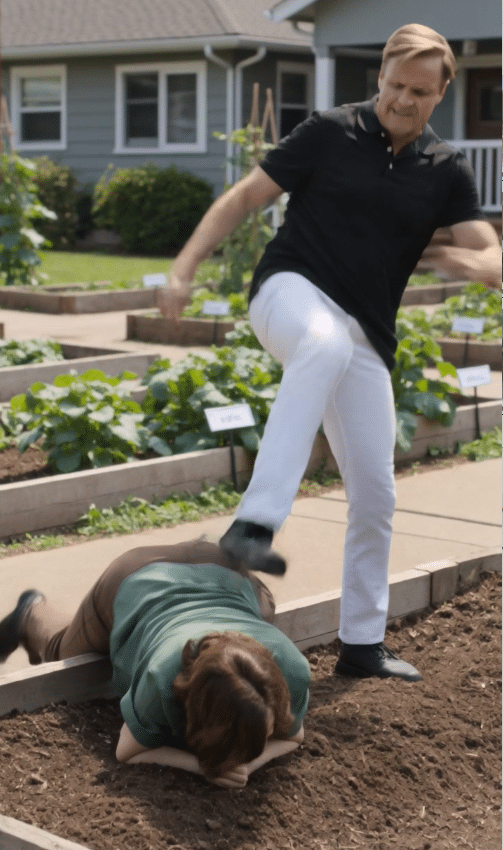
Margaret Ellis held a ripe tomato in her gardening glove when a man in a black polo shirt came storming down the narrow path between the vegetable beds. Before she could place the tomato in her basket, he snatched it from her hand and held it up as though he had caught her stealing a priceless jewel.
“Trash. Stop stealing from my garden.”
Margaret stared at him, stunned by the accusation. She was fifty-five, dressed in a faded green gardening shirt and brown work pants, with soil on her gloves and a small basket resting beside the wooden border of the shared vegetable row.
“I picked one tomato,” she said quietly. “This row is for everyone.”
The man, whose name was Grant Whitmore, glanced at the surrounding plots with the proprietary confidence of someone who believed that anything valuable near him must somehow belong to him.
He was forty-two, wealthy, impeccably dressed, and known around the residential community for making sure everyone understood both facts. His black polo was spotless, his white trousers showed no trace of the garden’s damp soil, and a gold watch flashed at his wrist whenever he moved his hand.
Grant had a private garden plot several rows away.
It was larger than most, with a decorative plaque bearing his name and a carefully arranged collection of expensive gardening equipment. He had paid for raised beds, imported soil, and a small irrigation system, and he often spoke about his vegetables as if they were the product of a personal agricultural empire.
But the tomato Margaret had picked had not grown in his private plot.
It had grown in the community row, where residents were encouraged to plant, tend, and harvest produce together.
The wooden sign at the end of the bed said so plainly.
Grant had walked past that sign hundreds of times.
He simply did not believe its rules applied to him.
“You people see something growing and think you can just take it,” he said.
Margaret glanced at the tomato in his hand.
“You know that’s not your row.”
His expression hardened.
“Excuse me?”
“The shared row. It’s marked on the garden map.”
She nodded toward a laminated sign attached to a post near the entrance. A simple diagram showed the numbered private plots, the communal vegetable beds, and the paths residents were expected to keep clear.
Grant looked at the sign, then back at her.
“I know exactly how this garden works.”
“Then you know I haven’t stolen anything.”
For a moment, neither spoke.
A woman kneeling beside a bed of lettuce slowly raised her head. Two men watering their plants at the far end of the garden stopped what they were doing.
Grant noticed the attention and seemed to take it as a challenge.
He stepped closer to Margaret.
“You should be grateful people like me maintain places like this.”
Margaret’s expression changed, though not into anger.
It was something closer to disappointment.
“People like you?”
“People who actually invest in the community.”
Margaret glanced around at the small vegetable rows, the carefully painted name plaques, and the garden tools arranged beside the shed. A few children had decorated the wooden borders with hand-painted flowers the previous spring. Someone had left a basket of seed packets near the water station for anyone who needed them.
This garden had never been the work of one wealthy resident.
It had been built by people who showed up with shovels, donated seeds, repaired broken borders, and watered vegetables after long shifts at work. Some contributed money. Others contributed time. Many did both.
Margaret had done more than most.
But she did not announce that fact.
She simply reached for her basket.
“I’m not going to argue with you over a tomato.”
Grant’s mouth tightened.
He interpreted her restraint as weakness.
Before Margaret could step away, he kicked her forcefully in the chest.
She fell backward beside the soil border, catching herself badly with one hand. The basket tipped over, spilling several tomatoes into the dirt, and a small scrape on her hand left a thin trace of blood.
For a moment, the garden seemed to lose every sound except the rustle of leaves.
Margaret tried to sit up.
Grant moved closer and delivered two more forceful kicks to her back and ribs.
She curled inward, trying to protect herself while avoiding the delicate plants beside her. Even as pain overwhelmed her, she instinctively kept one arm between her body and a row of young seedlings.
The witnesses froze.
A woman covered her mouth. One of the men near the watering cans took a step forward but stopped, visibly uncertain about what Grant might do next.
Grant stood over Margaret, breathing hard.
“Grow your own food somewhere else.”
The words were so cruel, so wildly disproportionate to the incident, that nobody seemed able to process them immediately.
Margaret lay beside the wooden border, struggling to catch her breath. A tomato rested in the dirt near her glove.
Then a woman in a green jacket came hurrying down the garden path.
She carried a large plot map and a folder of land-use papers. When she saw Margaret on the ground, she moved directly between her and Grant, shielding the injured woman before turning toward him.
Her name was Evelyn Brooks.
She was sixty-one, the founder of the community garden, and the person who had fought for years to keep the land open to residents.
She looked at Grant, then at Margaret, and finally at the vegetable rows stretching behind them.
Her voice was calm, but something in it made the entire garden go still.
“That garden only exists because she gave it up.”
Grant stared at her.
He looked at the map in Evelyn’s hands.
Then he looked down at the ground beneath his expensive shoes.
“Gave it up?”
For the first time, the man who claimed to know exactly how the garden worked seemed to realize that he might not know its history at all.
And Evelyn had only begun to tell it.
Act II
Evelyn crouched beside Margaret long enough to make sure she was protected from further harm. She called for emergency assistance and asked another resident to bring the garden’s first-aid kit.
Only then did she stand and face Grant.
“Step away from her.”
Grant hesitated.
“Evelyn, she was stealing from my—”
“Your what?”
He stopped.
Evelyn’s gaze moved to the tomato still lying in the dirt, then to the communal row and its clearly marked sign.
“You have a private plot. That is a shared bed. Those are not the same thing.”
Grant gave a short, dismissive laugh.
“This is getting ridiculous. She picked something that wasn’t hers.”
“And you attacked her.”
“She was disrespectful.”
“You kicked a woman because she picked a tomato from a shared garden.”
The words sounded even worse when spoken aloud.
Grant glanced toward the residents who had witnessed the incident. A moment earlier, their silence had seemed to protect him. Now their expressions had begun to change.
He straightened his shirt and adjusted his gold watch.
“I expect there to be consequences for the theft.”
Evelyn stared at him in disbelief.
“You are still talking about a tomato?”
Grant had built much of his identity around being the person who understood value.
He knew the price of property, the cost of landscaping, and the difference between an inexpensive fixture and a luxury finish. He liked to point out inefficiencies and remind people that community amenities did not maintain themselves.
In his mind, money created a hierarchy.
Those who paid more deserved more influence. Those who owned larger homes deserved more consideration. And those who arrived without obvious wealth were expected to understand their place.
Margaret had never fit into that hierarchy.
She lived in a modest apartment on the quieter side of the residential community. She wore practical clothes, drove an aging car, and carried reusable shopping bags long after other residents had switched to newer alternatives.
She did not host elaborate parties or talk about expensive vacations.
When people asked about her work, she usually answered simply that she had spent years managing land and community projects.
Most residents assumed she had retired from an ordinary administrative position.
Grant had made the same assumption.
He had seen Margaret repairing the garden borders, collecting fallen leaves, and helping new residents understand how to use the planting beds. He had mistaken her willingness to do unglamorous work for evidence that she held little influence.
He had never asked why she knew which plots received too much afternoon sun, which parts of the soil needed replenishing, or where the garden’s original water lines ran beneath the paths.
He had never wondered why Evelyn consulted her before major decisions.
And he had certainly never asked why the founder kept a copy of the land-use agreement in a folder that Margaret was often asked to review.
To Grant, she was simply a quiet woman who spent too much time in the dirt.
That assumption had shaped every interaction between them.
Months earlier, he had complained that the community garden looked untidy. He proposed replacing the shared vegetable beds with decorative shrubs and a stone walkway that would make the grounds look more expensive.
Evelyn had rejected the proposal.
Grant then argued that residents who paid higher community fees should have a greater say in how the land was used.
Again, Evelyn refused.
The garden’s purpose was to give residents a place to grow food, learn practical skills, and build relationships across the community. It was not meant to become another landscaped feature designed to impress visitors.
Grant had taken the rejection personally.
He began treating the communal beds as if they were poorly managed property that he needed to supervise. He criticized residents who harvested vegetables, questioned whether children should be allowed to water plants, and complained when donated tools were left beside the shed.
Margaret had often been the person who calmly corrected him.
She never raised her voice.
She simply pointed to the posted rules, explained how the beds were allocated, and returned to her work.
That made Grant dislike her even more.
He could tolerate someone who challenged him angrily. Anger gave him an excuse to argue. Margaret’s quiet certainty left him with nothing to fight except the rules themselves.
Now, as Evelyn stood over him with the plot map, Grant tried to return the conversation to familiar territory.
“I’m one of the people who pays to maintain this place,” he said. “I have a right to protect it.”
“You have a right to use the space assigned to you,” Evelyn replied. “You do not have a right to attack another resident.”
She looked toward the scattered tomatoes.
“And you do not get to rewrite the rules because you dislike who is following them.”
A resident near the water station finally spoke up.
“I saw Margaret pick it from the communal row.”
Another nodded.
“So did I.”
Grant turned sharply toward them.
Neither resident looked away this time.
The witnesses had been frightened by the attack, but Evelyn’s arrival had changed the atmosphere. They were beginning to understand that Grant could not simply intimidate his way out of what had happened.
Evelyn unfolded the garden map.
The paper was old, its edges softened by years of handling. Several areas were marked in different colors, and a set of handwritten notes ran along the bottom.
Grant glanced at the map impatiently.
“What does any of this have to do with her?”
Evelyn looked down at the document.
“Everything.”
Because the garden’s story did not begin with the first seed planted in its soil.
It began years earlier, when the land was worth far more as a development site than it would ever be worth as a place for neighbors to grow tomatoes.
And the woman lying beside the vegetable bed had been the reason the land was still there.
Act III
Before there was a garden, there was an empty parcel of land between two residential developments.
The ground was uneven, with patches of stubborn weeds, discarded construction materials, and a drainage ditch that flooded after heavy rain. Most people passed it without looking twice.
Developers saw something else.
The parcel occupied a valuable position near the entrance to the community. A larger residential project could use it for additional parking, a private recreation building, or a row of premium townhouses.
The land had belonged to Margaret’s family for decades.
Her father, Thomas Ellis, had bought it when the neighborhood stood near the edge of the city. At the time, the surrounding streets were quieter, and the parcel was part of a much larger piece of property he used for growing vegetables and maintaining a small nursery.
As the city expanded, the land became increasingly valuable.
After Thomas died, Margaret inherited the property.
She could have sold it immediately and secured a comfortable financial future. Several developers approached her with offers, each one larger than the last. Their representatives brought polished presentations and projections showing how much the land could earn if it were converted into commercial or residential use.
Margaret listened.
Then she declined.
Her father had taught her that land was more than a number on a contract. He believed that a place could be valuable because of what it allowed people to do together, not merely because of what someone could build on it.
When Margaret was a child, neighbors had gathered at the property to exchange seeds and share vegetables. Her father gave away surplus produce, helped families start small gardens, and taught children how to recognize healthy soil.
The land had fed people during difficult years.
It had also given them a reason to know one another.
Margaret remembered an elderly neighbor who had lived alone and rarely left her house. After Thomas invited her to help with the vegetables, she began visiting every week. She would arrive with a small basket, stay for an hour, and gradually become part of the neighborhood again.
Years later, Margaret still remembered the change in that woman’s face.
It had convinced her that her father’s idea was worth preserving.
So when developers began making offers, Margaret decided not to sell the land outright.
Instead, she worked with Evelyn Brooks, a local community organizer who had spent years helping residents establish shared gardens and neighborhood programs. Together, they explored ways to turn the neglected parcel into a permanent community resource.
The legal arrangements were complicated.
The land needed drainage improvements, safe access paths, clear boundaries, and a formal agreement that would protect the garden’s use. The project also needed funding, volunteer labor, and a management structure that could survive disagreements among residents.
Margaret contributed the land-use rights under an agreement that reserved the parcel for community gardening and related educational activities.
Evelyn helped organize the volunteers, secure donations, and establish the rules.
Other residents contributed materials and labor.
For months, the group worked through weekends. They removed debris, improved the soil, built wooden borders, installed water access, and created small plots for residents who wanted to grow their own vegetables.
The first harvest was modest.
A few tomatoes, some lettuce, handfuls of herbs, and several baskets of beans.
But residents came to the garden anyway.
They traded advice, shared tools, and learned each other’s names. Children who had never planted anything discovered how quickly a seedling could change after a week of sunlight and water.
The garden became a small, living reminder that a neighborhood could be more than a collection of locked doors.
Margaret never put her name on the entrance.
When Evelyn suggested recognizing her contribution with a plaque, Margaret refused.
“Put up the rules and the planting calendar,” she said. “People need to know how to use the garden. They don’t need to know who made it possible.”
Evelyn understood the sentiment, but she still kept the original agreement in the garden’s records.
The land-use documents mattered.
They established the garden’s boundaries, protected the shared plots, and explained the conditions under which the parcel had been made available. They also made clear that the space could not be quietly converted into a private amenity for a handful of residents.
That provision became important when the surrounding community grew more affluent.
New residents arrived, property values climbed, and the garden began to look increasingly unusual beside the manicured landscaping of the development.
Some people loved it.
Others considered it untidy.
Grant Whitmore belonged to the second group.
He had moved into the community after making a fortune in commercial property investments. He was accustomed to viewing unused land as wasted potential, and the garden’s modest appearance offended his sense of what an upscale residential community should look like.
He saw a valuable parcel occupied by vegetables and wooden borders.
He did not see the agreement that protected it.
He did not know that Margaret had declined offers that would have made her considerably wealthier.
And he did not understand that her decision had involved a real sacrifice.
Keeping the land for community use meant giving up the chance to sell it for development. Margaret had paid legal fees, covered early maintenance costs, and spent years resolving practical problems that no one noticed when the garden was working well.
She had also accepted restrictions on how the property could be used, because she wanted the garden to remain available to future residents.
The agreement was not an act of charity that could be withdrawn whenever the land became inconvenient.
It was a deliberate commitment.
Margaret had given up the possibility of a much larger private profit to preserve something that belonged, in practice and purpose, to the community.
Evelyn knew the full history.
So did a small number of people who had helped negotiate the agreement.
Grant knew none of it.
He had never bothered to ask why Evelyn treated Margaret’s opinions with such respect, or why the founder always consulted her before making changes to the garden’s boundaries.
He simply assumed that Margaret was a volunteer with no authority.
That assumption had now brought him to the edge of a revelation he could not easily dismiss.
Evelyn held the land-use papers open and pointed to the section outlining the purpose of the property.
“This garden was created because Margaret chose not to sell the land,” she said. “She gave the community the right to use it instead of taking the money she could have made.”
Grant looked from the document to the garden around him.
For the first time, the wooden borders and vegetable rows seemed to tell a different story.
He had thought he was defending something he owned.
He was standing on land someone else had chosen not to profit from.
And the person he had just attacked was the reason he had a garden to argue about at all.
Act IV
Grant stared at the papers as if he expected the words to rearrange themselves.
“You’re saying she owns this land?”
Evelyn did not answer immediately.
“I’m saying she made it possible for this garden to exist. The legal agreement explains the rights granted to the community and the conditions that protect them.”
“But I pay fees.”
“So do other residents.”
“I’ve invested in my own plot.”
“And you are entitled to use your own plot under the rules.”
Grant pointed toward the vegetable beds.
“Then why does she get to decide what happens here?”
“She doesn’t decide everything,” Evelyn said. “Neither do you. That’s why we have a management committee and a land-use agreement.”
She held the map where he could see it.
“The shared rows are marked here. Your private plot is marked here. The garden has never belonged to you.”
Grant’s face flushed.
He looked around for someone who might support him, but the residents had gathered closer. No one appeared eager to defend the idea that a man could kick a woman because he believed he deserved a tomato more than she did.
One of the residents who had witnessed the attack stepped forward and told Evelyn what he had seen. Another confirmed the sequence of events, including Grant’s accusation and his refusal to step away.
Evelyn listened, then asked the garden coordinator to preserve the incident report and any available footage from the community’s entrance camera. She made it clear that Margaret’s injuries would be documented and that the assault would be referred to the appropriate authorities.
Grant began to protest.
“This has become a witch hunt.”
“No,” Evelyn replied. “It has become a record of what happened.”
That distinction silenced him.
For years, Grant had treated disagreements as contests of influence. If he could make the other person look unreasonable, he believed he could regain control of the conversation.
But the garden’s records did not care how confidently he spoke.
The map showed where the shared rows were located. The land-use agreement explained why they existed. The witnesses had seen the attack, and the incident report would document what followed.
There was no need for Evelyn to exaggerate anything.
The facts were already serious enough.
Margaret was helped to a safe place while arrangements were made for medical evaluation. She remained shaken and in pain, but her attention kept returning to the damaged soil border where she had fallen.
One of the younger residents noticed.
“Don’t worry about the plants,” he told her gently. “We’ll take care of them.”
Margaret nodded, though her eyes lingered on the seedlings.
It was not that she valued vegetables more than her own safety. The garden had become a symbol of something she had spent years protecting, and seeing it threatened by the same sense of entitlement that had nearly destroyed the community’s trust was deeply upsetting.
Evelyn came to sit beside her.
“You don’t need to take care of everything yourself,” she said.
Margaret looked at the soil on her glove.
“I know.”
But knowing and believing were different things.
For years, she had taken responsibility quietly. When a border broke, she helped repair it. When a new resident arrived, she showed them where to plant. When people argued about the rules, she tried to calm them before the disagreement became personal.
She had never wanted recognition.
Yet she had sometimes wondered whether her quiet approach had allowed people to overlook the work that kept the garden alive.
Grant had certainly overlooked it.
He had seen a modestly dressed woman picking a tomato and concluded that she had no right to be there.
He had never considered what it meant that the land was still available for him to enjoy.
Evelyn returned to the residents gathered near the vegetable beds.
She explained that the garden would remain open under its established rules, but that Grant’s conduct would be reviewed formally. His private plot did not give him authority over shared beds, and his financial contributions did not excuse threatening or violent behavior.
The committee would also review how complaints were handled, ensuring that disagreements over plots or produce could be resolved without residents feeling intimidated.
No one called for revenge.
No one proposed destroying Grant’s garden or stripping away his rights without due process.
The response was more measured and more serious than that.
The community would preserve the garden, protect its residents, document the assault, and let the proper process determine the consequences.
Grant looked again at the land-use map.
His own plot was outlined in one color. The shared beds were marked in another. A note near the bottom referenced the original agreement that had secured the garden’s future.
He had seen the map before.
He had simply never cared enough to read it.
Now the document seemed to carry the weight of every decision he had made without understanding the place where he lived.
The land beneath his shoes was not merely an amenity.
It was a gift with conditions.
And Margaret had never asked anyone to thank her for it.
That, perhaps, was what unsettled Grant most.
If she had demanded recognition, he could have dismissed her as someone seeking attention. If she had bragged about her wealth or authority, he could have treated the confrontation as a battle between competing egos.
Instead, she had quietly preserved something he had assumed was his to control.
The garden had existed for years without needing his approval.
It would continue to exist without it.
And when the residents eventually gathered for the next community meeting, the first item on the agenda would not be the tomato he had tried to claim.
It would be the conduct of the man who had attacked the woman who made the garden possible.
Act V
In the weeks that followed, the garden became the center of a difficult but necessary conversation.
The incident was documented, the witnesses’ accounts were collected, and the matter was referred to the appropriate authorities. The community association reviewed Grant’s conduct under its established procedures, making clear that no resident could use intimidation or violence to enforce a personal interpretation of the garden’s rules.
The review did not turn into a public spectacle.
It focused on what had happened, what the evidence showed, and what measures were necessary to protect residents going forward.
Grant was given the opportunity to respond through the proper process. But the facts of the incident were difficult to dispute, and his claim that he had been protecting his property could not explain away the attack.
The garden’s rules were also posted more clearly.
Private plots and communal beds were labeled separately, harvest guidelines were reviewed, and residents were reminded that shared produce was intended for everyone to enjoy according to the posted arrangements.
The changes were practical rather than dramatic.
That was exactly how Margaret wanted them.
When she was ready to return, she found the garden waiting for her.
The wooden border beside the row had been repaired. The scattered tomatoes were gone, and the damaged seedlings had been replanted by volunteers. Someone had left a fresh pair of gardening gloves beside the toolshed, along with a handwritten note wishing her a quick recovery.
Margaret stood beside the communal bed for a long moment.
Evelyn approached carrying two small baskets.
“You don’t have to work today,” she said.
Margaret gave her a faint smile.
“I wasn’t planning to.”
“Good.”
They stood together, looking at the rows.
The plants had continued growing while the residents argued about ownership, authority, and the consequences of Grant’s behavior. New leaves had opened, the vines had climbed their supports, and several tomatoes were beginning to ripen.
Life in the garden had not stopped.
But something had changed among the people who cared for it.
Residents who had previously kept to their own plots began spending more time in the shared area. They brought extra seedlings, offered to repair the water station, and asked whether the community could organize a regular harvest day for people who wanted to learn how to grow vegetables.
A father volunteered to help the children paint new signs.
An older couple offered to lead a workshop on preserving tomatoes and herbs.
The woman who had witnessed the attack began checking in on Margaret, sometimes bringing coffee and sitting with her near the garden entrance.
Nobody made a grand announcement about unity.
They simply started acting as though the garden belonged to all of them again.
One afternoon, a young resident approached Margaret while she was checking the tomato vines.
“I heard what happened,” he said. “I’m sorry nobody stepped in sooner.”
Margaret looked at him.
He seemed embarrassed, and she could tell that he had replayed the moment in his mind many times.
“You were frightened,” she said.
“I still should have done something.”
“Next time, call for help. Get someone who can intervene safely. Don’t assume that because a person is loud, everyone else has to let them decide what happens.”
He nodded.
Margaret adjusted a vine that had slipped from its support.
“That’s how communities change. Not by never being afraid, but by deciding what to do when fear shows up.”
The young man stayed to help with the plants.
Across the garden, Grant’s private plot remained where it had always been. His name plaque still marked the wooden border, and the irrigation system he had paid for continued watering his vegetables.
The community did not need to destroy what belonged to him to prove that he had been wrong.
His private plot was his to maintain.
The shared rows were everyone’s responsibility.
The distinction was simple, and it had been written into the garden’s rules from the beginning.
What Grant had lost was not his right to grow vegetables.
It was the assumption that money gave him the right to decide who else deserved to.
The garden’s founder made sure that the land-use agreement remained available for residents to review. The committee reaffirmed its commitment to the original purpose of the space, and Margaret’s contribution was formally acknowledged in the community’s records.
When Evelyn suggested adding a plaque to the garden entrance, Margaret hesitated.
“I told you years ago I didn’t want one.”
“I remember,” Evelyn said.
“Then why ask again?”
“Because some people still don’t understand what happened here. They think the garden appeared because somebody built a few beds and planted some vegetables.”
Margaret looked around.
Children were watering seedlings near the fence. Two neighbors were comparing the leaves on their tomato plants. Someone had left a basket of spare herbs on the shared table with a note inviting people to take what they needed.
“What would the plaque say?” Margaret asked.
Evelyn considered the question.
“Maybe nothing about you. Maybe something about the agreement that protects the land, and why the garden exists.”
Margaret nodded slowly.
“That might be useful.”
So the committee installed a small sign beside the garden map. It explained that the land had been made available for community use under an agreement intended to preserve shared gardening space for present and future residents.
It did not list the value of the offers Margaret had declined.
It did not describe the money she had spent or the years she had volunteered.
It simply stated the garden’s purpose.
A place to grow food, share knowledge, and make room for one another.
Months later, as the summer harvest reached its peak, Margaret returned to the same tomato row where the confrontation had begun.
She wore the same green gardening shirt and brown pants. Her gloves were worn at the fingertips, and her basket rested against the wooden border.
A ripe tomato hung from a vine within easy reach.
She checked the plant, gently lifted the fruit, and picked it.
This time, no one challenged her.
A little girl nearby watched with curiosity.
“Can I pick one too?”
Margaret smiled and pointed toward the communal row.
“Of course. Just look for the ripe ones, and be gentle with the plant.”
The girl reached up carefully and twisted a tomato free.
Her face brightened as she dropped it into her small basket.
Across the path, Evelyn watched the moment unfold.
She remembered the day the land had been nothing but weeds and construction debris. She remembered the negotiations, the difficult conversations, and the fear that the project might never become permanent.
And she remembered Margaret’s insistence that the garden should belong to the community in spirit, not merely on paper.
Grant had seen the same land and imagined something entirely different.
He had seen property, status, and a place to demonstrate control.
Margaret had seen a chance to give people something that could not be measured by the price of a tomato or the size of a private plot.
She had surrendered the chance to make a larger personal fortune because she believed the community would gain something more valuable.
And when a man attacked her for taking one tomato from a shared row, the truth finally became impossible to ignore.
The garden was not there because Grant had paid fees.
It was not there because wealthy residents wanted attractive landscaping.
It was there because one woman had chosen to preserve the land for everyone else.
The tomato had been worth almost nothing.
The entitlement behind the accusation had nearly cost Margaret her safety.
But the revelation that followed exposed the real difference between them. Grant believed ownership gave him power over other people. Margaret believed that having something valuable sometimes meant deciding not to keep it all for yourself.
That afternoon, she carried her basket toward the garden entrance.
The little girl waved goodbye. Evelyn lifted the plot map to show a new resident where to plant next season, and the other gardeners returned to their work.
The rows were full of vegetables, the paths were busy with neighbors, and the shared table held more produce than anyone could use alone.
Margaret paused beside the sign at the entrance.
She ran her gloved fingers over its wooden edge, then continued toward home.
She had never needed the community to call her powerful.
She had only wanted the land to remain useful long after she was gone.
And now, every tomato picked from the shared row was proof that the sacrifice had been worth it.
Grant thought the garden belonged to the people who could afford to control it. Margaret had given it up so that nobody would have to.