Act I
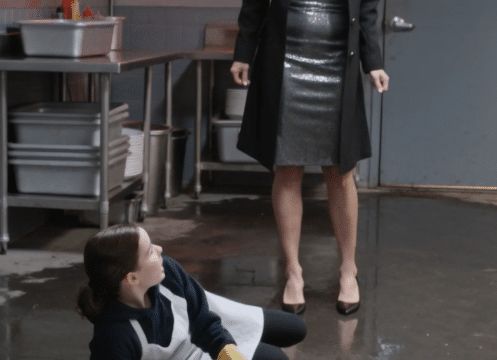
The Major threw mud into her face before she could finish speaking.
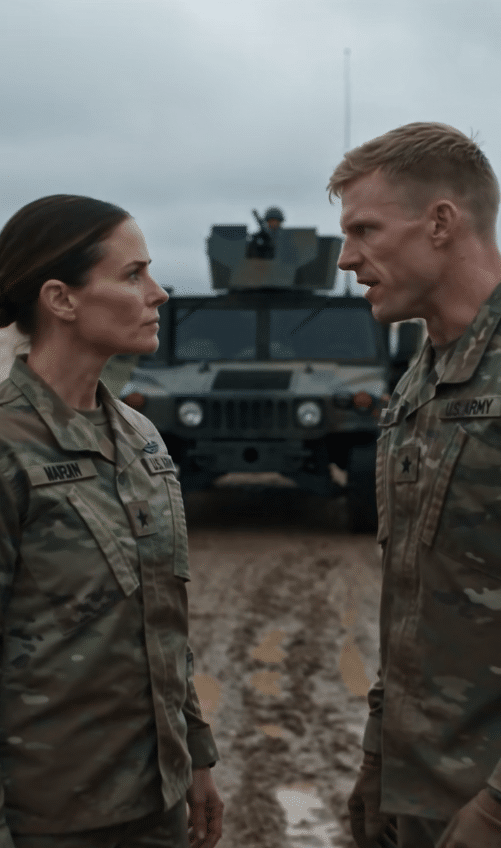
It splattered across her cheeks, caught in her dark-brown hair, and streaked down the collar of her OCP uniform. Around them, military trucks idled in the rain-soaked evacuation lane, their tires sunk deep into the mud. Soldiers carrying equipment slowed to watch, but nobody moved.
“You don’t move my vehicles.”
Major Ryan Mercer stood between the woman and a tactical truck, his short blond hair damp beneath the gray afternoon sky. His gloves were stained with dirt, and his expression carried the casual arrogance of a man accustomed to having the last word.
The woman wiped mud from one eye.
“I move anything blocking an evacuation.”
Her voice was calm. Almost unnervingly so.
She was thirty-seven, with dark-brown hair secured in a low bun and tan boots already caked in mud. There was nothing flashy about her uniform, no conspicuous collection of decorations or carefully displayed insignia. She looked like an officer who had spent more time solving problems than explaining herself.
Mercer mistook that restraint for weakness.
He had been controlling vehicle movements all morning, shouting at drivers, pushing soldiers to move faster, and treating every question as a challenge to his authority. The exercise had fallen behind schedule after the overnight rain, and he had spent the past hour blaming everyone except himself.
Now a woman he barely knew was telling him to move a truck.
Worse, she was doing it in front of his soldiers.
Mercer stepped closer.
“Who do you think you are?”
She glanced past him toward the blocked lane. Beyond the truck, the designated evacuation route narrowed between a drainage ditch and a temporary command tent. Another vehicle attempting to squeeze through could force a dangerous maneuver on the slick ground.
“Move it, Major.”
That was all she said.
No threat. No raised voice. No appeal to rank.
The simplicity of the order enraged him more than an argument would have.
Mercer’s hand tightened inside his tactical glove. He looked around and noticed the growing audience: two junior soldiers beside a cargo pallet, a driver standing near a military transport, and a fifty-year-old Master Sergeant wearing reflective movement gear near the edge of the lane.
They were watching.
Mercer could have moved the truck. He could have asked why the lane needed to be cleared. He could even have demanded identification through proper channels.
Instead, he chose to make an example of her.
He slapped her across the cheek.
The sound cracked through the wet air.
Her head turned with the force of the blow. For a fraction of a second, the only sound was the low rumble of the idling truck.
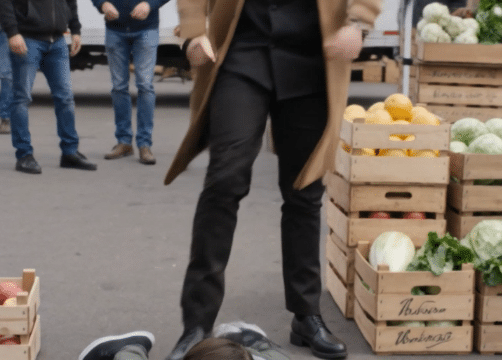
Then Mercer drove a kick into her stomach.
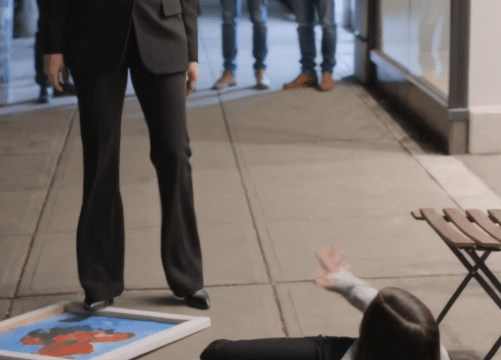
She folded forward, the breath leaving her in a sharp, involuntary gasp. One knee struck the mud, followed by her hand. She stayed conscious, one arm guarding her abdomen as she fought to draw air back into her lungs.
Nobody laughed.
Nobody spoke.
Mercer stood over her, breathing hard, as if the violence had somehow proved that he was right.
“Stay in the dirt where you belong.”
Mud dripped from her chin.
Her cheek was already reddening and swelling, and a faint trace of blood marked the corner of her mouth. Yet when she raised her eyes toward him, there was no pleading in them.
Only a cold, steady attention that Mercer did not understand.
He thought he had reduced her to the ground.
He had no idea what had just fallen from her pocket.
And when a Master Sergeant saw it lying face-up in the mud, the entire meaning of the confrontation began to change.
Act II
The woman had not arrived at the exercise site to challenge Mercer.
Her name was Colonel Evelyn Shaw, and she had come to conduct an unannounced inspection of the unit’s field procedures. She had deliberately avoided advance notice because she wanted to see what happened when commanders believed nobody important was watching.
For three weeks, reports from the training area had raised quiet concerns. Equipment was being repositioned without proper coordination. Safety checks were being rushed. Junior personnel had complained privately about officers who treated reasonable questions as insubordination.
The reports were not dramatic enough to trigger an immediate investigation. They were fragments: a transport route altered without notification, a maintenance discrepancy dismissed as paperwork, a soldier ordered to sign a checklist he had not completed.
But patterns had begun to emerge.
Colonel Shaw believed that leadership revealed itself most clearly under pressure. Anyone could sound professional in a conference room, with a prepared briefing and a dozen people waiting to agree.
The field was different.
Rain ruined schedules. Mud swallowed tires. Communications failed at the worst possible moments. And when something went wrong, the people with the least authority often paid the highest price.
That was why Shaw had arrived in an unremarkable field uniform, without announcing herself to the officers responsible for the exercise. She wanted to observe the unit as it actually operated.
The blocked evacuation lane had caught her attention almost immediately.
Mercer’s tactical truck was positioned where it should not have been, narrowing a route designated for emergency movement. When Shaw asked a nearby soldier whether the vehicle had a documented reason for being there, he hesitated before answering.
He was not being disrespectful.
He was afraid of saying the wrong thing.
Shaw had seen that expression before. It was the look people developed when they learned that honesty could cost them more than silence.
She had instructed the soldier to locate the movement log. Then she had approached Mercer herself and asked him to clear the route.
She had expected irritation.
She had not expected an assault.
Now, on one knee in the mud, Shaw concentrated on breathing. Pain tightened across her abdomen, but she refused to let the Major’s actions dictate what happened next.
She could have shouted her rank.
She could have demanded that every soldier present identify himself and prepare a statement.
She could have turned the moment into a display of authority.
Instead, she looked at the blocked lane again.
The truck was still there.
Even after attacking an inspecting officer, Mercer had not accomplished the one thing that mattered: he had not cleared the route.
A few yards away, Master Sergeant Daniel Brooks had gone completely still.
Brooks had served long enough to recognize the difference between a routine inspection and a situation that could reshape an entire command. He had watched officers arrive with impressive reputations and leave with their careers in pieces. He had seen powerful people protected by friends, and ordinary soldiers blamed for decisions they had never made.
But he had never seen anything quite like the dark object half-buried beside Colonel Shaw’s hand.
At first, it looked like a piece of scrap metal.
Then the rain shifted, washing a thin film of mud away from its surface.
A symbol emerged.
Brooks stopped breathing for a moment.
He knew that symbol.
Not because it appeared in a regulation manual or hung in a display case. He knew it because he had spent years hearing stories about the people who carried it—and because one of those stories had changed the course of his own military career.
The coin was rare. Not a routine unit keepsake, not a souvenir handed out after a successful exercise, and not something a person could simply order online.
It belonged to an elite Joint Task Force whose members had been assembled for missions so sensitive that even experienced officers knew better than to ask for details they were not cleared to receive.
The coin was given personally.
And the man who presented it was known for one rule: he never gave one to anyone who had not earned his absolute trust.
Brooks looked from the coin to Colonel Shaw.
Then he looked at Mercer.
The Major was still standing over the woman he had assaulted, completely unaware that the small piece of metal in the mud carried a history he could not afford to ignore.
Brooks took a cautious step forward.
“Major… nobody gets that coin by accident.”
Mercer turned toward him with a look of irritation.
For the first time since the confrontation began, someone had spoken to him without the slightest trace of fear.
And Brooks had not even begun to explain what the coin meant.
Act III
Mercer glanced down at the object.
It was dark, round, and scratched along its edges. Mud clung to the engraved surface, but the central insignia remained visible. There was no gold plating, no polished display stand, no elaborate inscription announcing the importance of its owner.
That offended him.
He had spent years learning how to make rank visible. He kept his equipment immaculate when he could, made sure his awards were properly displayed, and expected the people around him to understand the hierarchy before he ever needed to state it aloud.
To Mercer, authority was something people should recognize immediately.
The coin looked like nothing.
The Master Sergeant’s reaction looked like everything.
Mercer straightened and gave a short, contemptuous laugh.
“Coins don’t outrank me.”
He said it loudly enough for the surrounding soldiers to hear.
It was a performance now. He could feel the room—though there was no room, only a rain-soaked strip of ground between trucks and tents—slipping away from him. The soldiers who had watched him strike the woman were no longer looking at him with the same uncertain attention.
They were watching Brooks.
That was intolerable.
Brooks had never been a man who confused confidence with competence. His uniform was worn in the ordinary places, his boots carried the same mud as everyone else’s, and he did not waste words trying to impress officers. When he spoke, people listened because experience had taught them that he rarely spoke without a reason.
If Brooks was alarmed, there was a reason.
Mercer simply could not accept that the reason might be more important than his own authority.
Colonel Shaw slowly lifted her head.
Her breathing was still guarded, and she kept one hand close to her abdomen. The impact had hurt her badly enough to leave her momentarily unable to speak, but the pain had begun to settle into something she could manage.
She looked at Mercer.
Then at Brooks.
The Master Sergeant’s expression had changed completely. He was no longer merely concerned about an officer striking another officer. He looked as though he had just discovered that a familiar name had appeared in a place where it should never have been.
Shaw did not explain.
She did not need to.
The coin had been in her pocket for years. Its edges had worn smooth in places, and a small scratch crossed the metal near the rim. She carried it not as a badge of status but as a reminder of a promise made long before she had reached her current position.
The man who gave it to her had once told her that a uniform could tell you what someone had been assigned to do.
It could not tell you what they would do when everything went wrong.
He had given her the coin after a joint operation that had nearly ended in disaster. Shaw had been younger then, still learning how to make decisions when every available option carried a cost. She had helped bring a stranded team home after a chain of failures left them without reliable communications and with less time than anyone was willing to admit.
The operation had been officially described in dry, forgettable language.
The people who survived it remembered something else.
They remembered who had stayed when leaving would have been easier.
They remembered who had accepted responsibility instead of blaming the people beneath them.
And they remembered the senior commander who had personally handed Shaw the coin, looked her in the eye, and told her that character mattered most when nobody could guarantee a reward.
That commander was now one of the most respected figures in the joint military community.
His name did not appear on the coin.
It did not need to.
Among the people who knew the symbol, the giver’s identity was part of its meaning.
Brooks knew that history. He had not served on Shaw’s operation, but years earlier he had supported a joint training rotation connected to the same task force. He remembered the commander’s reputation, the strict criteria for the coin, and the quiet reverence with which veteran personnel spoke of those who had received one.
He had seen replicas and ceremonial imitations.
This was not one of them.
The inscription was correct. The insignia was correct. Even the unusual mark near the rim matched the version described in an old briefing he had never forgotten.
Mercer saw none of that.
He saw a dirty woman on the ground and a Master Sergeant who seemed to have forgotten who was in charge.
Colonel Shaw’s voice cut through the silence.
“No. The man who gave me that one does.”
She spoke quietly.
That was what made the words dangerous.
There was no boast in them, no threat, and no attempt to frighten Mercer into submission. She simply stated a fact and allowed him to decide what it meant.
For the first time, the Major’s expression faltered.
He looked at her uniform again, searching for something he should have noticed earlier. Her insignia had been partially obscured by mud and outer gear. Her posture, even after the assault, remained controlled. And the Master Sergeant was not looking at her as though she were a stranger who had somehow acquired an impressive object.
He was looking at her as though he had just realized who stood in front of him.
Mercer’s mouth tightened.
He had already crossed a line he could not uncross.
Now he was beginning to suspect that the line had been far more important than he understood.
But the worst part was not the coin.
It was the possibility that the woman he had treated like nobody had been trusted by a man whose judgment could reach into every corner of his military world.
And if that man had trusted her, Mercer suddenly had no idea what else she might know.
Act IV
For several seconds, nobody moved.
The rain ticked against the metal sides of the vehicles. Somewhere behind the command tent, an engine revved and then settled into a low idle. The ordinary sounds of the exercise continued, but the small circle around Colonel Shaw had become strangely still.
Mercer tried to recover his composure.
He had built his reputation on being decisive, aggressive, and impossible to intimidate. He believed that if he held his ground long enough, other people would eventually retreat. It had worked with junior officers. It had worked with drivers who questioned his orders. It had worked with soldiers who knew that challenging a Major could turn an already difficult assignment into a miserable one.
But this was different.
Brooks was no longer watching Mercer for instructions.
He was watching him for what he might do next.
That distinction unsettled the Major more than the coin itself.
“Who are you supposed to be?” Mercer demanded.
The question came out harsher than he intended.
Shaw made no effort to answer it.
Instead, she shifted carefully, moving her weight away from the injured side of her abdomen. She did not rush to stand, and she did not pretend the assault had left her untouched. Her cheek throbbed, her breathing remained painful, and the mud soaked through the knee of her uniform.
But her eyes never left Mercer.
The Major glanced toward the other soldiers.
One of them looked down immediately. Another stood rigid beside a pallet, his hands clasped in front of him. The driver near the transport had stopped pretending to inspect his vehicle.
Every witness had seen the same thing.
Mercer had not lost control in the middle of a chaotic emergency. He had not acted to protect a soldier from imminent danger. He had thrown mud in a woman’s face, struck her, kicked her in the stomach, and insulted her while she struggled to breathe.
He had done it because she had given him an order he did not like.
And he had done it in front of people whose silence he had mistaken for approval.
Brooks stepped closer, his eyes briefly dropping to the coin before returning to Mercer.
The Master Sergeant had no intention of explaining the entire history of the Joint Task Force to a man who had just demonstrated that he could not be trusted with a simple movement order. He also knew that the coin’s meaning was not his to disclose casually.
But he understood the immediate danger.
Mercer was still trying to turn the situation into a contest of personalities. If he continued down that path, he would make the assault worse with every word he spoke.
“Major,” Brooks said, his tone firm, “you need to stop talking.”
Mercer’s face hardened.
“Excuse me?”
Brooks did not repeat himself.
The silence that followed was more damaging than an argument. It was the first time Mercer had been openly checked in front of his own personnel without anyone immediately rushing to soften the moment.
Shaw lowered her gaze to the coin.
She had not deliberately revealed it. She had not reached into her pocket and held it up as a warning. The object had fallen because Mercer had put her on the ground.
That detail mattered to her.
She had spent much of her career trying to separate authority from intimidation. Rank was necessary in the military, but it was not a personal license to humiliate people. Orders had to be followed, yet the people giving them were responsible for understanding why those orders existed.
Mercer had treated obedience as a measure of personal loyalty.
He had mistaken silence for respect.
And now he was learning that the two things were not remotely the same.
Shaw slowly pushed herself upright, keeping one hand against her abdomen. Brooks moved as though he might assist her, then paused when she gave the smallest shake of her head. She wanted to stand under her own power.
When she was upright, she brushed mud from the front of her uniform.
The movement was small, almost ordinary.
Yet Mercer took a half-step backward.
He could not explain why. He only knew that the woman who had been kneeling in the dirt a moment earlier no longer seemed vulnerable in the way he had imagined.
Her pain had not disappeared.
Her authority had not needed to appear.
Both were present at once.
Mercer looked at the coin again, then at Brooks. He was trying to assemble the missing pieces, searching for a name he might have heard in a closed briefing or a story told by an older officer after a long exercise.
His mind returned to the rare task force insignia.
The personal presentation.
The commander whose challenge coins were never distributed as routine souvenirs.
A memory surfaced from years earlier, when Mercer had been a younger officer listening to senior personnel discuss a joint operation. They had spoken about the commander’s standards in careful, almost reverent terms. He remembered one detail more clearly than the rest: the commander had personally selected a small number of officers whose judgment he trusted when the situation became impossible.
Mercer had never met the man.
He had, however, built a career around believing that proximity to powerful people was the same as understanding them.
Now he was looking at a woman who apparently possessed something he had only heard about.
Her uniform had never impressed him.
Her calm had annoyed him.
Her refusal to back down had enraged him.
But the coin suggested that someone whose judgment mattered far more than Mercer’s opinion had seen something in her that he had completely failed to recognize.
His confidence began to collapse.
Not all at once. First, the smirk disappeared. Then his jaw tightened. His eyes moved from Shaw’s face to the coin and back again, as if one of them might change if he looked long enough.
Brooks saw the realization arriving.
So did Shaw.
Neither of them helped him.
The evacuation lane remained blocked behind Mercer. The truck that had started this confrontation was still occupying the space he had refused to clear. The soldiers around them were still waiting to see whether he would choose another act of arrogance or finally understand the scale of his mistake.
Mercer swallowed.
His voice, when it came, was no longer commanding.
It was almost a whisper.
“Who gave you that…?”
Act V
Colonel Shaw did not answer immediately.
She looked down at the coin resting in the mud, then back at the Major who had thrown it into view by forcing her to the ground. There was no satisfaction in her expression. No triumphant smile. No pleasure at watching a man who had seemed invincible discover that he was not.
What she felt was disappointment.
Not because Mercer had failed to recognize her rank.
That was precisely why she had come unannounced.
She was disappointed because he had not needed to know her rank to treat her like a human being. He had not needed to understand the coin, recognize a famous commander, or fear the consequences of an official investigation.
He had only needed to hear a reasonable order concerning an evacuation route.
Instead, he had chosen humiliation.
And when humiliation had not worked, he had chosen violence.
Shaw bent carefully and retrieved the coin. She wiped the mud from its surface with her thumb, exposing the engraved symbol once more. For a moment, the dark metal caught the pale light beneath the overcast sky.
Then she slipped it back into her pocket.
The movement was deliberate but unremarkable. She did not offer the coin to Brooks for inspection. She did not ask Mercer to apologize to it, or to her, or to the man whose name he was suddenly desperate to learn.
The coin was not the authority in that field.
It was only evidence of a trust Mercer had never understood.
Shaw turned toward the blocked lane.
“Clear the evacuation route.”
She spoke as if the conversation had ended.
Mercer stared at her.
For a heartbeat, his instincts urged him to challenge the order. He could still feel the eyes of the soldiers around him, and some part of him wanted to restore the old arrangement—to make Brooks look away, to force the junior personnel back into silence, to prove that the incident had changed nothing.
But the words would not come.
He looked at the Master Sergeant.
Brooks was already signaling to the driver. The tactical truck began to reverse slowly, its tires churning through the mud as it cleared the designated lane. Two soldiers moved to guide it, their gestures precise and professional.
Nobody waited for Mercer to approve the movement.
Nobody needed to.
The route opened.
The practical problem Shaw had identified before the assault was finally resolved, and it had taken less than a minute once the Major stopped making it personal.
That was the part Mercer would remember later.
Not the pain in his hands from clenching them inside his gloves. Not the mud on the coin. Not even the terrible uncertainty surrounding the identity of the man who had given it to Shaw.
He would remember that his entire display of power had delayed a simple, necessary task.
He had made the operation less safe because he could not tolerate being corrected.
And in doing so, he had exposed something far more serious than a temper.
Brooks approached Shaw only after the truck had cleared the lane.
“Colonel, are you able to stand?”
“I’m standing, Sergeant.”
Her tone was gentle, but it left no room for confusion.
Brooks nodded. He did not ask her to explain the coin. He did not ask whether the commander who had given it to her would hear about what had happened. Those questions belonged to another conversation, and he understood that he had already said enough.
But the assault could not simply disappear into the rain.
The witnesses would need to be identified. Their statements would need to be recorded. The vehicle placement and movement logs would need to be preserved. The incident would have to be reported through the proper chain of command, and Shaw’s injuries would need to be assessed.
There would be no informal arrangement in which Mercer apologized, the witnesses forgot what they had seen, and everyone returned to work pretending that nothing had happened.
Shaw intended to make sure of that.
She turned to the nearest soldier.
“Document the vehicle position and preserve the movement log. I want the witnesses’ names recorded before anyone leaves this area.”
“Yes, ma’am.”
The soldier moved immediately.
Mercer remained beside the truck, watching the scene reorganize itself around a set of priorities he had ignored. The Master Sergeant was helping maintain the evacuation lane. The junior personnel were recording the relevant details. Colonel Shaw was directing the response without raising her voice or invoking the identity of the man who had given her the coin.
She had no need to threaten Mercer with a powerful name.
The facts were already serious enough.
He had struck an officer during an official inspection. He had kicked her while she was trying to recover from the first blow. He had humiliated her in front of witnesses. And he had done all of it after being told to clear a route that existed for the safety of the people under his command.
His rank would not erase the witnesses.
His reputation would not change the sequence of events.
And whatever the coin’s giver might think of him would not determine whether the evidence was examined fairly.
That was the real reversal.
Mercer had spent years believing that power meant controlling the people around him. Shaw understood it differently. Power meant accepting responsibility when the consequences of a decision were no longer convenient.
The Major’s eyes returned to her pocket.
He still wanted to know who had given her the coin. He wanted a name that would explain why Brooks had gone pale, why the soldiers had stopped looking at him for guidance, and why the woman he had treated as an obstacle now seemed to stand at the center of a much larger world.
But Shaw did not give him one.
She walked past him toward the command tent, her uniform stained with mud and her cheek still swollen. Every step reminded her of the pain in her abdomen, but she kept moving without rushing or pretending she was untouched.
At the tent entrance, she paused and looked back once.
“Major, you will remain here until the incident has been formally reported and your commanding officer has been notified.”
Mercer opened his mouth.
Nothing came out.
For the first time that afternoon, he had no insult ready, no threat that could restore his position, and no audience willing to mistake aggression for leadership.
Shaw disappeared into the tent.
Behind her, the exercise continued. Engines turned over. Equipment moved. Soldiers returned to their assigned tasks, but the atmosphere had changed. They had watched an officer abuse another person because he believed he could do so without consequence.
Then they had watched that person’s dignity survive the assault.
The coin had revealed a connection Mercer could not comprehend, but it had not created Shaw’s authority. She had possessed that authority before the mud struck her face, before the slap, before the kick, and before Brooks recognized the symbol.
The coin had only forced the people watching to reconsider what they thought they knew.
Later, when the formal investigation began, Mercer would learn that the incident was not going to be decided by rumors, rank, or the identity of a senior commander. The witnesses would speak. The records would be reviewed. His actions would be measured against the standards he had demanded from everyone else.
The outcome would depend on evidence.
That was exactly how Shaw intended it.
And somewhere beyond the rain-soaked training grounds, the man who had given her the coin remained unaware that it had surfaced in the mud that afternoon.
Mercer had asked who he was.
He would eventually learn the answer.
But by then, the more important question would no longer be who had given Colonel Shaw that coin.
It would be why a Major had believed that no one else mattered until he discovered that someone might be watching.