Act I
“You can’t take flowers or stones from the park.”
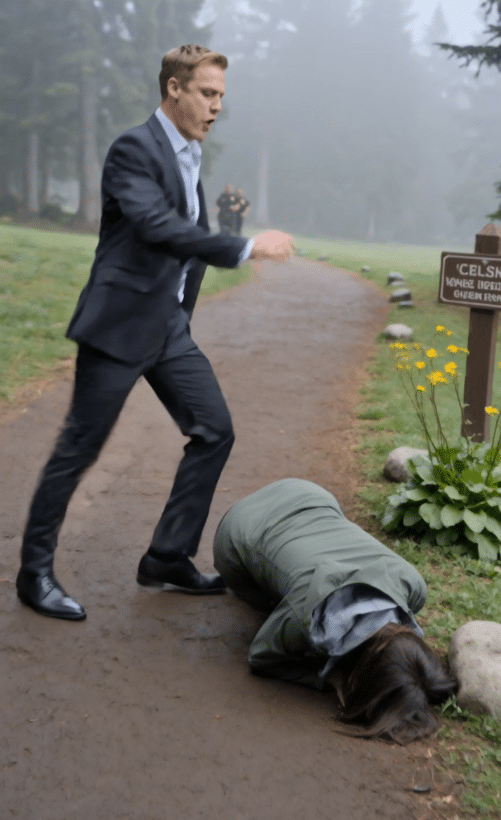
The woman’s voice was calm, almost gentle, but it stopped the man halfway through stuffing another handful of wildflowers into his expensive hiking backpack. A few feet away, a wooden sign stood beside the mist-covered trail, its weathered lettering clearly warning visitors not to remove plants, rocks, or other natural objects from the protected landscape.
The man looked at the sign, then at the woman in the green volunteer jacket.
“Trash,” he muttered. “Nature doesn’t belong to you.”
Her name was Sarah Bennett, and she had spent the last six years volunteering at Pine Ridge State Park. At thirty-five, she had learned that most visitors responded to a polite reminder with an embarrassed smile. Some apologized. Others pretended they had not heard her.
But occasionally, someone arrived believing that money, expensive equipment, and a sense of personal importance placed them above every rule that applied to everyone else.
This man appeared to belong to the last category.
He wore a premium hiking jacket, spotless trail boots, and a watch that probably cost more than Sarah’s car. His backpack was already bulging with small stones, colorful wildflowers, and delicate plants he had pulled from the ground along the trail.
Sarah noticed that some of the flowers had been uprooted before they could finish blooming.
“Sir, I need you to put those back if you can,” she said. “Some of these plants are protected, and the stones provide shelter for insects and small animals. Once visitors start removing them, the damage adds up.”
He gave her a look of open disgust.
“Do you have any idea how much I paid to come here?”
“That doesn’t change the park rules.”
For a moment, he simply stared at her. Mist drifted between the trees, and somewhere beyond the trail, a bird called from the undergrowth. A couple standing near the wooden sign exchanged uncomfortable glances.
The man stepped closer.
“I’ll take whatever fits in my bag.”
Sarah kept her voice steady. She had no desire to argue, and she certainly had no interest in embarrassing him. She simply pointed toward the sign again and reached for the radio clipped to her jacket.
That was when his expression changed.
The anger in his face sharpened into something colder, something that had very little to do with flowers.
“You think you can tell me what to do?”
“I’m asking you to follow the rules.”
He struck her before she could say anything else.
His boot drove into her chest, sending her backward onto the damp trail. Sarah hit the ground hard, her radio tumbling from her hand as wildflowers scattered across the wet stones.
A sharp gasp rose from the nearby visitors.
For one stunned second, nobody moved.
Sarah struggled to draw a full breath. Pain spread through her chest, and when she tried to brace herself against the trail, her forearm scraped a rough stone. She stared at the thin trace of blood on her skin, unable to understand how a conversation about a few flowers had become this.
Then the man stepped toward her again.
Two more kicks landed against her back and side before she could get away.
Sarah curled instinctively, one hand pressed against the ground and the other reaching toward the radio that had fallen beyond her fingertips. Her face tightened with pain. She could hear the witnesses breathing, whispering, and shifting their feet, but no one came forward.
Still, she pointed toward the wooden sign.
“You can’t take flowers or stones from the park,” she managed to say again.
The man stood over her, breathing hard, apparently offended that she had not learned her lesson.
“Trash,” he said. “Nature doesn’t belong to you.”
He glanced at his backpack and shoved the remaining flowers inside.
Then, as if the assault had been nothing more than an unpleasant interruption to his morning hike, he turned toward the trailhead.
“I’ll take whatever fits in my bag.”
He had no idea that someone had already seen enough to bring the entire park administration running down that trail.
And the first order that greeted him would have nothing to do with the flowers.
Act II
Sarah had never considered herself particularly brave.
She was not a police officer, a wilderness rescuer, or a person who enjoyed confrontation. She had spent most of her adult life working ordinary jobs, helping her neighbors, and finding comfort in the quiet routines that other people barely noticed.
Pine Ridge State Park had become the place where those routines finally made sense.
Years earlier, Sarah had brought her father to the park after he began struggling with the exhaustion of a long illness. They had walked only a short distance that first morning, stopping every few minutes to rest beneath the pines.
Her father had pointed out things she would once have hurried past: a tiny cluster of mushrooms beneath a fallen branch, the pale underside of a fern, the intricate pattern of a stone worn smooth by centuries of rain.
“People think nature is made of big things,” he had told her. “Mountains. Waterfalls. Trees. But sometimes the big things survive because somebody takes care of the little ones.”
He died the following winter.
Sarah returned to Pine Ridge the next spring, initially just to walk. Eventually, she began volunteering, collecting litter, assisting visitors, reporting damaged trail markers, and helping park staff monitor sensitive areas.
She never imagined the work would make her important. She liked that it rarely did.
The flowers along the eastern trail were particularly fragile. Their roots grew in shallow soil between exposed stones, and the surrounding plants helped prevent erosion during heavy rain. Visitors often assumed that taking a handful of flowers or pocketing a few attractive rocks was harmless.
But hundreds of harmless acts could strip a trail of the very things that made it worth visiting.
That was why Sarah had approached the man.
His name, she would later learn, was Richard Cole, a forty-year-old property investor who had built a reputation among his business associates for getting whatever he wanted. He was wealthy enough to treat inconveniences as problems that could be solved by paying someone else to remove them.
He had arrived at Pine Ridge that morning expecting a peaceful hike, a collection of impressive photographs, and perhaps a few unusual souvenirs to display in the glass cabinet of his vacation home.
The rules had seemed like suggestions.
When Sarah challenged him, he interpreted her calm professionalism as an insult. He could not accept that a woman in a volunteer jacket, carrying a trash bag and a basic handheld radio, had the authority to deny him something he wanted.
To him, she was not protecting a landscape.
She was embarrassing him.
The people who witnessed the assault were equally unprepared for what happened. One woman covered her mouth. A father pulled his teenage son a few steps backward. Another hiker raised a phone, but his hands shook so badly that the first seconds of the recording showed mostly wet ground and blurred trees.
They were frightened by Richard’s sudden violence, and each person waited for someone else to move first.
Sarah, meanwhile, tried to sit up.
Her chest hurt when she breathed. Her radio lay several feet away, and the man who had kicked her was still close enough to make her afraid that any movement might provoke him again.
She looked at the flowers scattered around her.
It was an absurd detail to notice at that moment, but it was the first thing she saw clearly. Bright petals lay crushed in the mud, mixed with small stones that had been torn from their natural places.
She had spent years trying to teach visitors that the park was not a store, a playground, or a collection of objects waiting to be claimed.
Now she was on the ground beside the very sign she had been trying to protect, wondering whether anyone would remember what had happened after the man walked away.
Then she heard an engine.
A ranger vehicle came around the bend near the trailhead and stopped abruptly. Two doors opened almost at once. Three uniformed figures emerged, followed by a fourth person carrying a field case and wearing the distinctive insignia of the park’s conservation team.
The superintendent was already running toward her.
Richard turned at the sound of the approaching footsteps.
For the first time that morning, he looked uncertain.
He was about to discover that Pine Ridge had rules for more than its flowers and stones.
It had rules for the people who thought those rules did not apply to them.
Act III
“Everybody stay where you are!”
The command cut through the mist.
Superintendent Thomas Reed, fifty-nine, moved down the trail with the urgency of a man who had spent decades responding to emergencies in places where a few seconds could make the difference between safety and disaster. His silver hair was damp from the fog, and his face tightened when he saw Sarah on the ground.
He did not look at Richard first.
He dropped beside Sarah.
“Sarah, can you hear me? Don’t try to get up yet.”
She nodded, though the movement made her wince.
“I’m here,” she whispered.
“Good. Just stay still. We’re going to get medical help.”
One of the rangers radioed for an ambulance while the other positioned himself between Richard and the injured volunteer. The conservation officer, a woman named Elena Ruiz, knelt nearby to assess Sarah’s condition without moving her unnecessarily.
Only after Sarah was being attended to did Thomas stand.
Richard immediately began talking.
“This is a ridiculous misunderstanding. She was harassing me over some flowers, and I was trying to leave.”
Thomas looked at him without changing his expression.
“Step away from the backpack.”
Richard blinked.
“What?”
“You heard me. Set the backpack on the ground and step away from it.”
“I haven’t done anything that justifies this.”
Thomas turned toward the ranger beside him.
“Secure the area. Keep the witnesses here if they’re willing to provide statements. Nobody touches those plants or stones until the conservation officer documents them.”
Then he faced Richard again.
“Open his bag. Document every violation.”
The words landed harder than a shout.
Richard’s mouth fell open slightly. For several seconds, he seemed to be searching for the familiar response he expected from people when he complained loudly enough.
He was accustomed to apologies, explanations, and the quiet retreat of employees who did not want trouble. He had learned that confidence could be mistaken for authority, particularly when the person challenging him had less money or a less impressive job title.
But the superintendent was not retreating.
One ranger asked Richard to place the backpack on the ground. Richard hesitated, gripping one shoulder strap.
“Do you understand who you’re dealing with?” he demanded.
Thomas’s expression remained unchanged.
“I understand that a park volunteer is injured, several witnesses saw what happened, and you’re standing in a protected area with natural materials in your bag.”
Richard glanced at Sarah.
She was still on the ground, her face pale, breathing carefully while Elena spoke to her. Her green jacket was smeared with damp earth, and her radio lay near the wooden sign.
He looked back at Thomas, apparently expecting the superintendent to recognize him.
“My company has sponsored conservation projects,” Richard said. “I’ve donated money to environmental organizations. I know people at the state level.”
Thomas let the words hang in the air.
“Then you should understand why protected areas have rules.”
A witness stepped forward.
“I saw him kick her,” the woman said, her voice trembling. “She was only telling him not to take the flowers.”
Another man nodded. “He kicked her more than once. She was already down.”
Richard swung around.
“You don’t know what happened.”
“I know what I saw,” the man replied.
The ranger near Richard’s backpack began documenting its contents before removing anything. Inside were several clusters of wildflowers, a collection of unusually colored stones, and small plants pulled from the soil with their roots still attached.
Elena identified the materials and photographed their condition. Some could potentially be returned to their original locations, but others had been damaged beyond any easy restoration. The conservation team would need to determine what could be salvaged.
Each item was recorded.
Each photograph became another piece of evidence.
Thomas watched the process carefully. His anger was visible now, but it remained controlled. He had seen visitors damage trails, disturb nests, and ignore closures. He had also seen the long, patient work required to restore places that had been harmed in a single afternoon.
What he had not expected was to find a volunteer who had been attacked for doing precisely what the park had asked her to do.
Richard stared at the growing record of his morning’s choices.
“You’re seriously going through my personal belongings over a few flowers?”
Thomas looked toward the sign Richard had ignored.
“Those flowers were not yours to take. Neither were the stones.”
Then he added something that made Richard stop arguing.
“And the assault is a separate matter.”
For the first time, Richard seemed to understand that the backpack was not the only thing being examined.
The entire morning was now being reconstructed: the warning, the attack, the witnesses, the stolen natural materials, and the choices he had made after believing nobody could stop him.
Yet Thomas had not finished asking questions.
Because the most important evidence was still waiting to be collected.
Act IV
The ambulance arrived as the mist began to thin.
Sarah was carefully transferred to a stretcher and taken for medical evaluation. She had significant pain in her chest and side, along with a superficial scrape on her forearm. The medical team wanted to rule out more serious injuries, and Thomas made it clear that nobody was to pressure her into providing a statement before she was ready.
As the ambulance doors closed, Sarah caught his eye.
“Did they get the flowers?” she asked.
Thomas leaned closer.
“Yes. Elena is documenting everything.”
Sarah exhaled, her eyes briefly closing.
It was such a small question after such a frightening attack. Thomas understood that she was not asking about the flowers because they mattered more than her injuries. She was asking because protecting the park was why she had stepped forward in the first place.
“I’ll make sure we handle it properly,” he promised.
The ambulance pulled away.
Behind it, Richard was growing increasingly agitated.
He had initially assumed the incident would dissolve into a disagreement between a volunteer and an impatient visitor. Now the rangers were separating witnesses, recording statements, and documenting the contents of his backpack under the conservation officer’s supervision.
A ranger explained that Richard would remain at the scene while the incident was investigated. Any applicable citations or criminal charges would depend on the evidence and the relevant state law, but the reported assault would be referred to the appropriate authorities.
Richard’s face reddened.
“You can’t just ruin somebody’s life because of a misunderstanding.”
Thomas turned toward him.
“You were given a warning. You chose to respond with violence.”
“She wouldn’t leave me alone!”
“She was doing her job.”
Richard looked around, searching the faces of the bystanders for sympathy. A few people lowered their eyes, uncomfortable with the confrontation, but no one stepped forward to defend him.
The woman who had witnessed the attack approached one of the rangers and offered to provide a formal statement. The man beside her volunteered the video he had recorded. A third visitor explained that he had seen Richard collecting stones before Sarah approached him.
The story Richard had tried to tell was beginning to collapse under the weight of what other people had seen.
Then the ranger discovered the second part of the evidence.
Several photographs on Richard’s phone showed the same trail from earlier that morning. In them, he was holding up flowers and arranging stones for pictures, apparently pleased with the collection he had assembled.
The images did not establish the assault by themselves, but they helped document his activity before the confrontation. The ranger recorded their relevance and followed the proper procedures for preserving evidence.
Richard watched the process with mounting disbelief.
“You’re going to treat me like a criminal over this?”
Thomas’s voice remained low.
“We’re going to document what happened and let the evidence speak for itself.”
The superintendent knew that money and influence could complicate an investigation. People with resources sometimes expected the rules to become negotiable when consequences appeared. But he also knew that the integrity of an investigation depended on doing things correctly, not on making dramatic threats at the scene.
He did not promise that Richard would be convicted. He did not invent a penalty or claim that the park could decide the outcome of a criminal case.
Instead, he ensured that the incident was recorded, that the witnesses had a way to provide their accounts, and that the injured volunteer received care.
Richard was escorted away from the immediate scene while the investigation continued. His backpack remained documented, and the collected natural materials were handled according to conservation procedures. The relevant authorities would determine what violations had occurred and what consequences were warranted.
The trail remained closed briefly while staff completed the initial evidence collection and checked the disturbed area.
When Thomas finally walked back to the wooden sign, he saw a crushed flower lying beside its base.
He crouched and picked it up carefully.
For a moment, he thought of Sarah’s question from the ambulance.
Did they get the flowers?
They had recovered most of what Richard had taken. Some plants might survive if returned to suitable conditions, while others could not be saved. The damage would be assessed, and the park would use the incident to reinforce its conservation procedures.
But the most troubling damage could not be measured by counting flowers.
It was the belief that had brought Richard to that trail: the idea that anything beautiful became his property simply because he wanted it.
Thomas had encountered that attitude in wealthy visitors, careless hikers, and even people who claimed to love the outdoors. It was not limited to one income bracket or one personality type. Yet Richard had taken it further, turning a simple reminder into an act of violence.
The superintendent looked down the misty path toward the place where Sarah had fallen.
He knew that the next part of the story would not be decided by the man’s anger.
It would be decided by what happened after the evidence was gathered.
Act V
Sarah returned to Pine Ridge three weeks later.
She was not fully recovered, and the medical team had advised her to take things slowly. For a while, even the sound of hurried footsteps behind her had made her tense. She sometimes replayed the moment before the first kick, wondering whether she could have said something differently or walked away sooner.
Thomas reminded her that the responsibility belonged to the person who had chosen to attack her.
“You gave him a warning,” he told her during a quiet meeting at the visitor center. “You did not cause what happened.”
Sarah looked down at her hands.
“I keep thinking about those people standing there. They saw it, and nobody moved.”
Thomas did not dismiss her feelings with an easy answer.
“People freeze when they’re frightened. Some don’t know what to do. That doesn’t make what happened to you acceptable, and it doesn’t mean you deserved to be left alone.”
He explained that the park was reviewing its volunteer safety procedures, including radio response protocols and guidance for handling aggressive visitors. Volunteers would receive clearer instructions on when to disengage, how to summon help, and how to keep a confrontation from escalating.
Sarah listened quietly.
She did not want the trail to become a place where volunteers were afraid to speak. She also did not want anyone to believe they were required to risk their safety to protect a patch of flowers.
Both things could be true.
A volunteer could care deeply about conservation without being expected to endure violence for it.
Meanwhile, the investigation moved forward through the appropriate channels. Witness statements and available video were reviewed, and the park’s records documented the collected materials and the reported assault. Richard faced the consequences determined by the authorities under the applicable law; his money and professional connections did not erase the evidence.
The park did not turn the case into a public spectacle. It did not need to.
The record of what happened was enough.
Richard had arrived believing that a trail was a place where he could take whatever pleased him. He left it facing an investigation that began with the flowers in his backpack and expanded to include the person he had hurt.
His question at the scene—Every violation?—became the phrase Sarah remembered most vividly.
Not because she took pleasure in his fear, but because it revealed the precise moment he understood that his choices had consequences.
For years, he had treated rules as obstacles that applied to other people. That morning, the superintendent had refused to let his confidence replace the facts.
And for Sarah, the most meaningful change came on an ordinary afternoon, when she returned to the eastern trail with a small group of volunteers.
The mist had lifted. Sunlight filtered through the pine branches, illuminating the wildflowers that remained beside the path. The damaged patch had been marked for monitoring, and the conservation team was evaluating what could recover.
Sarah stopped near the wooden sign.
Someone had placed a new notice beneath the existing rules. It explained why visitors were asked to leave flowers, stones, and other natural objects where they belonged—not simply because removal was prohibited, but because the smallest parts of an ecosystem often depended on one another.
She ran her fingers along the edge of the sign.
Then she heard footsteps approaching.
A young father came down the trail with his daughter, who could not have been more than seven. The girl spotted a cluster of purple flowers beside a flat, pale stone and immediately crouched to reach for them.
Her father gently stopped her.
“Let’s leave those here,” he said. “They belong to the park.”
The girl frowned. “But they’re pretty.”
“I know. That’s why we want other people to see them, too.”
Sarah stood a little farther down the trail, listening.
The child studied the flowers for another moment, then pulled her hand back. Instead of picking them, she asked her father to take a picture.
He smiled and lowered his phone so they could look at the flowers together.
Sarah felt something loosen inside her chest.
It was a small moment, almost invisible to anyone passing by. No superintendent arrived. No ranger issued an order. Nobody was humiliated or forced to admit defeat.
A child had simply learned that loving something did not mean owning it.
Sarah continued along the trail, collecting a discarded bottle and a few scraps of paper left near the path. Her radio rested securely at her side, and the green jacket she wore was clean again.
She still remembered the pain, the fear, and the silence of the witnesses. Recovery would take time, and the incident would never become a pleasant memory.
But it no longer defined the entire trail.
The flowers were still there. The stones remained beneath the trees. The wooden sign stood where it had always stood, waiting for the next visitor to decide whether its words mattered.
And somewhere in the park’s records, the incident remained a reminder that protecting nature was not merely about preventing people from carrying away pieces of the landscape.
It was also about protecting the people who stood up and asked them not to.
Because the flowers could not speak for themselves.
But Sarah had.
And when a man tried to punish her for it, the park did not look away.