Act I
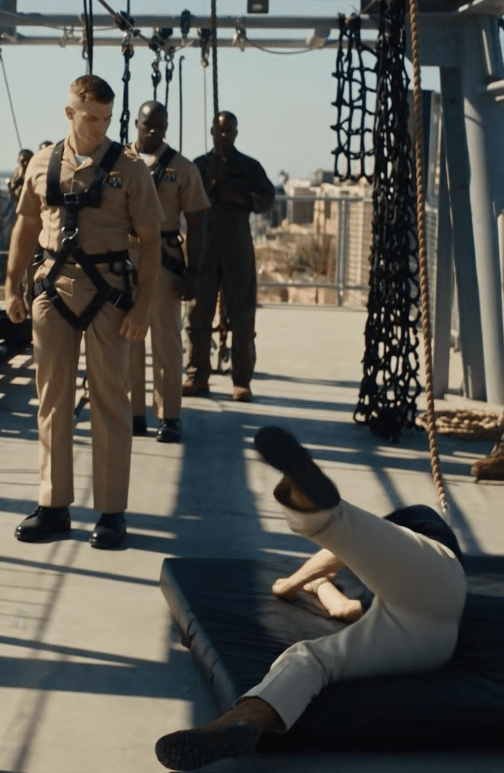
The Colonel ripped the safety rope from the older instructor’s hands and slapped her in front of dozens of soldiers. When she refused to abandon an unsafe anchor point, he kicked her onto the training mat and sneered that old instructors had no right to cancel his demonstration.
Then her hair shifted.
Behind her ear was a small scar beside a tiny, faded unit mark. The senior instructor watching from the platform recognized it instantly—and the look on his face made the Colonel wish he had never touched her.
“Colonel, she stopped your demonstration.”
The training aide delivered the complaint as soldiers gathered around the steel rappelling tower. Ropes hung from overhead anchor points, harnesses lined the equipment racks, and thick safety mats covered the ground beneath the platforms.
Colonel Marcus Vance stood at the center of the training area, dressed in a field uniform and a properly secured climbing harness. At forty-eight, he had built his reputation on discipline, aggressive training schedules, and an intolerance for anyone who challenged his authority in public.
The woman standing opposite him appeared to be an unlikely obstacle.
She was sixty-five, with silver hair tied low at the back of her head. Her dark instructor polo was plain, her tactical trousers worn from use, and her black boots showed none of the polish associated with officers who spent their careers behind desks.
She held a safety rope in one gloved hand and pointed toward a steel anchor fixed to the tower.
“That anchor point isn’t secure.”
Vance barely glanced at it.
“Who authorized you to stop my demonstration?”
“I did. The anchor is moving under load.”
A few soldiers looked toward the metal fitting. One had already noticed a slight shift when the rope tightened, but nobody wanted to contradict the Colonel in front of the assembled trainees.
Vance stepped closer.
“We have a schedule to maintain.”
“And people who could fall if you ignore that anchor.”
The answer was calm, direct, and entirely free of apology.
That was what angered him most.
He had expected a volunteer instructor to understand her place when a senior officer gave an order. Instead, this older woman had halted his demonstration in front of his troops and made it clear that his schedule meant nothing compared with their safety.
“Release the rope,” he ordered.
She kept hold of it.
“Not until that anchor is checked.”
Vance’s expression hardened. He ripped the rope from her hand and struck her across the face.
The crack echoed between the steel supports.
Her head snapped sideways. Her silver hair loosened, and a few strands fell across her cheek. A collective gasp rose from the soldiers below the tower.
Before she could fully regain her balance, Vance drove a forceful kick into her torso.
She stumbled backward and fell beside the safety mat, struggling to draw a breath.
For several seconds, nobody moved.
Vance stood over her, breathing hard, his anger disguised as righteous authority.
“Old instructors don’t cancel my training.”
The woman pressed one hand against the mat and slowly lifted herself upright.
Her cheek was red and swelling. A faint trace of blood marked her lip, and pain tightened her expression as she drew another breath.
But she did not look at the Colonel.
She looked straight past him.
At the anchor.
Even after being struck and kicked to the ground, her first concern was still the piece of equipment that could send a soldier falling.
Vance followed her gaze and laughed.
Then the woman brushed the loose hair away from her face.
And the senior instructor on the platform saw something that made his hand freeze around a harness strap.
Act II
The woman rose without accepting help.
She steadied herself against the edge of the safety mat, took a careful breath, and examined the anchor again. Her movements were measured, but the pain in her torso was unmistakable.
She had no interest in proving that she could endure a beating.
She wanted the demonstration stopped.
“Secure the tower before anyone climbs,” she told the nearest trainee.
The soldier glanced at Vance.
The Colonel’s jaw tightened.
“Did I give you permission to issue orders?”
The trainee froze.
The woman turned toward him.
“No one climbs until that anchor is inspected.”
Her voice was not loud. It did not need to be.
Something in her manner suggested that she had delivered instructions in far more dangerous places than this training ground, under circumstances where hesitation could cost lives.
Vance, however, saw only a woman refusing to acknowledge his authority.
He had spent years believing that public challenges weakened command. If a subordinate questioned him in front of the troops, he responded immediately and decisively. He called it discipline, though the distinction between discipline and personal pride had grown increasingly difficult for him to recognize.
The training aide had reinforced that habit.
When the older instructor first stopped the demonstration, he had presented her decision as an embarrassment to the Colonel rather than a safety concern. Vance had arrived expecting to correct an insubordinate volunteer.
Instead, he had created a scene nobody would forget.
Now the aide stood several feet away, his earlier confidence gone. He watched the woman regain her balance and wondered whether he should have checked the anchor himself before reporting her.
Across the training area, senior instructor Daniel Reeves had not taken his eyes off her.
At fifty-eight, Reeves had served in training commands long enough to recognize the difference between an ordinary injury and a mark connected to an extraordinary past. He had supervised rappelling courses, inspected climbing systems, and trained instructors who understood that a single overlooked fault could destroy a soldier’s life.
He had also spent years hearing about a mission that senior personnel rarely discussed casually.
The woman pushed a loose strand of hair behind her ear.
For one brief moment, the skin behind it became fully visible.
There was a small scar, pale against the surrounding skin, with a tiny unit mark beside it. Neither was large enough to attract attention from someone who did not know what to look for.
Reeves knew.
His grip tightened around the harness strap.
He had seen that mark in an old photograph, one kept in a restricted training archive alongside a handful of records from a mission that had changed the lives of the people involved.
The photograph had shown a younger woman standing beside a damaged structure, her uniform dusty and her expression exhausted. The scar had been visible behind her ear.
The accompanying record contained little information about the operation itself. The details had been carefully limited, and several names had been withheld from the training materials Reeves later encountered.
But one fact had stayed with him.
The woman in that photograph had been a senior officer who took responsibility when a mission went catastrophically wrong—and who refused to abandon the people under her command.
Reeves looked from the scar to the injured instructor.
The resemblance was unmistakable.
Then he noticed Vance stepping toward her again.
And Reeves realized that the Colonel had no idea what he had just done.
Act III
“Colonel…”
Reeves spoke before Vance could reach the woman.
The Colonel turned sharply.
“What?”
The senior instructor descended from the platform, one hand still gripping the harness strap. His expression had changed completely. The color had drained from his face, and his eyes remained fixed on the small mark behind the woman’s ear.
“Don’t touch her again.”
The words fell into the training area with startling weight.
Vance stared at him.
“Are you questioning my authority?”
Reeves did not answer immediately.
His attention remained on the scar.
He remembered the old photograph. He remembered the mission reports, the missing details, and the quiet respect with which experienced instructors spoke about the officer who had returned from that operation.
Most importantly, he remembered the warning attached to the file.
The mark was not a decoration.
It was a trace of something that had happened in a place where the people involved had faced circumstances that no ordinary training exercise could reproduce.
Reeves had never expected to encounter it in person.
He had certainly never expected to see it on someone standing beside a safety mat after being assaulted by her own training commander.
Vance gave a short, contemptuous laugh.
“Because of a scar?”
He gestured toward the woman’s ear as though Reeves had mistaken an old injury for a military credential.
“I’m supposed to stop my entire training because she has a mark on her skin?”
Reeves looked at him.
“That’s not what I’m telling you.”
“Then explain yourself.”
For a moment, the senior instructor seemed ready to speak. His lips parted, but he stopped himself.
The woman intervened before he could reveal anything.
“He knows what happened where I got it.”
Her voice was quiet.
She did not look at Reeves for confirmation. She did not tell Vance her name, recite her former rank, or offer the story of the mission that had left its mark behind her ear.
She simply allowed the sentence to stand.
Vance’s expression changed almost imperceptibly.
He looked at Reeves again.
The older instructor was no longer merely objecting to an assault. He looked frightened by the possibility of what the Colonel might discover.
That reaction unsettled Vance more than the scar itself.
Military training was full of old injuries. Soldiers carried scars from accidents, deployments, and difficult assignments. Most were private reminders of experiences that had little bearing on the chain of command.
But Reeves had recognized this one before anyone explained it.
And the woman seemed certain he remembered exactly where it came from.
Vance tried to recover his composure.
“I don’t care what happened years ago. This is my training tower.”
The woman glanced toward the anchor.
“Then you should care whether it holds.”
The words cut through the argument with devastating simplicity.
A young soldier near the tower shifted his weight. Another looked up at the steel fitting. The anchor had not suddenly become unsafe because the woman possessed an extraordinary past.
It had been unsafe from the beginning.
Her history merely made the Colonel’s refusal to listen look even more reckless.
Reeves stepped between Vance and the equipment, not touching either of them.
“Shut the demonstration down,” he said. “Until the anchor is inspected.”
Vance opened his mouth to object.
Then he saw the look on Reeves’s face.
There was no uncertainty in it now.
The senior instructor had recognized the scar, and the recognition had awakened a memory that Vance could not access.
For the first time, the Colonel began to suspect that the older woman had a history far beyond the modest instructor uniform he had dismissed.
And whatever that history contained, Reeves was convinced that Vance needed to stop before he made the situation worse.
Act IV
The training tower fell silent.
Ropes hung motionless from the upper platforms. Soldiers remained beside the harness racks, watching the confrontation unfold below them. Nobody wanted to become the next person to move without knowing what was happening.
Vance straightened his uniform.
“You’re shutting down my demonstration because of an old scar?”
“No,” Reeves replied. “I’m shutting it down because the anchor needs to be inspected.”
He paused.
“And because you need to stop.”
The second sentence landed harder than the first.
Vance’s face darkened. He had expected the older instructor to retreat after a stern warning. Instead, Reeves was looking at him with an expression that suggested he had crossed a boundary that could not be erased by an apology delivered for the benefit of witnesses.
The woman, meanwhile, had moved back toward the tower.
She tested neither her strength nor her balance for the Colonel’s benefit. She simply examined the anchor from a safe distance, watching as another instructor approached with the proper inspection equipment.
“Check the mounting points and the connection under load,” she said. “Don’t use this line until it’s cleared.”
The instructor nodded and began the inspection.
Vance watched her.
Even now, she was directing attention away from herself and toward the equipment. Her cheek was swollen, her breathing remained guarded, and the movement of her injured torso betrayed the force of the kick.
Yet she was more concerned about a faulty connection than about the man who had hurt her.
That fact made Vance uncomfortable in a way he could not explain.
He had spent the confrontation trying to force her to acknowledge his rank. She had spent every moment trying to prevent someone from getting hurt.
“Who are you?” he demanded.
This time, the question was not merely an attempt to intimidate her.
She turned to face him.
“An instructor who stopped an unsafe climb.”
“You know that’s not what I’m asking.”
“Yes,” she said. “I do.”
She offered nothing more.
Reeves looked at her, waiting for permission to explain. When she did not give it, he remained silent.
That silence made Vance increasingly uneasy.
He was accustomed to credentials being announced, titles being displayed, and people invoking powerful connections when they wanted a decision reversed. The woman’s refusal to do any of those things left him with no familiar argument to attack.
Instead, he had to confront what everyone had witnessed.
He had taken a safety rope from an instructor who had identified a hazard. He had struck her when she refused to abandon that concern. He had kicked her to the ground in front of his troops, then mocked her age and profession.
No revelation about her past could change those facts.
But it could explain why Reeves looked at her as though the scar represented a debt of honor he had never forgotten.
Vance turned toward the senior instructor.
“What mission are you talking about?”
Reeves lowered his eyes for a moment.
“The kind you don’t understand by looking at a photograph.”
“Then tell me.”
“I can’t give you the whole story.”
“Why not?”
“Because it isn’t mine to tell.”
The answer silenced him.
The woman looked at Reeves briefly. There was gratitude in the smallest movement of her eyes, but she did not invite him to say more.
Whatever had happened on that mission, it belonged to the people who had lived through it.
Reeves would not turn their experience into a public spectacle simply to win an argument with a colonel.
The equipment inspection continued.
A technician checked the steel mounting and examined the connection. His expression grew serious as he worked, and he called another instructor over to verify what he had found.
The anchor was not cleared for use.
A murmur passed through the soldiers.
Vance looked toward the tower.
His demonstration had been stopped for a reason.
The woman had identified a genuine danger, and he had answered her professional judgment with violence.
There was no clever interpretation that could make him right.
He looked back at Reeves, searching for an explanation that might restore the balance he had lost.
The senior instructor remained still.
The woman adjusted her safety gloves, then directed the team to isolate the anchor until repairs could be completed.
She did not demand an apology.
She did not threaten to report Vance.
She did not mention her former rank.
And somehow, that made the Colonel feel smaller than any public accusation could have.
He had spent the afternoon trying to establish that he was the most important person in the training area.
Now everyone was waiting for him to understand that the mission was never about him.
Then Reeves spoke quietly enough that only Vance and the woman could hear.
“You really don’t recognize her, do you?”
Vance looked at the scar behind her ear.
For the first time, he did not see an old instructor’s injury.
He saw the outline of a story that someone had tried very hard to preserve without turning it into a legend.
And a memory from his own early military career began to surface.
Act V
Vance had heard the story years earlier, long before he became a colonel.
It had surfaced during an advanced leadership course, when an instructor described a mission in which a team had been left facing impossible decisions after a structure failed and the extraction plan collapsed.
The details had been limited.
The course had not named every person involved, and the official account had focused on decisions rather than personalities. But the instructor had emphasized one figure: a senior officer who refused to leave anyone behind and who took responsibility for the consequences of that choice.
The officer had been injured during the operation.
A small scar behind the ear had become one of the few identifying details mentioned in a photograph used during the training.
Vance remembered the lesson because it had challenged the kind of leadership he once thought he understood.
The instructor had asked the class what made someone worthy of command.
Not rank.
Not confidence.
Not the ability to make a room fall silent.
The answer, the instructor had explained, was what a leader protected when pressure made protection inconvenient.
Vance had remembered the words.
Over the years, he had forgotten their meaning.
Now he stared at the woman standing beside the tower and understood why Reeves had reacted the way he had.
She was the retired Lieutenant General whose actions had become part of that lesson.
She had once held authority far greater than anything Vance possessed, and she had earned the respect of people who had served in conditions he had never experienced.
But she had not come to the training tower to remind anyone of that.
She had come to teach soldiers how to descend safely.
She had stopped the demonstration because an anchor was moving.
And when the Colonel had attacked her, she had returned her attention to the danger rather than using her past to humiliate him in return.
Vance’s mouth went dry.
The rank he had used to intimidate her suddenly felt meaningless. He had not simply insulted an older instructor. He had assaulted a retired general whose example had once been used to teach officers like him what command was supposed to mean.
Worse, he had ignored a legitimate safety warning that might have prevented a catastrophic fall.
Reeves watched the realization unfold across his face.
The woman remained beside the tower, listening as the technicians confirmed that the anchor would need repairs before it could be used again.
“Keep the demonstration suspended,” she instructed.
“Yes, ma’am,” one of the instructors replied.
Vance heard the respectful address.
It was not loud or theatrical. Nobody announced her history to the assembled soldiers. Nobody ordered the crowd to salute or demanded that the Colonel apologize on the spot.
The respect came naturally from the people who recognized the seriousness of her work.
And Vance, standing among them, finally understood why his attempts to dominate the situation had failed.
He had believed that authority meant being the person nobody could challenge.
She had understood that authority meant being willing to challenge a decision when someone’s life was at stake.
He took a half step toward her.
“General…”
The word came out uncertainly.
She turned.
For a moment, Vance seemed ready to explain himself. He could have blamed the schedule, the pressure, the public challenge, or the aide who had brought him to the tower.
But none of those things had forced him to strike her.
None had forced him to kick her while she was already hurt.
He had made those choices himself.
The woman studied him for a moment, her expression unreadable.
Then she looked toward the tower.
“Make sure no one uses that anchor until the repair is verified.”
She walked away before he could answer.
Reeves followed her with his eyes, his expression still heavy with the memory of the mission that had left its mark behind her ear.
The soldiers slowly returned to their duties. The damaged anchor was isolated, the demonstration remained suspended, and the training aide stood in silence beside the equipment racks.
Vance stayed where he was.
He had wanted a public display of obedience.
Instead, he had received a lesson in leadership that he could no longer pretend not to understand.
Then the memory returned with one final, unwelcome detail.
The mission had been remembered not because its commander possessed an impressive rank, but because she had refused to let anyone’s pride outweigh the lives entrusted to her.
Vance looked toward the instructor disappearing beyond the tower.
His voice barely carried across the steel platform.
“Where you got it…?”
The question hung unfinished in the air.
For the first time, the Colonel was afraid of the answer—not because the scar gave the woman power over him, but because it reminded him of the kind of leader he had once promised himself he would become.
And of how far he had fallen from that promise.