Act I
The Colonel slapped the woman across the face in front of an entire field hospital, then kicked her into a supply crate when she refused to surrender a bag of trauma kits. What he didn’t know was that the small silver coin falling from her vest belonged to a history he had spent his entire career trying not to think about.
“Colonel, she won’t give us the trauma kits.”
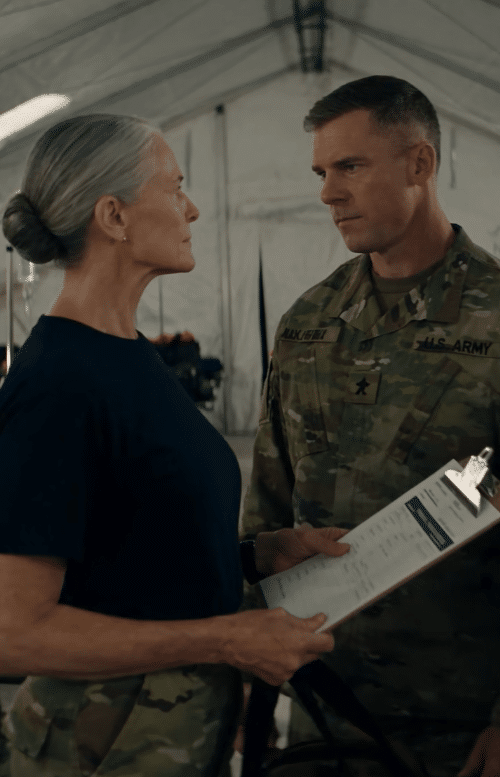
The young lieutenant delivered the complaint with the confidence of a man who believed the right uniform could turn any disagreement into insubordination. Behind him, Colonel Richard Harlan strode down the central aisle of the field hospital tent, his boots crunching against the gravel beneath the canvas floor.
Around them, medics moved between rows of cots, checking equipment and preparing emergency stations for the casualties expected during a major military exercise. Trauma bags sat beside color-coded supply crates. IV stands gleamed beneath harsh work lights. Every item had a designated place, and every minute mattered.
At the far end of the reserved supply section stood an older volunteer with silver hair tied into a neat, low bun. She wore an olive medical vest over a dark field shirt, a clipboard tucked beneath one arm and a trauma bag held firmly in her other hand.
She looked nothing like someone who intended to challenge a colonel.
That was precisely why Harlan assumed she would fold.
“What’s the problem here?” he demanded.
The woman glanced at the allocation sheet before meeting his eyes.
“Those kits are reserved for the incoming wounded.”
Harlan stared at her as though she had answered in a foreign language.
“My unit requested those supplies.”
“And the incoming casualties have priority.”
The lieutenant shifted uncomfortably. He had expected the volunteer to apologize, perhaps offer an explanation, and then hand over the equipment. Instead, she stood perfectly still, speaking with the quiet certainty of someone who understood the consequences of making the wrong decision.
Harlan extended his hand toward the bag.
“Give it to me.”
“No, sir.”
The two words were quiet. They were also absolute.
Harlan snatched the supply list from her hand and knocked it to the ground. Before anyone could react, he struck her across the face.
A sharp impact cracked through the tent.
Several medics froze mid-motion. A metal instrument tray rattled somewhere behind them, but nobody spoke.
The woman’s head turned with the blow. When she faced him again, one cheek was already reddening, a faint trace of blood appearing at the corner of her lip.
She did not release the trauma bag.
Harlan’s expression hardened at the sight of her resistance. He drove a forceful kick into her torso, sending her backward into a supply crate. She fell hard, the impact knocking the breath from her lungs.
The bag remained clutched against her body.
For a moment, the only sound was her strained breathing and the nervous rustle of uniforms around her.
Harlan stood over her.
“Supply women don’t ration equipment to colonels.”
He expected tears. An apology. At the very least, surrender.
Instead, the woman looked up at him with an expression so cold that his satisfaction briefly faltered.
Then she drew a painful breath, braced one hand against the crate, and began to rise.
And as she struggled back to her feet, something slipped from her vest and struck the ground with a small, unmistakable metallic ring.
Neither the Colonel nor his lieutenant understood what had just fallen.
But an older medic standing nearby did.
And the instant he saw it, the color drained from his face.
Act II
The woman regained her footing slowly, one hand pressed against her injured torso and the other keeping the trauma bag close.
She could have demanded medical attention. She could have ordered the surrounding staff to document the assault. She could have used the moment to embarrass the Colonel in front of everyone who had witnessed his behavior.
Instead, she checked the bag’s fastenings.
The incoming wounded still needed those supplies.
That was the only thing that mattered to her.
Harlan mistook her restraint for weakness. In his experience, authority was something a person displayed loudly enough to make others stop questioning it. He had spent years watching younger officers retreat the moment he raised his voice, and he had begun to confuse obedience with respect.
The volunteer’s silence irritated him more than an argument would have.
“Are you going to keep standing there pretending you know how this operation works?” he asked.
She said nothing.
The lieutenant looked from the Colonel to the allocation sheet lying on the ground. He had originally brought Harlan over because the supply delay threatened his unit’s schedule. He had not expected a public assault, and he certainly had not expected the woman to stand back up without asking anyone for help.
Still, he remained silent.
So did everyone else.
The field hospital was full of people trained to respond to emergencies. They knew how quickly a patient’s condition could deteriorate. They knew the difference between an inconvenience and a life-threatening shortage.
Yet a colonel’s rank had turned a clear medical decision into a confrontation nobody wanted to challenge.
Harlan bent toward the trauma bag again.
“I gave you an order.”
The woman straightened as much as her injuries allowed.
“And I gave you the medical priority.”
Her voice was quieter now, but nothing in it had weakened.
Harlan’s jaw tightened.
He reached for the bag, and she pulled it close enough to keep it out of his grasp without striking him or attempting to fight back.
That was when the senior medic noticed the coin rolling beside his boot.
It was silver, worn smooth around the edges, with the kind of age that no freshly issued military souvenir could imitate. Its surface caught the light for an instant before settling against the sole of his boot.
The medic, Sergeant Major Daniel Mercer, had spent more than three decades in military medicine. He had worked emergency wards during deployments, trained medical teams under pressure, and watched officers come and go through assignments that most people never heard about.
He had seen plenty of challenge coins.
This one was different.
Mercer lowered his eyes, then bent to retrieve it.
His fingers stopped just above the metal.
He recognized the markings.
More importantly, he recognized what those markings meant to the handful of people who had once served under the command associated with it.
His clipboard tilted in his other hand.
The Colonel was still talking, but Mercer no longer seemed to hear him. His gaze moved from the coin to the woman beside the crate.
Silver hair.
The controlled posture despite the pain.
The refusal to sacrifice the needs of wounded personnel simply because someone with a higher rank had demanded it.
Suddenly, several old memories returned at once.
Mercer had not seen that coin in years.
He had never expected to see it here.
And he had certainly never expected to find it beside a woman a colonel had just kicked to the ground.
What Mercer recognized was not merely an object.
It was a connection to a ward whose story had never truly ended.
Act III
“Colonel…”
Mercer’s voice was barely above the surrounding noise, but something in its tone made Harlan turn.
The senior medic was no longer standing casually beside the supply crates. His shoulders were rigid, his face pale, and his fingers closed carefully around the silver coin.
“Put that bag down.”
The command was so unexpected that even the lieutenant looked at him in disbelief.
Harlan gave a short, humorless laugh.
“Excuse me?”
Mercer did not repeat himself. He stared at the Colonel with an expression that had nothing to do with ordinary disagreement.
It was fear.
Not fear of punishment from a superior standing nearby. Not the nervous caution of a soldier who had made a mistake in front of an officer.
This was the look of a man who had recognized a name from history and suddenly realized he was standing inside the kind of story that people spent years trying to forget.
Harlan followed his gaze toward the coin.
Then he laughed again.
“For a coin?”
The words came out with practiced contempt. He wanted the surrounding medics to hear the dismissal. He wanted Mercer to remember who wore the colonel’s insignia and who was supposed to follow orders.
But the senior medic did not move.
His grip on the clipboard tightened until his knuckles turned pale.
The woman watched them both.
She did not reach for the coin. She did not explain its markings, announce her credentials, or demand that Mercer tell everyone who she was.
She simply stood beside the crate, breathing carefully through the pain.
Then she spoke.
“He remembers the ward it came from.”
Mercer looked at her.
For the first time since the assault, the woman allowed something other than professional detachment to enter her expression. It was not pride. It was not anger.
It was recognition of a memory shared by people who had seen what happened when a medical ward became the last line between life and death.
Mercer swallowed.
The Colonel’s smile began to fade.
“The ward?” Harlan repeated, but he was no longer speaking to her with the same certainty.
The woman held his gaze.
“You should ask him.”
That was all she offered.
No rank. No name. No list of accomplishments.
Only a sentence that seemed to remove the ground beneath the Colonel’s confidence.
Harlan turned toward Mercer, expecting the older medic to recover his composure and explain why a piece of silver had suddenly become the center of everyone’s attention.
Instead, Mercer looked as though he had been transported years into the past.
He remembered an overcrowded military ward during a devastating deployment, a place where the supply lines had broken down and the wounded kept arriving long after the staff had exhausted their strength.
He remembered a senior medical commander who had refused to let operational convenience dictate which patients received care.
He remembered an officer who had taken responsibility when the easiest option would have been to blame someone else.
And he remembered a silver coin that had passed through that ward, not as a trophy, but as a mark of service associated with the people who had held the line when the system itself was failing.
The full story had never been told at ordinary briefings.
Some of it belonged to official records. Some of it lived in the memories of the people who had been there.
Mercer had spent years believing that the woman at the center of those memories was far beyond the reach of an ordinary field hospital.
Now she was standing in front of him, injured, holding a bag of medical supplies, and refusing to surrender the needs of strangers.
The Colonel saw the change in Mercer’s face.
He did not yet understand the history.
But he understood that the older medic knew something he did not.
And for the first time, Harlan began to wonder whether he had made a mistake that his rank could not repair.
Act IV
Nobody moved.
The field hospital seemed to shrink around the three of them. The generators continued humming outside the canvas walls, and somewhere beyond the tent, military vehicles moved along the exercise route.
Inside, the atmosphere had changed completely.
Harlan looked at the coin again.
It was an ordinary enough object at first glance: silver, worn, small enough to disappear inside a pocket. No glittering decoration. No elaborate display of rank.
Yet Mercer was holding it with the care of someone handling a piece of military history.
“Who is she?” Harlan asked.
The question was directed at Mercer, but the woman answered before he could.
“Someone trying to get supplies to the wounded.”
Her response was so simple that the lieutenant lowered his eyes.
A few minutes earlier, he had treated her as an administrative obstacle. Now he could not bring himself to look directly at the cheek his commanding officer had struck.
Harlan’s face tightened.
“I’m asking about the coin.”
“And I’m telling you what matters.”
The Colonel stared at her.
He was accustomed to people using their credentials as weapons. He understood influence, hierarchy, and the quiet calculations that determined who got heard in a room.
But this woman was not negotiating for attention.
She was refusing to let him change the subject from the wounded to himself.
Mercer finally spoke again.
“Sir, I would strongly advise you to step away from that bag.”
The formal address did nothing to soften the warning.
Harlan turned sharply.
“Do you know who you’re speaking to?”
“Yes, sir.”
“Then act like it.”
Mercer glanced at the coin, then back at the woman. His expression remained grave.
“I do know who you are, Colonel.”
The distinction landed harder than an accusation.
For the first time, Harlan looked beyond the vest and the silver hair. He noticed the woman’s composure, the way she had assessed the supplies before answering him, and the absolute certainty with which she had protected the incoming casualties.
She had not tried to overpower him.
She had not appealed to the audience.
She had simply refused to let his authority determine who deserved medical care first.
That kind of discipline was familiar to anyone who had served alongside exceptional military leaders.
And Mercer was looking at her as though he had found someone he once believed he might never see again.
Harlan’s gaze shifted toward the lieutenant.
The younger officer immediately straightened, but there was no confidence left in his expression.
“You brought me here because she refused a supply request?” Harlan asked.
The lieutenant hesitated.
“Yes, sir.”
“Did you check the allocation?”
His mouth opened, then closed.
“No, sir.”
The silence that followed was more damaging than any excuse could have been.
Harlan had arrived believing that a subordinate had been obstructed by an insubordinate volunteer. Now he was discovering that neither he nor his aide had bothered to establish whether the requested equipment could legally or medically be reassigned.
He looked at the bag.
Then at the supply sheet.
Then at the woman whose refusal had prompted him to lose control in front of his own personnel.
She was still hurt. Her cheek was red and swollen, and she kept one arm close to her torso as she steadied herself against the crate.
Yet she was the only person in the tent who had remained faithful to the purpose of the operation.
Mercer extended the coin slightly, but the woman made no move to take it.
“Keep it,” she said.
The senior medic froze.
Harlan watched the exchange, and something in the gesture unsettled him more than the coin itself.
She did not need to reclaim it to prove anything.
She did not need to explain what it represented.
Mercer already knew.
And now Harlan could see that whatever had happened in that forgotten ward had left a mark on the people who had served there—a mark that had survived years of assignments, promotions, and changing commands.
The woman finally pushed herself away from the crate and stood upright.
“Those supplies stay here until the incoming casualties are accounted for.”
This time, she did not look at the Colonel when she spoke.
She looked toward the medical station.
A medic at the far end of the tent immediately returned to checking the reserved equipment. Another picked up the fallen supply sheet.
The operation began moving again, but nobody treated the incident as ordinary.
Harlan remained where he was, his hands suddenly uncertain.
He had used violence to force compliance.
Instead, he had exposed his own failure in front of people who understood exactly what military discipline was supposed to protect.
And the worst part was that the woman had not threatened him with a single consequence.
She had merely reminded him that there were people alive today because one ward, long ago, had refused to let rank decide the value of a wounded soldier.
Then Mercer looked at Harlan and spoke the words that finally stripped away the Colonel’s remaining confidence.
“You need to understand what that ward meant.”
He stopped there.
He did not explain further.
He did not have to.
The woman’s face remained calm, but her eyes told Harlan that the next piece of information would not make his position any easier.
For the first time, the Colonel looked at her as though he was seeing a person rather than a subordinate he could command.
And the question forming in his mind was one he had no idea how to ask.
Act V
Harlan looked down at the silver coin one final time.
The tent lights reflected off its worn surface, catching the shallow markings that Mercer had recognized instantly. The Colonel could not read the whole story from the metal, but he could read the senior medic’s face.
Whatever the coin represented, it belonged to a chapter of military medicine that Mercer regarded with something close to reverence.
Harlan had spent years believing that authority was a shield.
He was beginning to understand that it could also be a spotlight.
It illuminated not only what a person could order, but what that person did when nobody dared to refuse.
The woman reached for her clipboard. One of the medics handed it back to her, carefully avoiding her injured cheek.
She checked the allocation sheet again.
“Confirm the reserved kits are ready.”
The medic nodded and moved immediately.
No dramatic announcement followed. Nobody called the entire tent to attention. There was no sudden parade of senior officers rushing through the entrance to reveal her identity.
The reversal was quieter than that.
The people who mattered already understood.
Mercer had seen enough to recognize the woman behind the volunteer vest. The staff had witnessed a colonel attack someone who was protecting their medical supplies. And the lieutenant had learned that unquestioning deference could make him complicit in a failure he had never bothered to examine.
Harlan remained trapped between the woman and the memory he could not yet name.
“Who are you?” he asked at last.
She turned toward him.
For a moment, it seemed she might finally explain.
Instead, she gave him the same steady look she had offered when he first demanded the bag.
“Someone who knows what happens when a ward runs out of time.”
The answer carried no boast, no threat, and no invitation to argue.
It was simply the truth.
She looked past him toward the entrance, where the first vehicles carrying the exercise’s simulated casualties were beginning to arrive. The medics moved into position. Gloves snapped into place. Equipment was checked one final time.
The trauma kits remained where they belonged.
Harlan stepped back.
It was only half a step, but everyone noticed.
The woman did not watch him retreat. She was already preparing for the work ahead, her attention fixed on the people who would soon need the supplies he had tried to take.
Mercer closed his hand around the coin.
He had recognized its connection to a medical command that had once become legendary among the people who served in its wards. He had recognized the woman, too, though the Colonel still had not put all the pieces together.
And there was one detail Mercer could not forget: she had carried that coin for years without using it to demand special treatment.
Not when the supply system was under pressure.
Not when a colonel humiliated her.
Not even when she had been struck and knocked to the ground.
She had allowed the work to speak for itself.
Harlan stared at her, searching for the explanation that would make the scene fit into the familiar rules of rank and authority.
Then a memory surfaced.
An old account from a medical ward. A name he had heard during his early years in uniform. A story of a senior commander who had insisted that the wounded came before operational convenience, regardless of whose signature appeared on a request form.
He remembered the ward’s reputation.
He remembered the stories of its commander.
And he finally understood why Mercer had gone pale.
The woman before him was not merely a volunteer who had once worked in military medicine.
She was the retired Major General who had commanded one of the most respected medical operations of that era, a leader whose decisions in that ward had shaped the careers and convictions of the people who served under her.
Her rank was no longer displayed on her clothing.
Her authority did not depend on it.
And the silver coin was not a decoration she had brought to impress anyone.
It was a reminder of the people who had depended on that ward when there had been no room for arrogance, shortcuts, or excuses.
Harlan’s lips parted.
His eyes moved from the coin in Mercer’s hand to the woman standing beside the reserved supplies.
The title he had dismissed as irrelevant suddenly mattered far less than the person he had assaulted.
He had struck a retired general who had spent her career protecting military patients, then tried to take the equipment she had been guarding for the wounded.
Worse, he had done it in front of the very people who understood the difference between command and cruelty.
His face lost its color.
“Wait…”
The woman did not turn back.
The medics were already moving toward the incoming casualties, and she was watching them with the concentration of someone who had never forgotten what was at stake.
Harlan stood motionless as the final piece of the old story settled into place.
“That ward…?”
His voice broke on the last word.
For the first time in his career, the Colonel had no order to give, no rank to invoke, and no confident explanation that could restore the room to what it had been.
The silver coin had not changed the woman’s identity.
It had revealed the identity he had been too arrogant to recognize.
And as the field hospital filled with the sounds of urgent medical work, Harlan finally understood the difference between commanding a room and deserving its respect.