Act I
“Your chair doesn’t own this mall.”
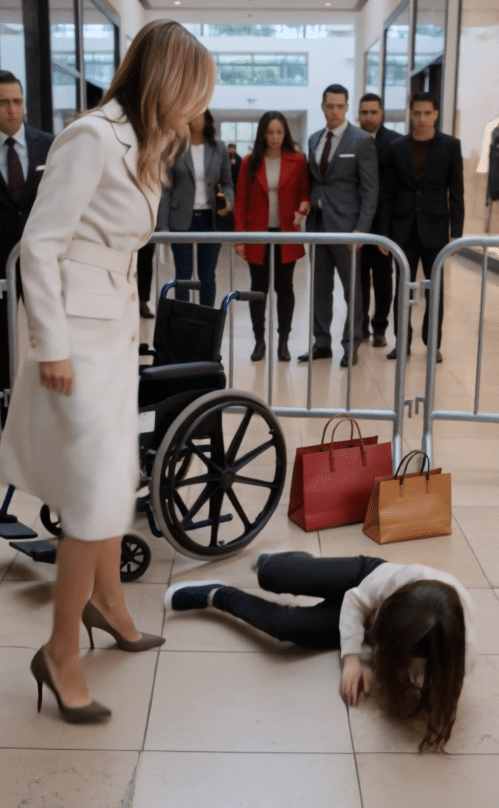
The words had barely left Vanessa Cole’s mouth when she stepped over the designer bags scattered across the luxury corridor and kicked seventeen-year-old Emily Carter out of her wheelchair.
The impact sent the chair jerking sideways. Emily fell hard onto the polished stone floor, her elbow striking the tiles as a small shopping bag burst open beside her. A bottle of water rolled beneath a storefront display, and a folded children’s sweater slid through a puddle of spilled juice.
For one terrible second, the crowd simply stared.
Emily’s ten-year-old brother, Noah, dropped to his knees beside her.
“Emily!”
His voice cracked as he reached for his sister, not knowing whether to touch her or how to help. Emily grimaced, struggling to catch her breath, one hand pressed against the floor while the other reached instinctively toward the wheelchair that had tipped beyond her grasp.
Vanessa stood above them in a white designer coat, oversized sunglasses, and heels that clicked sharply against the stone.
She looked less like someone who had just assaulted a teenager than someone annoyed that an ordinary inconvenience had interrupted her shopping trip.
Emily had asked for less than a minute of consideration.
Vanessa’s expensive shopping bags had been spread across the main corridor, blocking the accessible path beside the storefronts. Emily had approached slowly, guiding her wheelchair with practiced movements while Noah carried their small shopping bag.
“Excuse me,” Emily had said. “I just need room to pass.”
Vanessa had turned as though Emily had insulted her.
“Trash. Move around my bags.”
Emily glanced toward the narrow space between the display windows and a row of temporary promotional stands. It was barely wide enough for the wheelchair, and the stone floor sloped slightly toward the escalators.
“I can’t get through there safely,” Emily explained. “Could you move them just a little?”
Vanessa removed her sunglasses.
That was when her expression changed.
She was thirty-nine, wealthy, and accustomed to a world in which people hurried to accommodate her. Store managers knew her by name. Personal shoppers carried her purchases. When she complained, someone usually appeared to apologize before she had finished speaking.
She had mistaken service for superiority so many times that she no longer recognized the difference.
And now a girl in a beige sweater, black jeans, and worn sneakers had dared to tell her that the corridor was not hers to control.
Vanessa kicked Emily’s wheelchair.
The chair shifted violently, and Emily fell onto the floor.
A woman near the cosmetics counter gasped. A man holding a coffee stopped mid-step. Two teenagers stared in disbelief, their phones half-raised but their feet rooted to the ground.
Vanessa looked down at Emily.
“Move around my bags,” she repeated.
Emily tried to sit up, but pain stopped her. A thin trace of blood appeared on her elbow where the skin had scraped against the stone.
Noah was crying now.
“Please don’t hurt her!”
Vanessa barely glanced at him.
She stepped closer and kicked Emily again.
The crowd recoiled.
Emily curled instinctively, trying to protect herself as the second and third blows landed against her back and side. Her wheelchair lay at an angle nearby, one wheel spinning slowly. Noah clutched his sister’s sleeve, sobbing and calling her name.
Emily’s eyes filled with tears.
“I just need room to pass,” she whispered.
The words were almost lost beneath the sudden silence.
Vanessa straightened her coat.
“Your chair doesn’t own this mall.”
Nobody moved.
The humiliation was worse because it was happening in a place designed to sell people beautiful things. Glass storefronts glittered beneath the lights. Luxury handbags sat behind spotless displays. Shoppers held paper cups and glossy shopping bags while Emily lay on the floor beside a tipped wheelchair.
A security guard finally began running from the far end of the corridor.
But before he reached them, the doors of the VIP elevator opened sharply.
A tall man in a navy suit stepped out, followed by two security managers and several guards. He was sixty-one-year-old Daniel Whitmore, the owner of the entire shopping complex, a man whose name appeared on property documents, corporate filings, and the invitations to the city’s most exclusive business events.
He took in the scene in a single glance.
The girl on the floor.
The frightened child beside her.
The wheelchair lying several feet away.
The woman standing over them.
“Get medical assistance,” Daniel ordered. “Protect the girl and her brother. Nobody touches those bags or moves anything until security has documented the scene.”
Two guards immediately positioned themselves between Vanessa and the children. Another knelt at a respectful distance from Emily and asked whether she could hear him.
Daniel approached Emily first.
“Help is here,” he told her. “You don’t have to move until medical personnel arrive.”
Then he rose and turned toward the security managers.
His voice carried through the corridor.
“Close this wing immediately.”
Mall employees began pulling metal barriers across the entrances. Store managers emerged from their shops, and the shoppers who had been whispering moments earlier fell silent.
Vanessa stared at the barriers, then at Daniel.
Her confidence faltered.
She had expected security to remove the inconvenience.
She had not expected the owner himself to arrive.
“For her?” she asked.
The question came out smaller than she intended.
And when Daniel Whitmore looked at her, Vanessa finally understood that the woman she had kicked onto the floor was not someone the world had forgotten.
She was someone whose story Daniel already knew.
Act II
Emily Carter had learned to navigate the world through careful calculations.
How wide was the doorway?
Was the ramp too steep?
Would the crowd at the entrance leave enough room to turn around?
Could she carry her own drink without losing control of the wheelchair?
These were ordinary questions to Emily, but they were questions most people never had to consider.
Three years earlier, a winter highway accident had changed her life. Emily had been traveling home with her mother, Laura, and her younger brother when another driver lost control on an icy road.
Her mother did not survive.
Emily suffered injuries that permanently affected her mobility, and Noah, then seven, spent months asking when their mother would come home.
Their father had left when Noah was a baby. After Laura’s death, the siblings moved in with their maternal aunt, Rachel Carter, who became their legal guardian.
Rachel loved them, but she was raising two children while working long shifts as a hospital billing clerk. Money was tight, their apartment was small, and there were days when grief arrived without warning.
Emily had become fiercely protective of Noah.
She helped him with homework, packed his lunches, and learned to recognize the frightened silence that came over him when he remembered the accident. She never pretended she could replace their mother, but she tried to make sure he never felt alone.
Noah, in turn, treated his sister as though she were the strongest person he knew.
He knew how to fold her wheelchair for transport, how to hold doors open without making her feel helpless, and when to stop offering assistance because Emily wanted to do something herself.
They had developed a language of small gestures.
A tap on the shoulder meant I’m here.
A squeeze of the hand meant we can leave if you want.
A shared glance across a crowded room could turn an overwhelming moment into something manageable.
The shopping trip had been Noah’s idea.
His school was holding a winter fundraiser, and he had saved his allowance to buy a small present for Rachel. He wanted to get her a soft scarf because she always complained that the hospital’s air-conditioning made her cold.
Emily had offered to accompany him.
They could not afford the expensive stores, but the mall had a department store with an affordable section, and Noah had insisted that the gift did not need to be fancy.
“It just has to be something she’d like,” he had said.
Emily had smiled.
“Then you already understand the assignment.”
They bought the scarf, a small bottle of juice, and a children’s sweater Noah had spotted on sale. He carried the purchases in a paper bag, proud of the fact that he had stayed within his budget.
They were heading toward the lower-level exit when they encountered Vanessa.
At first, Emily had not recognized her.
Vanessa Cole was a familiar face in the city’s social pages, frequently photographed at charity galas, fashion launches, and private events. She owned a chain of luxury beauty clinics and had built a public image around elegance, philanthropy, and impeccable taste.
Her online profiles showed her handing oversized checks to children’s hospitals, posing beside smiling volunteers, and speaking about the importance of kindness.
She had recently sponsored a fundraising campaign for accessibility improvements at several public venues.
Emily had seen one of the advertisements.
The slogan had read: Every person deserves a place.
The irony would have been almost unbelievable if it had not hurt so much.
Vanessa’s bags had blocked the accessible route because she had decided that the floor space belonged to her. Emily’s polite request had threatened the illusion that everyone else existed to make her life easier.
Instead of moving the bags, Vanessa had treated Emily’s disability as an invitation to humiliate her.
And the crowd had watched.
That was the part Emily would struggle with long after her bruises faded.
Not everyone had been cruel. Some shoppers had looked horrified. A woman had begun to step forward before stopping when Vanessa’s voice rose. A store employee had rushed to call security.
But Emily had seen the hesitation.
She had seen people look at one another, waiting for someone else to act.
For a few seconds, the entire corridor had become a place where everyone knew something terrible was happening, yet nobody wanted to be the first person to challenge the woman causing it.
Noah had not hesitated.
He had cried out for his sister even when Vanessa turned toward him with contempt.
He had stayed beside Emily when the adults around them were still deciding what to do.
That was why, as medical personnel arrived, Emily reached for his hand first.
“Are you okay?” she whispered.
Noah stared at her in disbelief.
“I’m okay? You got kicked!”
“I know.”
“You’re the one who got hurt!”
Emily tried to smile, but her face tightened with pain.
“I’m still here.”
Noah burst into tears again.
Daniel Whitmore watched them from several feet away. He had ordered the corridor closed, but he understood that closing a shopping wing was the least important thing he could do.
He asked a security manager to preserve the camera footage from every angle and ensure that the witnesses’ details were recorded. He also instructed staff to keep the children away from the crowd and to avoid discussing the incident in public.
When the paramedics arrived, Daniel stepped aside so they could assess Emily.
Only after they had begun their examination did he turn back toward Vanessa.
She had removed her sunglasses and was looking around as though she expected someone to tell her the entire situation had been a misunderstanding.
“Do you know who I am?” she demanded.
Daniel did not answer immediately.
Vanessa seemed to take his silence as an opportunity.
“I am one of this mall’s most important clients. I spend a fortune here. I know the people who lease half these stores.”
Daniel’s expression did not change.
“Then you should understand why we have security procedures.”
“This is ridiculous. That girl was in my way.”
“She asked you to move your bags.”
“She could have gone around.”
“The accessible path was blocked.”
Vanessa folded her arms.
“So now I’m supposed to be a criminal because I didn’t rearrange my shopping?”
Daniel looked toward Emily, who was being carefully assessed by the paramedics.
“No,” he said. “You are being investigated because you chose to hurt her.”
For the first time, Vanessa had no immediate reply.
Then her phone began vibrating.
The screen showed a message from her public-relations director, who had apparently heard that security had closed the luxury wing.
Vanessa glanced at it and frowned.
“What is this about a closure?” she muttered.
Daniel heard her.
“It is about ensuring the scene is safe and preserving evidence. The closure is temporary.”
“You can’t shut down an entire wing over one argument.”
Daniel’s gaze sharpened.
“You are still calling it an argument?”
Vanessa looked away.
A security manager approached Daniel with a tablet. The initial camera review was complete, and the footage showed the confrontation from multiple angles.
Daniel watched the short sequence without speaking.
He saw Emily ask for space.
He saw Vanessa kick her.
He saw the child cry out.
He saw the second attack.
And he saw the crowd freeze.
When the footage ended, Daniel handed the tablet back.
“Preserve the original files. Record who accessed them. I want a full incident report, and I want the police contacted.”
Vanessa’s face changed.
“The police?”
“Yes.”
She laughed nervously.
“You can’t be serious.”
Daniel looked at her.
“You have spent the last several minutes explaining why you think the rules should not apply to you. I suggest you stop.”
Vanessa stared at him, suddenly aware that the luxury stores behind her could not protect her from what had happened in front of them.
But Daniel had not yet revealed why he was so determined to make sure the incident was handled properly.
That truth was waiting in a document his legal team had brought to the mall only hours earlier.
And it would turn Vanessa’s public image into her greatest liability.
Act III
The document was a partnership agreement.
Daniel Whitmore had spent nearly two years developing an accessibility initiative across his properties. The program was designed to improve routes for wheelchair users, expand staff training, and make sure visitors with mobility impairments could use the same public spaces as everyone else.
It was not a publicity stunt.
Daniel’s younger sister, Claire, had used a wheelchair for much of her adult life after a serious illness. Before she died, she had often told him that the hardest part of navigating public places was not the physical obstacle itself.
It was the way people reacted when she asked them to move it.
A blocked doorway could be cleared.
A misplaced chair could be shifted.
But the expression on someone’s face when they decided that her needs were an inconvenience—that was harder to forget.
Daniel had listened to those stories for years. After Claire’s death, he established a foundation that supported accessibility projects and helped businesses improve their treatment of disabled customers.
The initiative at his mall was meant to be its most ambitious project yet.
Several retailers had agreed to participate. A group of local disability advocates had reviewed the plans, and the mall’s management team had begun training staff on accessible customer service.
Vanessa’s company was among the proposed corporate partners.
Her beauty clinics had recently launched a campaign promising more inclusive services, and her public-relations team had approached Daniel’s foundation about funding part of the initiative.
The partnership agreement had been scheduled for final review that afternoon.
It was one reason Daniel had come to the mall.
He had expected to meet his legal and operations teams, review the latest accessibility improvements, and approve the next phase of the program.
Instead, he had stepped out of the VIP elevator and found Emily Carter on the floor.
The coincidence was not the reason Vanessa would face consequences.
Her actions were.
But the partnership made one thing painfully clear: the woman who had publicly promoted accessibility had just been caught violently humiliating a disabled teenager for asking to use an unobstructed path.
Daniel’s general counsel, Miriam Foster, arrived shortly after the police were contacted. She carried the partnership file and a written summary of the incident.
“Do you want us to delay the agreement?” she asked quietly.
Daniel looked at the file.
“Put it on hold. Preserve all communications and review the contract’s conduct and termination provisions. No one should make a final decision until the evidence and our obligations have been reviewed.”
Miriam nodded.
“And the foundation?”
“Same process. We will not use the foundation to make a point. We will make sure any decision is fair, documented, and based on the facts.”
Across the corridor, Vanessa was speaking rapidly with her public-relations director.
“This is being blown out of proportion,” she insisted. “The girl came at me with an attitude, and then she fell.”
The director glanced toward the security cameras.
“Vanessa, there are multiple recordings.”
“Then they should show the whole interaction.”
“They do.”
Vanessa lowered her voice.
“Find out who we need to speak to. The mall owner, his lawyers, whoever makes these decisions. I am not letting a misunderstanding destroy my company.”
Her director did not answer.
He had seen the footage on a security monitor.
It was not a misunderstanding.
When the police arrived, they separated the parties and began taking statements. Vanessa was given the opportunity to explain her account, while witnesses were interviewed individually. The officers secured the relevant evidence according to their procedures.
Daniel did not tell the police what conclusion to reach.
He did not demand an arrest or promise a punishment.
He provided the information available to mall management and made sure the original recordings were preserved.
The facts would be assessed through the appropriate process.
Meanwhile, Noah sat beside Emily as the paramedics prepared to transport her for further evaluation. Her injuries were not being treated as a spectacle, and the medical team focused on making sure she was stable and comfortable.
Noah held her hand.
“Are you going to be okay?”
Emily looked at him.
“I think so.”
“Promise?”
She hesitated.
“I promise I’ll let the doctors check everything.”
It was the most honest answer she could give.
Daniel approached them after asking the paramedics whether it was appropriate to speak briefly.
He crouched near Noah so the boy would not have to look up at a stranger standing over him.
“My name is Daniel,” he said. “I own this mall.”
Noah’s eyes widened.
“You’re the owner?”
“I am.”
“Can you make her stop?”
The question hit Daniel harder than he expected.
He glanced toward Vanessa, who was standing beside a security officer, still trying to speak over everyone around her.
“I can make sure she doesn’t come near your sister here while this incident is being handled,” he said. “And I can make sure the evidence is preserved. I cannot promise you every outcome, but I can promise that what happened will not be ignored.”
Noah nodded, gripping Emily’s hand tighter.
Emily looked at Daniel.
“Please don’t let them say I caused it.”
Daniel’s expression softened.
“I won’t allow anyone to change the record to protect their reputation. The evidence will speak for itself.”
She studied his face, trying to decide whether she could believe him.
Then she asked, “Why did you close the whole wing?”
“Because we needed to protect the scene, keep the crowd back, and give security and medical staff room to work.”
He paused.
“And because no shopping trip is more important than someone’s safety.”
Emily looked down.
For the first time since the attack, she felt the tightness in her chest ease slightly.
Not because the world had suddenly become fair.
Because one person with authority had finally treated her as though her safety mattered more than the inconvenience she had supposedly caused.
Daniel stood and returned to his team.
Miriam was waiting with the partnership file.
“The conduct review has started,” she said. “There are provisions allowing suspension of negotiations while serious incidents are investigated. We can also review whether any public claims connected to the proposed partnership remain accurate.”
Daniel nodded.
“Proceed carefully.”
Miriam opened the file.
“There is one more issue. Vanessa’s company has already announced that it expects to become the lead sponsor of the accessibility campaign. Their press release went out this morning.”
Daniel looked at the page.
The announcement included a photograph of Vanessa smiling beside a wheelchair-accessible entrance, one hand resting on a plaque that read A More Inclusive Future.
Beneath the photograph was a quote attributed to her.
Accessibility is not a privilege. It is a promise we make to every person who walks through our doors.
Daniel read the sentence twice.
Then he closed the file.
“Make sure the review includes the public claims and the proposed sponsorship,” he said. “We need to know whether their actions are consistent with what they have promised.”
Across the corridor, Vanessa watched the mall’s legal team gather around Daniel.
She could not hear their conversation, but she recognized the look on Miriam’s face. It was the expression of someone reviewing a contract, not someone waiting for a celebrity to finish complaining.
For the first time, Vanessa began to understand that the consequences might reach beyond a single afternoon.
And when her public-relations director showed her the first message from a reporter asking about the closed wing, she realized the story had already begun to escape her control.
Act IV
By the following morning, the incident had become the subject of intense local attention.
Several shoppers had recorded portions of the confrontation, and the mall’s confirmation that police were investigating prompted reporters to ask questions. Daniel’s team released a brief statement confirming that a serious incident had occurred, that medical assistance had been provided, and that the relevant evidence had been preserved.
The statement did not identify Emily or Noah.
It did not speculate about the legal outcome.
It did not turn the children into public symbols.
It simply made clear that the mall took the incident seriously and was cooperating with the appropriate authorities.
Vanessa’s public-relations team attempted a different approach.
Their first proposed statement described the event as a “heated disagreement over personal belongings” and said Vanessa regretted that “the situation had escalated.”
Miriam rejected the wording as inconsistent with the available footage.
Daniel refused to publish a statement on Vanessa’s behalf.
“If she wants to explain herself, that is her decision,” he told the team. “We will not help anyone misrepresent what our cameras recorded.”
The partnership review continued.
The proposed agreement contained conduct requirements, reputational safeguards, and provisions allowing negotiations to be suspended while serious allegations were examined. The foundation’s separate grant process also required sponsors to meet published standards.
Daniel instructed his legal team to apply those rules consistently.
Vanessa was not being punished simply because she had embarrassed him or contradicted his values. The question was whether her conduct and the claims made in her company’s accessibility campaign were compatible with the proposed partnership.
That distinction mattered.
A powerful person could not demand fairness only when fairness produced the outcome they wanted.
By the end of the week, the partnership negotiations had been formally suspended pending review. The foundation postponed its decision on the proposed sponsorship, and the mall’s management team began examining its procedures for blocked accessible routes, customer complaints, and security response.
The temporary closure of the luxury wing ended after the evidence had been secured and the immediate safety concerns addressed.
But the incident had already forced a wider conversation.
Employees were asked how they should respond when a customer blocked an accessible path. Security staff reviewed their procedures for protecting vulnerable visitors and preserving evidence. Managers were reminded that high spending did not give a customer the right to intimidate another person.
The mall also arranged an independent accessibility review to identify recurring obstructions and ensure that complaints could be reported without unnecessary delay.
Daniel wanted the changes documented, not merely announced.
He had learned from Claire that a promise of inclusion meant very little if a person in a wheelchair still had to ask permission to pass through a corridor.
For Vanessa, the fallout was immediate.
Retail partners began asking whether her public campaign reflected the standards she expected of others. Her communications team received questions about the incident and the suspended partnership. Several scheduled appearances were postponed while her advisers reviewed the situation.
At first, Vanessa blamed Daniel.
“He’s using me to promote his own image,” she told a friend. “He wants everyone to think he’s some kind of hero.”
Her friend looked uncomfortable.
“Did you really kick her?”
Vanessa stared at her.
“You don’t understand what happened.”
“Then explain it.”
Vanessa opened her mouth.
She could explain that she had been tired. That she had spent too much money and had too many bags. That Emily’s request had irritated her. That she had felt embarrassed when strangers began watching.
She could describe every feeling that had passed through her mind.
None of them explained why she had chosen to hurt a teenager.
She turned away.
Her friend did not follow.
At home, Vanessa watched a recording of the incident that a reporter had obtained from a shopper. She had already seen the security footage, but she had watched it with the sound turned low, focusing on the angles that might support her version.
This time, she heard Noah screaming.
She heard Emily say that she only needed room to pass.
She heard her own voice answering with contempt.
Then she watched herself stand over a girl on the floor and speak as though the girl’s wheelchair were an offense against her.
Vanessa stopped the recording.
For several seconds, she sat motionless.
She had spent years building an image of herself as a woman who understood compassion. She had donated money, attended charity events, and posed for photographs beside people whose stories helped communicate her generosity.
She had thought those gestures proved something about her character.
Now she was confronted with a moment in which nobody had asked her to perform kindness for a camera.
There had been no speech to prepare, no photographer to impress, and no publicist to remind her what to say.
There had only been a girl asking for space.
And Vanessa had chosen cruelty.
The realization did not instantly make her a better person. Shame can lead people toward honesty, but it can also make them more desperate to escape responsibility.
Vanessa spent the next several days alternating between anger and fear.
She worried about her company, her reputation, and the partnership she had expected to announce. She asked her lawyers what the investigation might mean. She asked her public-relations team whether the story would fade.
Almost every question concerned what would happen to her.
Very few concerned Emily.
Then an envelope arrived from her company’s compliance department.
It contained a notice that the board had requested a formal review of her conduct in light of the incident and the company’s public commitments. The board had also asked for an assessment of whether the accessibility campaign had been properly implemented in practice or had relied too heavily on promotional appearances.
Vanessa read the notice twice.
For the first time, she understood that Daniel Whitmore was not the only person who could question her decisions.
Her own company had responsibilities to its employees, partners, and customers. If the business had promised standards of inclusion, those promises could not depend entirely on whether Vanessa personally felt like honoring them.
She had built her authority by making decisions without being challenged.
Now people were asking for records, explanations, and evidence.
The very things she had assumed were meant for everyone else.
Still, one question continued to trouble her.
Why had Daniel reacted so quickly when he saw Emily on the floor?
Why had he seemed to recognize something in the situation before anyone explained who the girl was?
Vanessa eventually learned the answer from a journalist who had been researching the mall’s accessibility initiative.
Daniel’s sister had used a wheelchair.
She had spent years asking people to move objects from paths that should have been accessible in the first place. She had once been forced to wait outside a restaurant because its entrance was blocked by promotional displays. On another occasion, a shopper had mocked her for asking to pass through a crowded aisle.
Daniel had heard every story.
He had helped her challenge businesses that refused to make reasonable changes, and after her death, he had built a foundation to carry that work forward.
Emily was not his relative.
She was not a secret heiress.
She had no hidden fortune that made her suddenly worthy of protection.
She was a teenager who had asked for enough room to move safely.
That was precisely why Daniel’s response mattered.
He had not intervened because Emily possessed a power Vanessa could not see.
He had intervened because she was a person who deserved to be safe.
And when Vanessa finally understood that, the question she had asked in the corridor—For her?—began to sound different even to herself.
She had believed the mall was being closed for a girl who did not matter.
The truth was that it had been closed because what happened to that girl mattered.
Act V
Emily returned to the mall several weeks later.
She did not go to the luxury stores.
She and Noah came to meet Daniel Whitmore and the accessibility team after Emily agreed that she was comfortable participating in a private discussion about the changes being made.
Rachel, their guardian, accompanied them.
She held Emily’s hand as they entered the management office, though she let go when Emily reached the conference table and maneuvered her wheelchair into place herself.
Daniel greeted them without cameras or reporters.
“I wanted to thank you for meeting with us,” he said. “You don’t owe the mall your time, but your experience can help us understand what needs to change.”
Emily looked at the documents spread across the table.
“What are you going to do?”
Daniel explained that the mall was reviewing accessible routes, requiring stores to keep designated paths clear, and creating a clearer process for visitors to report obstructions. Security staff would receive additional training on responding to harassment and protecting people involved in incidents.
The team would also review how quickly security could reach a location when someone reported physical aggression.
Emily listened carefully.
“Will people actually follow the rules?”
Daniel did not offer a perfect promise.
“We will monitor compliance and address problems when they’re reported. We can’t guarantee that every person will make the right choice, but we can make sure our staff have clear responsibilities and that complaints are taken seriously.”
Emily nodded.
It was not the answer she would have wanted when she was lying on the floor.
But it was an honest one.
Noah, sitting beside Rachel, raised his hand slightly.
“Can I ask something?”
“Of course,” Daniel replied.
“Why did she hate my sister?”
The room fell quiet.
Emily turned toward him.
“Noah—”
“I just want to know,” he said, his eyes beginning to fill. “She didn’t do anything.”
Daniel leaned forward.
“I don’t know what Vanessa was thinking. But sometimes people become so used to getting what they want that they start treating other people as obstacles instead of human beings.”
Noah frowned.
“But Emily wasn’t an obstacle.”
“No,” Daniel said. “She wasn’t.”
He paused.
“And nothing about what happened was your sister’s fault.”
Noah seemed to consider that answer for a long time.
Then he nodded and reached for Emily’s hand.
The meeting continued with practical questions about signage, store displays, and accessible routes. Emily pointed out that temporary promotions could be just as obstructive as permanent fixtures, especially when staff moved displays during busy periods.
Daniel’s team took notes.
She was not asked to tell the story of her attack again. Nobody required her to turn her pain into an inspirational speech. She was invited to describe the barriers she had encountered and what would make the mall easier to navigate.
For once, her experience was being treated as useful information rather than a reason to pity her.
Before they left, Daniel handed Emily a copy of the proposed accessibility procedures.
“We’ll send you the updated version when the review is complete,” he said.
Emily looked at him.
“You don’t have to do that.”
“I know.”
She smiled faintly.
“Thank you.”
The partnership review involving Vanessa’s company reached its own conclusion through a separate process. The proposed sponsorship did not proceed under the original terms, and the foundation continued its work with other partners while reviewing how it assessed public commitments against practical conduct.
The police investigation and any legal proceedings followed their own course. Daniel did not announce a private punishment or pretend he could dictate the outcome. He made sure the evidence was available and allowed the appropriate authorities to do their work.
Vanessa faced scrutiny from her company’s board and the partners who had once welcomed her to public events. Her public image changed, but the most important consequence was not that people stopped admiring her.
It was that she could no longer use admiration as proof that she had done nothing wrong.
Months later, she sent Emily a letter.
It was brief, written without a publicist’s signature or a request for publicity.
Vanessa acknowledged that she had blocked the path, refused to move her bags, and assaulted Emily when she asked to pass. She admitted that her behavior had been cruel and unjustifiable. She apologized for frightening Noah and for treating Emily’s disability as though it made her less deserving of respect.
The letter ended with a promise that Vanessa would not contact Emily again unless Emily chose to respond.
Emily read it at the kitchen table.
Rachel sat nearby, giving her space.
Noah watched from the doorway.
“Are you going to forgive her?” he asked.
Emily folded the letter carefully.
“I don’t know.”
“Does that mean you’re still mad?”
“Sometimes.”
Noah came closer.
“Is that bad?”
Emily shook her head.
“No. It just means I’m still figuring it out.”
She placed the letter in a drawer.
She did not throw it away, but she did not write back.
Forgiveness was not a debt she owed someone because they had finally admitted what they did. It was not a prize Vanessa could claim by saying the correct words.
Emily might eventually forgive her.
She might not.
Either way, she did not have to carry the responsibility for Vanessa’s transformation.
She had enough to carry already.
The months that followed brought quieter changes.
Emily returned to school and continued her rehabilitation. She spent more time with friends, began exploring college programs, and started helping Rachel organize a small neighborhood accessibility group. The group collected reports about blocked ramps, inaccessible entrances, and public spaces that were difficult to navigate.
Emily did not present herself as an expert.
She simply understood what it felt like to ask for a clear path and be treated as though the request were unreasonable.
Noah eventually gave Rachel the scarf he had bought that day.
He had worried that the present had been ruined when the shopping bag spilled across the mall floor, but Rachel had washed the scarf and wrapped it in fresh paper. When she opened it, she cried.
“It is exactly the right color,” she told him.
Noah grinned.
Emily watched them from the couch, her wheelchair beside her.
For a moment, the memory of the mall returned—the stone floor, the designer bags, the shouting, and Noah’s frightened voice.
Then Rachel wrapped an arm around both children.
The memory did not disappear.
It simply stopped being the only thing Emily could see when she thought about that day.
She remembered the people who had watched and done nothing.
She also remembered the security guards who finally moved to protect them, the paramedics who treated her carefully, and the stranger who had crouched beside her brother and promised that the evidence would not be ignored.
Most importantly, she remembered what Daniel had told her.
She had deserved protection before he arrived.
His authority had not made her valuable.
It had made it harder for others to pretend she was not.
One afternoon, Emily and Noah returned to the mall to meet Rachel after work. They passed the same corridor where the incident had occurred, now clear of bags, promotional stands, and temporary displays.
The accessible route was marked more clearly than before.
A store employee moved a rolling rack out of the way when he noticed it narrowing the path. He did so without being asked.
Emily guided her wheelchair forward.
Noah walked beside her, carrying a small shopping bag.
Neither of them stopped.
They did not need to.
The corridor belonged to everyone who used it.
And Emily no longer felt that asking for space was an act of defiance.
She had not won because the mall owner was more powerful than Vanessa. She had not won because a wealthy woman lost a partnership or because an embarrassing video circulated through the city.
She had won something quieter and more lasting.
She had reclaimed her right to move through the world without apologizing for existing in it.
The luxury storefronts gleamed around her, displaying handbags and watches behind immaculate glass. Shoppers hurried past, absorbed in their own lives. Somewhere in the distance, the VIP elevator opened and closed.
Emily kept moving.
And this time, nobody asked her to move around them.
Because the real lesson of that afternoon was never that the wrong person had been humiliated.
It was that no person should have to wait for a powerful stranger to arrive before their dignity is taken seriously.
A wheelchair does not make someone less deserving of space.
Money does not make someone more deserving of respect.
And the measure of a person’s character is not how graciously they behave when the world is watching them succeed.
It is what they do when someone vulnerable asks for the smallest kindness—and they have every opportunity to give it.