Act I
“There may be a gas leak inside.”
Noah Grant stood behind the yellow emergency tape, blocking a furious store owner from entering the sealed street. Wind swept loose paper across the pavement, and a gas leak warning sign rattled beside the metal closure post. Beyond the barrier, storefronts sat dark and abandoned while emergency radios crackled with updates.
Calvin Ross pointed toward his shop.
“I need to get inside. My inventory is in there.”
Noah tightened his grip on the street closure map. At thirty-seven, he had seen enough emergency scenes to understand that an empty street did not necessarily mean a safe one. Until the gas utility team could assess the danger, residents and business owners had to stay outside the restricted area.
“Sir, you cannot cross this tape.”
Calvin’s face twisted with contempt.
“Trash. Your fake rules cost me inventory.”
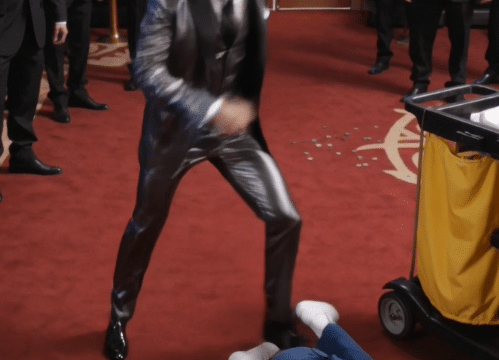
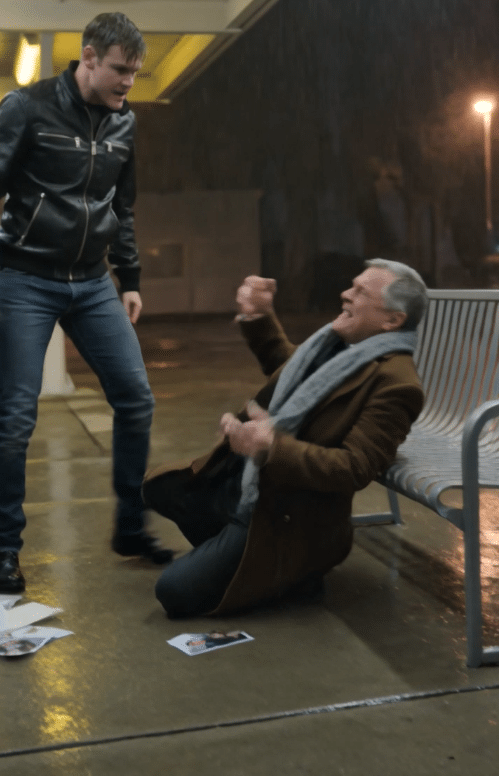
Before Noah could explain further, Calvin surged forward and drove a forceful kick into his chest.
Noah was thrown backward into the metal closure post. His map dropped to the pavement, and his radio slid across the street. His elbow struck the base of the post, leaving a thin trace of blood as he fell.
Residents watching from a distance gasped.
One woman covered her mouth. A man took several quick steps backward, pulling his companion away from the restricted street.
Noah grimaced, struggling to breathe. His body curled around the pain, but his hand still reached toward the yellow tape. Even after being knocked down, he was trying to keep civilians from entering the potentially dangerous block.
Calvin stepped across the tape.
Then he delivered two more forceful kicks into Noah’s back and side while the emergency worker lay beside the closure post.
Nobody intervened. The residents stood frozen, frightened by the sudden violence and uncertain what might happen if they approached.
Calvin looked down at Noah as if the injured man were the obstacle rather than the person trying to protect the neighborhood.
“I’m opening my store.”
He said it with the certainty of someone who believed that owning a building gave him the right to decide when an emergency was over.
Then a command vehicle and a fire truck braked sharply at the end of the block.
Their arrival sent another wave of attention down the street. A woman in a dark command jacket stepped out of the vehicle, followed by police officers and a gas utility team carrying detection equipment.
Director Elaine Ford had arrived.
At fifty-nine, the city emergency management director had spent years coordinating responses to dangerous situations where incomplete information could cost lives. She took in the yellow tape, the injured worker, and the store owner standing on the wrong side of the closure.
The police immediately moved between Calvin and Noah while the gas team began positioning its equipment. Residents pulled farther away from the restricted street.
Elaine did not begin by arguing with Calvin about his store.
She looked down the block and issued a command that changed the scale of the emergency.
“Evacuate the block. Now.”
Calvin’s expression stiffened.
He had been furious about losing access to one storefront. Now the city’s emergency director was ordering the entire block cleared.
He stared at her, his confidence giving way to disbelief.
“Evacuate the block?”
Act II
Calvin Ross had built his business through years of long hours, careful purchases, and an almost obsessive attention to what things cost.
At forty-six, he owned a neighborhood store that sold household goods, packaged food, cleaning supplies, and seasonal merchandise. It wasn’t a glamorous business, but it was his livelihood. Every shelf represented money he had invested, and every day the doors remained closed meant another day without revenue.
Calvin understood risk when it came to his inventory.
He watched delivery schedules closely. He worried about theft, damaged shipments, rising prices, and customers who walked out without buying anything. He knew how quickly a small business could lose money when unexpected problems interrupted its routine.
But he had developed a dangerous blind spot.
He could calculate the financial cost of leaving his store unattended. He could not seem to calculate the cost of ignoring a warning that might affect the entire neighborhood.
The possible gas leak had followed a disaster that left parts of the area damaged and uncertain. Emergency crews had closed the block while specialists worked to determine whether the situation was safe. Yellow tape and warning signs marked the restricted area, and residents were being kept away until the danger could be assessed.
Noah Grant was among the emergency management workers assigned to enforce the closure.
His job was not to decide whether Calvin’s inventory mattered. It plainly did. A damaged business could mean lost income, spoiled goods, missed payments, and months of uncertainty for an owner already under pressure.
Noah’s responsibility, however, was to prevent civilians from entering an area that had not been cleared.
He could not make an exception because Calvin was worried about money.
He could not promise the store would be safe.
And he could not allow someone to cross the barrier simply because the person demanding access owned the property behind it.
When Calvin arrived, Noah explained that there might be a gas leak inside the restricted area. The gas utility team had not completed its assessment, and the closure needed to remain in place.
Calvin heard the word might and treated it as proof that the restriction was unnecessary.
He demanded access to his store. Noah refused.
The argument could have ended there. Calvin could have stepped back, contacted the appropriate officials, and waited for an update. Instead, he decided that the emergency worker was using authority to interfere with his livelihood.
He called Noah trash.
Then he kicked him to the ground.
The attack stunned the residents watching from a distance. They had been concerned about the closure, but now their attention had shifted to the man lying beside the metal post, his radio out of reach and his map scattered on the pavement.
Even injured, Noah tried to keep the tape in place.
Calvin continued demanding access as if his frustration justified everything he had done.
Then the command vehicle arrived.
Director Elaine Ford stepped out with police officers and a gas utility team. Unlike Calvin, she wasn’t focused on the inventory inside one shop. She needed to understand the threat affecting the block and ensure that the people responsible for assessing it could work without civilians entering the danger zone.
Police secured the area around Noah first.
The gas team moved into position with its detection equipment, while residents were directed farther away. Elaine assessed the scene and gave the order to evacuate the block.
Her command made clear that the incident was no longer about a single shopkeeper’s demand.
The possible gas leak was still unresolved, and the city’s response was expanding.
Calvin had wanted the emergency to become smaller—to reduce it to one storefront, one closed door, and one worker he could pressure into moving.
Elaine’s order did the opposite.
And Calvin was about to discover why the officials were no longer treating the closure as a minor inconvenience.
Act III
“Evacuate the block. Now.”
Elaine Ford’s voice carried down the street, cutting through the wind and the crackle of emergency radios.
Police officers maintained their position between Calvin and Noah. The injured worker remained near the closure post while the gas utility team moved into the restricted area with detection equipment.
The yellow tape snapped in the wind.
For the residents watching from a distance, the command made the situation suddenly more serious. They had known that the street was closed, but a full-block evacuation meant that officials were taking the potential danger seriously enough to move people farther away.
A man turned toward the buildings behind him, looking for a family member. A woman who had been watching from the curb began walking toward the designated safe area.
Nobody was being invited to debate the order.
Calvin, however, remained fixed on the director.
“An entire block?” he demanded. “My store is right there.”
Elaine did not respond by promising that his inventory would be protected. She did not assure him that the situation was harmless, either.
The gas team needed room to work, and the people responsible for managing the emergency had to keep the area clear until they understood what they were dealing with.
Calvin’s shop was one building among many.
The closure protected more than his merchandise or the property of the neighboring businesses. It protected the residents who lived and worked along the street, including people who might not even know that a potential hazard had been reported.
Elaine turned her attention back to the response.
The gas utility team continued preparing its equipment. Police held the perimeter, and the residents moved farther from the closed block. The emergency command vehicle and fire truck remained at the end of the street, their lights reflecting off the storefront windows.
Calvin watched as the operation expanded around him.
His store had once been the center of his attention. Now he could see the neighboring buildings, the residents retreating from the street, and the personnel who had arrived to assess a possible danger that no business owner could dismiss on his own.
He looked toward Noah.
The emergency worker was still in pain, his map on the ground and his radio out of reach. He had been trying to enforce the same restriction that Elaine was now ordering everyone to respect.
Calvin had attacked him for doing that.
For a moment, the contradiction seemed to reach him. If the closure was serious enough for the city director to order a full-block evacuation, then Noah’s refusal had not been an act of personal hostility.
He had been enforcing the restriction because the danger had not been ruled out.
But understanding that did not come easily to Calvin.
He had already committed himself to the belief that the rules were fake and the worker was wasting his time. Admitting otherwise would mean facing the possibility that he had attacked someone who was trying to protect him and everyone else on the street.
So he looked back toward Elaine, searching for a reason to challenge the decision.
The director’s attention remained on the emergency response. Police controlled the space around Noah, the gas team was preparing to assess the area, and residents were being moved farther away.
No one was opening the tape.
No one was sending the gas team away.
And no one was telling Calvin that his store mattered more than the safety of the neighborhood.
The closure was expanding, the evacuation was underway, and the officials were taking control.
Calvin’s demand had not stopped the emergency.
It had only made his refusal to respect it impossible to ignore.
Act IV
The block began to empty.
Residents moved away from the closed street while police maintained the perimeter. The fire truck remained near the command vehicle, and the gas utility team prepared to assess the potential hazard.
Loose paper skittered across the pavement, caught in the wind that moved between the buildings.
Calvin stood near the yellow tape, staring toward his store.
He had wanted to retrieve his inventory before anything happened to it. In his mind, the closure was an administrative overreaction, and Noah was the person preventing him from protecting his business.
But Elaine Ford had made the situation unmistakable.
“Evacuate the block. Now.”
The order applied to the area, not just Calvin’s storefront. It could not be reduced to a disagreement between a shop owner and one emergency worker.
Police officers continued standing between Calvin and Noah, preventing him from approaching the injured man again. The gas team moved into position, and the residents were directed farther away from the potential danger.
Elaine’s first priority was controlling the emergency scene.
That meant protecting the worker who had been attacked, keeping civilians outside the closure, and giving the gas specialists room to do their job. Only then could the city determine what would happen next.
Calvin seemed unable to accept that sequence.
He wanted an answer about his store. He wanted to know when he could go inside, whether his inventory was safe, and why a possible leak justified shutting down the whole street.
Those were understandable questions in ordinary circumstances.
They were not permission to cross the barrier.
And they certainly did not justify attacking Noah.
The residents who had witnessed the assault kept their distance. Earlier, they had gasped and covered their mouths as Calvin kicked the worker beside the closure post. Now they watched the official team take control, their expressions marked by shock and uncertainty.
No one rushed to Calvin’s defense.
The man who had treated the emergency restriction as a personal insult was now watching the entire block being cleared under the director’s command.
Elaine did not need to humiliate him in front of the neighborhood. She did not need to threaten him with a dramatic speech or explain every possible consequence of his actions.
The emergency itself had exposed the flaw in his reasoning.
He had treated uncertainty as proof that there was no danger. The director was treating uncertainty as a reason to maintain precautions until the specialists could determine the facts.
One approach put everyone at risk.
The other protected them while the assessment continued.
Calvin looked from the gas team’s equipment to the storefronts. The people who lived and worked on the block were leaving the area, and the workers who had arrived to manage the emergency were not abandoning their responsibilities.
His inventory was still inside.
But so was a risk that had not yet been ruled out.
He had demanded access as if ownership settled the question. Now he was seeing that the safety of an entire street could not be decided by one man’s financial concerns.
The director’s command had shifted the focus from his store to the people around it.
And the more Calvin watched the evacuation unfold, the harder it became to pretend that Noah had invented the danger.
The yellow tape still marked the boundary.
The police still controlled the entrance.
The gas team was still preparing to investigate.
Calvin’s store remained closed, and his authority as its owner had not changed any of those facts.
He had wanted to force the emergency worker out of his way.
Instead, the city had expanded the restriction, and the entire block was moving according to the emergency director’s orders.
Calvin’s defiance began to falter.
He was no longer arguing over a locked storefront.
He was facing the reality that the officials had decided the whole area needed to be cleared.
Act V
“Evacuate the block. Now.”
Elaine Ford’s order remained in force as the emergency response continued.
The gas utility team moved into position with its detection equipment. Police officers held the perimeter, and residents continued withdrawing from the closed street. The fire truck and command vehicle stood at the end of the block beneath the flashing emergency lights.
Noah Grant remained beside the closure post.
His radio lay out of reach, and the street closure map had fallen onto the pavement. He was still in pain from the attack, but the tape remained between the residents and the potentially dangerous area.
He had been trying to do one thing: keep civilians out until the gas team could assess the risk.
Calvin had treated that responsibility as a personal obstacle.
He had called the rules fake, insulted Noah, and attacked him because he wanted to retrieve his inventory. Even after knocking the emergency worker down, he had continued insisting that he was opening his store.
Now the city had ordered the entire block evacuated.
The change was visible everywhere.
Residents who had been watching from the curb were moving farther away. Police were maintaining the restricted area. The gas team was preparing to investigate, and the storefronts remained closed while officials managed the potential hazard.
Calvin’s shop was still part of the block, but it was no longer the center of the response.
The safety of the people who lived and worked nearby came first.
That was the principle Noah had been enforcing before the attack. It was the principle Elaine had reinforced when she arrived, and it was the reason the evacuation was continuing even while Calvin stood demanding access.
The director had not promised that the store was in danger.
She had not claimed that a leak had been confirmed.
She had ordered the block cleared because the risk had not yet been ruled out, and the specialists needed to assess the situation safely.
That distinction mattered.
In an emergency, waiting for certainty can be too late if the potential consequences are severe. The proper response is to control the area, move people away, and let qualified personnel determine whether it is safe to return.
Calvin had wanted to reverse that process.
He wanted access first and answers later.
But the emergency response was not going to be shaped around his impatience.
Police remained between him and Noah. The gas team continued preparing its equipment, and the residents kept their distance as Elaine maintained control of the scene.
Calvin looked toward the store he had been so determined to enter.
The inventory inside still represented money, effort, and the future of his business. His frustration had not disappeared, and neither had the uncertainty hanging over the neighborhood.
But he could no longer pretend that the closure was just one worker’s arbitrary decision.
The director had arrived with the city response behind her. She had seen the injured worker and taken control of the emergency. Her order had expanded the evacuation from a restricted storefront area to the entire block.
And nobody was treating the danger as a joke.
Calvin’s face tightened as the meaning finally began to settle in. He had wanted the street opened for his convenience. Now the people responsible for protecting it were moving everyone away from the possible hazard.
The yellow tape snapped in the wind behind him.
Emergency lights flashed against the closed storefronts. Police held the perimeter, and the gas team’s equipment clattered as the specialists prepared to work.
Calvin stared toward Elaine, his earlier defiance giving way to stunned disbelief.
He had thought he was fighting for his inventory.
Instead, he had become part of an emergency scene that was growing more serious by the minute.
Then he asked the question that revealed how completely the director’s order had changed his understanding of the situation.
“Evacuate the block?”