Act I
“This trail is closed for a reason.”
Ranger Ethan Wells stood between a group of tourists and the safety rope stretched across the narrow mountain path. A landslide warning sign rattled in the cold wind, warning hikers away from the unstable ground beyond it. On the other side of the rope, the trail narrowed toward a rocky drop that disappeared into the mist.
Jason Pike barely glanced at the sign.
The twenty-five-year-old tourist leader wore an expensive trekking jacket, dark sunglasses, and a camera backpack that looked more suited to a luxury adventure tour than a dangerous mountain route. His friends had traveled for the view, and Jason had decided that no ranger was going to ruin their photographs.
Ethan raised one hand, keeping the rope between the group and the closed trail.
“You need to turn around and use the open route.”
Jason’s expression hardened.
“Trash. We came for the view.”
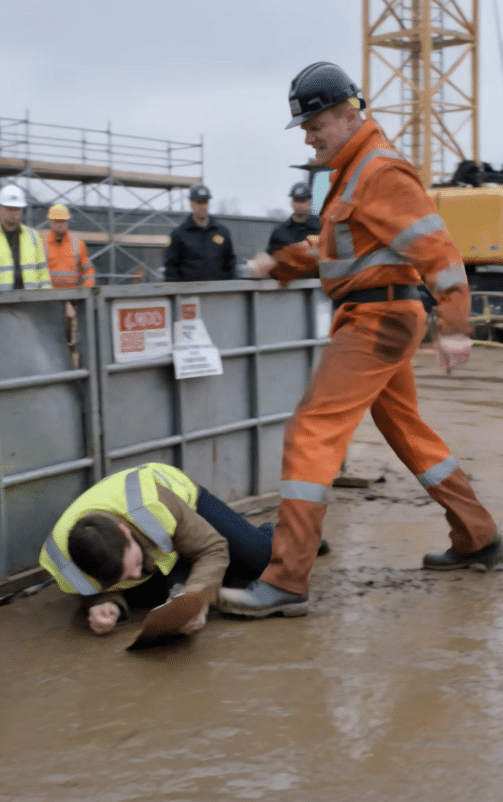
Before Ethan could respond, Jason charged forward and drove a forceful kick into the ranger’s chest. Ethan stumbled backward into the metal warning signpost, then crashed onto the rocky ground beside the rope.
His radio clattered away. His wide-brim hat rolled across the path, and his elbow struck the base of the signpost, leaving a thin trace of blood.
The other tourists gasped.
One woman covered her mouth. Another stepped away from the cliff-side path, clutching her camera as though she had suddenly forgotten why she had brought it.
Ethan grimaced and struggled to breathe. His body curled around the pain, but he still reached toward the safety rope, trying to keep the group from crossing into the closed area.
Jason stepped over the rope.
Then he delivered two more forceful kicks into Ethan’s back and side while the ranger lay beside the warning sign.
Nobody intervened. The tourists stood frozen, frightened by the sudden violence and the dangerous drop just beyond the path.
Jason straightened and looked down at Ethan with open contempt.
“Your little sign can’t stop us.”
The ranger reached toward the rope again.
Even after being attacked, he was still trying to protect the people who had just watched it happen.
Then the wind changed.
A rescue helicopter descended over a nearby clearing, its rotor wash blasting dust across the rocks and whipping the safety rope violently through the air. The tourists turned toward the sound as the aircraft landed hard enough to drown out the last whispers on the trail.
The door opened.
A mountain rescue team stepped out, followed by Chief Ranger Howard Blake, a sixty-two-year-old veteran whose dark green command jacket snapped in the rotor wash.
Howard’s eyes moved from the injured ranger to the tourists standing beyond the rope.
The rescue team immediately took control of the space around Ethan, positioning themselves between him and Jason. The helicopter continued turning behind them as the chief ranger studied the scene.
Then Howard spoke.
“Pull every permit tied to this group.”
Jason’s defiant expression faltered.
He had expected someone to tell the ranger to move.
Instead, the chief ranger had just put every permit connected to his group in jeopardy.
Jason stared at him.
“Every permit?”
Act II
Jason Pike had always believed that the best experiences belonged to people willing to ignore the rules.
He was young, confident, and accustomed to presenting himself as the kind of traveler who knew how to find places other people never saw. His social media accounts were filled with dramatic overlooks, narrow ridgelines, and photographs taken from places that looked almost impossible to reach.
The more dangerous the location appeared, the better the picture performed.
Over time, Jason had started treating restrictions as obstacles designed for less adventurous people. A closed path became a challenge. A warning sign became an inconvenience. A ranger asking him to turn around became someone who didn’t understand what he had come to accomplish.
For this trip, he had assembled a small group of friends and paying participants who wanted spectacular mountain photographs. Jason had promoted the outing as an exclusive experience, promising views far beyond the ordinary tourist route.
The group had traveled a long way. They had paid for transportation, equipment, and the promise of a memorable day in the national park.
Jason had made himself responsible for delivering it.
That responsibility should have made him cautious.
Instead, it made him reckless.
When the group reached the narrow trail, they found a safety rope stretched across the entrance and a landslide warning sign positioned where nobody could miss it. The path beyond had been closed because unstable ground made the route unsafe.
Ethan Wells had been assigned to keep visitors out.
At forty-one, Ethan knew the mountains could change faster than people understood. A slope that appeared solid in one photograph could shift underfoot. Rocks could loosen without warning, and a narrow trail above a drop offered little room to recover from a mistake.
The closure wasn’t a suggestion.
Ethan had explained the restriction calmly. He had offered the group a simple alternative: turn back and use an open route.
Jason heard an insult instead.
He had spent money, made promises, and imagined the photographs he would take. He didn’t want an alternative view. He wanted the view he had come for, and he expected the ranger to stand aside.
When Ethan refused, Jason called him trash.
Then he attacked him.
The violence stunned the group. A few people stepped backward toward the safer section of the path, while others stood motionless, their cameras hanging uselessly from their hands.
The warning sign rattled in the wind above Ethan. His radio lay out of reach, and his hat had rolled away from the place where he had fallen.
Yet he continued reaching toward the rope.
Jason had tried to make him stop doing his job through intimidation. Even injured, Ethan was trying to keep the tourists from entering the dangerous area.
That was when the helicopter arrived.
The aircraft was part of a mountain rescue response operating nearby. Its arrival brought trained personnel to the scene and transformed the narrow trail from a confrontation controlled by Jason’s temper into an incident under official command.
Chief Ranger Howard Blake stepped out with the rescue team.
Howard had spent decades dealing with the consequences of people who believed warnings were meant for someone else. He had seen how a single reckless decision could endanger an entire group, force rescuers into unnecessary danger, and turn a preventable incident into a tragedy.
He did not need Jason to explain why he wanted the photograph.
He could see the closed trail, the warning sign, the safety rope, and the injured ranger.
The rescue team moved to secure Ethan’s immediate surroundings. The tourists stepped aside as the chief ranger took control.
Then Howard issued his order.
“Pull every permit tied to this group.”
For Jason, the words were almost impossible to understand.
He had expected the arrival of senior park personnel to settle the matter in his favor. Instead, the first consequence he heard concerned the very permits that had helped make his exclusive mountain outing possible.
And the chief ranger had not even finished taking control of the scene.
Act III
The helicopter’s rotor wash swept across the trail, lifting dust and sending the safety rope snapping against its anchors.
Jason looked past the rescue team toward Howard Blake, waiting for someone to explain that there had been a mistake.
The chief ranger offered no reassurance.
The mountain rescue team had already positioned itself between the tourist group and Ethan. One member moved toward the injured ranger while another helped keep the narrow path clear. The others maintained a safe distance between the group and the closed trail.
Nobody was allowing Jason to approach Ethan again.
For a moment, the only sounds were the helicopter, the wind, and the crunch of boots against rock.
Then Jason tried to recover his confidence.
“Every permit?” he repeated, as if saying the words aloud might reveal how unreasonable they were.
Howard remained focused on the scene.
The permit issue was not an argument over whether Jason’s photographs were worth taking. His group had entered a restricted situation, and the leader had allegedly responded to an employee enforcing the closure by attacking him.
The chief ranger’s order made clear that the incident would not be treated as an ordinary disagreement between a tourist and a park employee.
Jason’s entire group was now under scrutiny.
Some of the tourists looked at him with disbelief. They had followed him to the mountain expecting a memorable experience, not a confrontation with a ranger beside a landslide warning sign.
One woman lowered her camera.
She had spent the morning taking pictures of the scenery, trusting Jason’s confidence that he knew where they were going. Now she was looking at the rope and wondering why she had believed his assurances when the official warning had been standing directly in front of them.
Jason noticed the change in their expressions.
He had presented himself as the person who could deliver an extraordinary experience. He had made decisions on the group’s behalf and encouraged them to keep moving when Ethan ordered them to stop.
Now the same people were watching as the chief ranger took control.
Jason glanced toward the trail beyond the rope. The route still looked dramatic and beautiful from where he stood, with the rocky drop and distant ridges framed by cold mountain light.
But the warning sign was still there.
The danger had not disappeared because he wanted a better photograph.
Ethan had understood that. He had tried to prevent the group from crossing, and he had continued reaching toward the rope after Jason knocked him down.
The truth was difficult to avoid: the ranger had not been trying to ruin the trip. He had been trying to keep it from becoming a rescue operation.
And now the rescue team had arrived anyway.
Howard turned slightly toward his personnel, maintaining control of the area around Ethan. His attention remained on the immediate safety situation before any further confrontation with Jason.
The group fell silent.
Jason’s friends had once looked to him for direction. Now they watched him as though they were seeing him clearly for the first time.
The chief ranger’s order had changed the meaning of the day.
It was no longer about who could reach the best viewpoint or capture the most dramatic image.
It was about what happened when a person treated a safety restriction as an insult and used violence to get his way.
And Howard Blake had made it clear that the consequences would not stop with a single argument at the trail entrance.
Act IV
“Pull every permit tied to this group.”
Howard’s order cut through the wind and the noise of the helicopter.
The mountain rescue team continued controlling the space around Ethan. The chief ranger had prioritized the injured employee and the safety of the trail before confronting Jason, leaving no doubt about what mattered most in that moment.
The tourists moved farther from the cliff-side path.
The same rope Jason had stepped over now marked the boundary between his group and the closed area. The warning sign rattled in the cold air, its message unchanged despite the violence that had unfolded beneath it.
Jason stood near the entrance, suddenly uncertain what to do with his hands.
He had spent the confrontation acting as though the only problem was Ethan’s refusal to cooperate. In his mind, the ranger had stood between him and an experience he had paid to enjoy.
But Howard was treating the scene as something far more serious.
The chief ranger had arrived with a rescue team, seen the injured employee, and taken control of the area. His order concerning the group’s permits signaled that the incident would have consequences beyond the immediate confrontation.
Jason’s status as the group leader offered no automatic protection.
If anything, it made his position more complicated. He had been the person encouraging the others to pursue the closed trail. He had been the one who attacked Ethan. And he had been the one who continued behaving defiantly while the ranger lay injured beside the signpost.
The people who had trusted his judgment were now standing behind him, watching the rescue team work.
Nobody cheered for him.
Nobody stepped forward to argue that his photograph was worth the risk.
A tourist who had been smiling at the trail moments earlier stared at the ground. Another carefully moved her camera backpack away from the edge of the path. Their silence made Jason’s earlier confidence look increasingly hollow.
He had promised them something extraordinary.
Now they were learning what his leadership looked like when someone refused to obey him.
Howard did not shout or indulge in a public argument. He had spent too many years working in the mountains to confuse anger with authority. The immediate situation needed to remain controlled, and the injured ranger needed attention.
The chief ranger’s calmness made the order even more difficult for Jason to dismiss.
There was no heated exchange he could use to portray himself as the victim of an overreaction. There was no confusion about whether Ethan had been blocking a harmless shortcut. The closure was marked, the safety rope was visible, and the warning had been explained.
Jason had chosen to attack the person enforcing it.
Now the official response was unfolding around him.
The rescue team remained between the group and Ethan. The helicopter’s rotors continued turning in the clearing, stirring the dust around their boots. Howard’s personnel kept the narrow trail under control while the tourists stayed back.
Jason looked at the chief ranger again.
He wanted to know what would happen to the permits, what it meant for the group, and whether there was any way to reverse the decision.
But Howard’s order had not been an invitation to bargain.
It was a clear signal that the group’s conduct was being taken seriously.
Jason’s face tightened as he realized that the experience he had promised could be lost because of the choices he had made himself.
He had wanted the mountain to provide proof of his fearlessness.
Instead, the closed trail had exposed his recklessness.
And the chief ranger was no longer allowing him to dictate what happened next.
Act V
The helicopter remained in the clearing as the mountain rescue team secured the area around Ethan Wells.
The ranger was still in pain, his hat lying away from him and his radio resting on the rocky path. He had been attacked for enforcing a closure that existed to protect visitors from an unstable mountain slope.
Even after being knocked down, he had tried to keep the rope between the tourists and the dangerous route.
Howard Blake had seen enough to take control.
The tourists stood back as the rescue team worked. The cold wind moved across the ridge, and the warning sign continued to rattle beside the trail. Beyond it, the rocky path disappeared toward the drop that Jason had been so determined to photograph.
It was still beautiful.
It was still closed.
And no photograph could make the danger disappear.
Jason had begun the encounter believing that the ranger’s authority was an inconvenience. He had treated the warning as an obstacle, the rope as something to step over, and Ethan as someone whose instructions could be ignored.
When Ethan refused to move, Jason had chosen violence.
He had expected fear to accomplish what his demands could not.
Instead, the attack had brought the chief ranger and a mountain rescue team directly into the scene. Howard’s first priority was protecting the injured ranger and controlling the space around him. Only then did the chief ranger make clear that every permit tied to Jason’s group was subject to being pulled.
The words had changed the atmosphere completely.
Jason’s friends were no longer looking at him as the confident leader who knew where the best views could be found. They were watching a man who had endangered the group, assaulted a ranger, and now stood facing the consequences of his own behavior.
The cameras remained silent.
The group had come for photographs that would make them look fearless. But the moment they were witnessing now would be remembered for a different reason: the instant a ranger refused to gamble with their safety, and a tourist decided that refusal deserved punishment.
Ethan had not been trying to control Jason’s life.
He had been enforcing a boundary on a dangerous mountain trail.
Howard understood the distinction. His rescue team continued to protect the injured ranger while the chief ranger maintained command of the scene. The group was kept away from the closed path, and Jason was no longer in a position to pressure Ethan into changing the decision.
The permits were no longer a symbol of the privilege Jason believed he possessed.
They were now part of the official response to what had happened.
Jason glanced at the warning sign, then toward the helicopter. His expression remained defiant for a moment, as though he could still insist that the entire incident was an overreaction.
Then confusion began to spread across his face.
He had wanted one photograph.
He had assumed the rules could not stop him.
Now he was hearing that the consequences might extend to every permit connected to the group he had led onto the mountain.
The wind whipped the rope behind him. The rescue team stood between him and the injured ranger, and the chief ranger’s order remained unanswered.
Jason looked toward Howard, trying to understand how the day had turned so completely against him.
Then the question slipped out, stripped of the confidence he had carried to the trail.
“Every permit?”