Act I
“Sir, this area is not safe.”
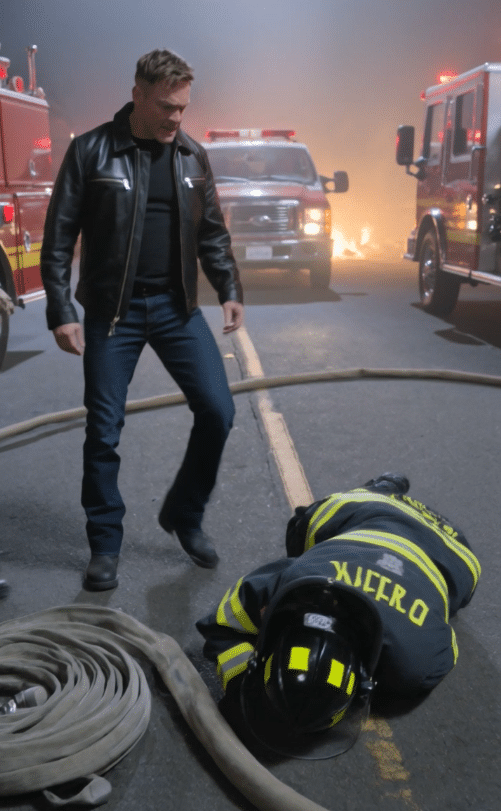
Firefighter Adam Cole stood beneath flashing red emergency lights, one gloved hand holding the safety barrier while the other pointed a neighbor away from a burning house. Fire engines blocked the residential street, hoses stretched across the road, and smoke drifted through the cold night air.
Derek Shaw didn’t care.
The forty-five-year-old neighbor wore a black leather jacket, dark jeans, and heavy boots. His car sat trapped behind the restricted zone, and every second he spent waiting seemed to him like a personal insult.
Adam stepped into his path before he could cross the line.
Derek charged.
His boot slammed into Adam’s chest, sending the firefighter backward into a coiled hose beside the curb. Adam’s helmet shifted on impact, and his radio struck a metal hose coupling with a sharp clatter. His elbow hit the connector, leaving a thin trace of blood on the skin.
For a moment, the street seemed to freeze.
A neighbor gasped behind the safety barrier. Someone covered their mouth. Others backed away as Adam struggled to catch his breath, the reflective bands on his turnout gear flashing red with every pulse of the emergency lights.
Even on the ground, Adam tried to point civilians away from the danger zone.
The fire was still active. Smoke continued to rise, hoses remained pressurized, and emergency crews were moving equipment through the narrow street. The barrier wasn’t decoration. It was there because one careless step could put someone directly in the path of a working fire response.
Derek stood over him, furious that anyone had dared to stop him.
“Trash. Move your fake barrier.”
Adam grimaced, curling around the pain as he tried to steady his breathing.
He had spent years responding to emergencies, often arriving when frightened people needed someone calm enough to make difficult decisions. He knew that panic and frustration could make people irrational.
But Derek wasn’t confused about the danger.
He simply believed his inconvenience mattered more than everyone else’s safety.
He stepped across the line and kicked Adam twice more, striking his back and side while the firefighter lay beside the hose. The neighbors recoiled beneath the red lights, horrified but too frightened to intervene.
Derek straightened his jacket.
“My car matters more than your tape.”
He said it loudly enough for everyone behind the barrier to hear.
To him, the firefighter was an obstacle. The burning house was a problem for someone else. The safety line was a meaningless restriction between him and his property.
Adam remained down, breathing hard, still trying to direct people away from the restricted area.
Then a fire command vehicle braked sharply behind the engine.
Its door opened.
And the man who stepped into the red-lit street was about to turn Derek’s little dispute into something much bigger.
Act II
Derek Shaw had always believed that people made rules for everyone else.
At work, he disliked being questioned. At home, he expected things to happen when he wanted them to happen. If a clerk took too long, a neighbor complained, or an employee challenged one of his decisions, he interpreted the disagreement as disrespect.
He rarely thought of himself as unreasonable.
In his own mind, he was simply a man who knew what he wanted and refused to let less important people stand in his way.
That evening, his car had become the center of his attention.
A house fire had brought engines, hoses, emergency personnel, and safety barriers onto his street. The firefighters had restricted access to protect residents and allow crews to work. Derek understood that the street was an active emergency scene, but he didn’t believe the restrictions should apply to him for any longer than he found acceptable.
His vehicle was inside the restricted area.
He wanted it out.
When Adam told him to step back, Derek didn’t hear a safety instruction. He heard a subordinate telling him no.
And that was enough to set him off.
Adam Cole had no interest in winning an argument with a resident. At thirty-nine, he had learned that emergencies demanded discipline, not pride. His job was to keep people away from hazards, protect access for responding crews, and make sure nobody added another emergency to the one already unfolding.
He had been clear.
The area was not safe.
Derek had responded with violence.
Now Adam lay near the curb while the emergency continued around him. His radio had clattered against the hose coupling, and the equipment that had been organized moments earlier was scattered near his position.
The neighbors could see the contrast between them.
Adam was wearing protective gear and trying to do his job. Derek stood over him in ordinary street clothes, angry because he couldn’t retrieve his car.
Yet Derek behaved as though he were the person who had been wronged.
The safety barrier had been disturbed where he crossed it. Firefighters were still working nearby, and the hoses across the road could not simply be moved because one resident demanded access.
Nobody behind the line had forgotten the danger.
They had watched Derek attack a firefighter in the middle of an active response, and the shock kept them rooted in place.
Then the command vehicle arrived.
Chief Robert Kline stepped out wearing a white fire command helmet and a dark coat with reflective trim. A scene officer followed him, along with members of the fire investigation team.
The chief took one look at the scene.
He saw the injured firefighter near the hose, the disturbed safety line, the neighbor standing beyond it, and the residents gathered behind the barrier.
There was no need for a dramatic explanation before he acted.
His first responsibility was to regain control of the scene and protect the people working within it.
The scene officer moved to block Derek from approaching Adam again. The investigators began documenting the disturbed barrier and the surrounding area.
Derek turned toward the arriving team, expecting the familiar ritual of complaints and explanations.
Instead, Chief Kline took command of the street.
And his first order made Derek realize that getting his car back was no longer the most important problem he had.
Act III
“Lock down the entire block.”
Chief Robert Kline delivered the order in a voice that carried above the engine rumble.
The scene officer immediately moved to control Derek’s position, preventing him from approaching the injured firefighter. Members of the investigation team began documenting the safety line and the area where the assault had occurred.
The chief did not rush toward Derek to exchange insults.
He did not begin by asking why a man in a leather jacket believed he could cross an emergency barrier.
His first priority was the scene itself.
Adam needed protection. Fire crews needed room to work. The disturbed safety line needed to be documented, and residents had to remain clear of the active fire area.
The command vehicle’s arrival had changed the atmosphere, but the chief’s order made the shift unmistakable.
This was no longer a dispute between one firefighter and one impatient neighbor.
It was an emergency scene under direct command.
Derek watched the team move around him.
A few moments earlier, he had been the person forcing everyone else to react. He had charged across the barrier, knocked Adam into the coiled hose, and continued the attack while the firefighter was down.
He had expected fear to keep everyone else quiet.
Now the scene officer stood between him and Adam, while investigators began recording the condition of the barrier he had crossed.
Derek’s eyes moved toward his car.
It was still there, beyond the restricted zone, close enough to see but no longer something he could simply reach.
He looked back at the chief.
Perhaps he expected an argument. Perhaps he expected the chief to demand an explanation before deciding what to do. He might even have believed that if he complained loudly enough about the barrier, someone would finally acknowledge his priorities.
Chief Kline gave him no such opening.
The order had already been issued.
The entire block was to be locked down.
Behind the barrier, the neighbors fell silent. The same people who had stepped backward when Derek attacked now watched the official team take control. Nobody pushed forward, and nobody tried to interrupt.
The fire engines continued running. Water moved through the hoses. Red lights swept over the walls of nearby homes, illuminating the smoke hanging in the street.
Adam remained near the curb, still in pain.
The chief had not allowed the confrontation to distract him from the injured firefighter. His team was protecting Adam and controlling the immediate area before dealing further with Derek.
That sequence mattered.
Derek had attacked because he believed his own demand should override the safety of everyone around him. Chief Kline’s first action was to make sure Derek could no longer create another hazard.
Only then would there be room to address what he had done.
The investigators continued their work.
The safety line that Derek had dismissed as fake was now one of the details being documented. His car, which he had treated as the only thing that mattered, was trapped behind the very restrictions he had tried to force his way through.
He stared at the scene officer.
Then he looked at the chief again.
The anger was still there, but something had begun to replace it.
Uncertainty.
Act IV
Derek had expected the arrival of the fire chief to make the situation easier for him.
He was accustomed to believing that the right complaint, delivered with enough confidence, could persuade people to reconsider their decisions. He had treated Adam’s warning as an inconvenience and the safety barrier as an obstacle that existed only because someone had decided to make his life difficult.
The command vehicle had arrived, he thought, so someone could finally deal with the problem.
Instead, Chief Kline had expanded the restrictions.
“Lock down the entire block.”
The order echoed through Derek’s mind as he watched the scene officer maintain the boundary between him and Adam.
The fire investigation team was documenting the disturbed safety line. The neighbors remained behind the barrier, keeping their distance. The command staff had taken control of the space around the injured firefighter before turning its attention to the man responsible.
Derek’s car was still inside the restricted zone.
Now the lockdown extended across the block, leaving him unable to reach it.
His expression tightened.
He looked toward the vehicle, then back toward the command team. The situation was no longer moving according to his demands. Nobody was discussing how quickly he could retrieve his property, and nobody was treating his frustration as the most urgent issue on the street.
The fire was still active.
The hoses were still deployed.
Emergency personnel were still working.
And the firefighter Derek had attacked had been trying to keep civilians away from precisely these dangers.
That fact should have been obvious from the beginning.
Derek had crossed the line anyway.
He had kicked Adam hard enough to throw him backward into the coiled hose. He had struck him again while he was down, then stood over him and declared that his car mattered more than the barrier.
There was no misunderstanding that could turn those actions into an innocent mistake.
The chief’s response was controlled, but it left no doubt that the emergency scene would not be reorganized around Derek’s impatience.
The scene officer kept him from moving closer. The investigators continued documenting what had happened. The rest of the command team maintained the restricted area so that crews could continue their work without another confrontation.
Derek looked around for someone who might sympathize with him.
The neighbors did not move toward him.
They had seen him attack Adam. They had heard him dismiss the safety barrier and declare that his car mattered more than the tape. Whatever complaint he had intended to make about being inconvenienced had been overwhelmed by what everyone had witnessed.
The street was quiet apart from the machinery and the movement of the crews.
The chief remained focused on the emergency.
He did not need to threaten Derek or announce a consequence in front of the crowd. The immediate change in control was visible enough. The restricted zone was being secured, the firefighter was being protected, and the investigation team was documenting the scene.
Derek’s car remained inaccessible.
For the first time that night, he was forced to wait while other people made decisions he could not override simply by becoming angry.
He stared toward the command vehicle, then back at the safety line.
The same barrier he had called fake now marked the boundary he could not cross.
And the chief’s order had made that boundary larger than Derek ever expected.
Act V
Derek Shaw stood beneath the flashing red lights, staring at the street as the command team carried out the chief’s order.
The anger that had driven him across the safety line was still visible in his face, but it was no longer the only emotion there. He had expected to force his way toward his car and make the firefighters accommodate him.
Instead, the entire block was being locked down.
The scene officer continued to block his path. Investigators documented the disturbed safety line, while the command team maintained control around Adam.
The firefighter remained near the curb, his helmet shifted and his radio having struck the hose coupling during the attack. Pain tightened his expression as he struggled to breathe steadily, but even from the ground he had tried to direct civilians away from the danger zone.
That was what he had been doing when Derek attacked him.
He had not been guarding a personal possession or picking a fight. He had been protecting people from an active fire scene where smoke, hoses, equipment, and emergency vehicle movements made unrestricted access dangerous.
Derek had wanted his car.
He had decided that his desire mattered more than the safety instruction, more than the firefighter enforcing it, and more than the people who might be endangered if the barrier failed to hold.
Now the command team had restored control without allowing him to dictate the terms.
The neighbors remained silent behind the safety line. The red lights swept across their faces and the surrounding houses, while the fire engines continued to rumble through the smoky night.
Derek looked toward his car again.
It was close enough to see, but the expanded lockdown kept it beyond his reach. The street he had treated as his personal inconvenience had become a controlled emergency zone under the fire chief’s command.
Chief Kline remained composed.
He had not been distracted by Derek’s anger or allowed the confrontation to become a contest of egos. His team had secured the space around Adam first, blocked Derek from approaching the injured firefighter, and begun documenting the area before turning further attention to the man who had crossed the line.
The result was unmistakable.
Derek was no longer controlling the situation.
He looked at the chief, then at the scene officer standing between him and the restricted area. His eyes shifted toward the investigators and the barrier he had tried to force aside.
The certainty in his expression gave way to stunned disbelief.
He seemed to be calculating what the order meant for the one thing he had cared about from the start: his car.
The answer was written across the controlled street.
He could not simply walk in and retrieve it.
He could not make the crews stop working because he was impatient.
And he could not turn the attack on Adam into a minor disagreement by insisting that the safety barrier was meaningless.
The entire block was now under restriction.
Derek stared into the smoky street, his anger faltering as the full meaning of the chief’s order settled over him.
“The entire block?”
His voice sounded smaller than before.
For the first time that night, he seemed unable to believe that the world would not rearrange itself around what he wanted.
The red emergency lights flashed across his face.
Hard cut.