Act I
“Why is my bed down here?”
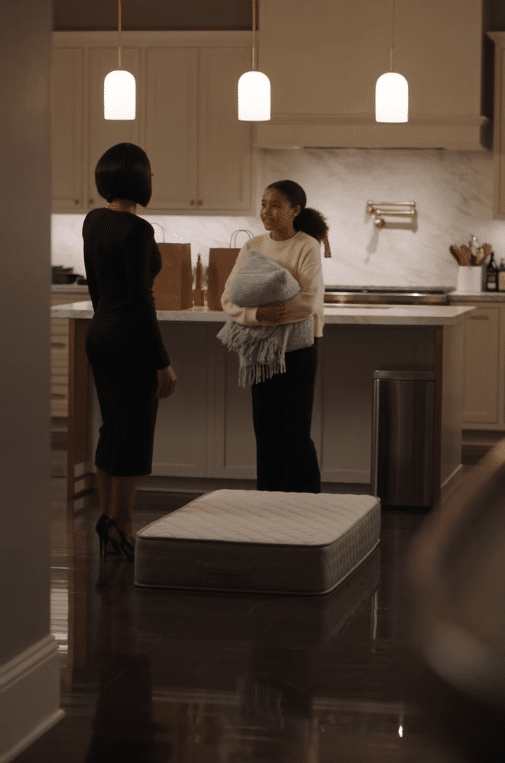
Nia stood beside the kitchen, clutching a pillow and blanket against her chest. At her feet lay a thin floor mattress, folded out on the polished floor as if someone had prepared a temporary sleeping spot for a guest who wasn’t welcome enough to use a real bedroom.
Her stepmother adjusted the blanket with the same calm precision she used when arranging cushions on the living room sofa.
“Your room is being renovated. You’ll sleep here.”
Nia stared at the mattress.
The kitchen lights reflected off the spotless floor. A refrigerator hummed nearby, and the familiar sounds of the house continued around her. Nothing about the room suggested that this was a place where a fourteen-year-old girl was supposed to sleep.
She looked upstairs, toward the bedroom she had gone to bed in the night before.
Her bed had been there. Her books had been there. Her clothes, school supplies, and the little things that made a room feel like hers had all been in their usual places.
Now she was standing beside the kitchen with a blanket in her arms.
“Nothing is broken in my room.”
Her stepmother turned toward her.
“You don’t decide what space you deserve in this house.”
The words hurt more than Nia expected.
She had asked a simple question. She hadn’t demanded a bigger room or complained about sharing. She wanted to know why her bed had been moved downstairs, and why nobody had explained what was happening.
But her stepmother had turned the question into something else.
This wasn’t about a mattress or a renovation. It was about whether Nia had the right to expect a proper place to sleep in the home where she lived.
Nia lowered her eyes.
She could feel the embarrassment rising in her face. If someone came through the front door and saw her beside the kitchen, what would they think? If her father walked in, would he believe the story about repairs before he asked her what had happened?
Her stepmother seemed entirely comfortable with the arrangement.
That was what made it frightening.
There was no visible emergency. No broken furniture, no exposed walls, no sign that workers needed access to the bedroom. There was only a small mattress on the floor and a girl being told that she would have to accept it.
Nia tightened her grip on the blanket.
Then footsteps sounded on the stairs.
Ava appeared, glanced at Nia, and stopped when she saw the mattress.
She had just walked past Nia’s bedroom.
And she knew the room looked perfectly normal.
Act II
“Mom, Nia’s room looks fine.”
Ava’s voice was cautious, but the question behind it was unmistakable.
She looked toward the staircase, then back at her mother. She had seen no tools, no damage, and no signs that anyone had begun repairing the room. The bedroom looked just as it always had.
Stepmother didn’t hesitate.
“It will look better when it’s useful to someone else.”
For a moment, nobody moved.
Nia slowly raised her head.
The sentence was brief, but it changed the meaning of everything. Her stepmother had claimed that repairs were the reason she couldn’t sleep in her own room. Now she was talking about making the room useful to someone else.
Ava looked at her mother as though she had heard more than she meant to say.
Nia’s face tightened.
She had spent the last several minutes trying to understand what was wrong with her bedroom. Perhaps a pipe had leaked. Perhaps there was damage she hadn’t noticed. Perhaps her father knew something she didn’t.
But her stepmother hadn’t named a single problem.
Instead, she had told Nia that she didn’t get to decide what space she deserved.
Ava glanced at the mattress again.
It was painfully small beside the kitchen cabinets, and the pillow looked out of place against the polished floor. The blanket Nia held was the only thing that made the arrangement resemble a bed at all.
The contrast with the upstairs bedroom was impossible to ignore.
Nia had a real room. Her belongings were there. The furniture was intact. Yet she was being told to sleep downstairs, in a place where family members would pass through to prepare food, wash dishes, and move around the house.
It wasn’t simply inconvenient.
It was humiliating.
Ava stepped closer to Nia, but she didn’t know what to say. She could see that her sister was trying not to cry, and she understood that offering sympathy wouldn’t make the mattress disappear.
Stepmother turned back toward the kitchen as though the discussion were finished.
She didn’t apologize for moving Nia’s sleeping space. She didn’t offer to show Ava the supposed damage. She behaved as if the arrangement required no explanation beyond the fact that she had decided it.
Then the front door opened.
Marcus walked inside, still wearing his dark-brown suit. He had expected an ordinary evening at home, perhaps dinner and a few minutes to unwind before the next day.
Instead, he saw his daughter standing beside the kitchen with a pillow and blanket in her arms.
His gaze dropped to the mattress.
Then he looked at Nia’s face.
“Why is Nia sleeping down here?”
Stepmother turned toward him, ready with the explanation she had already given Nia.
And this time, someone was asking her to defend it.
Act III
“Her room has a serious repair problem.”
Stepmother spoke with the confidence of someone who expected the conversation to end there.
Marcus didn’t answer immediately.
He looked at the mattress, then at the blanket in Nia’s arms. His daughter stood very still, watching him with an expression that made his concern deepen.
He had seen Nia disappointed before. He had seen her go quiet after arguments and retreat to her room when she felt unwelcome.
But this was different.
She had been moved out of her bedroom, and the explanation for it seemed to exist only in his wife’s words.
Marcus turned toward Nia.
She met his eyes.
“She won’t tell me what’s broken.”
The sentence was quiet. It wasn’t an accusation delivered in anger. It was a statement of fact from a girl who had asked for an explanation and received an insult instead.
Marcus looked at his wife again.
“What kind of repair problem?”
Stepmother’s expression tightened, but she didn’t give a clear answer.
Ava moved toward the staircase.
“Come look.”
Marcus followed her upstairs, leaving Nia beside the mattress for a moment. Ava stopped outside Nia’s bedroom and stepped aside so her father could see inside.
The room was neat.
The bed was intact. The furniture stood where it always had. The floor was clean, the walls undamaged, and the shelves remained orderly. There were no tools, no protective sheets, no debris, and no evidence that repairs were underway.
Nothing suggested a serious problem.
Marcus walked a few steps into the room.
He looked at the walls, the ceiling, and the furniture. He checked the places where damage would have been visible if the room genuinely needed major work.
There was nothing.
The bedroom looked ready to be used that very night.
Marcus’s expression hardened.
Downstairs, Nia was still being asked to sleep beside the kitchen because of a supposed repair problem that left no trace in the room itself.
He returned to the landing and looked toward his wife.
She remained downstairs, composed but watchful.
Marcus had entered the house with a question. Now he had seen enough to know that the answer she had given him wasn’t supported by what was in front of him.
But the intact bedroom only exposed the first part of the lie.
As Marcus began descending the stairs, Caleb stood beside a shopping bag near the living area. The ten-year-old had been unusually quiet, observing the adults as the tension grew.
He reached into the bag and pulled out a folded sheet of paper.
He looked at Marcus.
Then he held it out.
“This is what she’s building.”
Marcus took the paper and began unfolding it.
What he saw would explain why Nia’s room had suddenly become unavailable.
Act IV
The paper opened across Marcus’s hands.
At first, it looked like a renovation plan. Lines marked the walls and dimensions of the room, with drawn sections indicating where fixtures and storage would go.
Then Marcus understood what the plan actually showed.
It was Nia’s bedroom.
But it wasn’t being redesigned as a bedroom.
The layout showed the space converted into a dressing room and walk-in closet for Stepmother. The bed and familiar furniture were absent from the proposed design. In their place were storage sections and dedicated areas for clothing and accessories.
The room had not been cleared because it needed repairs.
It was being repurposed for his wife.
Marcus studied the drawing again, as though a second look might somehow change what it showed. The details were too clear to mistake. The space she had described as unusable was the very space she planned to claim for herself.
He lowered the paper.
His eyes moved toward the kitchen.
Nia was still standing beside the small mattress. She held her pillow and blanket close, her shoulders drawn inward as she waited to discover whether her father believed her.
The contrast made the plan feel even more deliberate.
Upstairs, a clean and undamaged bedroom had been marked for a private dressing room. Downstairs, a fourteen-year-old girl had been given a thin mattress beside the kitchen and told that she didn’t get to decide what space she deserved.
Marcus looked back at the blueprint.
It was no longer possible to explain the situation as a simple misunderstanding. The drawing showed an intended use for the room that had nothing to do with repairing it.
The supposed renovation was a cover for taking the space.
And Nia was the person expected to absorb the cost.
Caleb watched his father silently. He hadn’t delivered a long speech or tried to explain what everyone should think. He had simply found the document and brought it forward.
Now the evidence lay in Marcus’s hands.
Ava stood near the stairs, her earlier observation confirmed by what her father had seen upstairs. The room was fine. The claim about serious repairs had no visible support. The blueprint showed what the space was actually meant to become.
Marcus looked toward his wife.
She was no longer carrying herself with the same easy certainty she had shown when she placed the pillow on the mattress. Her eyes moved from the paper to Marcus’s face.
For the first time that evening, she seemed to understand that her explanation was no longer controlling the story.
Marcus glanced once more at Nia.
She had not chosen to give up her room. She had not agreed to sleep downstairs. And she had not been given an honest explanation for why her belongings and sleeping arrangements had been changed.
He turned fully toward Stepmother, holding the blueprint where she could see it.
The question he asked next left no room to hide behind the word renovation.
Act V
“You put my daughter beside the kitchen so you could take her room?”
Marcus’s voice cut through the silence.
Stepmother stared at him.
The blueprint remained open in his hands, its lines exposing the plan she had tried to conceal behind a claim about repairs. Behind Marcus, the staircase led directly to Nia’s intact bedroom. Beside the kitchen, the small mattress still lay on the polished floor.
There was no need for another explanation of what the drawing meant.
Her proposed dressing room was mapped out on the page.
Nia’s sleeping space was mapped out on the floor.
And the two arrangements told a story that her words could no longer disguise.
Stepmother’s face lost its composure.
She had been able to dismiss Nia’s question by telling her that she didn’t decide what space she deserved. She had been able to answer Ava by suggesting that the room would become more useful to someone else. She had even told Marcus that there was a serious repair problem.
But Marcus had seen the bedroom himself.
He knew the walls were intact, the furniture undamaged, and the room perfectly usable. Caleb had handed him the plan that showed exactly what his wife intended to do with it.
The truth was no longer hidden behind a closed bedroom door.
Nia watched her father, still clutching her pillow and blanket. She didn’t rush forward or demand an apology. She looked exhausted by the effort of trying to understand why a place that had always been her bedroom had suddenly become somewhere she wasn’t allowed to sleep.
Ava stood close by, silent now that the evidence had spoken for itself.
Caleb remained near the shopping bag, watching the adults.
Marcus kept his eyes on his wife.
He had not asked her to defend a decorating preference. He had asked why his daughter had been made to sleep on a mattress beside the kitchen so that his wife could turn her bedroom into a private closet.
The distinction mattered.
A family might rearrange a room, plan a renovation, or make decisions about its living space. But the explanation Stepmother had given did not match the condition of the bedroom or the purpose shown on the blueprint.
She had presented the loss of Nia’s room as an unavoidable necessity.
The drawing revealed it as a choice.
Marcus waited for her to answer.
Stepmother took a small step backward. Her lips parted, but no words came. Her gaze flickered toward the blueprint and then toward Nia, whose hurt expression made the situation impossible to reduce to a question of furniture or space.
The confidence she had worn downstairs was gone.
The room remained silent.
Marcus held the blueprint steady, and Stepmother stood before him with nothing to say.
Hard cut.