Act I — The Colonel Who Couldn’t Wait
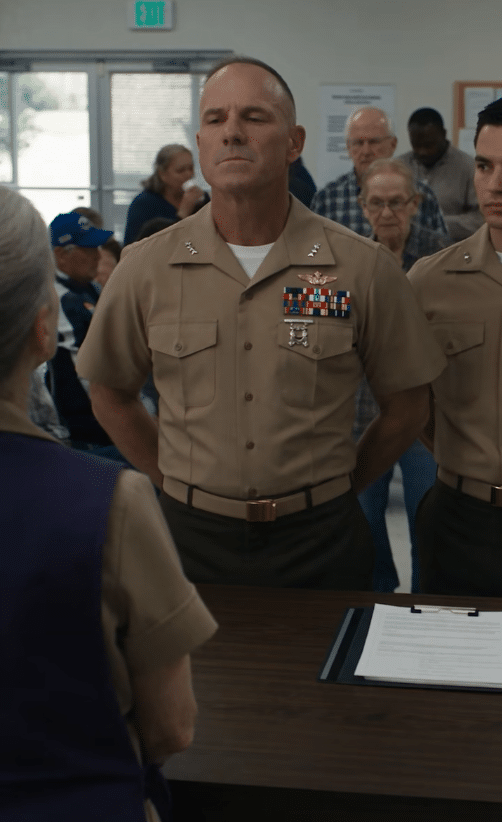
The community medical clinic was crowded with veterans and military families waiting for treatment. Volunteers moved between medicine cabinets and examination rooms, while boxes of medical supplies lined the walls.
Behind the volunteer desk, a sixty-five-year-old woman with neatly tied silver hair checked a clipboard. She wore a simple clinic polo beneath a faded volunteer vest, and a small portion of something silver remained hidden beneath her collar.
A wounded veteran sat nearby, struggling to remain upright as he waited for his medication.
A uniformed aide approached the woman with a fifty-year-old Colonel standing behind him.
“Colonel, she says the veteran goes first.”
The woman didn’t hesitate.
“He needs treatment more than you do.”
The Colonel stared at her as if she had just challenged his authority in front of an entire command. He had expected the clinic to make room for him immediately, regardless of who had arrived first or whose condition was more urgent.
“I’m not standing in this waiting room while a volunteer decides what happens to me,” he snapped.
The woman returned her attention to the clipboard.
“Then you can wait for your turn.”
The aide’s expression tightened. The Colonel stepped forward, his patience disappearing.
Act II — The Price of Defiance
The Colonel snatched the clipboard from the woman’s hands and threw it onto the floor.
Before she could move away, he slapped her hard across the face.
She fell beside the medicine cabinet, striking the floor with a sharp impact. Her cheek reddened and began to swell, while a faint trace of blood appeared at the corner of her mouth.
A woman in the waiting area gasped. An older veteran pushed himself forward in his chair, but the people around him froze, uncertain how to respond to an officer openly assaulting a clinic volunteer.
The Colonel advanced and delivered two forceful kicks to the woman’s torso.
“Get me a private room!” he demanded. “Now!”
The woman curled briefly against the pain, drawing a shallow breath. Yet even as the Colonel stood over her, she reached toward a medication box that had slid beneath the cabinet.
It belonged to the wounded veteran.
She pulled it toward herself and checked the label before attempting to rise.
The Colonel looked down at her with contempt.
“Clinic volunteers don’t rank patients above colonels.”
She pressed one hand against the cabinet and slowly steadied herself. Her cheek was swollen, and pain showed in every careful movement, but her eyes remained fixed on the medication box.
“The medicine goes to him,” she said.
The Colonel’s aide stopped smiling.
Act III — The Silver Pin
The woman managed to stand, keeping one hand against the cabinet for support. She placed the medication box securely on the volunteer desk and checked that the wounded veteran’s name was still visible.
As she reached forward, her collar shifted.
A small silver pin slipped into view.
It was understated, almost easy to miss beneath the clinic’s harsh fluorescent lights. There were no large ribbons or elaborate decorations around it, only a carefully worn insignia resting against the fabric of her shirt.
Near the medicine shelves, a sixty-nine-year-old retired Army doctor had been watching the confrontation.
He wore glasses and a white medical coat over ordinary civilian clothes. Until that moment, his expression had been one of quiet disapproval.
Then he saw the pin.
His face went pale.
The doctor stopped moving. His gaze locked on the silver insignia, and his shoulders stiffened as though a long-buried memory had suddenly become impossible to ignore.
He looked at the woman again.
Then he turned toward the Colonel.
“Colonel… I’d stop now.”
The warning was quiet, but it carried a weight that made the aide glance nervously between the two men.
The Colonel followed the doctor’s gaze to the woman’s collar.
For a moment, he appeared irritated rather than concerned.
Act IV — It’s Just a Pin
The Colonel gave a dismissive laugh.
“It’s a pin.”
The retired doctor didn’t laugh with him.
Instead, he stood rigid beside the medicine shelves, his eyes returning to the small silver insignia. His expression suggested that he had recognized something far more consequential than a decorative piece of metal.
The aide’s confidence began to crumble. He shifted backward, no longer willing to stand quite so close to the Colonel.
The woman noticed the doctor’s reaction, but she offered no explanation. She adjusted the medication box on the desk and ensured that the wounded veteran could reach it.
Then she slowly straightened.
Her injured cheek was visibly swollen. A faint mark remained at the corner of her mouth, and her breathing was measured against the pain.
She looked directly at the retired doctor.
“He remembers the field hospital it came from.”
The doctor’s jaw tightened.
For an instant, his eyes seemed to lose focus, as if the words had taken him somewhere far beyond the clinic. He lowered his gaze, then looked at the Colonel with a seriousness that had not been there before.
The Colonel’s smile weakened.
“What field hospital?”
Neither the woman nor the retired doctor answered.
The waiting room had become almost unnaturally quiet. Even the aide seemed afraid to ask another question.
The woman turned back toward the volunteer desk, leaving the silver pin visible at her collar.
Act V — The Hospital He Remembered
The Colonel studied the insignia again.
At first, he seemed determined to dismiss it as an irrelevant keepsake worn by an elderly volunteer. But the retired doctor’s reaction had been too immediate, too genuine, to explain away.
The doctor wasn’t looking at the woman as a helpless clinic worker who had been assaulted.
He was looking at her as someone whose past he recognized—and whose significance the Colonel had somehow failed to understand.
The aide took another small step away from his superior.
The Colonel noticed.
He looked at the retired doctor, hoping for an explanation that would restore his confidence. Instead, he found a man who seemed increasingly unwilling to say anything at all.
The woman calmly returned the clipboard to the desk. She checked the wounded veteran’s medication one final time, then placed it within his reach.
She never demanded an apology. She never announced her former rank or threatened to report the Colonel.
She simply continued doing the work he had tried to stop.
The Colonel’s expression began to change. His jaw tightened, his eyes narrowed, and the arrogance that had filled his face moments earlier gave way to an uneasy recognition.
The words field hospital seemed to have opened a door he had no desire to enter.
The camera moves closer until only the Colonel’s face remains. The clinic dissolves into a blurred background, leaving his widening eyes and tightening jaw in sharp focus.
His breath catches.
“That hospital…?”