Act I — The Woman in the Front Row
“Colonel, she won’t leave the front family row.”
The young lieutenant stood beside a row of reserved chairs, holding his event clipboard as a silver-haired woman sat quietly near the stage. Flags stirred in the breeze, photographers adjusted their cameras, and decorated officers gathered for the military medal ceremony.
The woman was seventy-two, wearing a modest blouse, a simple cardigan, a dark skirt, and practical shoes. A small handbag rested beside her chair. She looked like an ordinary elderly guest who had arrived to watch the ceremony.
The Colonel responsible for seating approached with an irritated expression.
“Ma’am, this row is reserved for military families.”
The woman looked at the name card attached to the chair.
“They put my name on this chair.”
The lieutenant glanced at the card but said nothing. The Colonel barely looked at it. Her clothes had already convinced him that she didn’t belong among the families seated closest to the stage.
“I’m not going to explain this twice,” he said. “Get up.”
The woman remained seated for another moment, looking directly at him.
“Perhaps you should check the name first.”
Several nearby guests turned toward them. The Colonel’s face tightened. In front of his fellow officers, an elderly civilian had just questioned his authority.
He reached for the name card.
Act II — An Example Made in Public
The Colonel tore the name card from the chair and threw it aside.
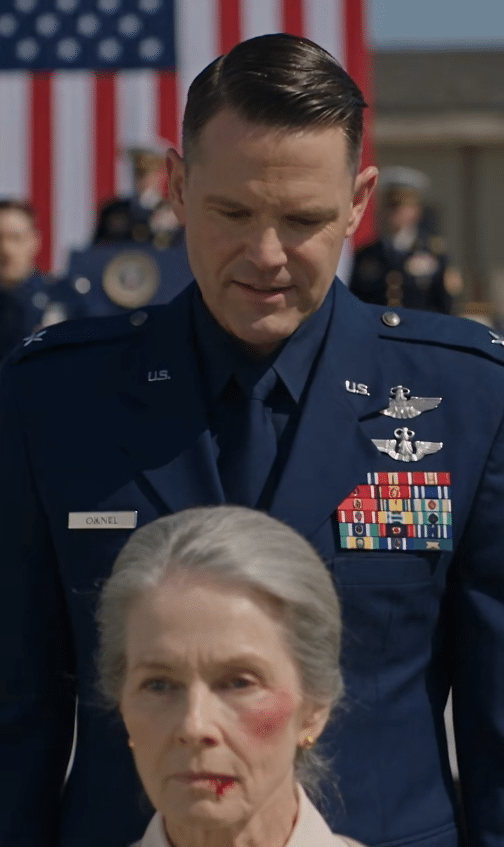
Then he slapped the woman hard across the face.
She fell beside the front row, her cheek reddening as a faint trace of blood appeared at the corner of her mouth. A photographer lowered his camera. Nearby officers froze, unsure whether the Colonel would stop or continue.
He didn’t stop.
The Colonel kicked her handbag away, sending it sliding across the pavement. Then he used his boot and the position of his body to force her farther from the reserved seats.
“Learn your place,” he snapped.
The woman drew a painful breath and pushed herself upright. Her cheek was swelling, but she didn’t ask anyone for help. She didn’t plead with him or apologize for sitting in the chair assigned to her.
She simply stood on her own.
The Colonel looked her over with open contempt.
“Front-row families don’t dress like this.”
The insult carried farther than he intended. A few guests looked down, while others stared at the woman and then quickly turned away.
The lieutenant stood beside the discarded name card, his earlier confidence fading.
The woman didn’t reach for her handbag. She didn’t argue about her clothes.
She looked at the Colonel with cold, unwavering eyes.
He had expected embarrassment to make her leave.
Instead, she stood beside the chair as if she had every right to remain there.
Act III — General Bennett’s Question
Footsteps sounded from the stage area.
A uniformed aide hurried toward the front row, scanning the chairs with growing concern. He passed a group of officers, glanced at the stage, and then stopped abruptly when he saw the elderly woman standing beside the Colonel.
His expression changed at once.
He looked at her swollen cheek, then turned toward the officer responsible for the seating.
“Colonel…” His voice was careful, but the urgency was unmistakable. “General Bennett is asking where his grandmother is.”
For a moment, the Colonel didn’t respond.
The lieutenant stared at the aide. A nearby officer slowly turned toward the stage, while the photographer who had lowered his camera watched the Colonel’s face.
The elderly woman remained silent.
She hadn’t mentioned General Bennett. She hadn’t used a family connection to defend her place or stop the assault. She had simply insisted that the name on her chair belonged there.
Now, the aide had supplied the one detail the Colonel had never bothered to ask about.
“His grandmother?” the Colonel repeated.
The aide didn’t elaborate. He stood waiting, his attention fixed on the woman.
The Colonel looked at her again, but his expression remained stubborn. He seemed determined to dismiss the information rather than accept that his judgment might have been wrong.
The woman straightened her cardigan.
Then she spoke.
Act IV — You Were About to Meet Her
“You were about to meet her.”
The woman’s voice was quiet, almost gentle. There was no boast in it, no attempt to intimidate the Colonel with a name or a rank.
That made the words harder to dismiss.
The Colonel glanced at the aide, expecting him to correct the situation or explain that there had been some mistake.
The aide did neither.
“General Bennett is waiting,” he said.
The lieutenant looked down at the discarded name card. He bent as though he might retrieve it, then hesitated, suddenly aware of what it represented.
The Colonel’s eyes moved between the aide and the elderly woman.
Only moments earlier, he had treated her appearance as proof that she didn’t belong in the front row. He had torn away her name card, struck her in front of the assembled guests, and kicked her belongings aside without once checking the seating arrangements.
Now he was learning that the woman he had humiliated was the very person someone on the stage was looking for.
The woman remained composed, though pain showed in the way she held herself. She didn’t demand that the Colonel apologize. She didn’t tell him what would happen next.
She simply waited beside the chair.
The aide’s expression remained serious.
Behind him, the ceremony continued only in fragments: a microphone being adjusted, a chair scraping against the ground, the distant rustle of flags.
The Colonel looked toward the stage.
His confidence was beginning to disappear, but he still seemed unable to accept the obvious.
Act V — Bennett’s…?
The Colonel stared at the woman, then at the aide.
He looked down at the discarded name card lying beside the front-row chair. For the first time, he seemed to understand that the card had never been an inconvenience. It had been the simplest explanation for why the woman was sitting there.
He had ignored it because he believed her appearance told him everything he needed to know.
The lieutenant stepped away from the Colonel, no longer willing to stand beside him. The surrounding guests remained silent, their attention fixed on the officer who had turned a seating dispute into a public assault.
The woman stood with her swollen cheek and her hands resting calmly at her sides.
She hadn’t changed.
Only the Colonel’s understanding of her had changed.
The aide waited for the woman to be escorted backstage, but the Colonel couldn’t seem to move. He looked from the front-row chair toward the stage, where General Bennett was still waiting for his grandmother.
His jaw tightened.
His face lost color, and the certainty that had driven his actions collapsed into restrained panic.
He finally whispered the name as if saying it aloud might make the situation more real.
“Bennett’s…?”