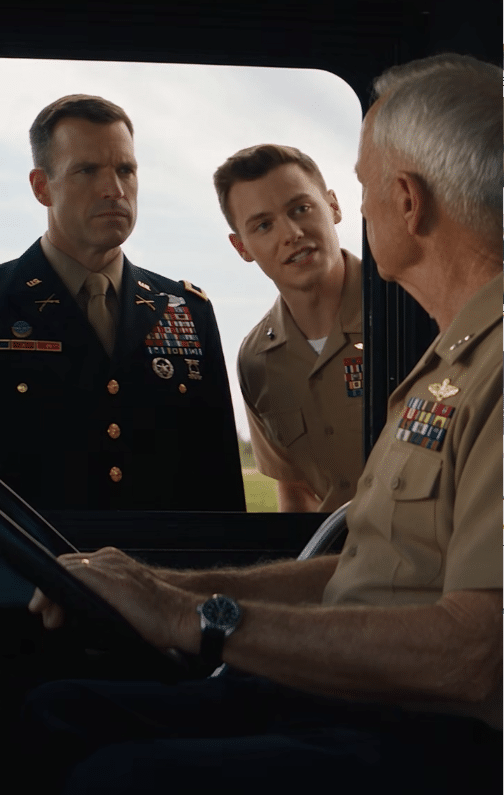
Act I — The Veterans Had Boarded First
“Sir, he says the veterans boarded first.”
The aide delivered the complaint beside a free veterans shuttle parked outside a military hospital. Major General Richard Caldwell stood at the open doors in his immaculate service uniform, visibly irritated as elderly veterans climbed aboard with walking canes and carefully balanced steps.
Behind the wheel stood a silver-haired man in a simple driver’s polo and dark trousers. He looked seventy-four, with weathered hands and the patient expression of someone who had spent years helping people who needed an extra moment.
“They did,” the driver answered.
Caldwell stared at him.
The general’s party had arrived expecting priority. To Caldwell, the fact that elderly veterans had boarded ahead of him was an insult to his rank, and the driver was the convenient target for his frustration.
He stepped toward the driver’s seat.
“You were told to wait,” Caldwell snapped.
The driver glanced toward an elderly veteran gripping a cane beside the entrance. He wasn’t interested in arguing about rank. He was making sure the man could board safely.
That quiet refusal was all Caldwell needed to convince himself that the driver had challenged his authority.
He had no idea who was sitting behind that ordinary-looking uniform.
Act II — The Man He Thought He Could Throw Away
Caldwell grabbed the elderly driver and yanked him from his seat.
Before the aide could react, the general punched him hard across the cheek. The driver crashed into the shuttle’s stepwell, his face reddening as a thin trace of blood appeared at the corner of his mouth.
Then Caldwell kicked him twice in the torso and pointed toward the parking lot.
“Get out of my way!”
The veterans inside the shuttle fell silent. One man tightened his grip on his cane. Another stared through the open doorway, stunned that a senior officer would attack someone who was simply doing his job.
The aide stood frozen beside Caldwell.
The driver took a painful breath and steadied himself against the handrail. His cheek was swelling, and every movement hurt. Yet he didn’t plead for mercy or ask the general to stop.
Instead, he turned toward the elderly veteran waiting at the entrance.
With visible effort, he opened the door wider and helped clear the way for the man to board.
Caldwell watched him in disbelief.
“Bus drivers don’t set priority for generals.”
The driver said nothing.
He had been struck, kicked, and publicly humiliated, yet the first thing he did after getting back on his feet was return to the responsibility Caldwell had tried to take away from him.
That was when the general made his second mistake.
He assumed the driver’s silence meant he had won.
Act III — The Silver Coin on the Floor
As the driver steadied himself beside the stepwell, something slipped from his shirt pocket.
A silver coin struck the rubber floor and rolled toward an elderly passenger seated near the front.
The driver barely glanced at it.
But a retired colonel sitting nearby saw the coin’s design—and went completely still.
Colonel Thomas Whitaker had spent decades around military leadership. He had seen countless challenge coins, commemorative tokens, and personalized gifts exchanged between officers.
This one was different.
His expression changed instantly. The color drained from his face, and his hand tightened around the edge of his seat.
He looked from the silver coin to the battered driver, then toward Caldwell.
“General… where did he get that?”
Caldwell turned with an annoyed laugh.
The coin lay on the floor between them, its silver surface catching the daylight spilling through the shuttle doors. The driver made no attempt to snatch it away or explain its significance.
Whitaker, however, looked as though he had just witnessed something he never expected to see again.
The aide noticed the retired colonel’s reaction and slowly lost his smirk.
Caldwell noticed it, too.
For the first time since the confrontation began, someone else’s expression had made the general uncomfortable.
But rather than investigate, he chose to dismiss what he didn’t understand.
Act IV — “He Knows Who Gave It to Me”
“Probably found it,” Caldwell said.
He delivered the remark with a contemptuous shrug, as though the retired colonel had mistaken a worthless trinket for something important.
Whitaker didn’t answer.
He continued staring at the coin, his posture rigid and his expression deeply troubled. Whatever he recognized, it wasn’t something he was willing to explain in front of the general’s aide and a shuttle full of veterans.
The driver slowly straightened.
His cheek was red and swollen. Pain tightened his expression for a moment, but his eyes remained steady as he looked at Caldwell.
“No. He knows who gave it to me.”
The words were quiet.
They were also unmistakably deliberate.
Caldwell’s smile weakened.
He looked down at the coin again, this time studying it rather than dismissing it. Then he turned toward Whitaker, expecting the retired colonel to laugh off the misunderstanding.
Instead, Whitaker looked back at him with an expression that bordered on alarm.
The veterans remained silent. Even the aide appeared reluctant to move.
Caldwell had spent years believing that rank gave him the right to demand immediate obedience. He had treated the driver’s ordinary clothing as proof that the man occupied an insignificant place in the military world.
Now a retired colonel was reacting to a small silver coin as though it carried a history Caldwell couldn’t afford to ignore.
The driver didn’t reveal his past.
He didn’t announce that he had once commanded soldiers, held senior office, or occupied a position far above the one Caldwell currently held.
He simply stood beside the shuttle entrance, protecting the veterans’ right to board safely.
And the more Whitaker refused to explain, the more Caldwell began to wonder what kind of person could make a retired colonel look that afraid.
Act V — The Question the General Couldn’t Ignore
Caldwell bent his gaze toward the silver coin one more time.
His expression had changed. The smugness was fading, replaced by the uncomfortable realization that Whitaker’s reaction was genuine.
The retired colonel wasn’t looking at the driver with pity.
He was looking at him with recognition.
Caldwell glanced at the veteran seated nearby, then at the coin, and finally at Whitaker. The colonel’s silence seemed to confirm that the object had not come from an ordinary exchange between strangers.
It had come from someone important.
Someone whose identity could change the meaning of everything Caldwell had done.
The general looked back at the driver.
The old man had not threatened him, raised his voice, or demanded special treatment. Even after being attacked, he had continued helping the veterans who depended on the shuttle.
Caldwell had seen weakness in that behavior.
Now he was beginning to see something else: a man who had no need to prove his importance to someone like him.
The driver remained composed, his injured face revealing the cost of Caldwell’s arrogance but nothing about the life behind it.
Whitaker still hadn’t explained the coin.
And Caldwell was no longer certain he wanted to hear the answer.
His eyes narrowed as he looked at the silver surface again. Then his jaw tightened, and the last trace of confidence disappeared from his face.
He finally spoke, his voice dropping into an uncertain whisper.
“Who gave it…?”
The camera moved into an extreme close-up.
Caldwell’s eyes widened. His breathing caught, and the authority he had wielded so casually outside the hospital seemed to collapse under the weight of a question he could no longer dismiss.
The shuttle remained still.
The veterans watched in silence.
And the man Caldwell had treated as a disposable driver stood beside the open door, waiting to help the next veteran aboard.
Whatever the silver coin meant, the retired colonel knew.
And for the first time that morning, Major General Caldwell was afraid to discover why.