Act I
The slap sent a wineglass rattling across the VIP table.
For a moment, the entire lounge seemed to stop breathing. Beyond the floor-to-ceiling windows, fighter jets taxied along the runway, their engines rumbling beneath the silence that had fallen over a room full of senior officers, decorated pilots, and wealthy airshow guests.
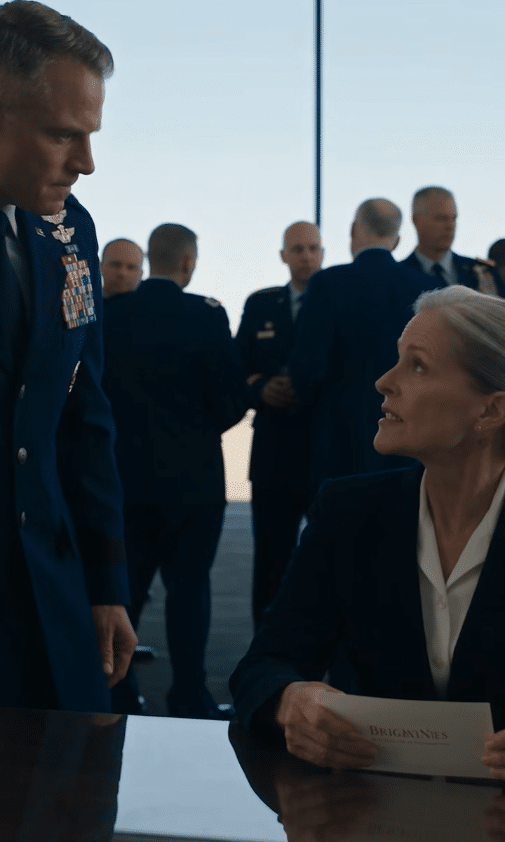
Brigadier General Marcus Hale stood beside the table, his hand lowering slowly to his side.
The woman he had struck was sixty-eight years old. Her silver hair had been gathered into a low bun, and she wore a navy blazer, a white blouse, and dark trousers. She had arrived with an invitation bearing her name and a specific table assignment overlooking the runway.
Now one hand gripped the edge of that table to keep her balance.
Her name was Evelyn Carter.
And the general had just slapped her because she refused to surrender her seat.
It had started only seconds earlier, when Captain Ryan Mitchell approached Hale with the expression of a man delivering an inconvenient report.
“General, she says she’s not moving.”
Hale glanced toward the woman, then toward the runway windows. Several important guests had already gathered near the premium tables, including representatives from aviation companies and members of the press.
He wanted the best view. More importantly, he wanted everyone to see him occupying it.
Evelyn looked down at the invitation resting beside her untouched glass of water.
“My invitation says this table.”
Her voice was composed, without a trace of hostility.
That made Hale’s expression tighten even further.
He had spent years surrounded by people who moved when he spoke. Junior officers stood straighter. Staff members hurried. Invitations were adjusted, schedules rearranged, and inconvenient people quietly redirected whenever his preferences changed.
He had mistaken obedience for respect so many times that he no longer recognized the difference.
He reached across the table, snatched Evelyn’s invitation, and crushed it in his fist.
She rose to retrieve it.
“I believe that’s mine,” she said.
Hale stepped closer.
The slap came without warning.
Evelyn’s head turned sharply. She stumbled against the table, sending silverware clattering against porcelain as she caught herself with one hand. Her silver hair loosened, falling away from the side of her face.
Around them, conversations died instantly.
A pilot near the catering station froze with a glass halfway to his mouth. Two officers exchanged horrified glances. A lounge attendant stood motionless beside a tray of untouched drinks.
Hale straightened his uniform.
“Retired nobodies don’t take command views.”
Evelyn slowly turned back toward him.
Her cheek was reddening, and pain flickered across her face. But there was no pleading in her eyes, no desperate attempt to explain herself to a man who had already decided she was beneath him.
She smoothed the front of her blazer.
Then she remained beside the table.
Hale gave a contemptuous shake of his head, convinced that he had won.
He had no idea why an older woman who avoided the spotlight had been invited to the airshow in the first place.
And he certainly had no idea what had just become visible behind her ear.
Across the lounge, a senior pilot abruptly lowered his glass.
The color drained from his face.
He stared at the small, pale scar behind Evelyn’s ear—and at the tiny wings mark beside it.
Then he looked at the woman herself.
For a moment, he seemed to be seeing someone who had been missing from his life for years.
He placed his glass on the catering table with trembling fingers.
And when he began walking toward the general, he did not look like a man preparing to settle a seating dispute.
He looked like a man who had just watched history walk back into the room.
Act II
The pilot’s name was Colonel James Whitaker, though most people at the airshow simply called him Jim.
At fifty-six, he was one of the most respected senior pilots in the service community. His career had included demanding assignments, difficult evaluations, and years of mentoring younger aviators who dreamed of earning the same reputation.
He was not easily frightened.
He had landed aircraft in conditions that would have made inexperienced pilots abandon the attempt. He had sat through investigations in which a single sentence could determine the future of an entire squadron. He had learned to keep his face still when circumstances became dangerous.
But the scar behind Evelyn Carter’s ear brought back a memory he had spent years trying to put into words.
He remembered a flight that had gone catastrophically wrong.
He remembered the confusion surrounding the incident, the frantic communications, and the hours during which nobody knew whether the aircraft involved would ever return.
Most of all, he remembered the woman who had been at the center of it.
At the time, Evelyn had not been an obscure guest at an airshow. She had been one of the Air Force’s most capable command pilots, a woman whose judgment was trusted when the margin for error became painfully small.
She had eventually risen to lieutenant general.
Then, after years of service, she had disappeared from public view.
There had been no dramatic farewell tour. No television interviews explaining her retirement. No appearances at every ceremony where former senior officers were expected to exchange handshakes and reminisce beneath framed photographs.
She had simply stepped away.
Some people assumed she had become ill. Others believed she had grown tired of the institution. A few whispered that she knew things about the old flight incident that had never been fully explained.
The rumors had continued because nobody could produce an account that satisfied everyone.
Evelyn herself had never encouraged them.
She had accepted occasional invitations to small aviation-history events, usually when the organizers were more interested in preserving records than celebrating prominent names. She preferred quiet conversations with young pilots to speeches about her own achievements.
That was why she had accepted the invitation to this airshow.
She had been asked to attend a private gathering recognizing the people who had helped advance military aviation. Her assigned table was not a prize she had demanded. It was simply where the organizers had placed her.
She had arrived early, declined an escort, and settled into her seat with a clear view of the runway.
No one had announced her arrival.
No one had needed to.
Her past was not something she wore like a medal.
It was something she carried.
The scar behind her ear was part of that burden.
The injury had healed years ago, but the skin had never returned to its original shape. Beside it was a tiny wings mark, discreet enough to remain hidden beneath her hair.
To most people, the two marks meant nothing.
To Whitaker, they were unmistakable.
He had seen that combination before, during the months following the flight incident. He remembered the questions surrounding the injury, the technical details that had been discussed in private, and the uncomfortable realization that the public story had left out things that mattered.
He had also remembered Evelyn’s name.
Not because she had demanded to be remembered.
Because she had done something that changed the way he understood courage.
Now, as he crossed the lounge, he watched Brigadier General Marcus Hale standing beside the woman he had just assaulted.
Hale was a rising figure in military circles, known for his polished public appearances and talent for attracting influential supporters. He was the kind of officer who could make a routine event feel like a campaign for the next promotion.
Whitaker had met him before.
He knew the general valued reputation.
He also knew Hale had no idea whose reputation he had just endangered.
Whitaker reached the table and stopped a few feet away.
His gaze moved from Evelyn’s face to the scar behind her ear.
Then he looked at Hale.
“General… I think you should let this go.”
Hale turned toward him, visibly irritated.
For the first time since the slap, someone had challenged him in front of the very audience he had been trying to impress.
And the person doing it was a senior pilot who understood exactly what that scar meant.
Act III
Hale gave Whitaker a hard stare.
“Let what go?”
Whitaker did not answer immediately.
His eyes returned to Evelyn, searching her face for confirmation. She offered none. She simply stood beside the table, her hair still displaced, her reddened cheek turned toward the light.
She did not introduce herself.
She did not explain her history.
She did not need to.
Hale followed Whitaker’s gaze and scoffed.
“Over a scar?”
The words were delivered with a short, dismissive laugh, as though the entire scene had become absurd because another officer had suddenly developed an interest in an elderly woman’s appearance.
Whitaker’s face tightened.
He set his shoulders, but his voice remained controlled.
“Sir, I’m asking you to stop.”
“Stop what? She was occupying a table assigned to senior command guests.”
“Her invitation says otherwise.”
Hale’s jaw flexed.
The captain who had brought him the complaint now stood silently behind him. Mitchell had expected the situation to end with Evelyn being moved to another seat. He had never expected a slap, and he certainly had not anticipated Whitaker’s reaction.
The lounge staff were watching.
So were the pilots.
Hale could feel the audience shifting away from him, and he hated it.
He turned back toward Evelyn.
“Who exactly are you supposed to be?”
She looked at him without blinking.
“Someone who was invited.”
The answer was simple enough to be almost insulting.
Hale took a half step closer, but Whitaker’s warning had unsettled him. He was no longer entirely certain that another display of authority would produce the result he wanted.
Evelyn adjusted her sleeve.
Her hair remained behind her ear, exposing the scar and the tiny wings mark.
Then she looked past Hale and addressed Whitaker.
“He knows why it never healed clean.”
The senior pilot went completely still.
It was not the scar alone that frightened him.
It was the fact that Evelyn had chosen those exact words.
The old incident had left questions that could not be answered by looking at an official photograph or reading a short account in an aviation journal. There had been technical failures, conflicting recollections, and decisions made under pressure that were later discussed in rooms where very few people were allowed to speak freely.
Whitaker had been there when the details were still fresh.
He remembered the damage.
He remembered the difficult recovery.
And he remembered that the explanation offered afterward had never accounted for everything he had witnessed.
For years, he had wondered whether the surviving account was merely incomplete or whether someone had decided that the full truth would be inconvenient.
He had never found enough evidence to settle the question.
Until now, he had never expected to see Evelyn again.
Hale watched Whitaker’s expression change.
The general was accustomed to reading people. He knew the difference between discomfort and fear, between irritation and the instinctive stillness of someone who had encountered a memory too powerful to dismiss.
Whitaker was not curious.
He was afraid of what Evelyn might say next.
“What flight are we talking about?” Hale demanded.
Whitaker’s eyes flicked toward him.
“Not here.”
That answer only deepened Hale’s confusion.
“Why not?”
“Because you don’t understand what you’re asking.”
Hale let out a disbelieving breath.
He looked at Evelyn again, trying to fit the quiet woman before him into the growing outline of a story he had never heard.
The navy blazer. The silver hair. The disciplined posture.
The scar.
The wings.
The sudden fear in the eyes of a pilot who had spent decades around aircraft and senior officers.
There was something familiar about the way Evelyn held herself, though Hale could not place it. It was not the stiff posture of someone trying to imitate military authority. It was the ease of someone who had once carried responsibility so heavy that she no longer needed to demonstrate it.
Whitaker finally spoke again.
“General, you need to understand something. That mark is not a souvenir.”
Hale stared at him.
“Then what is it?”
Whitaker’s lips pressed together.
For a moment, it seemed he might answer.
Instead, he looked toward the windows, where a fighter jet rolled slowly past the runway markers.
Then he turned back to Evelyn.
She gave him the smallest nod.
It was not permission to reveal everything.
It was permission to stop pretending the past had never happened.
Whitaker drew a slow breath.
And for the first time, Hale realized that the question was no longer whether Evelyn deserved the seat.
It was what she had survived to earn the right to sit there.
Act IV
The airshow continued outside.
A fighter jet turned at the far end of the runway, sunlight flashing along its fuselage. Inside the VIP lounge, however, the atmosphere had changed so completely that the roar of the engines seemed to belong to another world.
Hale looked around for support.
He found none.
Several officers were studying the floor. Others watched him openly, their expressions stripped of the polite admiration they had worn when he first entered the lounge.
The captain stood rigidly behind him, looking as if he wished he could return to the beginning of the evening and choose different words.
Hale turned on Whitaker.
“You are making a scene over something you clearly don’t understand.”
Whitaker’s expression hardened.
“I understand more than you think.”
“Then explain it.”
“I can’t explain an entire history in the middle of a lounge.”
“Why not?”
“Because you haven’t even bothered to learn who you’re standing in front of.”
The answer struck deeper than Whitaker had intended.
Hale’s face darkened.
He had spent years cultivating an image of himself as an officer who understood military tradition. He spoke confidently about the legacy of aviation, praised the sacrifices of earlier generations, and knew exactly how to position himself for photographs beside historic aircraft.
But his knowledge had always served a purpose.
He used history to reinforce his standing, not to question it.
He had seen Evelyn as an obstacle between himself and a better view.
Now the scar behind her ear had become a doorway into a past he could not control.
Whitaker lowered his voice.
“There was a flight years ago. A flight that nearly ended very differently from the way people were told it ended.”
Hale’s eyes narrowed.
“I’ve read the official account.”
“So have I.”
“Then what’s the problem?”
Whitaker glanced at Evelyn.
“The official account doesn’t tell you everything.”
A silence settled over the table.
The words carried no explicit accusation, but they changed the meaning of everything around them. Hale’s earlier confidence had depended on the belief that he understood the world he was operating in.
Now a veteran pilot was telling him that the history he knew was incomplete.
And the woman he had slapped might be living proof.
Evelyn finally spoke.
“James, don’t give him a history lesson.”
Whitaker turned toward her.
There was a faint softness in his expression now, a mixture of respect and regret.
“Understood.”
She looked back at Hale.
“You wanted my seat because important people were watching.”
Hale’s mouth tightened.
“I wanted the table reserved for command.”
“No. You wanted the table closest to the windows.”
He did not answer.
“You could have asked the staff to clarify the assignment. You could have waited for someone to check the invitation. You could even have complained afterward.”
Her eyes moved briefly toward the crumpled paper in his hand.
“Instead, you chose to strike someone you thought could not challenge you.”
Hale glanced at the invitation.
For the first time, the crushed paper seemed to embarrass him more than the presence of the watching officers.
He attempted to recover.
“You’re turning a simple disagreement into something it isn’t.”
Evelyn’s expression did not change.
“You made it something else when you raised your hand.”
No one spoke.
The words were not delivered dramatically. There was no anger in them, no threat, and no attempt to humiliate him in return.
That made them impossible to dismiss.
Whitaker watched Hale absorb the accusation.
He had seen officers make mistakes under pressure. He had seen good people become defensive when they were frightened. But this was different. Hale had not lost control in an emergency or reacted to a life-threatening situation.
He had attacked an older woman because she refused to surrender a legitimate privilege.
And now he was trying to argue his way out of the truth.
The captain finally stepped forward.
“General, perhaps we should leave the lounge.”
Hale turned sharply.
“Are you suggesting I leave?”
The captain hesitated.
Then, for the first time that evening, he looked directly at Evelyn.
“Ma’am, I’m sorry.”
It was not enough to undo what had happened. It did not erase his role in framing her refusal as defiance, nor did it excuse his silence after the slap.
But it was the first honest sentence anyone associated with Hale had offered her.
Evelyn acknowledged it with a small nod.
Whitaker remained beside the table, his attention fixed on the scar.
Hale saw that expression again.
That same recognition. That same fear.
And suddenly he understood that the pilot’s warning had not been about an embarrassing old story or a retired officer’s reputation.
It was about an event serious enough that people who had lived through it still struggled to speak about it.
He looked at the wings mark.
Then he looked at Whitaker.
The general’s voice dropped.
“You’re telling me she was involved in that flight?”
Whitaker did not answer.
Evelyn did.
“You should ask yourself why a pilot who knows that history is afraid to explain it.”
Hale’s face lost its color.
Outside, another aircraft began moving along the runway.
Inside, the woman he had dismissed as a retired nobody stood motionless, and the man who had struck her was finally beginning to understand that the most dangerous thing in the room was not her anger.
It was the truth he had never bothered to learn.
Act V
Hale stared at Evelyn.
He had expected her to demand an apology, threaten to report him, or announce some influential connection that would turn the evening against him. Those were the kinds of confrontations he understood.
This was different.
She was not trying to frighten him.
She was not even trying to prove that she was more important than he was.
She was simply refusing to let him decide who mattered.
Whitaker moved slightly away from the table, giving Evelyn room to stand without being surrounded by officers. He did not touch her or attempt to guide her away. He understood that she had not spent a lifetime commanding aircraft and personnel only to need someone else to speak for her now.
The captain picked up the crumpled invitation from the table.
He carefully unfolded it, but the crease remained across the paper.
Evelyn accepted it and placed it inside her handbag.
Then she straightened her blazer.
Her cheek was still red.
Hale noticed that she had not once asked anyone to help her.
He also noticed that nobody was looking at him the way they had when he entered the lounge.
The pilots who had once nodded respectfully now watched him with guarded expressions. The senior officers seemed reluctant to become associated with his behavior. Even the lounge staff, who had initially hurried to accommodate his presence, had stopped moving at his command.
He had wanted the best table because he believed appearances were power.
Now the entire room had witnessed the emptiness behind that belief.
Whitaker finally addressed him.
“General, I think you owe her an apology.”
Hale’s jaw tightened.
For a second, his old instincts returned. He looked ready to argue, to insist that the incident had been misunderstood, to remind everyone of his rank.
But he could not escape the simple facts.
Evelyn had presented a valid invitation.
She had refused to move.
He had crushed her invitation.
Then he had struck her.
No history could justify that. No rank could erase it.
His eyes moved toward Evelyn’s ear once more.
“Who are you?” he asked quietly.
She held his gaze.
“Evelyn Carter.”
“That isn’t what I mean.”
“I know.”
He swallowed.
Whitaker stood a few feet away, watching with an expression that was almost mournful. He had recognized the scar, but the scar was only a fragment of a much larger story. Whatever had happened during that flight had left its mark on more than Evelyn’s skin.
Hale looked between them.
His voice emerged as a whisper.
“You were flying…?”
For the first time, the general sounded less like a man issuing a command and more like someone asking a question he feared to have answered.
Evelyn did not respond.
She turned toward the runway windows.
A fighter jet was approaching the far end of the taxiway, its silhouette framed against the late-afternoon light. For a moment, her expression softened, and something distant moved behind her eyes.
It was not pride.
It was memory.
Whitaker followed her gaze.
He remembered the flight. He remembered the reports, the difficult conversations, and the details that had never fit neatly into the official version. He remembered the woman who had carried responsibility when others had no idea how close the situation had come to disaster.
And he remembered the scar.
It had never been a decoration.
It was evidence that the past had happened, whether or not anyone wanted to talk about it.
Evelyn looked back toward the table.
“Colonel Whitaker remembers,” she said. “That’s enough for tonight.”
Whitaker nodded.
He understood that she was not granting Hale forgiveness. She was refusing to let the general’s humiliation become the center of a story that belonged to something much larger.
There would be consequences for the assault. There would be questions about the incident, and the witnesses would have their own accounts to give. The airshow’s organizers would have to confront what had happened in their VIP lounge.
None of that could be settled by a single apology.
But Evelyn was not interested in revenge for its own sake.
She wanted the truth preserved.
She wanted people to understand that respect was not something a person earned by wearing the right uniform or occupying the most visible seat in the room.
And she wanted the history behind that scar to remain more than a rumor whispered between veterans.
Hale stood motionless as Evelyn returned to her chair.
She sat at the table assigned to her, placed her invitation beside her glass of water, and looked out at the runway.
The seat had never been the prize.
It had only revealed the character of the man who wanted it.
Across the lounge, the senior pilot remained standing, watching the woman he had once known as a commanding presence return to her quiet place beside the window.
And beside him, the brigadier general who had tried to humiliate her finally understood that some histories do not announce themselves with medals, speeches, or impressive titles.
Sometimes, they appear as a thin scar behind an elderly woman’s ear.
Sometimes, they are recognized by a man who suddenly cannot speak.
And sometimes, the person who believes he has all the power in the room discovers that the one person he treated as insignificant is the one person whose past he cannot afford to ignore.
Outside, the fighter jets continued across the runway.
Inside, Evelyn Carter watched them in silence.
She had once trusted the sky with her life.
She had survived what others still struggled to discuss.
And she had never needed a command view to prove who she was.