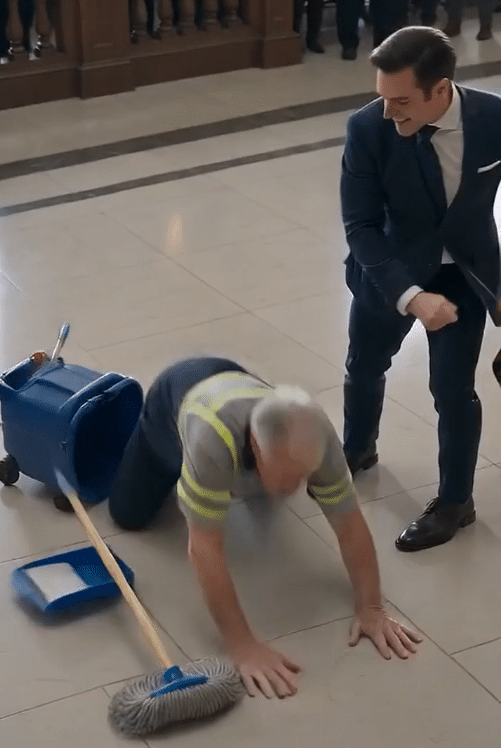
Act I – Justice Began in the Hallway, Not the Courtroom
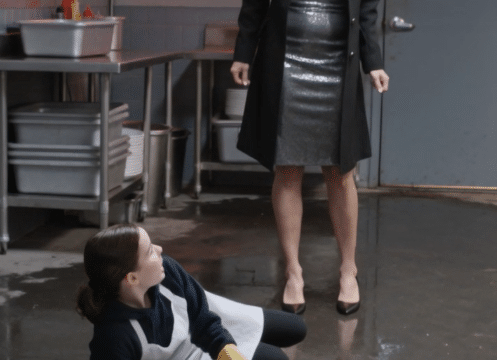
The kick landed so hard that the old man’s mop flew from his hands.
It clattered across the polished stone floor, spinning beneath a row of wooden benches before striking the courthouse wall with a hollow crack. His janitor’s cart lurched sideways, buckets overturned, and dirty water spread across the hallway like a slow-moving stain.
The entire corridor fell silent.
Lawyers carrying leather briefcases stopped mid-step. Police officers turned their heads. Clerks froze with stacks of legal files pressed against their chests. Even the conversations drifting from outside the courtroom doors disappeared beneath the sound of one elderly man struggling to breathe.
Harold Bennett lay curled on the cold floor.
At sixty-eight years old, years of hard labor had already bent his back and stiffened his knees. Now one brutal kick to his stomach had stolen the air from his lungs.
He pressed a trembling hand against his abdomen, fighting to inhale.
He refused to cry out.
Standing over him was attorney Victor Langston, one of the city’s most recognizable defense lawyers. His tailored Italian suit looked untouched by the chaos around him. His polished shoes reflected the courthouse lights, making the splash of dirty mop water around them seem almost offensive to him.
Victor glanced down with open disgust.
“You blind old fool.”
Harold tried to answer.
“I’m… sorry, sir. The floor was wet—”
“I don’t care.”
Victor shoved the overturned mop farther away with the tip of his expensive shoe.
Then, loud enough for everyone in the hallway to hear, he sneered,
“Trash. People like you clean the floor, not block lawyers.”
The words echoed between the marble walls.
Nobody answered.
A young legal intern looked horrified.
A bailiff frowned but remained still.
An elderly woman waiting for her hearing whispered, “Someone should help him.”
No one moved.
Everyone knew Victor.
He won impossible cases.
He donated to political campaigns.
He played golf with powerful judges, prosecutors, and business executives.
Crossing him could destroy careers.
Harold slowly pushed himself onto one elbow.
His breathing remained uneven, but there was no anger in his tired eyes.
Only quiet dignity.
He reached for the scattered cleaning supplies instead of defending himself.
One bottle rolled toward a police officer.
The officer instinctively bent to pick it up.
Victor glared.
“Leave it.”
The officer hesitated.
Then slowly stepped back.
Harold noticed.
He gave the young officer a tiny smile anyway.
“It’s alright,” he whispered.
“I’ll get it.”
His scraped elbow stained the gray sleeve of his uniform.
His hands shook as he gathered fallen brushes and paper towels.
Every movement revealed years of exhaustion.
Years that nobody had ever bothered to notice.
Victor adjusted his tie.
“You people never learn your place.”
Harold finally looked up.
Not with hatred.
Not with fear.
Just disappointment.
Because after nearly five decades cleaning government buildings, hospitals, and finally the courthouse, he had learned something most people never understood.
A person’s title revealed nothing about their character.
Only their choices did.
And Victor Langston had just made his.
At the far end of the hallway, heavy courtroom doors slowly began to open.
No one noticed.
Not yet.
Because everyone was still watching an old janitor clean the mess created by the man who had attacked him.
None of them realized they were about to witness a different kind of trial.
One without a jury.
One decided entirely by character.
Act II – The Man Behind the Uniform
Harold Bennett never expected respect.
He simply believed in earning an honest day’s pay.
Forty-two years earlier he had worn a different uniform.
Back then he had been a construction foreman, helping build schools, libraries, and public buildings throughout the state.
His hands were strong.
His back was straight.
His laughter filled every room.
Then one rainy afternoon everything changed.
A collapsing steel beam crushed his left leg while he pulled a younger worker to safety.
The young father survived.
Harold never walked without pain again.
The company paid compensation.
It disappeared beneath hospital bills.
His wife, Eleanor, worked double shifts as a waitress to keep food on the table.
Together they raised their only daughter, Amelia.
Money was scarce.
Love never was.
Harold refused to let Amelia see how frightened he truly was.
Every evening he helped with homework despite the pain in his knees.
Every Saturday he took her to the public library because buying books was impossible.
Whenever she doubted herself, he reminded her of one simple truth.
“Character is built when nobody is watching.”
Those words became the foundation of Amelia’s life.
She studied harder than anyone else.
Won scholarships.
Graduated at the top of her law school class.
Eventually she accepted a position as a prosecutor before becoming one of the youngest judges ever appointed in the county.
Reporters praised her brilliance.
Colleagues admired her fairness.
Almost nobody knew her father still worked nights cleaning the courthouse where she presided.
That had been Harold’s decision.
“I’m proud of my work,” he always told her.
“I don’t need people treating me differently because of you.”
Amelia argued countless times.
She offered him retirement.
A comfortable home.
Travel.
Anything.
He always smiled.
“My legs may be old,” he would say, “but they still carry me where I’m needed.”
So every morning before dawn, Harold quietly polished courtroom floors.
He greeted nervous defendants with kindness.
He helped frightened children find the right courtroom.
He carried extra tissues for grieving families.
He learned the names of every security guard.
Most people barely noticed him.
He preferred it that way.
Victor Langston certainly never noticed.
To Victor, janitors were part of the furniture.
Invisible.
Replaceable.
Today had already been a terrible morning.
He had lost a high-profile motion inside Courtroom Three.
His client blamed him.
Reporters waited outside.
His temper had been searching for someone weaker.
Harold became that target.
It wasn’t because Harold had done anything wrong.
The old man had simply pushed his mop bucket around a corner at the exact moment Victor stormed into the hallway.
Their shoulders brushed.
That tiny accident bruised Victor’s ego more than his body.
His pride demanded someone pay for it.
Harold paid instead.
As the hallway remained frozen in uncomfortable silence, the massive oak courtroom doors finally swung completely open.
The morning hearing had just concluded.
Footsteps echoed across the stone floor.
Black judicial robes appeared beyond the doorway.
Several attorneys immediately straightened their posture.
Conversations stopped.
Bailiffs instinctively stood taller.
Judge Amelia Bennett stepped into the corridor, reviewing paperwork with her clerk.
She looked up.
And the first thing she saw was an overturned janitor’s cart.
The second thing she saw was an elderly man lying on the courthouse floor.
The papers slipped from her hands.
For one impossible heartbeat…
She couldn’t breathe.