Act I
The black water bottle rolled across the rubber floor before the room stopped gasping.
It spun past a chrome training machine, bumped against the base of a mirrored wall, and settled beneath a row of celebrity photos that had been arranged to make the club feel untouchable.
Mr. Walker landed beside it.
His shoulder hit the mat. One hand caught the floor. A small mark appeared near his lip, but he did not swing back. He stayed down for half a breath, calm even through the shock, his black hoodie twisted at the collar and his gray joggers dusted from the rubber surface.
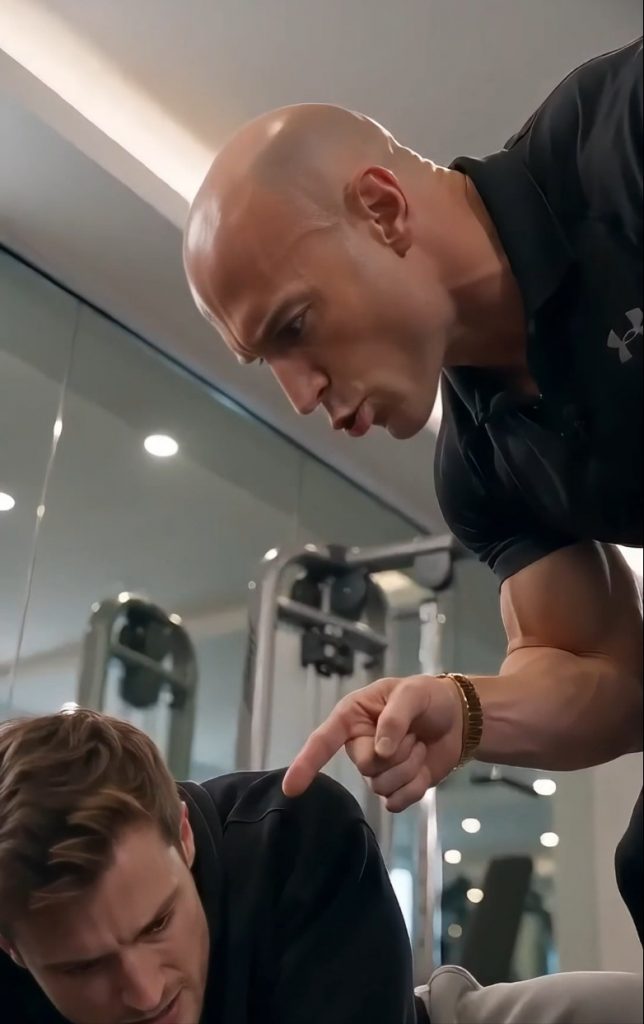
The man who punched him stood over him with his fists still clenched.
Shaved head. Black designer workout shirt. Gold watch. Shoulders pushed forward like he owned not only the machine, but the air around it.
“Private fitness is for winners,” he snapped, voice loud enough to reach the wellness bar, “not broke men pretending to belong.”
The club went silent.
A trainer froze with a towel in her hand. A receptionist looked up from the front desk. Wealthy members in designer athletic wear stopped mid-conversation beneath the soft wellness lighting. Behind the glass walls, Beverly Hills sunlight poured into a room suddenly colder than any spa could soften.
Mr. Walker slowly lifted his eyes.
He looked at the water bottle first.
Then the man.
His name was Evan Walker, but no one in that room seemed to know it yet.
The bully’s name was Grant Harlan.
Harlan was a finance executive, a founding member, and the kind of man who treated every private club like an extension of his own ego. He had spent the morning circling the VIP training machine, complaining that new members were “diluting the room” and asking why a man in a plain hoodie was allowed near premium equipment.
Evan had only been adjusting the safety setting.
Harlan saw casual clothes.
Plain sneakers.
No trainer trailing behind him.
No visible wealth.
That was enough.
Then footsteps came fast from reception.
The gym manager rushed across the floor with a tablet in one hand and two trainers behind her. Her black blazer moved sharply over her athletic wear, and her management badge caught the light.
She stopped beside Evan.
Her expression shifted from alarm to recognition.
Then to fury held under professionalism.
“Mr. Walker,” she said, voice clear and formal, “your ownership transfer was completed this morning.”
She turned the tablet toward the room.
WALKER PRIVATE FITNESS — OWNERSHIP CONFIRMATION.
The gym inhaled all at once.
Grant Harlan’s face lost color.
His mouth barely opened.
“Walker?”
Act II
Evan Walker had learned early that gyms could hurt people without ever dropping a weight.
His father had been a school bus driver with knee pain that came and went depending on weather and pride. His mother was a nurse who believed movement should help people return to their lives, not punish them for having bodies that changed, aged, healed, or struggled.
When Evan was fourteen, his father joined a discount gym after a doctor recommended gentle strength training.
He lasted three visits.
Not because of pain.
Because a group of men laughed when he moved slowly on a machine. Because a trainer ignored him when he asked for help. Because the place had mirrors everywhere and kindness nowhere.
His father never went back.
Evan remembered the look on his face afterward, sitting in the car with one hand on the steering wheel, pretending not to care.
That memory built something in him.
Years later, Evan studied kinesiology, business, and rehabilitation programming, but he never became obsessed with the culture of winning that so many elite clubs sold as health. He believed fitness should return dignity to people, not demand that they prove they deserved it.
He built small neighborhood studios first.
Quiet places. Warm lighting. Trainers who learned names. Programs for new parents, older adults, injured workers, anxious beginners, athletes coming back from surgery, and people who had avoided gyms for years because someone once made them feel ridiculous inside one.
The studios grew.
Then investors came.
Then invitations.
By thirty-five, Evan had the resources to purchase something much bigger: the struggling Walker Private Fitness chain, an elite network of clubs with glass walls, chrome machines, celebrity photos, and a reputation for exclusivity that had begun curdling into cruelty.
The Beverly Hills flagship was the worst.
On paper, it was perfect.
Private trainers. Spa facilities. Wellness bar. Recovery rooms. Luxury locker suites. Strict membership limits. Famous clients. High retention among wealthy members.
The internal reports told another story.
Trainers pressured to flatter aggressive clients.
Reception staff told to “manage optics” when casual or modestly dressed guests entered.
Members mocked for needing modifications.
Staff afraid to intervene when powerful clients intimidated others.
One anonymous complaint stayed with Evan.
This place calls itself wellness, but it teaches people to be ashamed of needing help.
So Evan came before the announcement.
No entourage.
No suit.
No owner badge.
Just a black hoodie, gray joggers, plain sneakers, and the black metal water bottle he carried everywhere.
He wanted to see what kind of club his name had just purchased.
He did not have to wait long.
Grant Harlan made the answer public.
Act III
Grant Harlan had never needed the gym for health.
He needed it for hierarchy.
The Beverly Hills club gave him the things he liked most: controlled access, nervous staff, expensive equipment, and rooms where people moved out of his way. He liked private training sessions not because he listened to trainers, but because they proved someone was paid to focus on him.
He liked the VIP machine area most of all.
It was absurd, really.
One corner of chrome equipment separated by a subtle black line on the floor and a discreet sign that said RESERVED TRAINING ZONE. The machines were not magical. They did not become more valuable because rich people used them privately.
But Grant loved that line.
Lines told him who mattered.
That morning, he found Evan standing beside the VIP machine, adjusting the resistance lock after noticing it had been left at an unsafe setting for the next user. Evan had seen an older member glance at the machine nervously and walk away. He checked it out of habit.
Grant saw trespassing.
“You using that?” he demanded.
Evan looked up.
“Not right now.”
“Then why are you touching it?”
“The lock is sticking.”
Grant smiled, slow and ugly.
“You work here?”
“No.”
“You a member?”
Evan paused.
“In a way.”
That answer irritated Grant.
Ambiguity bothered men who needed every room sorted by rank.
He stepped closer.
“This area is for VIP training.”
Evan glanced at the sign.
“It’s a machine. People should be able to use it safely.”
A trainer near the cables stiffened.
Grant noticed.
He always noticed fear.
“You hear that?” he said loudly. “The hoodie guy has opinions about private equipment.”
Several members looked over.
No one laughed.
That made Grant angrier.
He pointed toward the reception area.
“Go use the regular floor.”
Evan stayed calm.
“This is the regular floor. The lines are just marketing.”
The trainer’s eyes widened.
Grant’s smile vanished.
He took one step forward, chest lifted, jaw tight.
“You don’t know who you’re talking to.”
Evan picked up his water bottle.
“I know exactly what I’m looking at.”
That was the sentence Grant could not survive.
The punch came fast, meant not only to hurt, but to humiliate. Evan hit the mat. The water bottle rolled away. And the club’s polished silence split open.
Now the room had seen what its culture had been protecting.
Act IV
The gym manager’s name was Marisol Vega.
She had run luxury fitness clubs for twelve years and had the posture of someone who had learned to manage wealthy anger without letting it enter her bones. She had also sent three private reports to corporate about Grant Harlan.
No real action had followed.
Until ownership changed.
Marisol had been briefed that morning that the new owner might visit. She had not been told he would arrive dressed like any other member trying to avoid attention. She had certainly not been told she would find him on the floor with Grant Harlan standing over him.
Her tablet shook only once.
Then her grip steadied.
“Mr. Harlan,” she said, “step away from him.”
Grant blinked.
“Marisol, this is being exaggerated.”
Evan slowly stood.
One of the trainers moved to help, but Evan raised a hand gently.
“I’m all right.”
He looked at the water bottle beneath the celebrity photos.
A young spa attendant hurried over, picked it up, and handed it to him with both hands.
“Thank you,” Evan said.
The courtesy embarrassed half the room.
Grant tried to recover.
“I thought he was some random guy messing with equipment.”
Evan turned to him.
“You thought I had no one behind me.”
Grant’s jaw worked.
“That’s not what I said.”
“It is what you tested.”
Marisol looked toward the reception desk.
“Preserve all camera footage. Floor angle, reception angle, and audio from the training zone if available.”
Grant’s face shifted.
“Footage? Come on. It was one punch.”
“It was assault,” Marisol said.
The word landed hard.
A trainer near the mirrors spoke up.
“He’s grabbed members before.”
Grant snapped his head toward him.
The trainer did not stop.
“He corners people on machines. He threatens staff. He tells trainers to cancel clients if they’re not ‘serious enough’ for the room.”
Another employee added quietly, “We reported it.”
Marisol’s face tightened.
“I know.”
That admission changed the room.
It was not clean. It was not easy.
But it was honest.
Evan looked at her.
Marisol did not hide.
“The old ownership told us to protect his membership,” she said.
Grant laughed without humor.
“Because I pay for the highest tier.”
Evan took the tablet from Marisol and looked at the ownership confirmation. Then he looked around the room at trainers, reception staff, spa workers, and members who had watched too long before moving.
“This place has been measuring the wrong thing,” he said.
Grant’s voice sharpened.
“You can’t just throw me out. I’m one of the top members.”
Evan handed the tablet back.
“No,” he said. “You’re the first cancellation.”
Grant froze.
The final word came out smaller than his body.
“Walker?”
No one answered.
The name on the tablet had already done that.
Act V
Grant Harlan left the Beverly Hills club without finishing his workout.
Security walked him past the wellness bar, past the chrome machines, past the celebrity photos he had loved standing beneath. His gold watch flashed under the glass-wall sunlight, but it no longer made him look powerful.
It made him look decorated.
There is a difference.
Some members watched with open satisfaction. Others looked uncomfortable because Grant had only said out loud what the club had quietly allowed: that fitness, in this place, had become less about health and more about ranking bodies, clothes, bank accounts, and confidence.
Evan did not enjoy Grant’s removal.
That surprised people.
He did not smile. He did not pose. He did not make a speech while the man was still visible through the glass doors.
Revenge would have been too easy.
Repair was harder.
He asked Marisol to close the training floor for one hour.
Then he gathered everyone who worked in the club: trainers, receptionists, cleaning staff, spa attendants, nutrition staff, maintenance workers, and security. Some members remained nearby, pretending not to listen.
Evan stood beside the VIP machine with the black water bottle at his feet.
“This company changed ownership today,” he said. “But if all that changes is the signature on the paperwork, then nothing important happened.”
No one moved.
He looked at the machine beside him.
“I grew up watching someone I loved leave a gym because a room full of people made him feel like his effort was embarrassing. I bought this chain because too many places still confuse intimidation with discipline and exclusivity with excellence.”
A trainer lowered her eyes.
Evan’s voice stayed steady.
“Private fitness should mean personal care. Not permission to look down on people.”
Marisol looked at him then.
Not relieved.
Resolved.
That was better.
The changes began that week.
The VIP machine zone was removed. Not the equipment. The line. Evan ordered the floor redesigned so every member could access training spaces safely, with scheduling based on need and instruction, not status tier. Staff were given authority to stop sessions when members harassed, mocked, or intimidated others. Member conduct policies were rewritten in language plain enough that no one could hide behind misunderstanding.
Aggression was not intensity.
Humiliation was not motivation.
Money was not immunity.
Some clients objected.
A celebrity’s manager called to say his client needed “a more elite environment.”
Evan answered personally.
“Then I hope they find one. We’re building a healthier one.”
The phrase traveled fast.
Some mocked it.
More people needed it than the old club had ever admitted.
Within three months, the Beverly Hills flagship looked different in ways that mattered. Celebrity photos came down from the main wall and moved to a side hallway. In their place were photographs of real members and staff, not staged as transformations or trophies, but as people: a teacher returning after surgery, a grandfather training for a hiking trip with his son, a teenager learning confidence after years of avoiding sports, a trainer laughing with a client who had finally stopped apologizing for needing rest.
The wall was called Start Where You Are.
Evan hated sentimental names.
Marisol chose it anyway.
She was right.
The black water bottle stayed too.
Not in a glass case. Evan refused that.
Instead, it sat on a small shelf near the manager’s office with a simple label beneath it.
No one belongs here by proving they are better than someone else.
New staff asked about it.
Marisol told the story.
Carefully.
Not to glorify the punch.
To explain the pause after it.
“The room waited for authority,” she would say. “We train now so people do not have to wait.”
Grant tried to sue.
The footage ended that quickly.
He also tried to join two other private clubs. By then, the industry had heard enough. For perhaps the first time in his adult life, Grant discovered that money could open doors, but behavior could still close them.
Evan did not follow the gossip.
He was busy.
He visited every Walker Private Fitness location without warning. Sometimes in a hoodie. Sometimes in a suit. Sometimes with no introduction at all. He watched how staff greeted newcomers. How trainers corrected form without shame. How members reacted when someone needed help.
The chain was not fixed overnight.
No place ever was.
There were still rude members, tired staff, bad habits, old assumptions. But now the rules had courage behind them. That changed the air.
Six months later, Evan returned to the Beverly Hills flagship early on a quiet morning.
The sunlight through the glass walls was soft. The chrome machines stood clean and silent. A receptionist greeted a new member who looked nervous in plain clothes and inexpensive sneakers.
“First time here?” she asked warmly.
The man nodded.
“Yeah. I’m not really sure where I’m supposed to go.”
The receptionist smiled.
“You’re already where you’re supposed to be.”
Evan stopped walking.
The sentence hit him harder than he expected.
Marisol appeared beside him with a clipboard.
“You heard that?”
He nodded.
“Good hire.”
“I know.”
Across the floor, a trainer adjusted a machine for an older woman and explained each step patiently. Near the stretching area, two members moved equipment aside to give another person more space without making a show of it. At the wellness bar, a wealthy member waited while a staff member finished helping someone else.
No drama.
No reveal.
No tablet held up for the room.
Just small corrections in the places where cruelty used to hide.
People would still tell the story, of course.
The muscular businessman punched a man in a hoodie.
The water bottle rolled away.
The manager arrived with a tablet.
The man owned the whole fitness chain.
Walker?
It was satisfying because arrogance collapsed in front of the people it had tried to impress.
But Evan never liked that version best.
It made ownership the point.
The punch had been wrong before the tablet appeared.
The insult had been ugly before anyone saw his name.
The man on the mat had deserved help before the room learned he controlled the company.
That was why, whenever new managers trained with him, Evan did not begin with business metrics.
He brought them to the training floor.
He pointed to the machines, the mirrors, the mats, the people arriving with visible confidence and hidden fear.
“This room can heal someone’s relationship with effort,” he said. “Or it can make them never come back.”
Then he would look toward the shelf where the black water bottle rested.
“Our job is to know the difference before someone gets knocked down.”
Outside, Beverly Hills moved on in sunlight and polished cars.
Inside, Walker Private Fitness became quieter, steadier, and harder to impress with cruelty.
A gym, Evan believed, did not become elite by making ordinary people feel small.
It became worthy when anyone could walk through the glass doors, look at the floor ahead, and trust they would not have to earn dignity before taking the first step.