Act I
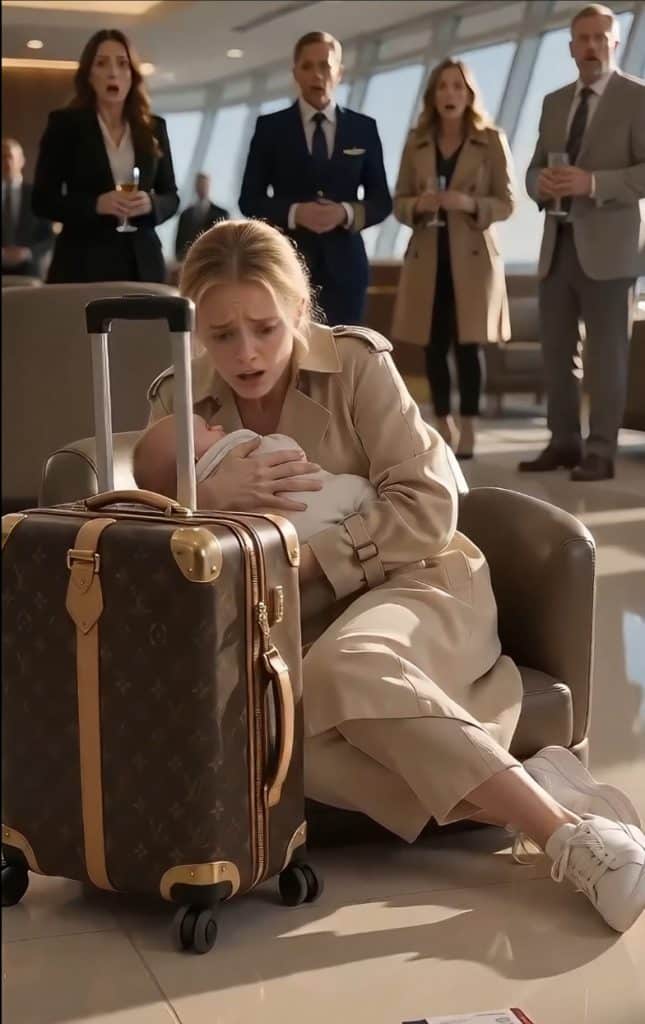
The boarding pass hit the lounge floor before the baby made a sound.
It slid beneath the edge of a luxury rolling suitcase, folded in half, the gold first-class lettering still visible against the polished tile. Mrs. Parker reached for it with one hand while keeping the baby pressed safely against her chest.
That was when the slap came.
Sharp.
Public.
Cruel.
Her head turned with the force of it, and she stumbled sideways into the suitcase. One knee touched the floor. Her palm scraped against the tile. A faint red mark appeared near her lip, but her first instinct was not to protect her own face.
It was to shield the baby.
The infant stirred against her beige travel coat, wrapped close and safe, while the first-class lounge fell into stunned silence.
Leather chairs. Champagne displays. A polished buffet counter. Floor-to-ceiling windows looking out over the runway. Wealthy travelers in designer coats stood frozen with tiny plates and crystal glasses in their hands.
The woman who had struck her stood above her in a cream designer suit, oversized sunglasses pushed into her sleek brunette bob, one manicured hand gripping the boarding pass she had snatched moments earlier.
“First class is not a shelter for desperate mothers,” she said.
The words landed harder than the slap.
Mrs. Parker stayed low, breathing carefully, one hand on the baby’s back.
The woman’s name was Victoria Lane, and she had spent the morning complaining about everything: the champagne temperature, the lounge lighting, the boarding delay, the sound of a child breathing too close to her seat.
When she saw Mrs. Parker standing near the priority boarding sign with a baby and tired eyes, she decided the young mother had slipped into the wrong room.
So she took the boarding pass from her hand.
Then, when Mrs. Parker bent to retrieve it, Victoria slapped her.
“Get out,” Victoria snapped. “Some of us paid to be here.”
Then the private boarding corridor opened.
A Black woman in a navy captain’s uniform stepped into the lounge with gold stripes on her sleeves and a face that went still the moment she saw Mrs. Parker on the floor.
Two flight attendants followed behind her.
The captain crossed the lounge without looking at Victoria.
She stopped beside Mrs. Parker and lowered her voice with controlled respect.
“Mrs. Parker,” she said, “the airline board is waiting for you before takeoff.”
The flight attendants bowed their heads.
The lounge gasped.
Victoria’s sunglasses slipped slightly down her nose.
“Mrs… Parker?” she whispered.
Act II
Grace Parker had learned to travel quietly.
That surprised people when they found out who she was.
Her husband’s family had built Parker Atlantic Airways from three leased aircraft and a stubborn belief that flying should feel human, not just efficient. The airline grew into an international carrier known for old-fashioned service, strong safety standards, and a board that still carried the founder’s name.
Then the company changed.
Not all at once.
That was how decline worked. A fee here. A cut there. A policy rewritten in language so clean it almost hid the cruelty underneath. Families seated apart unless they paid extra. Disabled passengers treated like logistical problems. Flight attendants disciplined for taking too long to comfort frightened travelers. Premium passengers allowed to behave badly because they spent more.
Grace heard about it first through letters.
Not official complaints.
Real letters.
A mother forced to nurse her baby in a restroom because a lounge guest said it “ruined the atmosphere.” A father traveling with twins asked to wait outside the first-class boarding area despite holding paid tickets. A gate agent who wrote that staff had been told to “protect the premium experience” even when premium passengers became abusive.
Grace brought the letters to the board.
Some directors listened.
Some nodded with the polite patience people use when they want compassion to finish speaking.
One executive said, “We have to consider our most valuable customers.”
Grace asked, “Which customers are least valuable when they are holding a crying child?”
The room went quiet.
After that, she decided to see the airline as passengers saw it.
No entourage.
No assistant.
No boardroom entrance.
Just a tired mother traveling with her baby.
That baby, Lily, was six months old and asleep against her chest when Grace entered the first-class lounge that afternoon. Grace had been up since four in the morning, carrying a diaper bag, a coat, a bottle, and a folder containing the board vote that could change the airline’s passenger conduct rules nationwide.
Her boarding pass was real.
Her first-class seat was real.
Her authority was real.
But she wanted to know what happened before anyone knew her last name mattered.
At first, the lounge staff were polite but nervous. A young attendant offered water and whispered that the private family room was “temporarily reserved for premium-tier guests.”
Grace looked at the mostly empty room behind the glass.
“Am I not a premium guest?”
The attendant flushed.
“I’m sorry, ma’am. That’s just what we were told.”
Grace did not blame her.
Policies often arrived wearing someone else’s fear.
Then Victoria Lane noticed the baby.
Act III
Victoria had built her identity around access.
First-class seats. Private clubs. Airport lounges. Hotel suites where staff remembered her sparkling water preference and apologized for things that did not require apology.
She called it standards.
Grace recognized it as hunger.
Not hunger for food or comfort, but for proof that she stood above someone.
Victoria had been loud from the moment she entered. She complained that the lounge was “turning into a daycare.” She told a gate agent that babies should be seated “behind curtains.” She asked if Parker Atlantic had “lost control of its brand.”
The gate agent smiled tightly and said nothing.
That silence taught Victoria she had permission.
Grace was standing near the gold boarding sign when Lily shifted and made a small sleepy sound against her chest. Not a cry. Barely a murmur.
Victoria turned as if personally attacked.
“Are you boarding first?” she asked.
Grace looked at her.
“Yes.”
Victoria’s eyes moved over the beige travel coat, the white sneakers, the tired face, the baby carrier.
“With that?”
Grace’s hand settled gently over Lily’s back.
“With my daughter.”
Victoria laughed once.
“Let me see your pass.”
“No.”
That was the first word that angered her.
Victoria was accustomed to staff obeying, strangers yielding, and mothers apologizing for taking up space. She reached forward and snatched the boarding pass from Grace’s hand.
Grace stepped after it.
“Give that back.”
Victoria glanced at the pass, then tossed it down near her suitcase.
“Pick it up outside.”
Grace bent carefully, protecting Lily’s head with one hand.
Then came the slap.
Now, with the captain standing over her and every person in the lounge watching, Victoria began to understand that she had not corrected a nuisance.
She had assaulted the woman the aircraft was waiting for.
The captain’s name was Dana Holloway.
She had flown for Parker Atlantic for eighteen years. She had known Grace’s late husband, Daniel Parker, before the boardrooms hardened him and before the illness took him. Daniel had believed pilots and flight attendants should be able to refuse abusive passengers without fearing executive punishment.
After he died, that belief became a plaque.
Then a slogan.
Then almost nothing.
Dana had been waiting in the boarding corridor for Grace because the board’s emergency vote was scheduled to happen by secure call before departure. The aircraft could not push back until Grace joined.
The captain looked at the boarding pass on the floor, then at the red mark near Grace’s lip.
Her voice lowered.
“Ma’am, are you hurt?”
Grace stood slowly.
Lily remained safe against her chest, still drowsy, unaware that the room had rearranged itself around her mother.
“I’m all right,” Grace said.
Captain Holloway did not look convinced.
Victoria tried to speak.
“I didn’t know who she was.”
Grace finally turned toward her.
“No,” she said softly. “You didn’t.”
Victoria exhaled with relief too soon.
Then Grace finished.
“But you knew she was a mother holding a baby.”
Act IV
The lounge did not recover from that sentence.
The champagne displays looked suddenly obscene. The gold boarding signs seemed brighter than they had a right to be. Passengers who had watched in silence shifted under the weight of their own inaction.
Victoria’s mouth tightened.
“She shouldn’t have been in the first-class lounge with an infant.”
Captain Holloway’s expression became ice.
“She had a first-class boarding pass.”
Victoria pointed toward the floor.
“It didn’t look like—”
“Like what?” Grace asked.
The question was quiet.
Victoria looked around.
No one saved her.
The lounge attendant who had been standing near the buffet finally stepped forward.
“She took the pass from Mrs. Parker,” the attendant said, voice shaking. “Then hit her.”
Another passenger added, “She insulted her before that.”
A man in a designer coat lowered his champagne glass.
“I saw it too.”
Victoria’s face flushed.
“Everyone is overreacting.”
Grace bent and picked up her boarding pass herself. Captain Holloway reached as if to help, but Grace shook her head.
Some things had to be retrieved by the person they were taken from.
Grace unfolded the pass.
Her name was visible now.
GRACE PARKER.
Below it was a notation most passengers would not recognize.
BOARD AUTHORITY CLEARANCE.
The lounge agent saw it and went pale.
Captain Holloway turned toward airport security entering from the corridor.
“Ms. Lane is not boarding this aircraft.”
Victoria jerked backward.
“You can’t remove me from a first-class flight.”
“I can,” the captain said. “And I am.”
“I paid twelve thousand dollars for that seat.”
Grace looked at her.
“Then you bought transportation. Not permission to harm another passenger.”
Victoria’s breathing became shallow.
“You’re going to ruin my trip because of one mistake?”
Grace’s eyes moved to Lily.
“No,” she said. “You ruined it when you decided a mother’s exhaustion made her beneath you.”
Security approached.
Victoria looked from the captain to the flight attendants to the passengers who now stared at her with the judgment they had withheld when it could have helped.
Her voice broke.
“Mrs… Parker?”
This time, Grace did not answer.
She turned to the lounge attendant.
“What is your name?”
The young woman swallowed.
“Emily.”
“Emily, has this happened before?”
The attendant’s eyes filled.
“Not exactly like this.”
Grace waited.
Emily looked at the floor.
“But close.”
That answer mattered more than Victoria’s panic.
Grace nodded once.
“Then the board can wait five more minutes while we discuss what this lounge has been trained to tolerate.”
Act V
The aircraft departed forty-three minutes late.
The official reason was passenger misconduct and operational review.
The real reason was that Grace Parker refused to let the airline move forward as if nothing had happened.
Victoria Lane was denied boarding and later banned from Parker Atlantic pending investigation. Her luggage went nowhere. Her first-class seat flew empty, a quiet little memorial to the lie that money always deserves accommodation.
But Grace did not spend the flight thinking about Victoria.
She thought about Emily, the lounge attendant whose hands shook when she finally spoke.
She thought about the passengers who gasped but did not move.
She thought about Lily, sleeping through the worst of it, and the kind of world she would inherit if powerful rooms kept teaching everyone that mothers were inconveniences until proven wealthy.
The board call happened at cruising altitude.
Grace sat in seat 1A with Lily asleep in the bassinet beside her. Captain Holloway joined from the cockpit during a scheduled cruise segment while the first officer handled communications. The rest of the board appeared on the secure screen, some from offices, some from cars, one from a hotel suite with a painting behind him worth more than a year of lounge staff wages.
Grace did not begin with numbers.
She lifted the boarding pass into view.
“This was taken from my hand today,” she said.
No one spoke.
“A passenger decided I did not belong in a lounge because I was traveling with an infant. Staff were too afraid to intervene until after I was hit. The captain acted correctly. The system before her did not.”
A director cleared his throat.
“We are deeply sorry that happened to you.”
Grace looked at him.
“I am not bringing this to you because it happened to me.”
The director went silent.
“I am bringing it because it has happened to people without my name.”
That became the vote that changed Parker Atlantic.
Not immediately in every heart.
But immediately in policy.
Captains received expanded authority to deny boarding for passenger harassment. Lounge staff were trained and empowered to intervene before abuse escalated. Family rooms could not be reserved exclusively for status-tier guests when parents needed them. Premium-service training was rewritten to make one principle unavoidable.
Comfort for one passenger cannot come from the humiliation of another.
The announcement went public three weeks later.
Some praised it.
Some mocked it.
A travel columnist called it “the baby policy.”
Grace hated that phrase.
It was not about babies.
It was about dignity.
Months later, she returned to the same airport lounge.
Again with Lily.
Again without an entourage.
This time, the first thing she saw was not champagne or leather chairs.
It was Emily.
The lounge attendant stood near the entrance with a new badge and a steadier voice.
“Welcome, Mrs. Parker,” she said.
Grace smiled softly.
“Hello, Emily.”
Then Emily turned to a young father struggling with a stroller, a backpack, and a crying toddler.
“Sir,” she said, “the family room is open. Would you like help getting settled?”
The father looked startled.
Then grateful.
Grace watched him exhale.
That was what change looked like most of the time.
Not a dramatic reveal.
A person allowed to breathe.
Captain Holloway appeared near the boarding corridor a few minutes later.
“You’re early,” she said.
“I’m a mother,” Grace replied. “Early is just late with more bags.”
The captain smiled.
Then her eyes flicked toward the spot near the luxury suitcase display where Grace had fallen months before.
“You ever think about that day?”
Grace looked down at Lily, who was now awake and tugging gently at the edge of her coat.
“Yes.”
“So do I.”
Grace adjusted the baby against her shoulder.
“I think about who moved after they knew who I was.”
Captain Holloway nodded.
“And who should have moved before.”
Across the lounge, a woman in a designer coat frowned when a child laughed near the buffet. Emily noticed immediately. She stepped closer, not confrontational, not afraid.
“Ma’am,” Emily said politely, “children are welcome in this lounge. I can help you find a quieter seat if you prefer.”
The woman blinked, surprised to meet a boundary wrapped in courtesy.
Then she looked away.
Grace felt something loosen in her chest.
The airline was not fixed.
No company was fixed by one policy or one scandal. There would be more complaints, more training failures, more moments when staff had to decide whether the rules on paper had enough courage behind them.
But something had begun.
Later, when boarding was called, Grace walked through the gold-signed corridor with Lily in her arms and the folded boarding pass in her pocket. She had kept it, though it had been replaced in the system.
The crease from the floor was still there.
So was a faint scuff near the corner.
Objects remember what institutions try to smooth over.
People would tell the story, of course.
The first-class passenger slapped a tired mother.
The captain arrived.
The mother was Mrs. Parker.
The board was waiting.
Mrs… Parker?
It was a satisfying story because arrogance panicked in public.
But Grace knew the better lesson was quieter.
The slap had been wrong before anyone knew her last name.
The insult had been ugly before the captain arrived.
The mother on the floor had deserved help before the boarding pass was unfolded.
She stepped onto the aircraft, kissed Lily’s forehead, and looked once down the aisle.
First class. Business. Economy. Families. Executives. Students. Elderly travelers. Flight attendants already moving with practiced care.
A plane was never just a machine.
It was a temporary world.
And in that world, no seat number, ticket price, or gold sign should decide who gets treated like a person.
Grace Parker sat down, held her daughter close, and watched the runway lights stretch ahead.
This time, when the cabin door closed, it did not feel like exclusion.
It felt like a promise.