Act I
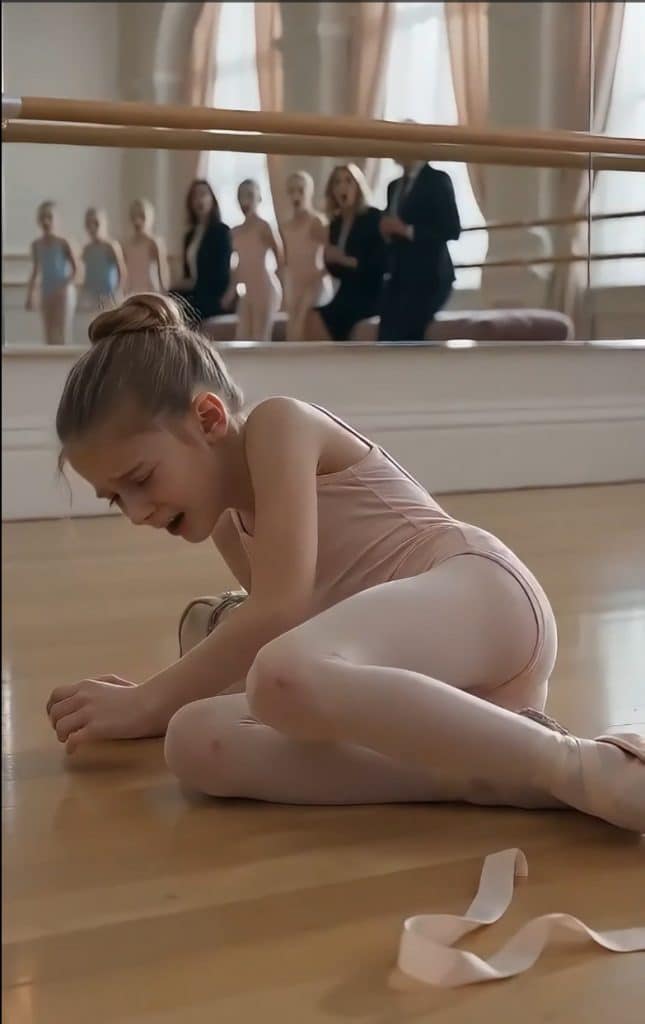
The ribbon came loose before Lily hit the floor.
It slipped from her worn ballet shoe in one pale curl, dragging across the polished wood as her small body stumbled sideways from the slap. A second later, her knee struck the studio floor, and the entire room gasped.
No music played.
No one moved.
The mirrored walls caught everything: the shocked faces of young dancers at the barre, the wealthy parents frozen on velvet benches, the tall arched windows with pink curtains glowing softly in the afternoon light.
And in the center of it all, Lily Hart knelt with one trembling hand against the floor.
She was ten years old.
Her ballet bun had come loose on one side. Her pale pink leotard was clean but old, faded from washing. Her shoes were carefully sewn but worn thin at the toes. The loose ribbon lay beside her like a small, quiet witness.
Above her stood Vanessa Ellison.
Sleek blonde hair. Designer black dress. Pearl earrings. A polished smile that had vanished the moment Lily stepped beside her daughter at the front of the studio.
Vanessa looked down at the child as if she had removed something unpleasant from the room.
“Poor girls don’t dance beside future stars,” she said.
The words cut deeper than the slap.
Lily lowered her eyes.
Around her, the other students stood frozen in matching leotards. Some looked frightened. Some looked ashamed. One girl near the mirror covered her mouth with both hands.
The parents did nothing.
They had all heard Vanessa complain before. About casting. About auditions. About which children belonged in elite spaces and which children were “being indulged.” But this was different.
This was not a whisper at the coffee table.
This was a grown woman striking a little girl in front of an entire academy studio.
Vanessa lifted her chin.
“Get up and go back to wherever they found you.”
Lily’s fingers curled around the loose ribbon.
Then the studio door opened.
A graceful older woman in a charcoal wrap dress stepped inside, silver glasses catching the light. Behind her came a small film crew, cameras lowered as they sensed the room’s strange silence.
Academy Director Eleanor West stopped cold.
Her eyes moved to Lily on the floor.
Then to Vanessa.
Then to the ribbon lying undone against the wood.
The director crossed the room without rushing.
She knelt beside Lily first.
“Lily,” she said softly, “are you hurt?”
Vanessa’s expression flickered.
The director opened the folder in her hand.
A gold seal shone on the front.
Then Eleanor West stood, turned to the room, and said, “She is the scholarship prodigy selected by the Royal Ballet Foundation.”
Vanessa’s face went pale.
“Prodigy?”
Act II
Lily Hart had learned to dance in a community center basement where the mirrors did not match.
One panel was cracked at the corner. Another leaned slightly forward, making every movement look uncertain. The floor was not sprung like the floors at elite academies. The barre was wooden, old, and polished smooth by hundreds of small hands trying to become graceful in a room that smelled faintly of dust and floor cleaner.
Lily loved it anyway.
She loved the quiet before music began. She loved the strange discipline of repeating something until her body finally understood what her mind had begged it to do. She loved the way ballet made sadness move instead of sit heavy in her chest.
Her mother worked nights at a hospital cafeteria.
Her grandmother hemmed costumes for local dance recitals.
Her teacher, Miss June, had once danced professionally before an injury ended her stage career. She never spoke bitterly about it. She taught children as if every one of them carried a private door inside them, and dance was one way to open it.
The first time Miss June saw Lily improvise after class, she forgot to turn off the music.
Lily was eight.
Tiny. Serious. Barefoot because her shoes had split during rehearsal.
She moved with a kind of listening that made Miss June’s throat tighten. Not perfect. Not polished. But honest in a way that could not be taught.
Afterward, Miss June called Lily’s mother.
“Your daughter needs training,” she said.
Her mother laughed tiredly.
“She has training. She has you.”
“No,” Miss June said. “She needs rooms I can’t afford to put her in.”
That was how the audition tape began.
A borrowed camera. A simple black leotard. Hair pinned unevenly. A church hall with winter light coming through high windows.
Lily danced a short variation, then a piece Miss June choreographed for her called First Snow. It was not flashy. It did not demand applause. It simply made the room feel quieter.
The Royal Ballet Foundation responded three months later.
Full scholarship.
Elite academy placement.
Travel stipend.
Private mentorship.
Miss June cried when she opened the email. Lily’s mother sat down hard at the kitchen table and covered her face. Lily read the words again and again, not because she did not understand them, but because she was afraid they might disappear if she blinked.
The placement was at Ashford Conservatory, one of the most exclusive private ballet academies in the country.
Ashford had polished floors, mirrored walls, wealthy donors, and children whose parents discussed summer intensives the way other families discussed groceries. The tuition alone could have paid Lily’s rent for a year.
Lily did not want to go at first.
“What if they laugh at my shoes?” she asked.
Her grandmother took the worn pair from her hands and turned them over gently.
“Then they are looking at the wrong part of you.”
On her first day, Lily wore the best leotard she owned and tied her ribbons twice.
She carried a small canvas dance bag with a water bottle, a hairbrush, and a folded note from Miss June.
Dance like you are telling the truth.
No one had told the other parents about the scholarship reveal.
That was intentional.
Director Eleanor West had asked the foundation to film Lily’s first day quietly. Not as a spectacle, but as part of a documentary about access in classical training. She wanted the academy to understand that talent did not always arrive in expensive warm-up sets and new satin shoes.
Vanessa Ellison understood something else.
Threat.
Her daughter, Ava, had been considered the academy’s brightest young student for years. Ava was talented, disciplined, and kind when her mother was not watching. But Vanessa treated her child’s talent like a family investment.
Every class mattered.
Every placement mattered.
Every compliment given to another child felt, to Vanessa, like theft.
When she saw Lily placed near the front barre, she stiffened.
When she saw the director’s assistant checking Lily’s name against a gold-sealed folder, she grew suspicious.
When the instructor asked Lily to demonstrate a turn combination and the room went silent afterward, Vanessa’s smile disappeared completely.
The applause was small.
Respectful.
Enough to ruin everything.
Act III
The trouble began with a ribbon.
Lily’s shoe ribbon had loosened during the combination. She tried to step back and fix it quietly, but Ava Ellison, standing beside her, whispered, “You did really good.”
Lily smiled shyly.
“Thanks.”
Vanessa saw the exchange from the velvet bench.
To anyone else, it was nothing.
To Vanessa, it was the beginning of replacement.
She stood before the instructor could call the next exercise.
“Excuse me,” she said. “Is this child placed in the advanced group?”
The instructor hesitated.
“Mrs. Ellison, Director West will explain placements after observation.”
“I’m asking now.”
Lily looked down.
The room tightened.
Vanessa walked onto the studio floor in her designer heels, a violation of every rule parents had been given. No street shoes on the dance floor. No interruptions. No approaching students during class.
Rules, apparently, were for people with less influence.
She stopped in front of Lily.
“What is your name?”
“Lily,” the girl said softly.
“Lily what?”
“Lily Hart.”
Vanessa’s eyes moved over the old leotard, the worn shoes, the slightly messy bun.
“And who paid for your place here?”
The instructor stepped forward.
“Mrs. Ellison—”
Vanessa raised one hand.
“I’m simply asking.”
Lily swallowed.
“I have a scholarship.”
The word scholarship changed Vanessa’s face.
Not surprise.
Disgust.
She leaned down slightly.
“Scholarships are for children who need help. They are not permission to stand in front of children who earned their place.”
A murmur moved through the parents.
Ava’s face turned red.
“Mom,” she whispered.
Vanessa ignored her.
Lily took one small step back, but her loose ribbon caught beneath her foot.
She stumbled.
Vanessa’s hand flashed out.
The slap sent Lily down.
The studio gasped.
For a heartbeat, the mirrors seemed to hold the moment in endless copies: Vanessa standing tall, Lily low on the floor, the ribbon undone, the parents stunned into useless silence.
Then Vanessa delivered the sentence that would follow her long after the afternoon ended.
“Poor girls don’t dance beside future stars.”
Lily did not answer.
She picked up the loose ribbon with shaking fingers.
She wanted her mother.
She wanted Miss June.
She wanted the cracked mirror in the community center basement, where no one had ever made her feel ashamed for loving something beautiful.
Then the studio door opened.
Director West entered with the film crew.
The camera operator lowered his lens immediately, uncertain whether to keep filming. Eleanor West did not look uncertain at all.
She reached Lily, helped her sit upright, and examined her face with controlled concern.
“Breathe, sweetheart,” she said.
Vanessa tried to recover.
“Director West, I am relieved you’re here. This child was disrupting class.”
Eleanor slowly looked up.
Something in her expression made Vanessa stop talking.
The director stood and opened the folder.
The gold seal caught the studio lights.
“This child,” Eleanor said, “is Lily Hart.”
She faced the room.
“The Royal Ballet Foundation reviewed hundreds of applicants across the country. Lily was selected as this year’s scholarship prodigy.”
A collective gasp moved through the studio.
Eleanor’s voice sharpened.
“She was invited here because of her talent, her discipline, and her extraordinary promise.”
Vanessa’s mouth opened.
No words came.
Behind her, Ava looked at Lily with wide, tearful eyes.
For once, even the mirrors seemed silent.
Act IV
Vanessa tried to smile.
It was too late.
“Director,” she said carefully, “I had no idea.”
Eleanor West closed the folder.
“No idea of what?”
Vanessa blinked.
“That she was… selected.”
The director’s face did not soften.
“You did not need a gold seal to know she was a child.”
The words landed with quiet force.
Several parents looked down.
Vanessa’s hand tightened around her designer handbag.
“I was protecting the standards of this academy.”
Eleanor looked at Lily’s loosened ribbon on the floor.
“By striking a ten-year-old?”
Vanessa paled.
“I did not mean to hurt her.”
Lily looked up then.
Her cheek still stung. Her knee hurt. But the ache in her chest had begun changing into something steadier.
“You meant to make me leave,” she said.
The studio held its breath.
Vanessa stared at her.
The child’s voice was soft, but it carried.
“You said poor girls don’t dance beside future stars.”
Ava began crying.
“Mom, stop,” she whispered.
That broke through Vanessa for half a second. Not enough to make her remorseful, but enough to make her aware that the room included her daughter too.
Eleanor turned toward the instructor.
“Please take the students to Studio Two.”
Lily’s eyes widened.
The director looked back at her.
“Not you, Lily. Stay with me.”
The other children moved quietly toward the door. Ava paused beside Lily.
“I’m sorry,” she whispered.
Lily nodded once.
It was not forgiveness yet.
But it was kindness.
After the students left, the room felt colder. Only the parents, staff, director, and film crew remained.
Eleanor faced Vanessa.
“You will leave the academy premises immediately.”
Vanessa stiffened.
“My daughter trains here.”
“Your daughter is welcome to continue training under academy supervision. You are not welcome to remain on campus pending investigation.”
The parents murmured.
Vanessa’s face flushed.
“You can’t ban me.”
“I can,” Eleanor said. “And I am.”
Vanessa looked around, searching for allies among the parents who had once smiled at her at galas and nodded when she complained about casting.
No one stepped forward.
That silence wounded her pride more than any argument could have.
She turned back to Eleanor.
“My family has donated to this academy for years.”
“And today,” Eleanor said, “you demonstrated why donations cannot be allowed to purchase permission.”
Vanessa’s lips trembled.
“The foundation will hear about this.”
“They already will.”
The director glanced toward the film crew.
The camera was not pointed at Vanessa now, but it had been recording when they entered. More importantly, the studio had witnesses. Many of them. Parents. Instructors. Assistants. Children who would remember how adults behaved when cruelty entered the room.
Vanessa looked toward Lily.
For the first time, panic replaced contempt.
“I’m sorry,” she said quickly. “Lily, I am. Truly. I misunderstood.”
Lily looked at her worn shoes.
Then at the ribbon still hanging loose.
“You understood my clothes,” she said. “You misunderstood my worth.”
Eleanor’s eyes softened with pride.
Vanessa had no answer.
Security arrived quietly. There was no dragging, no shouting, no spectacle. Just two staff members at the door and a director who had already made her decision.
Vanessa walked out with her head high, but her hands shook.
At the doorway, she turned once.
The studio she had treated like her private court no longer belonged to her.
It belonged to the child standing barefoot beside a loose ribbon and a gold-sealed folder.
Act V
Lily did not dance again that day.
Director West did not ask her to.
Instead, she took Lily to her office, gave her warm tea with too much honey, and called her mother.
When Lily’s mother arrived, still in her cafeteria uniform, she rushed across the office and wrapped her daughter in a hug so careful it made Lily cry harder than the slap had.
“I’m sorry,” Lily whispered.
Her mother pulled back.
“For what?”
“For causing trouble.”
Her mother’s face changed.
“Lily Hart, listen to me. You did not cause trouble. Trouble saw you standing where you belonged and showed its face.”
Director West looked out the window while they held each other.
She had taught ballet for forty years. She had seen ambition sharpen children and parents until love turned into pressure. She had seen talent overlooked because it arrived without money. She had seen wealthy rooms congratulate themselves on excellence while quietly confusing privilege with promise.
But that day forced Ashford Conservatory to look at itself.
Not only at Vanessa.
At the silence around her.
Within a week, the academy suspended Vanessa Ellison from all parent events and removed her from the donor advisory circle. A formal child safety review began. Parents were barred from entering studio floors during class. Scholarship students were assigned mentors. Staff were trained to intervene immediately in public humiliation, no matter who caused it.
Some donors complained.
Eleanor let them.
“Ballet teaches discipline,” she told the board. “It should not teach children to endure cruelty politely.”
The Royal Ballet Foundation stood by Lily publicly but carefully. No one turned her pain into a promotional video. The footage from that day was sealed for the investigation. The documentary changed direction, becoming less about one prodigy and more about what talent must survive before anyone applauds it.
Lily returned to the academy two weeks later.
She wore the same leotard.
The same worn shoes.
But her ribbons were newly stitched by her grandmother, strong and neat, wrapped around her ankles with quiet care.
When she entered the studio, the room went still.
Not with judgment this time.
With attention.
Ava Ellison was at the barre.
Her mother was not.
Ava looked nervous as Lily approached.
“I’m glad you came back,” she said.
Lily studied her for a moment.
Then she placed her dance bag down.
“Me too.”
The instructor called them to first position.
Music began.
For a few seconds, Lily’s body remembered the floor. The shock. The heat in her cheek. The sound of Vanessa’s voice telling her poor girls did not dance beside future stars.
Then she remembered Miss June’s note.
Dance like you are telling the truth.
So she did.
At first, her movements were careful.
Then stronger.
Then free.
The mirrors reflected a girl in old shoes, standing in a room that had tried to measure her by fabric and found itself corrected by talent.
Director West watched from the doorway.
Lily did not dance perfectly.
That was not the point.
She danced honestly.
Months later, at the foundation showcase, Lily stepped onto a professional stage for the first time. Her mother sat in the front row beside her grandmother. Miss June sat between them, crying before the music even started.
Lily wore a simple pale costume, not flashy, not expensive-looking, but beautifully fitted. Her repaired ribbons were hidden now beneath stage light, but she knew they were there.
The music began.
She moved.
And the audience changed.
Not in a loud way.
In the way a room changes when people realize they are seeing the beginning of something rare.
Afterward, reporters asked Director West what made Lily special.
The director answered without hesitation.
“She never mistook cruelty for truth.”
Years later, people would talk about Lily Hart’s first big performance as if talent had simply appeared under the lights.
But Lily remembered the studio floor.
The loose ribbon.
The parents who looked away.
The director who opened the gold-sealed folder.
And the moment she understood that belonging was not something rich people handed down.
It was something no one had the right to take from her.
Because poor girls did dance beside future stars.
Sometimes, they became them.