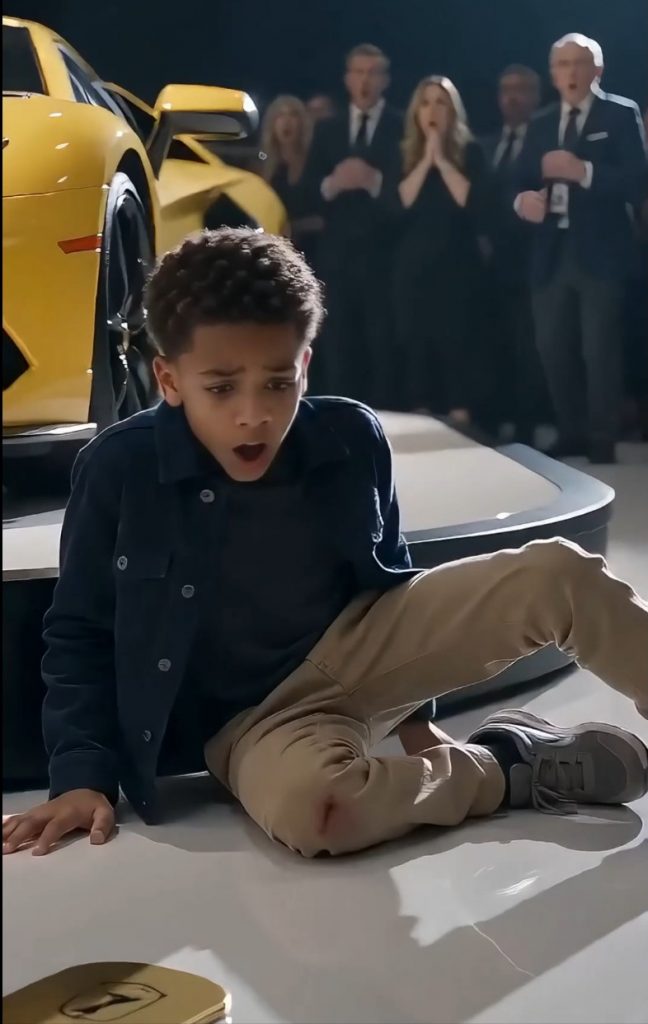
Act I
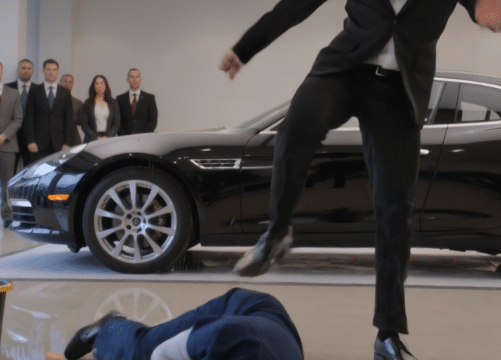
The gold paddle hit the showroom floor first.
It clattered across the glossy white tile, spinning once beneath the sharp spotlight before stopping near the wheel of a black Lamborghini displayed on a raised platform. For a second, everyone stared at it instead of the boy.
Then they saw him on the floor.
Twelve-year-old Ethan Bennett had landed hard on one knee, one hand braced against the polished surface, his navy jacket pulled crooked at the shoulder. His sleeve had torn slightly at the elbow. His face was still turned from the force of the slap.
The showroom went silent.
Around him, rare Ferraris and Lamborghinis gleamed under dramatic lights. A Rolls-Royce sat on a rotating display beneath a chandelier of chrome and crystal. Wealthy collectors in tailored suits held gold auction paddles like passports into another world.
The man who had struck Ethan stood over him in a burgundy blazer, gray slicked-back hair immaculate, luxury watch flashing at his wrist.
Arthur Kingsley smiled.
Not fully.
Just enough to show he was not sorry.
A few people gasped. Someone whispered, “He’s just a kid.”
Arthur ignored them.
He leaned down, eyes narrowing at Ethan’s plain sneakers and khaki pants.
“A kid like you couldn’t even afford the tires,” he said.
The insult echoed through the showroom.
Ethan’s fingers curled against the floor, but he did not cry out. He looked toward the gold paddle lying just out of reach, the private bidder number printed in black across its face.
Arthur followed his gaze and scoffed.
“You picked that up from the wrong table, didn’t you?”
Ethan said nothing.
That silence bothered Arthur more than fear would have.
He had spent decades in rooms like this, where money moved quietly and people stepped aside when he lifted his chin. He knew how shame worked. He knew how to make someone feel too small to defend themselves.
But this boy only looked at him.
Hurt, yes.
Humiliated, yes.
But not broken.
Then the giant bidding screen above the stage flickered.
The auction manager hurried down from the podium, black tuxedo sharp, tablet in hand, headset wire catching the light. His face had gone pale, and his eyes were fixed not on Arthur, but on the boy still kneeling beside the Lamborghini platform.
Arthur turned with irritation.
“What is it now?”
The manager did not answer him.
He bent beside Ethan with careful respect.
“Young Mr. Bennett,” he said clearly, “your grandfather asked us to prepare your winning bid.”
Behind them, the screen changed.
BENNETT FAMILY TRUST.
Arthur’s face went still.
Then he whispered one word.
“Bennett?”
Act II
Ethan Bennett had been raised around cars, but not around arrogance.
His grandfather made sure of that.
Walter Bennett was one of the most private collectors in America, though he hated being called a collector. Collectors, he used to say, sometimes loved ownership more than the thing itself. Walter loved stories.
He knew which Ferrari had been restored after a fire. Which Lamborghini had once belonged to a racing driver who refused to sell until hospital bills forced his hand. Which old Rolls-Royce had carried a civil rights attorney through the South when hotels would not let him sleep inside.
To Walter, cars were not trophies.
They were memory in metal.
Ethan learned this in a garage that smelled of leather, dust, and engine oil. His grandfather would lift the hood of a vintage car and explain not only the horsepower, but the hands that built it, the roads it traveled, and the mistakes made by men who thought beauty could excuse cruelty.
“Never judge a person by what they drive,” Walter told him once. “And never judge a person by what they arrive without.”
Ethan was nine when his mother died.
After that, the garage became the place he and his grandfather learned how to speak through grief. Walter did not push him to talk. He simply handed him a soft cloth and let him polish chrome in silence.
Some nights, Ethan cried beside a red Ferrari without knowing why.
Walter never told him to stop.
By twelve, Ethan could identify rare models faster than most adults in the auction room. He knew production numbers, restoration histories, engine notes, and provenance details. But Walter made him dress simply when they visited sales.
“No one learns humility by being announced,” his grandfather said.
That was why Ethan wore a plain navy jacket to the Kingsley & Rowe Supercar Auction.
Not a suit.
Not a custom blazer.
Not the Bennett family crest.
Just a jacket, khakis, sneakers, and a small gold paddle registered to the Bennett Family Trust.
Walter had been too ill to attend in person. His doctor had forbidden travel, though forbidding Walter anything usually ended badly. This time, Ethan convinced him to stay home by promising to bid carefully and call after every lot.
The car they wanted was not the most expensive one in the room.
It was a silver Ferrari once owned by Ethan’s mother.
Before she was a mother, before illness, before hospital rooms and quiet endings, she had loved driving along the coast at sunrise. Walter had sold the car years earlier to pay off a business emergency, then regretted it for the rest of his life.
Now it had returned to auction.
Ethan had come to bring it home.
Arthur Kingsley wanted the same car.
But not for love.
For victory.
Arthur had built his reputation by acquiring things other men wanted. Cars, watches, houses, memberships, rare bottles of wine he never drank. He did not talk about engines. He talked about scarcity. He did not ask who restored a vehicle. He asked who else had tried to buy it.
He liked winning more than owning.
When he saw Ethan standing near the Lamborghini platform, holding a gold paddle too calmly, he assumed the boy was someone’s child wandering too close to the real money.
At first, he only frowned.
Then Ethan lifted the paddle during the preview bidding rehearsal.
Arthur’s irritation became insult.
“You lost?” he asked.
Ethan looked up.
“No, sir.”
“Then where are your parents?”
Ethan’s face tightened, but he answered politely.
“I’m registered.”
Arthur laughed.
That drew a few looks from nearby collectors.
The auction assistant behind the registration desk glanced down at her tablet, then back at Ethan. She knew something Arthur did not, but she seemed too intimidated by him to interrupt.
Arthur stepped closer.
“Registered for what? A toy car?”
Ethan held the paddle more firmly.
“For Lot Twelve.”
Arthur’s smile faded.
Lot Twelve was the silver Ferrari.
His Ferrari, in his mind.
The one he had already told half the room he intended to take home.
Arthur looked at the paddle.
Then at Ethan’s clothes.
Then at his young face.
And in that tiny, poisonous calculation, he decided the boy had no right to stand between him and what he wanted.
Act III
The slap was not about the paddle.
Everyone knew that, even if they did not have the courage to say it.
It was about a man who could not tolerate being challenged by someone he had already dismissed.
Arthur struck Ethan in front of Ferraris, Lamborghinis, Rolls-Royces, cameras, assistants, collectors, and security staff who froze because wealth can make even obvious wrongness feel dangerous to confront.
Ethan stayed low for a moment after the impact.
His knee stung. His elbow burned where the fabric had torn. His cheek felt hot, but he kept his breathing steady the way his grandfather had taught him.
Do not hand cruel people the performance they want.
The gold paddle lay a few feet away.
Arthur pointed at it.
“Someone take that from him before he embarrasses the auction.”
The auction assistant near the platform looked sick.
But before anyone moved, the bidding screen flashed behind the stage.
At first, it showed the lot number.
Then the registration confirmation.
Then the name.
BENNETT FAMILY TRUST.
The auction manager, Paul Adler, nearly dropped his tablet.
He had been dealing with a private call from Walter Bennett’s office when the commotion started. At first, he thought someone had bumped into a display rope. Then he heard the gasp. Then the slap. Then Arthur’s insult, loud enough to humiliate a child across a showroom full of adults.
Paul rushed down from the podium.
He had worked auctions for twenty years. He had seen tantrums, threats, fraud attempts, fake bidders, bitter divorces, and men who treated cars like extensions of their egos.
But he had never seen someone slap a registered minor bidder in the middle of the floor.
Especially not that bidder.
“Young Mr. Bennett,” Paul said, lowering beside Ethan, “are you hurt?”
Arthur made a sharp sound.
“Young Mr. Bennett?”
Paul picked up the gold paddle and handed it back to Ethan with both hands.
The gesture changed everything.
A boy who had been treated like a trespasser was suddenly being addressed like the most important person in the room.
Paul turned so the crowd could hear.
“Mr. Ethan Bennett is here on behalf of the Bennett Family Trust. His grandfather authorized today’s bidding personally.”
The whispers came instantly.
“Walter Bennett?”
“The Bennett collection?”
“That trust bought the Le Mans car last year.”
Arthur’s face tightened.
Ethan stood slowly.
He did not hide his torn sleeve. He did not wipe his cheek. He simply held the gold paddle against his side and faced the room with a dignity that made several adults look ashamed.
Arthur tried to laugh.
“Come on,” he said. “This is ridiculous. I had no idea who he was.”
Ethan looked at him.
The room waited.
“That’s why you did it,” Ethan said softly.
Arthur blinked.
The boy’s voice was quiet, but it reached everyone.
“You thought I was nobody.”
The words landed harder than anger.
Paul’s expression became cold.
“Security,” he said.
Arthur’s eyes widened.
“Security? For what?”
Paul looked at the boy, then at the paddle, then at the crowd.
“For assaulting a registered bidder.”
Arthur’s confident smile finally disappeared.
Act IV
Arthur Kingsley did what powerful men often do when the room turns against them.
He tried to rename what happened.
“This is being blown out of proportion,” he said, lifting both hands. “It was a misunderstanding.”
Ethan’s cheek still burned.
The gold paddle was warm in his hand.
Paul stared at Arthur.
“You struck a child.”
Arthur’s jaw clenched.
“I was trying to stop unauthorized bidding.”
“The bidder was authorized.”
“I didn’t know that.”
Paul’s voice sharpened.
“You did not need to know his trust registration to know he should not be hit.”
The showroom went silent again.
A woman in a cream suit near the Rolls-Royce display lowered her eyes. A younger collector shifted uncomfortably. Two assistants whispered near the Ferrari platform, then stopped when Arthur looked their way.
Ethan noticed all of it.
He noticed how quickly people became brave once someone else spoke first.
Arthur stepped toward Paul.
“Do you know how much business I bring to this house?”
Paul did not move.
“I know exactly how much.”
“Then you know this auction cannot afford to insult me.”
Paul glanced at the screen behind him.
“No, Mr. Kingsley. I believe you just confused yourself with the cars.”
A few people inhaled sharply.
Arthur’s face reddened.
The giant screen updated again.
Lot Twelve: Silver 1998 Ferrari Maranello.
Current Winning Bid: Bennett Family Trust.
Arthur stared at it as if the machine had betrayed him.
“This lot is still open,” he said.
Paul checked his tablet.
“Not anymore.”
“What?”
“The Bennett Family Trust submitted a sealed reserve bid before the event.”
Arthur looked at Ethan.
Ethan’s grip tightened on the paddle.
Paul continued.
“Your bidding ceiling was exceeded before you arrived.”
The room shifted.
Arthur had not only slapped a boy.
He had slapped the boy who had already won.
His humiliation had been pointless in the cruelest possible way.
Arthur turned toward Ethan, panic now visible beneath his anger.
“Listen, kid.”
Paul stepped between them.
“You will address him as Mr. Bennett.”
Arthur froze.
Ethan looked down at the paddle.
For weeks, he had imagined winning the Ferrari and calling his grandfather with joy in his voice. He had imagined saying, We got Mom’s car back. He had imagined Walter crying quietly and pretending not to.
He had not imagined this.
A room full of strangers staring at him.
A grown man trembling because he had discovered the boy he struck had a powerful name attached.
Ethan lifted his eyes.
“My grandfather said this room would show me what people love more,” he said.
Arthur frowned.
“What?”
“Cars or themselves.”
No one spoke.
Ethan looked toward the silver Ferrari under its spotlight.
“My mom loved that car,” he said. “Not because it made people look at her. Because she said it sounded like freedom.”
The crowd softened.
Even Paul’s face changed.
Ethan turned back to Arthur.
“You wanted it because someone else wanted it.”
Arthur swallowed.
“That is not true.”
“You hit me because you thought I couldn’t fight back.”
Arthur’s mouth opened, but there was no sentence left that could save him.
Security arrived from the side corridor.
Two men in dark suits stopped beside Arthur, professional and calm.
That calm terrified him.
“You can’t remove me,” Arthur said to Paul. “I’m a preferred bidder.”
Paul looked at the torn sleeve of Ethan’s jacket.
“Not anymore.”
Arthur’s shoulders sank.
The room watched as his status evaporated in real time.
Not with shouting.
Not with chaos.
With procedure.
His paddle was collected. His account was suspended pending review. His access to the private sale floor was revoked. His staff badge for the collector preview was removed from the system before he reached the exit.
As security escorted him past the Lamborghini platform, Arthur looked once at Ethan.
For the first time, he seemed to see him.
Not as a child in plain clothes.
Not as an obstacle.
As the person who would remember.
“Bennett?” he whispered again, barely audible.
Ethan did not answer.
He only held the gold paddle steady.
Act V
Arthur Kingsley left the showroom without a car.
That was what the collectors talked about first.
By midnight, they talked about something else.
The boy.
The gold paddle.
The Bennett Family Trust.
The silver Ferrari his mother once drove.
The slap that turned an auction into a judgment.
Walter Bennett called before Ethan left the building.
Paul Adler offered him a private office for the call, but Ethan refused. He stood beside the Ferrari under the spotlight, paddle in one hand, phone in the other.
His grandfather’s voice was rough.
“Ethan.”
“I’m okay,” Ethan said.
There was a pause.
“You always say that when you are not.”
Ethan looked at his reflection in the Ferrari’s silver paint. His cheek was still marked faintly. His sleeve was torn.
“He hit me, Grandpa.”
“I know.”
The old man’s voice broke on the second word.
Ethan closed his eyes.
“I didn’t cry.”
“You could have.”
“I know.”
“No,” Walter said softly. “I need you to hear me. You could have.”
Ethan’s throat tightened.
For the first time all night, he felt like a child again.
Not Young Mr. Bennett.
Not the winning bidder.
Just Ethan, standing in a showroom full of expensive things, wishing his mother were there.
Walter continued.
“Your dignity was not proven by silence. It was already yours before he touched you.”
Ethan pressed the phone closer to his ear.
“Did we win her car?”
A breath moved through the line.
“Yes,” Walter said. “We won her car.”
Ethan looked at the Ferrari.
Then he smiled, small and tired.
The investigation moved quickly.
Auction footage confirmed everything. Witnesses gave statements. Arthur Kingsley’s bidder privileges were permanently revoked. Other auction houses quietly removed him from private invitation lists after the video reached their legal teams.
But Walter Bennett cared less about Arthur than about the room that had allowed the first seconds to happen.
He sent a letter to Kingsley & Rowe the next morning.
Not angry.
Worse.
Disappointed.
Within a month, the auction house changed its rules for minor trust representatives, bidder verification, floor security, and harassment response. No collector, no matter how valuable, could remain in a showroom after threatening or touching another guest. Staff were trained to intervene before wealth finished deciding who deserved protection.
Paul Adler resigned from the private client division and accepted a new role overseeing ethics compliance.
He told Ethan later, “I should have reached you sooner.”
Ethan answered honestly.
“Yes.”
Paul nodded.
He respected him more for not making forgiveness easy.
The silver Ferrari arrived at the Bennett estate three weeks later in an enclosed transporter.
Walter insisted on being outside when it came.
He stood with a cane near the driveway, thinner than Ethan remembered but smiling like the years had briefly stepped back. When the transporter opened and the car rolled into the light, Walter covered his mouth with one hand.
Ethan stood beside him.
“She would have laughed at us,” Walter said.
“Because we bought it back?”
“Because we probably overpaid.”
Ethan smiled.
“Did we?”
Walter glanced at him.
“Enormously.”
For the first time since the auction, Ethan laughed.
They placed the Ferrari not in the main collection hall, but in a smaller garage near the garden. Walter said some cars were not meant to impress guests. Some were meant to be visited like memories.
A small plaque was mounted beside it.
Not with the price.
Not with the production number.
With a line Ethan chose himself.
Some things are valuable because love remembers them.
One year later, Ethan returned to another auction.
He wore the same navy jacket, repaired at the elbow with a neat patch his grandmother sewed by hand. He carried the same gold paddle. This time, when he entered the showroom, people recognized him.
Some smiled too quickly.
Some stepped aside too carefully.
Ethan noticed.
But near the back, he saw a little girl standing beside a classic Porsche display, wearing scuffed shoes and holding a bidder badge almost bigger than her hand. A man in an expensive suit looked annoyed that she was in his way.
Ethan walked over before the man could speak.
“Great car, right?” Ethan said to the girl.
She looked surprised.
“You know this one?”
“A little.”
The man in the suit looked at Ethan’s paddle, then at his face, and quietly stepped back.
Ethan saw the movement.
He did not enjoy it.
Not exactly.
But he understood the power of being present.
The little girl pointed toward the car’s hood.
“My dad says the engine is special.”
“He’s right,” Ethan said. “Want to know why?”
She nodded.
So Ethan told her.
Not about the price.
Not about the collectors.
Not about status or who belonged under the lights.
He told her about design, sound, risk, beauty, and the strange magic of machines people loved enough to preserve.
Across the room, Walter watched from a chair, eyes bright.
The auction began a few minutes later.
Paddles rose.
Numbers climbed.
Collectors leaned forward with hunger in their eyes.
But Ethan was not intimidated anymore.
He had learned that the most expensive rooms were often the easiest to misunderstand. People saw polished floors and thought they were standing above others. They saw rare cars and forgot that every masterpiece had once passed through working hands.
Arthur Kingsley had thought a boy in sneakers could not belong in a room full of million-dollar machines.
He was wrong.
Ethan belonged because his love for the cars was real.
Because his mother’s memory belonged there.
Because his grandfather’s trust was not just money, but history.
And because no room, no matter how glossy, no matter how guarded, no matter how expensive, had the right to decide a child was nothing until a screen flashed his name.