Act I
The slap sounded like thunder in a room built for whispers.
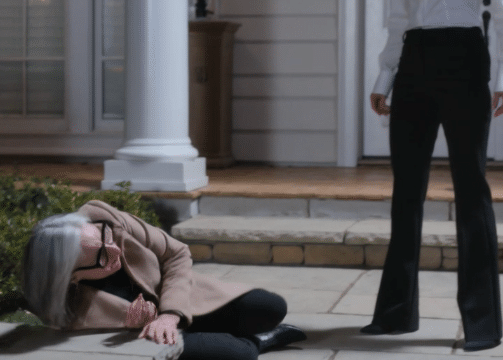
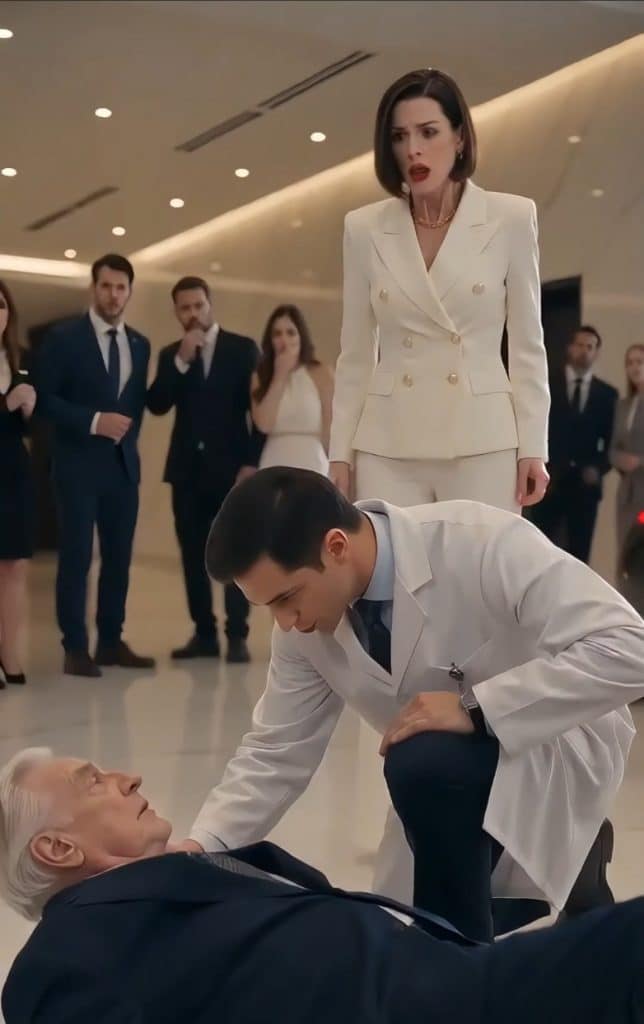
Professor Adrian Whitmore staggered backward, one hand reaching for the wooden cane that was no longer steady beneath him. The cane flew from his grip, struck the marble, and skidded toward the leather seating near the wall.
Then he fell.
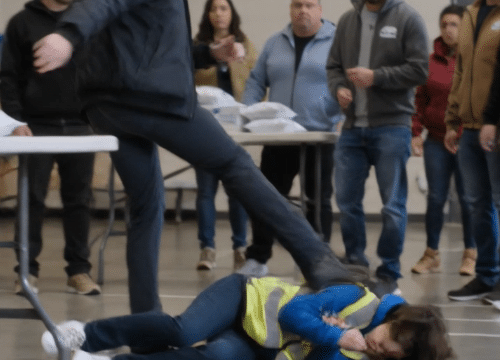
His dark navy suit folded beneath him as he hit the polished floor. The bystanders gasped, hands rising to mouths, champagne flutes trembling, polished shoes frozen in place beneath the warm recessed lights.
The woman who had struck him did not step back.
She stood above him in a white blazer and matching trousers, red lipstick sharp as a wound, gold necklace catching the light at her throat. Her dark bob framed a face twisted with disgust.
“Step aside,” she snapped. “This isn’t for you. If you have no money, don’t dirty the VIP lounge.”
The professor breathed slowly.
He did not answer.
That restraint seemed to irritate her more than protest would have.
Her name was Bianca Ravel, and she had entered the lounge that afternoon believing every closed door in the building should open for her. Her husband’s name was on donor walls. Her family foundation sponsored research galas. Her voice carried the confidence of someone who had never been told no in a room with marble floors.
So when she saw an elderly man with a cane standing near the private entrance, dressed well but not loudly, she decided he was in the wrong place.
Then she made sure everyone knew it.
The bystanders watched in silence.
That was the first failure of the room.
Then a sound rose from outside.
A low engine hum.
The double entrance doors shuddered.
Bianca turned.
A black Mercedes burst through the main doorway from the driveway, pushing past the damaged doors and rolling fully into the lounge. The tires squealed against the marble before the car stopped with enough clearance for the driver’s side door to swing open.
The engine settled into a low growl.
The driver’s door opened.
A man in a white lab coat stepped out from behind the wheel.
His medical ID badge swung against his tie as he crossed the marble with urgent steps, ignoring Bianca completely. He went straight to the fallen professor.
Then he knelt.
“Professor,” the doctor said, voice heavy with shame, “please forgive this disrespect.”
Bianca’s face emptied.
The professor remained calm on the floor beside his cane.
And the woman who had just slapped him whispered, “I didn’t expect this.”
Act II
Nobody expected Professor Adrian Whitmore to return to the Valerian Institute.
Not after what they had done to him.
Twenty years earlier, his name had been spoken there with reverence. He was the surgeon-scholar who built the institute’s first free cardiac research program. He trained doctors who became department heads across three continents. He turned down private fortunes because he believed medicine lost its soul the moment a patient became a luxury product.
Then the donors came.
The institute expanded upward, outward, and away from the people it was founded to serve. Private wings. Platinum memberships. Executive lounges. Concierge medical pathways disguised as “personalized access.” The wealthy called it innovation.
Whitmore called it abandonment.
He fought the board for years.
He lost.
Not because he was wrong, but because he was old enough for powerful people to pretend he belonged to another era.
The final break came when the board voted to close the Whitmore Community Clinic, the program he had built in memory of his wife, who had treated uninsured patients until the week she died.
The vote passed by one seat.
A seat influenced by Ravel money.
Bianca’s husband, Lucien Ravel, became the institute’s most celebrated donor after that. The VIP lounge was redesigned with his foundation’s funding. Bianca loved saying it had “restored prestige” to the building.
Professor Whitmore did not set foot inside again.
Until that afternoon.
A new crisis had forced the institute to call him back.
Three patients in the cardiac wing needed access to an experimental procedure only one living physician had helped design. The institute’s current lead surgeon, Dr. Samuel Hale, had once been Whitmore’s student. He knew the technique. But he also knew the difference between knowing a procedure and understanding the mind that created it.
So he begged the professor to come.
Whitmore refused twice.
Then Hale sent a final message.
Not for the institute.
For the patients.
Whitmore came.
He arrived through the front, not with cameras, not with security, not with a donor escort. Just a navy suit, a wooden cane, and the same quiet dignity that had made generations of doctors stand straighter in his presence.
Bianca did not know any of that when she saw him near the lounge entrance.
She saw age.
A cane.
A man without visible money.
And she mistook him for someone safe to humiliate.
Act III
Dr. Samuel Hale had not planned to drive through the lounge doors.
No responsible man plans such a thing.
But nothing that afternoon had gone as planned.
The private medical driveway was supposed to be cleared for Whitmore’s arrival. Instead, a security supervisor acting under Bianca’s instructions had locked the external patient-transfer doors after she complained that “unauthorized elderly visitors” were wandering near the VIP area.
Hale was delayed at the surgical wing.
When he learned Whitmore had arrived alone, he ran to the service garage, took the nearest executive vehicle with emergency override clearance, and drove toward the lounge entrance.
He saw the professor fall through the glass.
That was the moment calculation left him.
The double doors were designed as breakaway access doors for emergency transfers, though no one had used them that way in years. Hale struck them at an angle, hard enough to force them open, slow enough to stop before reaching the crowd.
Still, the sound shook the lounge.
Good, he thought.
Let the room wake up.
Now, kneeling beside Whitmore, Hale reached for the professor’s shoulder with careful hands.
“Are you hurt?”
Whitmore looked at him.
“Your entrance was dramatic.”
Hale almost laughed, but fury kept his mouth still.
“You were on the floor.”
“I noticed.”
“You should have let me escort you.”
“You should have built a hospital where I did not need escorting.”
Hale lowered his eyes.
The words cut because they were true.
Bianca watched them from a few steps away, her posture stiff, her arrogance beginning to collapse under confusion.
“Doctor,” she said, trying to recover command, “what is going on?”
Hale turned his head slowly.
For the first time, he looked directly at her.
“What is going on,” he said, “is that you assaulted Professor Adrian Whitmore.”
A murmur passed through the lounge.
The name moved from person to person.
Whitmore.
Some recognized it instantly.
Others took longer, then looked toward the old man on the floor with dawning horror.
Bianca’s lips parted.
“That’s impossible.”
Whitmore reached for his cane.
Hale picked it up and placed it gently in his hand.
“No,” the doctor said. “What’s impossible is that this building forgot him.”
Act IV
Lucien Ravel arrived seven minutes later.
He entered through the damaged doors with two institute executives behind him, both pale, both already calculating legal exposure. Lucien wore a charcoal suit and the expression of a man accustomed to walking into chaos and naming someone else responsible for it.
Then he saw Professor Whitmore.
His expression changed.
“Adrian,” he said carefully.
Whitmore stood with Hale’s support, one hand on his cane.
“Lucien.”
Bianca looked between them.
“You know him?”
Lucien did not answer fast enough.
That was answer enough.
Hale turned to the institute’s security director.
“Preserve all lounge footage. Audio too. No edits. Send copies to legal, ethics review, and patient safety.”
Bianca snapped, “For a misunderstanding?”
The professor looked at her.
“You slapped me.”
Her face flushed.
“I didn’t know who you were.”
Whitmore’s gaze did not move.
“That is the only honest sentence you’ve said.”
The room quieted again.
A man near the bar lowered his eyes. A woman in a cream dress looked at the professor’s cane as if seeing, for the first time, what had been taken from him in that moment.
Lucien stepped forward.
“Professor, this should be discussed privately.”
Whitmore gave him a faint, tired smile.
“Private rooms are where this institute hides public shame.”
Hale stood beside him, silent but ready.
Whitmore turned toward the lounge.
“Twenty years ago, this building had one entrance for all patients. Rich, poor, known, unknown. It was imperfect, crowded, and human. Now it has lounges for the wealthy and locked doors for everyone else.”
Bianca’s voice trembled.
“That has nothing to do with—”
“It has everything to do with why you thought I did not belong.”
No one interrupted.
Not Lucien.
Not the executives.
Not the bystanders who had failed to move until a Mercedes forced the room to pay attention.
Whitmore looked at Hale.
“The patients?”
“Waiting,” Hale said softly.
The professor nodded.
“Then I won’t waste more time on people who confuse money with medicine.”
He took one step.
Then another.
The room parted for him this time.
But he did not look grateful.
He looked grieved.
Act V
Professor Whitmore entered the surgical wing thirty minutes later.
He did not operate with shaking hands or wounded pride. He reviewed charts, corrected assumptions, questioned dosage timing, and asked each attending physician to explain the patient before explaining the procedure.
Not the scan.
Not the insurance status.
The person.
That was how he had always taught.
Hale watched him with the reverence of a student who had spent years becoming powerful only to realize he still needed his teacher.
The procedures succeeded.
That was the part the institute wanted to announce.
Whitmore refused to let them use his name in the press release.
“Three patients lived,” he said. “That is the headline.”
But the lounge incident could not be buried.
Too many people had seen it. Too many cameras had recorded it. Too many employees had carried years of quiet resentment toward the world Bianca represented.
The board opened an emergency review. Bianca Ravel was banned from all patient areas pending investigation. The security supervisor who locked the transfer doors was suspended. Lucien Ravel resigned from the access committee after internal emails showed donor pressure had shaped patient pathways for years.
The damaged VIP doors stayed boarded for weeks.
Not because repairs were impossible.
Because Hale refused to approve restoration until the board voted on a new access policy.
The lounge itself was eventually closed.
Leather seating removed.
Private bar dismantled.
Gold-lettered donor signage taken down.
In its place, the institute opened the Whitmore Family Access Center, a waiting area for families of critical patients regardless of payment status. There were private consultation rooms, yes, but assigned by need, not wealth. There was coffee that did not require membership. There were chairs wide enough for sleeping parents, translation services, financial counselors, and social workers.
Whitmore objected to the name.
Of course he did.
Hale expected that.
“You cannot name a waiting room after me,” the professor said.
“It’s not after you.”
“It has my name on it.”
“It’s after what you refused to let us forget.”
Whitmore grumbled, which Hale accepted as approval.
Months later, Bianca Ravel sent a letter.
It arrived on thick stationery, folded perfectly, her handwriting elegant and controlled. Whitmore read only the first line before setting it aside.
She had written, I apologize for failing to recognize you.
That was enough.
He did not read the rest.
Hale found the letter on his desk.
“Will you respond?”
Whitmore shook his head.
“She still thinks recognition was the missing ingredient.”
“What was?”
“Decency.”
The cane remained part of the story.
Employees remembered the sound of it clattering across marble. The institute’s training department asked permission to use the incident in staff education, edited carefully to protect the professor’s privacy. Whitmore agreed on one condition.
“Do not make the lesson that I was important,” he said. “Make the lesson that I was vulnerable.”
So they did.
New employees watched the reconstruction and were asked a simple question.
Who should have moved before the doctor arrived?
The answer was always the same.
Everyone.
A year after the incident, Whitmore returned to the institute for a lecture. He arrived through the main entrance, not the private one. His cane tapped steadily against the floor. A young receptionist greeted him warmly without overperforming respect.
“Good morning, Professor Whitmore. Dr. Hale is expecting you.”
Whitmore nodded.
“Is he behaving?”
The receptionist smiled.
“Mostly.”
“Then there is still work to do.”
He passed the former VIP lounge, now filled with families, nurses, translators, children with coloring books, and one exhausted father asleep with his hand wrapped around a paper coffee cup.
Whitmore stopped there for a moment.
No marble silence.
No velvet exclusivity.
No woman guarding the air as if kindness were contamination.
Just people waiting.
Afraid.
Hopeful.
Human.
Hale joined him near the doorway.
“You’re early,” he said.
“I’m old. We confuse people by being unpredictable.”
Hale laughed softly.
Whitmore looked toward the repaired entrance doors. There was no visible sign that a Mercedes had once broken through them. The institute had polished everything smooth.
But memory does not always need a mark.
Sometimes it lives in policy.
Sometimes in the way a guard steps forward faster.
Sometimes in the way a receptionist does not ask a tired stranger to prove they belong before offering help.
Whitmore leaned on his cane.
“Did you ever regret the car?”
Hale glanced toward the doors.
“The finance department did.”
“That’s not what I asked.”
Hale’s voice lowered.
“No.”
Whitmore nodded.
“Good. But next time, use your feet.”
“There won’t be a next time.”
The professor looked at him.
“There is always a next time somewhere. The work is making sure fewer people stand still when it comes.”
That became the closing line of his lecture that day.
Not the car.
Not the slap.
Not the public reveal.
The stillness.
He told the young doctors that hospitals often failed not in dramatic moments, but in the quiet seconds before them, when someone vulnerable is being dismissed and everyone waits for proof that caring is permitted.
“You will meet people whose names do not open doors,” he said. “Open them anyway.”
No one forgot it.
Years later, staff still whispered about the day a black Mercedes drove into the VIP lounge and a doctor stepped out to kneel before an old professor.
It was a dramatic story.
Too dramatic, Whitmore thought.
People loved the car because it made the reversal impossible to miss.
But the professor remembered something smaller.
His cane on the marble.
His hand reaching for it.
The room watching.
And the terrible truth that no one moved until power arrived loudly enough to embarrass them.
That was why he kept teaching.
Because dignity should never need an engine, a title, or a dramatic entrance through broken doors.
It should be recognized while it is still standing.
And protected before it falls.