Act I
The sound of tearing paper sliced through the school atrium like a verdict.
Every student turned.
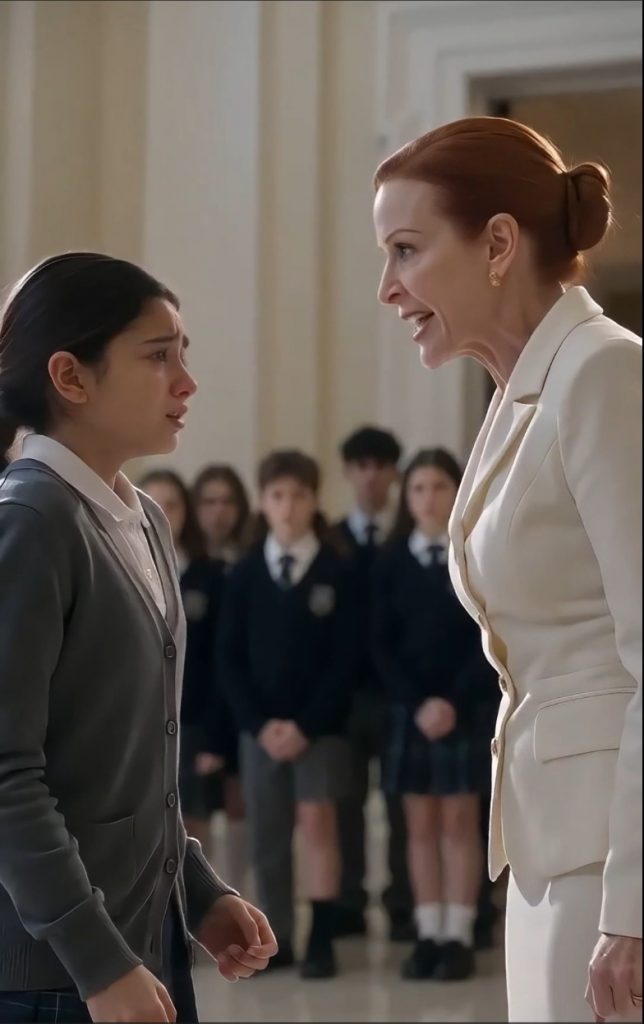
In the middle of the polished marble floor, under white columns and cold morning light, a girl in a gray cardigan stood with her hands still raised, empty now, as if her fingers could not understand what had just been taken from them.
Principal Helen Marbury held the stack of papers in both hands.
Then she tore them again.
And again.
Sharp white scraps fluttered down around the girl’s shoes.
The atrium went silent except for the soft, awful whisper of paper hitting tile.
The girl’s name was Sofia Alvarez.
She was thirteen, quiet, new to the academy, and the kind of student who apologized when someone else bumped into her. Her dark hair was tied back with a plain ribbon. Her plaid skirt fell neatly above her knees. Her white collared shirt was buttoned to the top, because she had been told this school valued discipline.
She had believed that.
Until the principal ripped apart her scholarship application in front of half the student body.
Helen Marbury stepped closer, her white pantsuit stiff and spotless, gold buttons shining beneath the atrium lights. Her red hair was pinned into a bun so tight it seemed to pull every expression into cruelty.
She threw the torn papers at Sofia’s feet.
“That fake sob story fools no one, young lady,” she said. “Kids like you don’t get into schools like this.”
A few students gasped.
No one laughed.
That almost made it worse.
Laughter would have been simple. Cruel, but simple.
This was heavier.
This was a room full of children watching an adult destroy someone and not knowing whether helping would make them next.
Sofia looked down at the scattered pieces.
Her essay was there. Or what was left of it. A paragraph about her mother’s work. A letter from her previous school. A recommendation from a teacher who had written that Sofia possessed unusual courage and discipline.
Now those words lay broken across the floor.
Principal Marbury pointed at her chest.
“This academy is not a charity shelter,” she said. “We have standards. Families work for years to earn a place here.”
Sofia swallowed.
“My mother said I was expected,” she whispered.
The principal’s mouth curled.
“Your mother should have taught you not to lie.”
Sofia’s eyes filled, but she did not cry.
Not yet.
Instead, she lowered herself to the floor.
Both knees touched the cold tile.
One by one, with trembling fingers, she began gathering the torn scraps.
The students around her shifted uneasily.
Someone whispered, “That’s messed up.”
Another whispered, “Don’t say anything.”
Then, through the glass entryway, a black security vehicle pulled to a stop outside.
A car door closed.
Firm footsteps entered the atrium.
And every head turned.
Act II
Ashbourne International Academy did not look like a school from the outside.
It looked like a museum built for children whose parents owned museums.
White stone façade. Tall windows. Gated driveway. Flags from several countries lining the entrance path. Inside, the floors were polished so brightly that students could see their reflections while walking to class.
The brochure called it a global leadership institution.
Sofia had read the brochure so many times the corners bent.
She knew the names of the debate champions. The science award winners. The students who had gone on to Oxford, Harvard, Sciences Po, and medical schools whose names sounded like locked doors.
Her old teacher, Mr. Bell, had placed the brochure on her desk with a smile.
“You belong in rooms like this,” he said.
Sofia had laughed because she thought he was being kind.
He had not laughed back.
“I mean it.”
The application had taken months.
Sofia wrote her essays at the kitchen table while her mother worked late. She revised them in pencil, then typed them on a borrowed laptop from the library. She described moving from country to country, not because she wanted pity, but because she had learned how to adapt quickly, listen carefully, and carry home inside herself.
She did not mention everything.
She did not write about the nights her mother returned from official dinners still wearing heels, then sat beside Sofia’s bed to help with math. She did not write about security briefings, coded phone calls, or the fact that her mother’s passport had more stamps than some classrooms had books.
Because her mother had asked for privacy.
“Let them see you first,” Ambassador Elena Alvarez had said. “Not my title.”
Sofia understood.
Mostly.
Her mother was not ashamed of being an ambassador. She had spent years representing her country with dignity, intelligence, and a kind of calm that made angry men lower their voices without realizing it.
But Sofia knew what titles did.
They changed faces.
Teachers became careful. Parents became eager. Students became curious in a way that felt less like friendship and more like inspection.
At her last school, after one parent discovered who her mother was, everything changed within a week. Suddenly Sofia was invited to birthday parties by girls who had never spoken to her. Teachers overpraised her ordinary work. A boy asked if her house had guards.
Sofia hated it.
So when she transferred to Ashbourne, she asked her mother for one thing.
“Please don’t tell them yet.”
Elena had studied her carefully.
“The administration must know enough for security and records.”
“But not the students. Not everyone.”
“No,” her mother agreed. “Not everyone.”
The admissions office had received everything officially: Sofia’s records, her testing results, her scholarship eligibility, the embassy contact, and a sealed letter confirming the ambassador’s involvement in a cultural education initiative with the academy.
But Principal Marbury had never liked exceptions.
She built her reputation on order. On selectivity. On the idea that Ashbourne was not merely expensive, but elevated. She adored legacy families. She memorized donor names. She smiled at trustees with the precision of a woman who knew power could be cultivated like a garden.
Scholarship students irritated her.
Not all of them publicly. That would be unprofessional.
But privately, she believed they disrupted the atmosphere.
They asked too many questions. They brought anxious parents. They reminded paying families that excellence could arrive without wealth attached.
Sofia’s file had been approved by the board while Marbury was away at a conference.
That insulted her.
A student admitted without passing through her hands felt like a challenge.
So on Sofia’s first week, Marbury watched.
She watched Sofia sit alone at lunch. Watched her carry books with both arms instead of using a leather satchel. Watched her wear the standard uniform without designer shoes, jewelry, or the casual ease of money.
And by Friday morning, when Sofia walked into the atrium with her scholarship confirmation papers and completed class placement forms, Marbury had decided what kind of girl she was.
A climber.
A charity case.
A mistake.
Sofia had only wanted to ask where to submit the documents.
Marbury took one look at the papers and held out her hand.
“Let me see those.”
Sofia obeyed.
She always obeyed adults at school.
The principal scanned the first page, then the second. Her face tightened when she saw the scholarship seal. Then came the essay about perseverance. The recommendation letter. The mention of diplomatic relocation, carefully worded but not fully explained.
Marbury’s eyes narrowed.
“Who wrote this for you?”
Sofia blinked.
“I did.”
“Don’t be clever.”
“I’m not.”
The atrium had begun filling with students between classes. A few slowed down. Then a few more. Soon a semicircle formed, not close enough to interfere, but close enough to witness.
Marbury noticed the audience.
And something in her seemed to enjoy it.
She held up the papers.
“This is exactly what happens when children are taught that emotional stories can replace merit.”
Sofia’s face burned.
“Please,” she whispered. “Those are my only copies.”
Marbury smiled coldly.
“Then you should have brought something real.”
And she tore them in half.
But what Marbury did not know was that outside the academy gates, an embassy security vehicle had already turned into the driveway.
Act III
The woman who entered through the glass doors did not hurry.
That was what made the room shift so quickly.
She wore a long black coat, dark trousers, and no jewelry except a small gold pin near her collar. Her dark hair fell smoothly over one shoulder. Her face was calm in a way that did not ask for attention, but received it anyway.
Behind her, through the glass, the black security vehicle remained parked at the curb.
Two escorts stood near it.
Principal Marbury turned toward the entrance with irritation already forming on her face.
“Excuse me, visitors must check in at reception.”
The woman did not answer her.
Her eyes had found Sofia.
Still kneeling.
Still holding torn pieces of paper in both hands.
Still trying not to cry in front of a crowd.
The woman’s expression changed only slightly.
But Sofia saw it.
“Mom,” she whispered.
The word was quiet.
Yet the students nearest her heard it.
A murmur passed through the atrium.
Elena Alvarez walked straight to her daughter and lowered herself beside her. She did not care about the marble floor. She did not care that students were staring. She did not care that the principal’s face had tightened with professional offense.
She placed one arm around Sofia’s shoulders.
“Sweetheart,” she said softly. “Are you hurt?”
Sofia shook her head, but tears slipped down anyway.
Elena looked at the scraps in her daughter’s hands.
Then at the torn pieces still scattered across the tile.
Then at Principal Marbury.
Only then did she stand.
The room seemed to rise with her.
Marbury lifted her chin.
“Mrs. Alvarez, I assume? There has been a misunderstanding. Your daughter presented questionable documents and made claims about enrollment status that appear to be inaccurate.”
Elena’s face remained composed.
“Did you verify them?”
Marbury hesitated.
“I was in the process of—”
“You tore them.”
The words were not loud.
They were worse than loud.
Marbury glanced at the students, then back at Elena.
“These documents were not submitted through proper channels.”
“They were copies of documents already in your administrative system.”
The principal’s expression flickered.
Elena continued.
“She brought them because your office requested physical confirmation before placement testing.”
A receptionist near the front desk lowered her eyes.
Marbury noticed.
Her voice sharpened.
“That is not the point. Your daughter approached me in a public area with an inappropriate attitude.”
Sofia looked up, stunned.
“I just asked where to turn them in.”
Elena’s arm tightened around her.
Marbury’s jaw set.
“This academy has procedures.”
“And dignity?” Elena asked.
Silence.
Students looked between the two women, their faces tense with the thrill and terror of watching an untouchable adult become answerable.
Marbury tried to regain control.
“Madam, I understand parents become emotional when their children are disappointed, but Ashbourne cannot admit every student with a sad story.”
Elena stared at her.
For the first time, something cold entered her calm.
“My daughter was already admitted.”
Marbury opened her mouth.
No words came.
Elena turned slightly so the whole atrium could hear.
“Sweetheart,” she said, her voice clear, “this principal just humiliated an ambassador’s daughter.”
The sentence landed like glass breaking.
Students froze.
The receptionist inhaled sharply.
Somewhere near the back, someone whispered, “Ambassador?”
Marbury’s face changed color.
Her lips parted.
The confidence drained from her posture as if someone had cut invisible strings.
“Ambassador?” she repeated.
And suddenly the torn papers on the floor looked less like trash.
They looked like evidence.
Act IV
Principal Marbury tried to smile.
It was a disaster.
Her lips moved, but the rest of her face had already betrayed her.
“Ambassador Alvarez,” she said quickly. “Of course. I was not aware—”
Elena interrupted.
“That my daughter mattered?”
Marbury flinched.
“No. That is not what I meant.”
“It is what you demonstrated.”
The atrium was so quiet that Sofia could hear the soft crinkle of paper in her own hands.
Marbury looked around, realizing too late that the students she usually controlled had become witnesses. Their silence no longer protected her. It judged her.
She stepped forward.
“Sofia, dear, I apologize if my tone felt harsh.”
Sofia did not move.
Elena’s gaze sharpened.
“If?”
Marbury swallowed.
“I apologize that my tone was harsh.”
“And the papers?”
The principal glanced down.
Several scraps lay near her shoes.
She seemed unable to make herself look at them for long.
“I regret damaging the documents.”
“You destroyed them,” Elena said.
Marbury’s face tightened.
“Yes. I destroyed them.”
The admission moved through the atrium like a confession pulled into daylight.
Then a man in a dark suit entered from the glass doors. One of Elena’s security officers. He did not speak, only handed her a slim leather folder.
Elena opened it.
Marbury’s eyes followed the movement.
“This is Sofia’s acceptance record,” Elena said. “Her scholarship confirmation. The board approval. The embassy correspondence. And the partnership letter your office acknowledged three days ago.”
Marbury’s eyes darted toward the reception desk.
The receptionist looked frightened now.
Not guilty.
Frightened.
Elena noticed.
“Do not blame your staff for records you chose not to read.”
Marbury stiffened.
“I oversee hundreds of students.”
“And yet you found time to tear one child’s work apart in front of them.”
That struck harder than any title.
Sofia looked at her mother, surprised by how calm she sounded. Elena did not yell. She did not threaten. She did not even seem interested in humiliating the principal back.
That made her more frightening.
Marbury tried again.
“This school maintains a culture of excellence.”
Elena looked around the atrium.
“At the moment, it appears to maintain a culture of fear.”
Several students lowered their eyes.
One boy near the front spoke before he could stop himself.
“She does this all the time.”
The room turned toward him.
His face went pale, but he kept going.
“She calls people out in assemblies. She reads discipline notes out loud. Last month she made Amira stand by the trophy case because her parents were late on tuition.”
A girl behind him whispered, “That happened.”
Another student stepped forward.
“She told Jonas his accent made him sound unserious.”
The whispers began multiplying.
Not loud enough to become chaos.
Just enough to become undeniable.
Marbury’s expression hardened in panic.
“That is enough. Students, return to class immediately.”
No one moved.
Elena glanced at Sofia.
Sofia was staring at the floor, still clutching the torn scraps, her cheeks wet.
Something in Elena’s composure shifted.
Not broke.
Shifted.
She turned back to Marbury.
“No child under your care should have to be powerful to be treated gently.”
The principal’s mouth trembled.
“I made an error.”
“No,” Elena said. “An error is misfiling a form. What you did was choose cruelty because you believed the child in front of you had no protection.”
Marbury’s eyes filled with fear.
The word protection seemed to remind her of the black vehicle outside, the security presence, the title now hanging over the atrium.
Elena took one step closer.
“I will meet with the board today.”
Marbury’s shoulders sank.
“Ambassador, please—”
“And Sofia will not attend another class until this school proves it can keep its students safe from the adults paid to lead them.”
A stunned silence followed.
Then Sofia rose slowly from the floor.
Her knees ached from the tile. Her hands were full of torn paper. A few scraps slipped between her fingers and fluttered down again.
A girl from the semicircle stepped forward.
Then another.
Without asking, they began picking up the remaining pieces.
One by one.
The students gathered Sofia’s destroyed papers from the floor while Principal Marbury stood frozen in the middle of the atrium, watching the authority she had abused turn against her.
Act V
By afternoon, Principal Marbury’s office door was closed.
By evening, her name had been removed from the academy website.
The official statement used careful language, the kind adults always use when they want the truth to wear a suit.
Administrative leave.
Internal review.
Commitment to student dignity.
But everyone at Ashbourne knew what had happened.
A principal tore up a girl’s papers in the atrium.
Then the girl’s mother walked in with an embassy vehicle outside.
But Sofia remembered different details.
She remembered the cold tile under her knees.
The way torn paper felt in her hands.
The way her classmates looked scared before they looked brave.
And her mother’s arm around her, steady and warm, before anyone knew what consequences would follow.
That evening, Sofia sat in the back seat of the security vehicle with the leather folder on her lap. Her mother sat beside her, reading emails on a phone that had not stopped buzzing since they left the school.
Sofia watched the academy disappear behind the gates.
“I’m sorry,” she said.
Elena lowered the phone immediately.
“For what?”
“For making it a problem.”
Her mother’s face softened with something close to pain.
“Sofia, you did not make it a problem. You revealed one.”
Sofia looked down at the torn scraps now sealed in a clear evidence sleeve.
“She said kids like me don’t get into schools like that.”
Elena was quiet for a moment.
Then she said, “People say things like that when they are terrified the world might become larger than their permission.”
Sofia almost smiled.
Almost.
“Do I have to go back?”
“No.”
The answer came quickly.
Too quickly to be diplomatic.
Sofia looked at her.
Elena took her hand.
“You may, if you choose. But not because we need them. And not before they understand that admission is not the same as belonging.”
The board called the next morning.
Then again that afternoon.
By the end of the week, Ashbourne announced an independent review of disciplinary practices, scholarship student treatment, staff reporting procedures, and discrimination complaints. Students were invited to submit anonymous statements.
They submitted dozens.
Some wrote about public shaming.
Some wrote about being mocked for accents, uniforms, family income, or parents’ jobs.
One student wrote only:
I thought it was normal to be scared of the principal.
That sentence changed everything.
Two months later, Sofia returned to Ashbourne for a meeting, not a class.
The atrium looked exactly the same.
The same columns. The same polished floor. The same glass doors. The same light spilling cold and bright across the entryway.
But the room felt different.
Maybe because Marbury was gone.
Maybe because students no longer went silent when an adult walked by.
Maybe because, near the reception desk, a new framed statement had been placed where the academy motto used to hang.
Excellence without dignity is failure.
Sofia stood in front of it for a long time.
Her mother waited beside her.
“Too dramatic?” Elena asked.
Sofia looked up at her.
“You probably wrote it.”
“I edited it.”
“That means yes.”
Elena smiled.
Across the atrium, a new head of school approached them. Dr. Naomi Bennett was younger than Marbury, with kind eyes and a voice that did not perform warmth because it already had it.
“Sofia,” she said. “Thank you for coming.”
Sofia nodded.
Dr. Bennett did not bend too low or speak too sweetly. She did not treat Sofia like a scandal or a symbol.
She treated her like a student.
“I read your essay,” Dr. Bennett said.
Sofia stiffened.
“The torn one?”
“The restored one.”
After the incident, several students had helped piece together the scraps. One girl scanned them. Another typed the missing sentences from memory. Mr. Bell, Sofia’s old teacher, sent the original file again with a note that read:
Paper can be torn. Work cannot.
Dr. Bennett held out a clean folder.
“Your placement is still available. So is your scholarship. But the choice is yours.”
Sofia took the folder carefully.
For weeks, she had imagined returning to the atrium and feeling only fear.
But now, looking around, she saw the place differently.
The floor where she had knelt was still there.
So were the students who had helped her stand without touching her.
The building had not changed much.
But the silence had.
It no longer belonged to the cruel.
Sofia looked at her mother.
Elena did not nod. Did not push. Did not decide for her.
That mattered.
Sofia turned back to Dr. Bennett.
“I’ll try one week.”
Dr. Bennett smiled.
“That is fair.”
As they walked toward the glass doors, Sofia paused near the spot where the papers had fallen. She could almost hear the rip again. The gasp. The principal’s voice. The terrible sentence meant to make her feel small.
Kids like you don’t get into schools like this.
Sofia looked around the atrium.
At the students moving between classes.
At the new motto.
At her mother standing beside her, not as a title, but as a shield she had never wanted to need.
Then Sofia straightened her cardigan.
Kids like her did get into schools like this.
And sometimes, when they arrived, they changed what the school had to become.