Act I
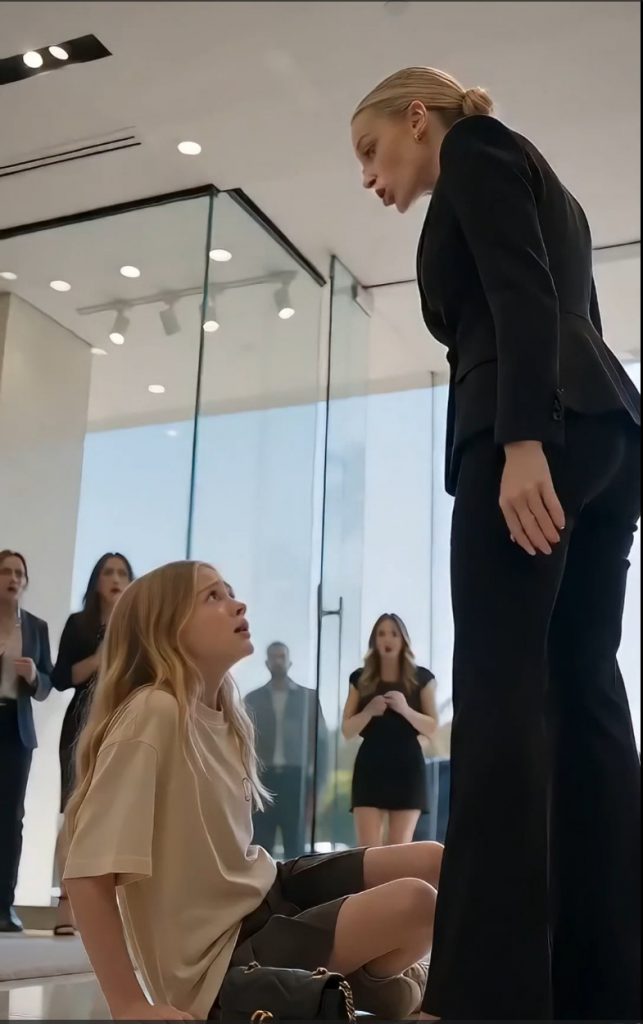
The slap cracked through the boutique like glass breaking.
Every customer turned.
The little girl stumbled backward, one hand flying toward her cheek, the strap of her small Gucci bag slipping from her shoulder. Her shoes slid on the polished tile, and she fell beside the glass entrance, landing hard enough that two women near the perfume display gasped and covered their mouths.
The bag dropped next to her.
Soft leather against cold floor.
For one second, the entire luxury boutique forgot how to breathe.
The manager did not.
She stood over the child in a sharp black blazer and black trousers, blonde hair tied back so tightly it made her face look even harder.
“Get your hands off that display and get out,” she snapped.
The girl looked up from the floor.
Long blonde hair. Oversized beige T-shirt. Dark skirt. Small body trying very hard not to shake.
The manager’s name was Claudia Mercer, and she had spent twelve years learning how to protect luxury from the wrong kind of people.
At least, that was what she called it.
She looked down at the girl’s Gucci bag, then at the designer displays behind her, and her mouth twisted.
“Girls like you don’t belong near luxury like this.”
Then she kicked the bag.
It skidded across the tile, the strap dragging behind it until it stopped near the boutique entrance.
A security guard by the wall looked away.
A sales associate froze behind the counter.
Outside the glass, beyond the bright showroom lights, a black G-Wagon waited at the curb beneath tall palm trees.
The girl slowly pushed herself up.
She did not cry loudly.
That was what unsettled the room.
She only stood, one hand near her cheek, eyes glassy but steady, and walked toward the bag Claudia had kicked.
Before she reached it, the G-Wagon door slammed.
Heavy footsteps approached the entrance.
The glass door opened.
A large man in a black suit stepped inside, his face serious, his posture instantly changing the temperature of the room. He walked straight past the displays, straight past Claudia, and stopped in front of the girl.
Then he bowed his head.
“Owner’s daughter,” he said, calm and formal, “forgive our late arrival.”
Claudia’s face went blank.
The boutique fell silent.
The girl stood still beside the kicked bag.
Claudia’s mouth trembled open.
“How?” she whispered.
Act II
Her name was Lily Beaumont, though almost no one in the boutique knew that.
To them, she looked like a child who had wandered too close to something expensive.
That was the easiest story for Claudia to believe.
Lily’s T-shirt was too big. Her skirt was plain. Her shoes were scuffed on one side from the way she walked when she was tired. She carried the small Gucci bag not like a trophy, but like something borrowed from a memory.
It had belonged to her mother.
That was why she held it so carefully.
Three years earlier, Camille Beaumont had stood inside the same boutique and argued with a board of executives who wanted to turn her family’s fashion house into a machine for influencers, resale speculation, and private-client arrogance.
Beaumont Atelier had not started that way.
Camille’s grandmother opened the first shop in Marseille with two sewing machines and a promise: no customer would be judged at the door. The brand grew slowly, then suddenly. Red carpets. Editorial shoots. Flagship boutiques. Waiting lists for handbags that cost more than some families’ rent.
Success made the company famous.
It also made parts of it cruel.
Camille hated that most.
She used to bring Lily to the boutique after closing, letting her run between the displays in socks while staff restocked shelves. She told her stories about fabric, craft, patience, and respect.
“Luxury is not the price,” Camille said once while polishing a glass case with her own hands. “Luxury is care. If care disappears, all that remains is expensive emptiness.”
Lily remembered that sentence because her mother said it the night before she died.
A sudden illness.
A rushed hospital stay.
A funeral with too many flowers from people who wanted to be seen grieving.
After Camille’s death, Lily’s father, Adrian Beaumont, became the public owner. But the company’s controlling trust had a clause no one outside the family discussed.
When Lily turned twelve, she would inherit her mother’s protected shares.
Not voting control yet.
Not daily management.
But enough legal standing to inspect stores, review internal conduct, and challenge leadership decisions made in her name.
She was eleven when she walked into the boutique that afternoon.
Her birthday was two weeks away.
Her father had sent her ahead with her bodyguard, Marcus, while he finished a call in the car. Lily had begged to enter alone first.
Just for a minute.
“I want to see if it still feels like Mom,” she told him.
Adrian hesitated.
Then he nodded.
“One minute. Marcus stays close.”
But traffic had blocked the curb, and the G-Wagon stopped a few storefronts away. Lily slipped inside before Marcus reached the door.
She did not go to the most expensive display.
She went to the handbag wall.
There, beneath warm light, was the reissued Camille Mini, a design named after her mother. The marketing card called it a “heritage icon.” Lily looked at it and felt something twist in her chest.
She touched the edge of the display shelf gently.
Not to steal.
Not to stain.
To remember.
Then Claudia saw her.
Act III
Claudia Mercer had built her career on deciding who deserved attention.
She could spot wealth when it entered the boutique in obvious forms: diamonds, drivers, handlers, the right watches, the right surgery, the right carelessness with money. She greeted those customers with champagne and lowered her voice as if speaking inside a private club.
Everyone else received surveillance disguised as service.
“Can I help you?” with the wrong tone.
“Are you waiting for someone?” with the wrong smile.
“Please don’t touch that,” before a hand even lifted.
Claudia believed she was protecting the brand.
In truth, she was protecting her own hunger to stand above someone.
When Lily entered in the oversized T-shirt, Claudia saw a problem.
A child near the displays.
A small Gucci bag that looked, to her, too valuable for the girl carrying it.
A face she did not recognize.
A story she invented before a single question.
“Where are your parents?” Claudia asked.
Lily turned.
“My dad is outside.”
“Then wait outside.”
Lily looked back at the Camille Mini.
“I only wanted to see this.”
“You don’t get to touch displays.”
“I wasn’t hurting it.”
Claudia’s expression hardened.
The girl’s calm bothered her.
Children were supposed to become nervous when adults spoke sharply. Employees did. Customers often did. Claudia mistook fear for order and obedience for respect.
She reached for Lily’s arm.
“Come with me.”
Lily stepped back.
“My dad said I could—”
Claudia grabbed the fabric of her T-shirt and pulled.
That was when the first bystander gasped.
Lily tried to keep up, stumbling toward the entrance as Claudia dragged her across the showroom floor. The sales associate behind the counter whispered, “Claudia,” but did not move.
At the door, Lily twisted once toward her mother’s display.
“Please, my bag—”
Claudia slapped her.
Now, with Marcus standing inside the boutique and the words owner’s daughter still hanging in the air, Claudia’s entire world began rearranging itself around a child she had decided was nobody.
Marcus bent to retrieve the Gucci bag.
He did not brush it off immediately.
He held it with both hands, jaw tight, as if the kick had landed somewhere far deeper than leather.
“Miss Beaumont,” he said quietly, “your father is coming.”
Claudia took one step back.
“Beaumont?”
Lily looked at her.
“Yes.”
The name moved through the boutique like a storm behind glass.
Act IV
Adrian Beaumont entered less than a minute later.
He did not run.
That made him more frightening.
Tall, composed, wearing a dark suit without a tie, he walked through the glass entrance with two security staff behind him. He saw Lily first, standing beside Marcus with one cheek flushed and the small bag held close to her body.
Then he saw Claudia.
Then he saw the customers.
The silent staff.
The polished floor where his daughter had fallen.
His voice was almost quiet.
“What happened?”
Claudia spoke too fast.
“Mr. Beaumont, there has been a misunderstanding.”
Lily did not look at her father.
She looked at the display behind Claudia.
Adrian followed her gaze and saw the Camille Mini beneath the boutique lights.
His face changed.
Not publicly.
Not dramatically.
But enough for Marcus to notice.
He crouched in front of Lily.
“Did she touch you?”
Lily nodded once.
The room seemed to shrink.
“Did she hit you?”
Another nod.
Claudia lifted both hands.
“I didn’t know who she was.”
Adrian stood.
His eyes were cold now.
“That sentence keeps coming from people who should know better.”
Claudia swallowed.
“I thought she was unattended. I thought she might damage merchandise.”
“You thought my daughter’s appearance gave you permission to put your hands on her.”
“No, I—”
“Stop.”
The word was not shouted.
It did not need to be.
The boutique manager stopped speaking as if a hand had closed around the room.
Adrian turned to the sales associate behind the counter.
“Pull the security footage. Preserve every angle. Send copies to legal and child protection compliance.”
The associate moved immediately, tears in her eyes.
“Yes, sir.”
Claudia’s face drained.
“Child protection? Mr. Beaumont, please. I’ve worked here for twelve years.”
“And in twelve years,” Adrian said, “how many people have you treated this way when no one powerful arrived afterward?”
No answer.
That was the answer.
One customer stepped forward, a woman with a cream handbag and shaking hands.
“She slapped her,” the woman said. “And kicked her bag.”
Another customer added, “She dragged her from the display.”
The security guard near the wall lowered his head.
“I saw it,” he said.
Adrian turned to him.
“And did nothing.”
The guard’s face tightened with shame.
“No, sir.”
Lily’s voice came then, small but clear.
“Mom would have hated this.”
Everything stopped.
Adrian looked at his daughter.
Lily held the Gucci bag against her chest.
“She said stores like this were supposed to be beautiful because people cared. Not because people were scared.”
Adrian closed his eyes briefly.
When he opened them, grief and fury stood together in his face.
“My daughter will wait in the car,” he said. “Then this store closes for the day.”
Claudia whispered, “Closes?”
Adrian looked at her.
“For longer than that, if necessary.”
Act V
The boutique doors were locked within fifteen minutes.
Not because of a robbery.
Not because of a celebrity visit.
Because a child had been hurt under bright showroom lights while adults watched luxury protect itself before it protected her.
Claudia Mercer was suspended that afternoon and terminated after the footage review. The official reason listed physical misconduct toward a minor, discriminatory conduct, and violation of client safety protocol.
The unofficial reason was simpler.
She had shown the company what it had become.
The video did not go public. Adrian refused to turn Lily’s pain into a lesson for strangers online. But inside Beaumont Atelier, every executive saw it. Every regional director. Every store manager. Every security lead. Every staff trainer who had ever written polite language that allowed cruelty to wear a blazer.
The footage stopped just before the slap during the first review.
Adrian could not watch that part twice.
Lily did not watch it at all.
She spent the evening at home with the Gucci bag on her bed and her father sitting on the carpet beside her like he used to do when she was smaller.
“I should have been faster,” he said.
Lily traced the bag’s worn strap with one finger.
“You were outside.”
“I still should have been faster.”
“She was already mean before you could have known.”
That was the truth that hurt most.
The problem was not one slap.
The slap was the sound the problem made when it finally stopped hiding.
In the weeks that followed, Adrian ordered an audit of every flagship boutique. Complaint logs were reopened. Security reports were reviewed. Mystery shoppers were sent in without luxury signals: no obvious designer clothes, no entourage, no appointment names that carried weight.
The results were ugly.
Customers followed too closely.
Teenagers questioned at doors.
Black and brown shoppers watched harder than white ones.
Plainly dressed clients discouraged from trying pieces.
Staff praised for “protecting brand image” when what they had really protected was prejudice.
Adrian read every report.
Then he changed the rules.
Beaumont Atelier closed its flagship boutiques for one day of mandatory retraining. Not the empty kind with slides and corporate phrases. Real training. Recorded incidents. Live accountability. Clear intervention duties for security. A policy that any staff member who put hands on a customer without immediate safety necessity would be terminated and reported.
Some luxury clients complained about the closures.
Adrian did not answer them personally.
Lily did.
At the annual shareholders’ gathering two months later, she asked to speak.
Adrian almost said no.
Then he remembered Camille’s voice.
Do not teach her to inherit silence.
So Lily stood at a podium in a simple blue dress, the same small Gucci bag resting on the table beside her.
The room was full of adults who knew exactly who she was now.
That did not impress her.
She looked nervous, but she did not step away.
“My mom loved this company,” she said. “Not because it was expensive. Because people made things carefully.”
The room quieted.
“When I went into the store, the manager thought I didn’t belong. She didn’t ask my name. She didn’t ask if I needed help. She just decided.”
Lily looked down at the bag.
“She kicked this because she thought it couldn’t matter.”
Adrian’s jaw tightened.
Lily continued.
“But it mattered to me.”
A few people looked away.
Good, Adrian thought.
Let them.
Lily lifted her eyes again.
“I don’t want people to be nice to me because I’m the owner’s daughter. I want them to be nice before they know.”
No one clapped at first.
The sentence needed space.
Then applause rose slowly, not loud enough to erase the discomfort, but strong enough to admit it.
Afterward, the Camille Mini display was changed.
No velvet rope.
No cold plaque.
A small card was placed beside it with words from Camille Beaumont’s final design journal.
Luxury without kindness is just expensive fear.
The flagship boutique reopened under new management.
The first day back, a young mother entered with a toddler and a stroller, looking nervous around the glass cases. A sales associate greeted her warmly and offered space instead of suspicion. Near the entrance, the same security guard stood with new training, new responsibility, and the memory of the day he had failed to move.
He watched a teenage girl reach toward a display.
Before fear could shape his response, he stepped closer and said, “That piece is beautiful. Would you like someone to show it to you?”
The girl smiled.
That was how culture changed.
Not in one grand apology.
In a thousand corrected moments.
A year later, Lily returned to the boutique alone, though Marcus waited outside by the G-Wagon because promises to fathers had limits.
She wore another oversized T-shirt.
She carried the same bag.
The new manager greeted her by name, but Lily noticed something better. She greeted everyone else kindly too.
A delivery courier asking for directions.
A grandmother in worn sneakers.
Two girls taking careful pictures of a window display.
No one was made to feel like touching beauty required proof of wealth.
Lily walked to the Camille display and placed her fingers lightly on the glass.
This time, no one slapped her hand away.
She looked at the reflection of her face beside her mother’s design and felt something loosen in her chest.
Not gone.
Not forgotten.
But changed.
Behind her, the glass door opened, and sunlight from the street poured across the polished floor.
Outside, palm trees moved gently above the curb.
Inside, the boutique was quiet again.
But no longer silent in the same way.
It was the kind of quiet that came after a place had been forced to listen.
And the little girl who had once been dragged across that floor did not need to ask how she belonged there.
She already knew.
Her mother had built the answer long before anyone had tried to kick it away.