Act I
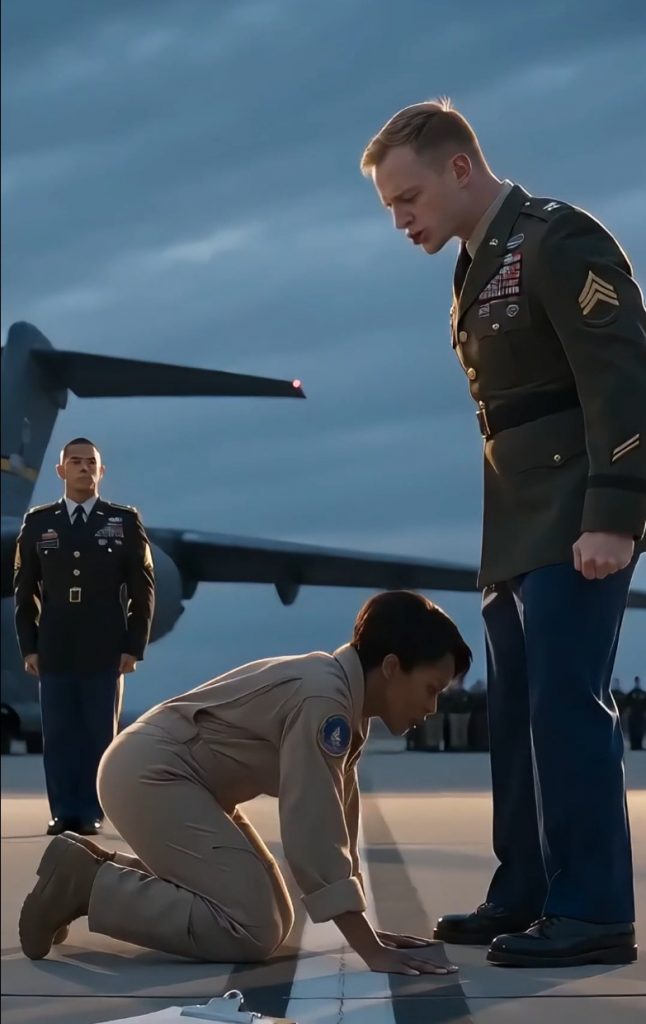
The clipboard hit the tarmac before Captain Naomi Carter said a word.
It clattered across the concrete, skidding over the thick white line painted down the center of the airfield. Wind tore over the open runway, snapping at uniforms, carrying the smell of fuel, cold metal, and coming rain.
Naomi dropped to one knee.
Not because she wanted to.
Because Sergeant Grant Vacfen had shoved her hard enough to send her backward in front of half the formation.
“Off the line!” he barked, stepping over the clipboard as if it were trash. “Officers only. Field strays don’t run command.”
The words cracked through the dusk.
No one moved.
A military cargo aircraft sat in the background like a sleeping giant, its gray body dark beneath the overcast sky. Beyond it, near the hangar, soldiers stood rigid in formation, eyes forward, pretending discipline meant they had not seen what just happened.
Naomi’s hand pressed against the white line.
Her tan flight suit was dusty at the knee. Her short dark hair moved in the wind. Her breathing stayed measured, controlled, almost too calm for a woman who had just been humiliated in front of uniformed personnel.
Vacfen loomed over her.
Blond, sharp-jawed, and stiff in his formal Army service greens, he looked like a man who had confused volume for authority his entire career.
Behind him, Lieutenant Rejen stood silent.
His face was tense. His jaw worked once, like he wanted to speak and knew better. He looked from Naomi to Vacfen, then down at the fallen clipboard.
Naomi noticed.
She noticed everything.
Vacfen leaned closer.
“You hear me?” he snapped. “You don’t stand on command line unless command puts you there.”
Naomi slowly lifted her eyes.
There was no panic in them.
That was the first thing that irritated him.
The second was that she still had not answered.
Naomi rose from the tarmac with careful precision. She brushed dust from the front of her flight suit, adjusted her collar, and picked up nothing. The clipboard stayed where it had fallen, pages fluttering in the wind.
Vacfen’s mouth twisted.
“You got something to say?”
Naomi looked at him for one long second.
Then she looked past him.
Far across the airfield, a low mechanical thrum began to build beneath the wind.
At first, it was distant.
Then it grew heavier.
Rotor blades.
Vacfen turned sharply.
A black military helicopter appeared against the blue-gray dusk, descending toward the tarmac with its lights cutting through the air.
Naomi did not move.
She only stood on the white line, silent and steady, as the wind rose around her.
And for the first time, Sergeant Vacfen looked unsure.
Act II
Two weeks earlier, Naomi Carter had read the first report alone in a windowless office.
The file was thin.
Too thin.
That was how she knew something was wrong.
Official reports always had weight. Details. Names. Signatures. Times. Witness notes. Corrections in margins. This one had been polished smooth, scrubbed of anything that might make a superior officer look twice.
Incident resolved internally.
Training misunderstanding.
No further action required.
Naomi read it three times.
Then she opened the attached statements that had not been included in the final summary.
Those told a different story.
A young mechanic had been reassigned after challenging unsafe loading procedures. A Black warrant officer had been mocked for “acting above his station” when he corrected a briefing error. A female pilot had been removed from a mission rotation after refusing to falsify equipment readiness logs.
The same name appeared again and again.
Sergeant Grant Vacfen.
And beside him, always quieter but always present, Lieutenant Mateo Rejen.
Naomi did not know yet whether Rejen was complicit or afraid. She had learned not to confuse silence with innocence, but she had also learned that fear could make decent people look guilty from a distance.
Vacfen was different.
His record was decorated enough to be protected and messy enough to be dangerous. He performed well during inspections. He spoke cleanly in front of command. He used the right phrases at the right times.
Standards.
Discipline.
Operational integrity.
But beneath those words, something had rotted.
Naomi had seen men like him before.
They loved rank when it shielded them. They hated it when it appeared on the chest of someone they had already decided not to respect.
The base was waiting for a new commanding officer.
Most personnel had not been told who it was.
That had been deliberate.
The incoming command transition was sensitive. The airfield had suffered three failed audits, two near-miss safety violations, and one buried complaint that had finally reached the wrong desk.
Naomi’s desk.
Colonel Naomi Carter had spent seventeen years learning how institutions protected themselves. Not always through conspiracy. Sometimes through boredom. Sometimes through paperwork. Sometimes through a hundred small decisions made by people who preferred peace over truth.
So she chose not to arrive with ceremony.
No full dress uniform.
No entourage.
No announcement at the gate.
She came in a tan flight suit with a clipboard, her rank subdued, her name patch partly covered by her harness strap. To anyone paying attention, there were signs. To anyone professional, there were protocols.
But to someone arrogant, she looked like an easy target.
That was the point.
Her mentor, Colonel Everett Shaw, had not liked the plan.
Shaw was old Army in the best and worst ways. He believed in order, chain of command, formal process, and polished boots. But he also believed no uniform excused cruelty.
“You’re walking into a trap to see who springs it,” he said.
Naomi signed the inspection authorization.
“I’m walking into my command.”
“You could simply arrive with orders in hand.”
“I could,” Naomi said. “Then everyone would salute before I learned who they are.”
Shaw studied her across the desk.
“And if someone crosses a line?”
Naomi’s expression did not change.
“Then we will know exactly where the line is.”
He sighed.
“You sound like your father.”
Naomi looked up.
Her father had served thirty-one years before retiring with a bad knee, a quiet house, and a belief that leadership was mostly what people did when no one important was watching.
He had taught her how to shine boots when she was seven.
He had taught her how to hold her voice steady when she was twelve.
He had taught her, after her first officer evaluation, that the most dangerous people in uniform were not always enemies.
“Some people weaponize the system from inside it,” he had said. “Never let your rank become a decoration. Use it to protect the people who cannot afford to speak.”
Naomi had never forgotten.
So when she arrived at the airfield at dusk, clipboard in hand, she did not introduce herself as the incoming commanding officer.
She asked questions.
Simple ones.
Who signed this maintenance clearance?
Why was the cargo inspection skipped?
Who authorized personnel movement across the white command line?
Vacfen answered the first question with irritation.
The second with contempt.
By the third, he had decided she was a problem.
And now, as the helicopter dropped toward the tarmac, Naomi knew the real inspection had only just begun.
Act III
The helicopter landed with a blast of rotor wash that swept dust across the concrete.
Naomi stood still as the wind struck her flight suit.
Vacfen snapped into something close to attention, though the movement came late and stiff. Lieutenant Rejen straightened behind him, eyes fixed forward, face drawn tight with dread.
The helicopter door opened.
Colonel Everett Shaw stepped down onto the tarmac.
He wore formal service greens, ribbons and insignia sharp against his chest, his expression carved from granite. He did not rush. Men like Shaw did not need speed to command attention. His boots struck the concrete one measured step at a time.
The rotor noise began to fade, but the silence that replaced it was worse.
Vacfen lifted his chin.
“Sir.”
Shaw did not return the greeting.
His eyes moved first to Naomi.
Then to the clipboard on the ground.
Then to the dust on her knee.
Then to Sergeant Vacfen.
The air seemed to tighten.
“Stand down,” Shaw ordered.
Vacfen’s posture snapped rigid.
“Attention on deck.”
Every soldier within earshot locked into stillness.
The wind continued to move. Nothing else did.
Shaw walked past Vacfen and stopped beside Naomi. For half a second, his face softened in a way almost no one else would notice.
Naomi noticed.
Then it was gone.
He turned back to the formation.
“Sergeant Vacfen,” he said.
“Sir.”
“Explain why this officer was on the ground.”
Vacfen hesitated.
Only for a breath.
But everyone heard it.
“She crossed a restricted command line without authorization, sir.”
Shaw’s eyes did not leave him.
“And you considered physical force appropriate?”
“She refused to identify herself properly.”
Naomi’s gaze stayed forward.
Rejen’s throat moved as he swallowed.
Shaw glanced at him.
“Lieutenant Rejen. Did she refuse?”
Rejen’s eyes flicked toward Vacfen.
That tiny motion told Naomi more than any confession could.
“Lieutenant,” Shaw said, voice harder.
Rejen inhaled.
“No, sir.”
Vacfen’s jaw tightened.
Shaw stepped closer.
“Then what happened?”
Rejen’s face looked pale under the tarmac lights.
“She asked for the cargo readiness verification. Sergeant Vacfen told her she had no authority to request it. She stated she was here for command review. He told her field personnel did not belong on the line.”
Shaw waited.
Rejen forced the rest out.
“Then he shoved her, sir.”
The formation remained frozen, but the truth moved through it like a current.
Vacfen turned slightly.
“Lieutenant.”
Shaw’s voice cut across him.
“You will not correct him for telling the truth.”
Vacfen faced forward again.
For the first time, his confidence showed a crack wide enough for fear to enter.
Naomi bent down at last and picked up the clipboard. She brushed grit from the metal clip with her thumb, then opened it to the page that had nearly blown loose in the wind.
There were names there.
Dates.
Statements.
Signed complaints.
Not rumors.
Not misunderstandings.
Evidence.
Shaw looked at the page, then at Vacfen.
“This airfield has been operating under review for six weeks,” he said. “You were informed of that.”
Vacfen’s voice was tight.
“Yes, sir.”
“You were instructed to cooperate with incoming command personnel.”
“Yes, sir.”
“And yet, when questioned by an officer you assumed had no influence, you chose intimidation.”
Vacfen said nothing.
Shaw’s face hardened.
“You did not fail because you were confused, Sergeant. You failed because you believed respect was optional until rank became visible.”
Naomi finally looked directly at Vacfen.
There was no satisfaction in her eyes.
Only judgment.
That frightened him more.
Act IV
Vacfen tried to recover the only way men like him knew how.
He reached for procedure.
“Sir, with respect, her rank insignia was not visible, and no formal transfer ceremony has occurred. I acted to secure command space.”
Shaw almost smiled.
It was not kind.
“Secure it from whom?”
Vacfen opened his mouth.
No answer came.
Naomi closed the clipboard.
Her voice entered the tarmac for the first time.
“From me.”
It was not loud.
It carried anyway.
Every eye stayed forward, but every ear leaned toward her.
Vacfen’s expression flickered.
Naomi took one step closer, stopping directly on the white painted line.
“You saw a flight suit,” she said. “You saw no escort. You saw a Black woman with a clipboard asking questions you did not want asked. And in less than three minutes, you decided I was beneath your courtesy.”
Vacfen’s face flushed.
“Ma’am, that is not—”
“Do not interrupt me.”
The words struck clean.
Vacfen went silent.
Naomi’s calm did not soften.
“This line does not belong to you. This aircraft does not belong to you. This command does not exist to protect your pride.”
Behind Vacfen, Rejen stood rigid, but something in his face shifted. Shame, perhaps. Or relief. Sometimes the truth was terrifying. Sometimes it was oxygen.
Shaw let Naomi speak.
That was when the soldiers understood something important.
The colonel from the helicopter had not arrived to rescue her.
He had arrived to witness her taking command.
Naomi opened the clipboard again and removed a folded order from the back.
The paper snapped in the wind.
“Over the past six weeks,” she said, “this base has reported repeated procedural irregularities. Missing maintenance signatures. Retaliation complaints. False readiness confirmations. Personnel intimidation.”
Vacfen’s eyes moved, quick and involuntary, toward Rejen.
Naomi saw it.
“Lieutenant Rejen,” she said.
He stiffened.
“Yes, ma’am.”
“You will remain available for formal testimony.”
“Yes, ma’am.”
Vacfen’s breathing changed.
“Ma’am, I want to clarify—”
“No,” Naomi said. “You want to survive the version of yourself that finally had an audience.”
The tarmac went impossibly still.
Even Shaw’s eyes sharpened slightly.
Naomi held Vacfen’s gaze.
“You shoved an officer because you thought she was powerless. That is not a misunderstanding. That is a revelation.”
Vacfen’s lips parted.
But this time, he did not speak.
Shaw stepped forward, his voice formal now, carrying across the tarmac like a verdict.
“Sergeant Grant Vacfen, you are relieved of line authority pending investigation. You will surrender your access credentials and report to command review under escort.”
The words landed harder than the helicopter.
Vacfen’s face drained.
“Sir—”
“Now.”
Two military police officers moved from near the hangar.
Vacfen looked left, then right, as if searching for someone who would object. No one did. The soldiers who had feared him kept their eyes forward. The officers he had tried to impress remained silent. Rejen did not look at him.
That silence was not loyalty.
It was release.
As the MPs approached, Shaw turned toward Naomi.
“Ready, Colonel?”
Vacfen froze.
The word cut through him before the full announcement even came.
Colonel.
His eyes shifted to Naomi.
For the first time, he truly looked at her.
Not at the flight suit.
Not at the clipboard.
Not at the assumptions he had stacked between them.
Her.
Shaw faced the formation.
His voice rose, clear and final beneath the darkening sky.
“Colonel Naomi Carter. Commanding Officer.”
The tarmac changed.
Not physically.
The same wind moved across the same concrete. The same aircraft sat near the hangar. The same white line stretched beneath their boots.
But power moved.
It left Vacfen completely.
It settled where it had belonged from the beginning.
Naomi Carter stood on the command line, shoulders squared, eyes cold and steady.
Vacfen’s mouth fell open.
“Colonel?”
The word came out broken.
Small.
Terrified.
Naomi did not smile.
She only looked at the man who had shoved her to the ground and let silence finish what rank had begun.
Act V
They took Vacfen away without spectacle.
No shouting. No dramatic struggle. No heroic protest from the man who had mistaken cruelty for command. Just the sound of boots moving across concrete and access cards being unclipped from a uniform that suddenly looked less like authority and more like costume.
He looked back once.
Naomi was still standing on the white line.
That was the image he carried with him.
Not the shove.
Not the clipboard falling.
Her standing.
After the MPs led him toward the hangar, the airfield remained silent. The helicopter rotors slowed behind Shaw. The cargo aircraft lights blinked steadily in the dusk.
Naomi turned toward the formation.
For a moment, every soldier waited to see what kind of commander she would become.
Angry.
Vengeful.
Cold.
Naomi gave them none of that.
“At ease,” she said.
The formation shifted as one.
Breath returned to the tarmac.
Naomi looked across the faces in front of her. Some ashamed. Some relieved. Some unreadable. She knew not everyone standing there was innocent. She also knew fear made people quiet long before it made them corrupt.
Her work would be to learn the difference.
“This command will not be run by intimidation,” she said. “It will not be run by silence. It will not be run by people who believe rank gives them permission to degrade those beneath them.”
The wind moved over the line.
Naomi continued.
“Rank is responsibility. Nothing less.”
No one spoke.
She looked toward Rejen.
“Lieutenant.”
“Yes, ma’am.”
“You saw what happened today.”
“Yes, ma’am.”
“You saw what happened before today.”
His face tightened.
“Yes, ma’am.”
Naomi held his gaze.
“Then decide which kind of officer you intend to be before this investigation makes the decision for you.”
Rejen’s eyes lowered.
“Yes, ma’am.”
It was not forgiveness.
It was a door.
Whether he walked through it would be his burden.
Colonel Shaw stepped beside Naomi as the formation began receiving orders to disperse. His voice dropped low enough for only her to hear.
“You took that harder than you needed to.”
Naomi looked at the white line.
“I needed them to show me the truth.”
“And did they?”
She glanced toward the hangar where Vacfen had disappeared.
“Enough of it.”
Shaw nodded.
Then, after a pause, he said, “Your father would have hated watching that.”
Naomi’s expression shifted.
Only slightly.
“He would have hated Vacfen more.”
Shaw gave a dry laugh.
“He would have asked why you didn’t knock him flat.”
“My father was retired when he started giving that kind of advice.”
“He was still right sometimes.”
Naomi allowed herself the smallest smile.
Then it faded.
Across the tarmac, a young specialist approached hesitantly. She was barely old enough to look comfortable in her uniform, clutching a maintenance folder against her chest.
Naomi turned to her.
“Yes, Specialist?”
The young woman swallowed.
“Ma’am, there are more files.”
Shaw went still.
Naomi did not.
“Bring them to my office.”
The specialist’s shoulders loosened, like she had been holding her breath for months.
“Yes, ma’am.”
She walked away quickly.
Naomi watched her go.
That was how rot ended, she thought. Not all at once. Not with one announcement. Not even with one abusive sergeant being escorted off the line.
It ended when the first frightened person realized the truth had somewhere to go.
Hours later, after the helicopter had lifted away and night settled over the airfield, Naomi stood alone near the cargo aircraft.
The clipboard was under her arm again.
Its corner was dented from the fall.
She decided not to replace it.
Some marks were useful.
They reminded people that command was not clean marble or polished speeches. Sometimes command was concrete under your knees, wind in your face, and the discipline not to answer humiliation with humiliation.
Her phone buzzed once.
A message from her father.
He had seen the official command notice.
Proud of you, Colonel.
Naomi looked at the words for a long time.
Then she typed back.
First day was memorable.
His reply came seconds later.
Did they behave?
Naomi glanced toward the white painted line.
Not yet.
Then she added:
But they will.
The next morning, the entire airfield assembled before sunrise.
No helicopter.
No ceremony beyond the necessary one.
Colonel Naomi Carter walked to the command line in her formal uniform this time, ribbons in place, name clear, rank unmistakable. The same soldiers who had watched her fall now watched her take command.
Lieutenant Rejen stood among them, pale but present.
The young specialist stood near the back with new files already logged.
Vacfen was nowhere on the tarmac.
Naomi stopped on the white line.
The sky behind her burned faintly gold as dawn broke over the aircraft.
She looked across her command.
And this time, when the order came, every boot moved together.
Every spine straightened.
Every voice answered.
Not because they feared the loudest man on the airfield.
Because the quietest person on that line had turned out to be the one with the power to change everything.
Colonel Naomi Carter did not need to tell them she belonged there.
She had already proven something far more dangerous.
She knew who did not.