Act I
The slap echoed louder than the music.
For one sharp second, the entire marina seemed to freeze beneath the golden lights. Champagne glasses stopped halfway to painted lips. Conversations broke apart mid-sentence. Even the yachts behind the party seemed to go still, their deck lights shining over the water like witnesses.
Maya hit the polished walkway with one hand pressed to her cheek.
Her beige cardigan twisted at her shoulder. Her simple white dress caught against the floor. She had not even made it past the entrance before the blonde woman in the gold satin gown stepped in front of her and turned the whole gala into a stage for cruelty.
“Move,” the woman snapped. “The service dock is for people like you.”
Maya’s breath caught.
She looked up from the floor, stunned more by the hatred than by the pain. Around her, wealthy guests stood in tuxedos and silk dresses beneath strings of soft marina lights, pretending not to know where to look.
The woman above her did not pretend.
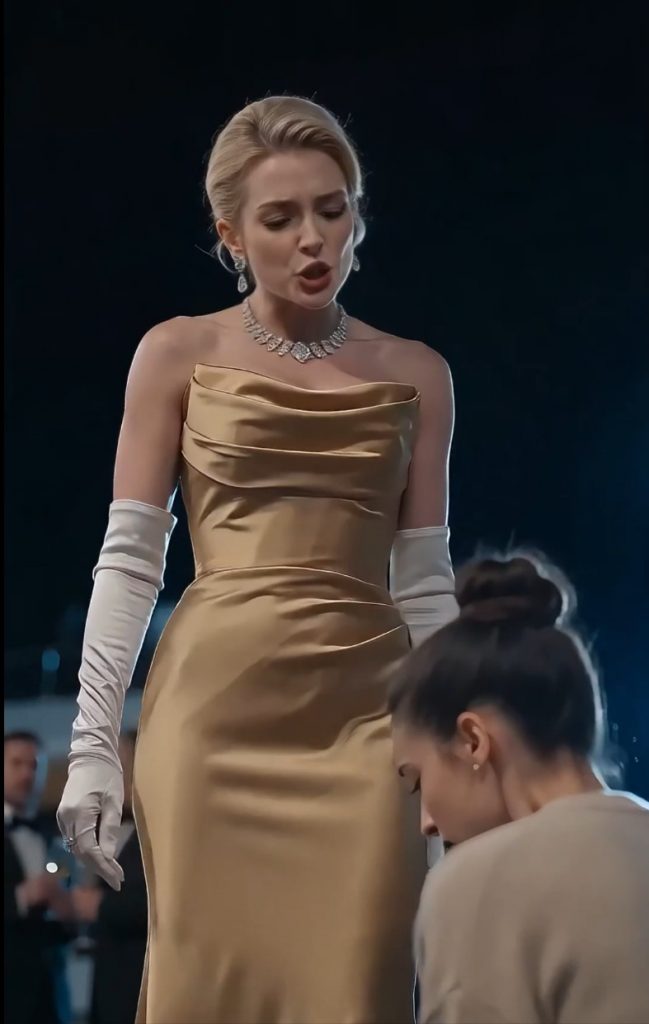
Cassandra Vale stood tall in her floor-length gold gown, white opera gloves pulled past her elbows, a diamond necklace heavy enough to buy a house glittering at her throat. Her face was flawless and cold, the kind of beauty that had learned to sharpen itself into a weapon.
Behind her, a man in a black tuxedo chuckled.
Not nervously.
Amused.
Dorian Pierce, heir to one of the company’s largest investors, shook his head as if Maya’s fall had been part of the evening’s entertainment.
Cassandra looked down at Maya like she had found dirt on the carpet.
“Girls dressed like you don’t stand with this family,” she said, her voice loud enough for every guest nearby to hear. “They get escorted off the marina.”
Maya did not answer.
She only lowered her eyes.
That silence made the humiliation worse. It made the crowd feel the weight of what they were allowing. But no one stepped forward. Not the donors. Not the executives. Not the guests who had spent the whole evening praising legacy, loyalty, and family values over champagne.
Cassandra smiled.
She thought the silence belonged to her.
Then a cane struck the deck.
Once.
Firm. Sharp. Final.
“Enough.”
The voice came from the grand white marble stairs leading down to the gala entrance.
Every head turned.
An elderly gentleman in a classic black tuxedo stood at the foot of the stairs, one hand wrapped around the handle of a polished black cane. His hair was silver, his face lined with age and authority, and his eyes were fixed not on Cassandra, but on Maya.
The color drained slightly from Cassandra’s face.
She knew him.
Everyone at the gala knew him.
Silas Harrow.
The founder.
The man whose name was carved into the company, the marina, the foundation, and half the buildings lighting the bay behind them.
Maya slowly lifted her head.
And when Silas stepped toward her, the crowd finally understood that the girl on the floor had not come to the wrong party.
She had come home.
Act II
Maya Harrow had spent most of her life being told that the marina was not for her.
Not directly.
That would have been too honest.
Instead, people used softer words. Complicated history. Family decisions. Adult matters. Old wounds. They told her the Harrow name carried weight, and weight could crush a child if placed on her too early.
So Maya grew up inland, far from the yachts and marble stairs, in a modest house with a rusted garden gate and a mother who never spoke badly of the rich but never trusted them either.
Her mother, Elena, had once been Silas Harrow’s only daughter.
The public story said Elena left the family because she wanted a quiet life. The private truth was uglier. She had fallen in love with a dockworker named Mateo Reyes, a man with calloused hands, kind eyes, and no family fortune.
Silas had disapproved.
But it was not Silas who drove Elena away.
It was the people around him.
Board members. Family advisers. Old-money friends who smiled at dinners and whispered in hallways. They convinced Silas that Mateo wanted access to the company. They warned him that Elena was being manipulated. They said the Harrow legacy could not survive if emotion replaced discipline.
Silas believed them long enough to lose his daughter.
Elena left before Maya was born.
For years, Silas sent letters.
Most never reached her.
When Elena died unexpectedly, Maya was sixteen. By then, she had learned to live with absence. She kept her mother’s old photographs in a shoebox and worked part-time at a café near the bus station. She knew her grandfather existed, but to her, he was more portrait than person.
Then, six months after the funeral, a man in a black suit arrived at her school.
Not to threaten her.
To bring her home.
Silas was older by then. Slower. Less certain of his own judgment. He had discovered that many of the letters he sent had been intercepted by his own legal team, people who feared Elena’s return would complicate succession plans. He had discovered that Mateo had never asked for money. He had discovered that his daughter died believing her father had stopped looking for her.
That knowledge broke something in him.
Maya met him for the first time in a quiet office overlooking the marina.
He did not hug her immediately. He seemed afraid he had no right.
Instead, he placed a small silver locket on the desk.
It had belonged to Elena.
Maya opened it and found a faded photograph of her mother as a little girl, sitting on the bow of a white yacht, laughing into the wind.
“She looked like you,” Silas said.
Maya stared at the picture.
“No,” she whispered. “I look like her.”
Silas wept then.
Not loudly. Not dramatically.
Just one old man lowering his head beneath the weight of everything pride had cost him.
From that day on, he tried to make things right.
But Maya did not want a crown.
She did not want headlines calling her the lost heir. She did not want strangers suddenly deciding she mattered because of a last name she had survived without.
So Silas agreed to keep her identity private until she was ready.
He trained her quietly. She studied the company from the bottom up. She spent mornings reading old contracts and afternoons walking the docks with maintenance crews. She learned the names of the captains, caterers, cleaners, mechanics, accountants, and junior staff who kept the luxury world shining for people who rarely looked down long enough to thank them.
And she noticed things Silas had stopped seeing.
The company had become beautiful on the surface and rotten underneath.
Too many executives treated workers like shadows. Too many charity events existed only for photographs. Too many people spoke of legacy while quietly preparing to divide the company after Silas died.
Cassandra Vale was one of those people.
Her family had hovered near the Harrow empire for years. Her father had once been Silas’s trusted adviser. Cassandra grew up on the marina, smiling in white dresses and calling Silas “Uncle” though no blood connected them.
She believed proximity was inheritance.
And she had spent years preparing to become the face of the Harrow social world.
Tonight’s gala was supposed to change that.
Silas had arranged a formal announcement. The founder’s granddaughter would be introduced publicly. The sole heir would take her place. The lost branch of the family would no longer be hidden.
Maya had begged him to keep it simple.
No diamonds. No designer gown. No grand entrance.
“I want them to meet me,” she said. “Not the costume they expect.”
So she wore her own clothes.
A beige cardigan. A simple white dress. Her mother’s locket tucked beneath the collar.
She arrived quietly at the marina entrance, hoping to stand beside her grandfather before the announcement began.
Cassandra saw her first.
And in one cruel moment, she showed Maya exactly what the family had become without her.
But Silas had seen it too.
Act III
Silas Harrow did not rush.
He was too old for rushing, and too powerful to need it.
His cane tapped against the polished deck as he moved toward Maya. The crowd parted instinctively, creating a path where no one had offered one before.
Cassandra stiffened.
“Mr. Harrow,” she said, trying to recover her smile. “I was just handling a security issue.”
Silas did not look at her.
He reached Maya first.
The old man lowered himself carefully, one hand braced on his cane, and extended the other toward the young woman still sitting on the walkway.
“Maya,” he said softly. “Are you hurt?”
The way he said her name changed the air.
Not girl.
Not intruder.
Not staff.
Maya.
People began to whisper.
Cassandra’s smile flickered.
Maya took his hand. Silas helped her rise with a gentleness that made the slap feel even uglier in memory. Her cheek was still warm, her knees unsteady, but she stood.
She did not hide behind him.
That made Silas proud.
Dorian Pierce stepped forward, clearing his throat.
“Sir, I’m sure Cassandra didn’t realize—”
Silas turned his eyes on him.
Dorian stopped speaking.
One look from the founder stripped the arrogance from his face.
Cassandra clasped her gloved hands at her waist.
“She came through the formal entry dressed like that,” she said. “None of us knew who she was.”
Maya looked at her.
That sentence hurt in a way the slap had not.
None of us knew who she was.
As if cruelty became understandable when the victim lacked a useful title.
Silas heard it too.
His face hardened.
“Is that your defense?”
Cassandra swallowed.
“I meant only that this event has standards.”
“Standards,” Silas repeated.
The word rolled through the crowd like a warning.
Cassandra looked suddenly smaller beneath her diamonds.
Before she could answer, the speakers around the marina crackled softly.
The MC, unaware that the announcement now carried more weight than anyone expected, began speaking in a polished, formal voice.
“Ladies and gentlemen, may I have your attention.”
The crowd was already silent.
Every face turned toward the stage, then back to Maya and Silas.
The MC continued.
“Tonight, we honor not only the legacy of Harrow Maritime Holdings, but the future of the family that built it.”
Maya’s pulse pounded.
Silas squeezed her hand once.
The MC’s voice rang across the marina.
“Please welcome the founder’s granddaughter, sole heir to the company, Maya Harrow.”
The silence after the announcement was absolute.
Then the truth moved through the crowd all at once.
Founder’s granddaughter.
Sole heir.
Maya Harrow.
Champagne glasses lowered. Guests who had looked at Maya with mild annoyance now stared as if she had transformed in front of them. Executives exchanged alarmed glances. Staff members near the service entrance covered their mouths.
Cassandra did not move.
Her face had gone pale beneath the gala lights.
“Sole heir?” she whispered.
The words trembled out of her.
Maya stood beside Silas, still in her simple cardigan, still with the sting of Cassandra’s hand on her cheek. Nothing about her appearance had changed.
Only the room had.
That was the part that made the moment devastating.
She had been worthy when she arrived.
They had simply needed a microphone to hear it.
Act IV
Cassandra tried to laugh.
It was a terrible sound.
Thin. Shaken. Too late.
“Maya,” she said, suddenly softening her voice. “My God. I had no idea. You must understand how this looked.”
Maya stared at her.
“How what looked?”
Cassandra’s eyes darted around the crowd, searching for the version of the room that had belonged to her five minutes earlier.
“A stranger walking into a private family gala,” she said. “No escort. No formal dress. No invitation visible.”
Silas looked toward the entrance staff.
“She had an invitation.”
A young attendant stepped forward, nervous but clear.
“Yes, sir. Miss Harrow presented it. Ms. Vale took it from her.”
A ripple moved through the guests.
Cassandra turned sharply.
“That is not true.”
The attendant’s face flushed.
Maya reached into the pocket of her cardigan and removed a torn corner of thick cream paper.
Cassandra’s gloved fingers had ripped it when she grabbed her.
Maya held it up.
The Harrow crest gleamed in gold ink.
Silas stared at the torn invitation.
Something colder than anger settled across his face.
Dorian stepped back.
He knew that look. Everyone who had ever sat in a boardroom with Silas Harrow knew it. It was the expression he wore before someone’s future changed permanently.
Maya spoke quietly.
“She asked if I was lost. I said I was here for the announcement. She laughed.”
Cassandra’s breath quickened.
“Maya, please. I was protecting the event.”
“No,” Maya said. “You were protecting a version of it where I didn’t belong.”
The crowd heard every word.
Silas turned to Dorian.
“And you found this amusing?”
Dorian’s smugness vanished.
“Sir, I didn’t know who she was.”
“There it is again,” Silas said.
Dorian looked confused.
Silas’s voice sharpened.
“You did not know who she was. So you felt free to enjoy her humiliation.”
Dorian lowered his eyes.
Cassandra’s hands shook near her necklace.
“You cannot seriously punish me for a misunderstanding.”
Silas planted his cane against the deck.
“A misunderstanding is when one guest is directed to the wrong table. You struck my granddaughter.”
Cassandra flinched.
The word struck seemed to finally pierce the fog of status and excuses.
Maya’s hand moved to the locket under her dress.
Silas noticed.
He looked at her, and in that glance, the entire history between them passed silently. Elena. The letters. The years stolen by pride and lies. The child who grew up away from the marina because powerful people had decided love was less important than appearances.
Silas turned back to Cassandra.
“Your father once told me my daughter’s husband was beneath this family,” he said. “I believed him. It cost me twenty years with my child.”
The crowd went still.
Cassandra’s mouth opened.
Silas continued.
“Now I stand here and hear his daughter use the same poison against my granddaughter.”
Cassandra’s face crumpled.
“That has nothing to do with me.”
“It has everything to do with you,” Silas said. “Because you inherited his cruelty and mistook it for taste.”
A few guests looked toward Cassandra’s parents, standing near the champagne table. Her mother’s face had gone rigid. Her father looked down at his shoes.
The gala was no longer a party.
It was an unveiling.
Silas lifted his cane slightly and pointed toward the marble stairs.
“Cassandra Vale and Dorian Pierce are to be removed from tonight’s program.”
Cassandra gasped.
“You can’t do that.”
Silas did not raise his voice.
“I founded the program.”
Dorian stepped in, desperate now.
“Mr. Harrow, my family has significant investment interests here.”
Silas smiled without warmth.
“Then your family should have taught you not to laugh at the person who will soon control them.”
Dorian went silent.
Maya looked at her grandfather.
“I don’t want revenge,” she said softly.
Silas’s expression softened only for her.
“I know.”
Then he looked back at the crowd.
“But consequences are not revenge.”
That line landed across the marina like a verdict.
Cassandra’s eyes filled with tears, but not the kind born from remorse. They were terrified tears, humiliated tears, tears that came from watching a throne disappear just as she reached for it.
Security approached from the side of the deck.
Cassandra stepped backward.
“Maya,” she whispered. “Please. Tell him. Tell him I didn’t know.”
Maya looked at the woman who had slapped her before knowing her name.
Then she answered with painful calm.
“That is exactly what I’m going to tell him.”
Act V
Cassandra was escorted past the same entrance where she had blocked Maya minutes earlier.
No one laughed now.
No one looked entertained.
Her gold gown brushed the walkway as she walked, but its shine no longer made her seem powerful. Her gloves were still immaculate. Her diamonds still flashed. Yet every step she took away from the gala sounded like something being stripped from her.
Dorian followed behind her, pale and silent.
When they reached the edge of the deck, Cassandra glanced back once.
Maya was still standing beside Silas.
Still in the cardigan.
Still wearing the simple white dress Cassandra had mocked.
But now the cameras had turned toward her. Guests had shifted around her. Executives who had ignored her arrival were waiting for permission to approach.
Cassandra understood then that Maya’s power had not appeared with the announcement.
It had been there the whole time.
The announcement merely took away everyone’s excuse not to see it.
Silas guided Maya toward the stage near the white marble stairs. She moved carefully, aware of the eyes on her, aware of the red warmth still lingering across her cheek, aware that her first public moment as a Harrow had begun with violence.
At the microphone, Silas paused.
“Would you like me to speak first?” he asked.
Maya looked out at the marina.
At the yachts glowing against the night.
At the cocktail tables and white tablecloths.
At the workers standing near the back, trying not to look too interested, though their eyes were full of something Maya recognized.
Hope.
She shook her head.
“No. I’ll do it.”
Silas stepped aside.
Maya took the microphone.
For a second, she said nothing.
The silence no longer belonged to Cassandra.
It belonged to Maya now.
“My mother used to tell me that rich rooms have quiet rules,” Maya began. “Rules about what to wear, where to stand, when to speak, and how much of yourself to hide so people will decide you are acceptable.”
Her voice trembled, but did not break.
“I came here tonight dressed as myself. And before anyone knew my last name, I was told I belonged at the service dock.”
Several guests lowered their eyes.
Maya continued.
“I want to be clear. The service dock is not an insult. The people who work there keep this marina alive. My father worked on docks. My mother loved him for the dignity of his hands, not the size of his bank account.”
Silas looked down.
The mention of Elena and Mateo struck him deeply.
Maya touched the locket at her chest.
“If this company has a future with me in it, then no one’s dignity will depend on whether they arrive in satin or a cardigan. Not a guest. Not an employee. Not a contractor. Not a stranger at the gate.”
The crowd was silent.
But this silence was different.
It was listening.
Maya looked toward the entrance where Cassandra had vanished.
“I was slapped tonight because someone thought I had no power. I was defended because someone discovered I did. Neither of those things should be required for basic respect.”
The words moved through the gala like clean air.
Then, from the back, someone began to clap.
It was not an executive.
It was one of the dock workers.
A young man in a black service jacket, standing near the champagne station, hands coming together slowly at first. Then another staff member joined. Then another.
Soon the applause spread.
Not wild.
Not empty.
Steady.
Real.
Silas watched his granddaughter at the microphone with tears shining in his eyes. For years, he had believed legacy meant preserving the name. Now, looking at Maya, he understood legacy meant correcting what the name had allowed.
The next morning, Cassandra Vale’s removal from the Harrow Foundation committee made the society pages.
By noon, Dorian Pierce’s family released a careful statement about respect and accountability. By evening, Silas announced an internal review of hiring, vendor treatment, staff conditions, and leadership culture across every Harrow property.
But the story people remembered was simpler.
A girl in a cardigan walked into a luxury marina.
A woman in diamonds slapped her.
Then the microphone told the truth.
Months later, Maya returned to the same marina in daylight.
No gala lights. No champagne glasses. No cameras.
Just gulls circling over the water and workers preparing boats along the dock.
Silas walked beside her slowly, cane tapping against the wood.
“You handled that night better than I did,” he said.
Maya smiled faintly.
“You looked pretty scary with the cane.”
“I was aiming for dignified.”
“You missed.”
He laughed, and the sound surprised both of them.
They stopped near the edge of the water.
Maya looked across the marina her mother had once left behind. For the first time, it did not feel like a palace built to reject her. It felt unfinished. Waiting.
Silas reached into his coat and removed an old photograph.
Elena, young and laughing on the bow of a yacht.
Maya held it carefully.
“She should have been here,” she said.
“Yes,” Silas answered.
No excuses.
No defense.
Just truth.
Maya leaned against the railing.
“Then we build something she would have wanted to come back to.”
Silas nodded.
And behind them, the marina continued waking up.
Not as a kingdom for people like Cassandra.
Not as a monument to old pride.
But as a place where a girl once pushed to the floor could stand in the center of everything and decide the future would be different.
Because Maya Harrow had not come to the gala to prove she belonged.
She had come to reveal who never should have been allowed to decide that in the first place.