Act I
The boy asked for one meal.
Not money.
Not a hotel room.
Not a miracle.
Just one meal.
He sat against the stone wall outside a row of luxury boutiques, knees tucked under an oversized hoodie that had once been blue and was now the color of rainwater. His jeans were ripped at both knees. Dirt streaked one cheek. Wet pavement reflected the bright window displays behind him, making the city look rich even where it was cruel.
A blonde woman in a tight floral dress slowed beside him, one hand on the handle of a sleek black stroller.
The boy looked up.
“One meal, please,” he said softly.
The woman’s face tightened like she had stepped near something spoiled.
She glanced down at the burger wrapped in paper in her hand, then at the child sitting below the boutique sign.
For one second, the boy thought she might give it to him.
Instead, she dropped it.
The burger hit the wet pavement with a soft slap.
Then she lifted one polished heel and crushed it flat.
“Don’t contaminate my food,” she said.
A few pedestrians looked over.
Nobody stopped.
The boy stared at the ruined meal, his mouth slightly open, as if humiliation had to travel a long way before it reached the part of him that could feel it.
The woman turned away, already lifting her phone to her ear.
“Yes, I’m here,” she said into the call, irritated. “No, I’m not waiting outside forever.”
Her hand loosened on the stroller.
The sidewalk sloped gently toward the curb.
The stroller’s front wheels turned.
At first, it rolled only an inch.
Then another.
The boy saw it before anyone else did.
His eyes snapped up from the crushed food.
The woman had her back half-turned, phone pressed to her ear, jewelry flashing beneath the gray daylight. The stroller drifted toward the curb, slow enough to seem harmless until the front wheels dropped.
Then it rolled faster.
Straight into the street.
A black SUV was coming.
The boy moved before the woman screamed.
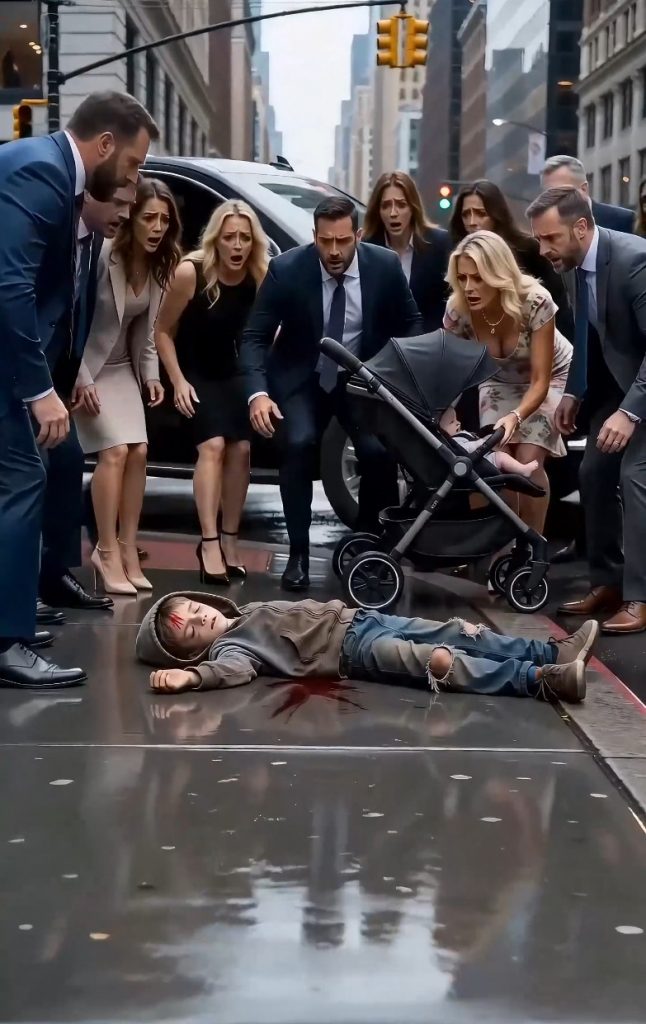
He launched off the sidewalk, shoes slipping against the wet pavement, hoodie flapping behind him. A man shouted. A horn blared. The stroller rattled into the lane with the baby inside, tiny and unaware under the black canopy.
The boy reached it just before the SUV did.
He shoved the handle with both hands.
The stroller shot across the vehicle’s path and rolled safely toward the opposite side of the street.
The SUV braked hard.
Too late for the boy.
The impact was dull, brief, and terrible enough to silence the entire block.
The child fell onto the wet road and did not get back up.
The stroller stopped safely near the far curb.
The baby began to cry.
The blonde woman finally dropped her phone.
And the driver of the SUV threw open his door, ran toward the boy, and froze when he saw the small silver bracelet on the child’s wrist.
Act II
Before the city knew him as the boy from the video, his name was Eli.
At least, that was the name he remembered.
Some shelters had called him Evan. One intake form called him Leo. A woman at a church kitchen once wrote down Ellis because she misheard him and he had been too tired to correct her.
But in the part of his memory that still smelled like clean sheets and pancakes, he was Eli.
He remembered a man lifting him onto his shoulders near a fountain.
He remembered a song about a moon that followed cars.
He remembered a woman with brown hair pressing a silver bracelet around his wrist and saying, “This way, even if you get lost, your name knows where to go.”
The bracelet had his initials.
E.V.
Eli Vale.
He did not know why that name made some adults go quiet.
Six years earlier, Daniel Vale had lost his first wife and his four-year-old son in the chaos after a highway pileup during a winter evacuation. His wife, Rachel, was found and buried. His son was not.
For months, Daniel refused to accept it.
He hired investigators. Printed posters. Called hospitals. Drove to shelters himself. Every rumor pulled him across state lines and every answer ended in a locked door.
Eventually, the world began speaking to him in past tense.
Your son was.
Your family had.
Your wife would have wanted.
Grief did not make him stronger. It made him easier to manage.
That was when Vanessa entered his life.
Blonde, polished, elegant, and relentlessly helpful, Vanessa worked for one of the charities Daniel funded. She knew how to stand beside a broken man without looking too eager to replace what he had lost. She brought meals. Organized memorial events. Handled calls when Daniel could not bear another false lead.
Two years later, she became his wife.
A year after that, their daughter Grace was born.
Daniel loved Grace fiercely, but he never stopped keeping Eli’s room untouched in the old house. Vanessa hated that room. She hated the tiny sneakers on the shelf, the moon-and-stars blanket, the framed photo of Rachel holding a laughing boy in a red sweater.
“That room keeps you trapped,” she would say.
Daniel would answer, “That room keeps him remembered.”
Vanessa learned not to argue where he could hear.
What Daniel did not know was that a private investigator had once found a boy matching Eli’s description in a temporary placement three counties away.
The report never reached him.
It reached Vanessa’s father first.
Charles Whitcomb was a family attorney with clean suits, quiet threats, and a gift for making inconvenient paperwork disappear. If Eli Vale returned, the estate Rachel had left for her son would reopen. Daniel’s trust would shift. Vanessa’s daughter would no longer be the only child in the Vale household.
Charles told Vanessa the lead was unreliable.
Vanessa told herself the same thing until it became easier.
Then she stopped asking.
And somewhere in the city, a boy with a silver bracelet learned that adults could lose you twice.
Once by accident.
Once by choice.
That morning, Eli had asked for a meal outside Vanessa Vale’s favorite boutique.
And she had crushed it beneath her heel without recognizing the child whose absence had helped build her life.
Act III
Daniel Vale knelt on the wet pavement beside the boy he had just struck and felt the past open under his hands.
“Call 911!” he shouted.
Someone already had.
Pedestrians gathered in a panicked circle, but a woman in a brown coat stepped forward and held out both arms.
“Give him space,” she ordered. “Let him breathe.”
Daniel heard the baby crying across the street.
Grace.
His daughter.
Safe.
Then his eyes dropped again to the boy.
The child’s face was pale beneath the dirt. A small mark showed near his forehead, but it was the bracelet that made Daniel’s breath stop. Silver. Scratched. Too small for his wrist now, but still there, held together with a bent link and stubbornness.
E.V.
Daniel’s hand hovered above it.
No.
The word formed inside him before any other thought could survive.
No, because impossible things do not happen on wet city streets outside boutiques.
No, because he had buried hope so deep that touching it felt dangerous.
No, because if this was Eli, then someone had allowed his son to sit hungry on a sidewalk while Daniel lived ten blocks away behind glass and security gates.
The blonde woman reached the stroller first.
She grabbed the handle, checked the baby, then looked toward the crowd around the boy with horror finally breaking through her face.
“My baby,” she whispered. “He saved my baby.”
Daniel turned.
Vanessa stood there, shaking, her floral dress damp at the hem, her phone lying cracked near the curb. Grace cried inside the stroller, alive because a hungry child had run when everyone else froze.
Daniel’s voice was raw.
“Vanessa.”
She looked at him.
Then she saw where his eyes had gone.
The bracelet.
All the color left her face.
A police officer arrived with paramedics seconds later. The block filled with sirens, questions, reflective vests, urgent voices. Daniel stepped back only when a medic told him to, but he kept staring at Eli’s wrist as if looking away might make the boy vanish again.
Vanessa tried to speak.
“Daniel, I didn’t—”
He turned on her.
“Didn’t what?”
She opened her mouth.
Nothing came.
That silence frightened him more than a denial would have.
At the hospital, while doctors examined Eli and Grace slept safely in a nurse’s arms, Daniel sat in a waiting room under fluorescent lights and watched the video on a stranger’s phone.
His wife dropping the burger.
His wife crushing it.
His son lowering his eyes.
His stroller rolling away.
His son running into traffic to save the baby Vanessa had protected by erasing him.
Daniel watched it once.
Then again.
Then he stood up and called his lawyer.
But before the truth could be brought into court, it came from Eli himself.
Act IV
Eli woke just after midnight.
Daniel was not in the room when it happened.
He had refused to leave the hospital, but he stayed outside the door because a social worker warned him not to overwhelm the child. Hope did not give him rights. Recognition did not erase years of abandonment Eli had no reason to understand.
A nurse came out and said, “He’s asking about the baby.”
Daniel closed his eyes.
Of course he was.
Not the woman who humiliated him.
Not the driver who hit him.
The baby.
“She’s safe,” the nurse told Eli gently. “You saved her.”
Eli blinked slowly.
“Good.”
Then he looked at the social worker beside the bed.
“Do I have to pay for the ambulance?”
The room went quiet.
The social worker’s face shifted.
“No, sweetheart.”
“I don’t have money. I only had enough for medicine.”
“What medicine?”
Eli’s fingers moved toward the pocket of his hoodie, but the hoodie had been taken for cleaning. Panic flickered across his face.
“My card. The pharmacy card. It was in there.”
Daniel stepped into the doorway without meaning to.
The social worker looked back at him, warning in her eyes.
He stopped instantly.
Eli saw him anyway.
For a moment, neither moved.
The boy stared at Daniel’s face as if trying to match him to something stored in a damaged corner of memory.
Then he whispered, “You’re the moon song.”
Daniel broke.
Not loudly.
He simply put one hand over his mouth and turned away because grief had finally found a sound he could not make in front of a child.
Eli watched him, confused and frightened.
The social worker sat beside the bed.
“Eli, do you know this man?”
Eli’s hand touched the bracelet.
“I don’t know.”
Daniel forced himself to face the room.
“My son had that bracelet,” he said. “His mother gave it to him.”
Eli’s eyes narrowed.
“My mom gave it to me.”
“What was her name?”
The boy’s lips trembled.
“Rachel.”
Daniel gripped the doorframe.
Vanessa, standing farther down the hallway with Grace in her arms, heard the name and nearly dropped against the wall.
Within forty-eight hours, the first records surfaced.
The old investigator’s report.
The amended intake documents.
The note from Charles Whitcomb’s office dismissing the lead as “non-actionable.”
The payment made to a private placement coordinator three days after Eli was located.
The missing follow-up.
The buried file.
Vanessa claimed she did not know the details.
Maybe that was true.
Maybe she had not asked because not asking protected her.
But the video of the sidewalk showed who she had become in the safety of her own ignorance.
She had looked down at a hungry child and seen contamination.
Daniel looked down at the same child and saw the son the world told him to stop searching for.
Charles Whitcomb was arrested before the week ended.
Vanessa was not allowed near Eli.
And when Daniel was asked whether he intended to remain married to the woman who had hidden the truth and nearly lost their daughter through carelessness, his answer was quiet.
“No.”
Act V
Eli did not move into Daniel’s house right away.
Daniel wanted it.
Of course he wanted it.
He wanted to carry his son through the front door and show him the room with the moon blanket, the shelf of books, the toy cars still lined up by color because Rachel used to laugh at how serious Eli was about red going before blue.
But love arriving late must learn patience.
Eli had lived too long with adults making decisions over his head.
So Daniel let the social worker lead.
Medical care first.
Then temporary guardianship.
Then therapy.
Then supervised visits.
Then longer ones.
The first time Eli came to the house, he stood in the doorway of his old room and said nothing for almost five minutes.
Daniel waited in the hall.
Finally, Eli touched the moon blanket.
“I thought I dreamed this.”
Daniel’s voice failed him.
Eli turned.
“Did you look for me?”
The question was small.
The answer was not.
“Every day,” Daniel said.
Eli studied his face carefully, searching for the lie.
There was none.
Not this time.
Grace grew used to Eli faster than anyone expected. Babies accept truth without paperwork. She reached for him whenever he entered a room, and Eli, who had risked everything to save her before he knew she was his sister, always looked startled by how happy it made him.
Vanessa lost custody temporarily while the investigation unfolded. Later, after hearings and evaluations, her contact with Grace became supervised. Her public apology was polished, tearful, and useless to the people who had seen the heel press into the burger.
Eli never watched the video.
Daniel made sure of it.
The city watched enough for him.
The boutique where it happened closed for three days after protesters left crushed burgers at the front door. Daniel bought the lease out months later, not to punish the owner, but to change what the corner meant.
He opened a small daytime center there.
No marble counters.
No perfume displays.
No velvet ropes.
Just warm meals, clean clothes, social workers, a children’s clinic partner, and a sign in the window that said:
No child should have to beg twice to be seen.
Eli hated the sign at first.
“It sounds like it’s about me,” he said.
Daniel nodded.
“It is. But not only you.”
That answer helped.
On the first winter morning the center opened, Eli stood inside near the window and watched children come in from the cold. Some had parents. Some came with caseworkers. Some came alone and tried to look like they were not afraid.
Eli recognized that posture.
He walked to the counter, picked up a paper bag with a warm sandwich inside, and handed it to a little girl in a purple coat.
She looked suspicious.
He understood that too.
“You don’t have to do anything for it,” he said.
She took it slowly.
Daniel watched from the doorway, holding Grace on one hip.
For a long time, he said nothing.
Then Eli looked over.
“What?”
Daniel shook his head.
“Nothing.”
Eli rolled his eyes.
“You’re doing the crying face again.”
Grace giggled.
Daniel laughed through the ache in his chest.
A year after the accident, they returned to the crosswalk.
Not for cameras.
Not for ceremony.
Just the three of them: Daniel, Eli, and Grace in her stroller. The pavement was dry that day. Traffic moved as always. The boutique signs had changed. The city had swallowed the violence of the memory and kept going.
Eli stood at the curb, hands in the pockets of a clean hoodie that fit him now.
Daniel stopped beside him.
“You okay?”
Eli looked at the road.
“I was scared.”
“I know.”
“I thought the car was going to hit the stroller.”
Daniel’s jaw tightened.
“I know.”
Eli touched the silver bracelet still on his wrist. It had been repaired but not replaced. The scratches remained because Eli wanted them there.
“They laughed when she crushed the food,” he said.
Daniel waited.
“But the baby didn’t do anything.”
“No,” Daniel said. “She didn’t.”
Eli looked back at Grace, who was trying to pull off one sock with intense concentration.
“I didn’t save her because of that woman.”
Daniel’s eyes softened.
“I know.”
“I saved her because she was little.”
That was the whole truth.
Simple.
Devastating.
Enough to build a life around.
Daniel placed one hand on the stroller handle, but he did not move it until Eli stepped back onto the sidewalk.
The crosswalk light changed.
People passed around them, unaware that this ordinary corner had once held a crushed meal, a rolling stroller, a speeding SUV, and a lost child choosing mercy before anyone had offered it to him.
Eli looked up at his father.
“Can we get burgers?”
Daniel smiled.
“As many as you want.”
Eli thought about it.
“One is enough.”
They walked away together, the baby babbling between them, the city bright and indifferent and no longer quite as powerful as it had seemed before.
Behind them, the new center’s window caught the sunlight.
And inside, a volunteer placed another warm meal on the counter for the next child who walked in hungry.
Because the boy who had once asked for one meal had saved a life before anyone saved him.
And when the world finally looked down at him, it did not see dirt.
It saw a son.
A brother.
A child who should never have had to prove his worth by running into the road.