Act I
Dr. Nathan Mercer had learned how to keep his face still.
He had stood beside grieving parents, angry spouses, frightened children, and men who swore they were fine while their hands trembled under hospital blankets. He knew how to soften bad news without lying. He knew how to let silence do some of the work.
But the child in Room 407 made him forget every rule.
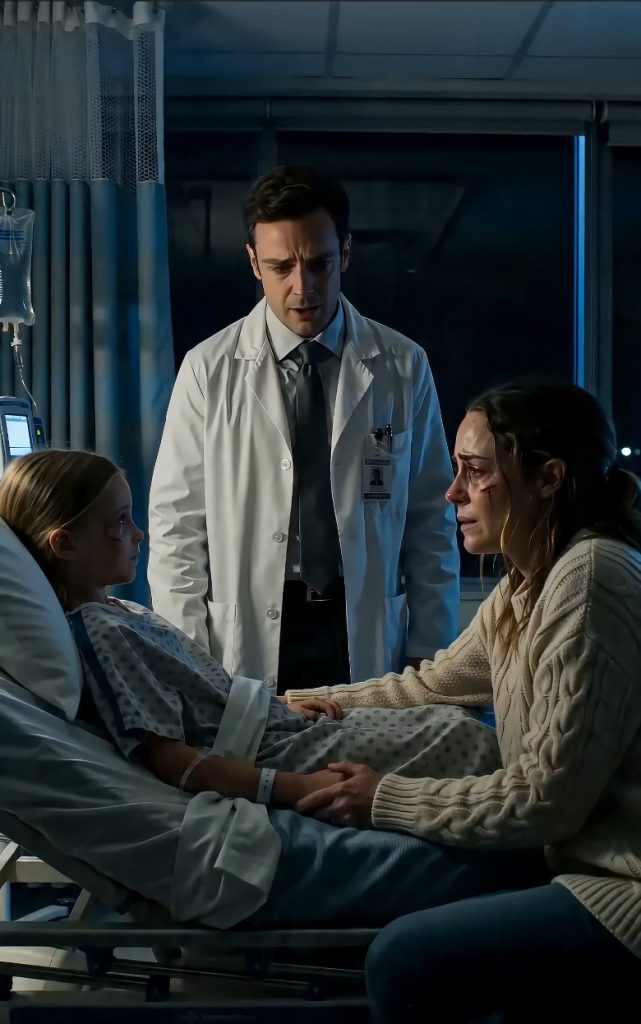
She was small beneath the white blanket, her patterned hospital gown too large at the shoulders. A plastic cup of water sat untouched on the side table. Behind her, the night pressed its dark face against the hospital window, turning the room into a pale little box of fluorescent light and breathing machines.
Her mother sat beside the bed, holding the girl’s hand as if the whole world might steal it away.
Nathan checked the chart twice, then looked at the child again.
The girl blinked up at him with gray-green eyes.
His eyes.
Not similar. Not vaguely familiar.
His.
A strange pressure moved through his chest.
“Ma’am,” he said carefully, his voice still wearing its professional calm, “your daughter… she seems familiar to me.”
The mother did not answer right away.
She only tightened her fingers around the child’s hand. Her cream sweater was wrinkled at the sleeves, the cuffs pulled over her palms like she had been cold for hours. Her brown hair hung loose around a face that looked exhausted from crying.
Then she lifted her eyes.
There was no surprise in them.
Only pain.
“You really don’t wonder why she looks like you?”
The room seemed to shrink.
Nathan heard the soft hum of the lights. The faint rhythm of distant hospital equipment. The nearly silent shift of the child under the blanket.
His hand slipped out of his coat pocket.
“What did you say?”
The mother’s lips trembled, but she did not look away.
“You heard me.”
Nathan looked back at the little girl. At her dark lashes. At the shape of her chin. At the small crease between her brows, the same crease his own father used to joke about when Nathan was a boy.
A memory moved somewhere deep inside him.
Not a clear one.
A flash.
Smoke.
Wind.
A road with no streetlights.
And a girl’s voice calling his name through the dark.
Then the mother whispered something that turned the memory into a blade.
“You left us on that road once,” she said. “And I have been waiting six years for you to remember.”
Nathan’s breath caught.
Because suddenly, he did remember a road.
And on that road, someone had carried him out of fire.
Act II
Her name was Clara Whitman.
Nathan did not know that when she first came into the emergency department with her daughter. The intake nurse had written it down, neat and ordinary, like it belonged to any other mother in any other late-night crisis.
Clara Whitman. Age thirty-four. Daughter, Lily Whitman, age six. Admitted after fainting at school. Possible cardiac irregularity. Awaiting specialist review.
Nothing in that file should have made Nathan stop.
Children fainted. Parents cried. Doctors worked.
But Lily’s face had stopped him cold.
It was not just resemblance. It was recognition without memory, the kind that made his body understand something before his mind was ready.
Clara had watched that recognition arrive.
She had not rushed him. That was what made it worse.
She had sat there with her little girl’s fingers wrapped inside hers, waiting for Nathan Mercer, the brilliant pediatric cardiologist with the polished shoes and perfect tie, to crack open and find the boy he had buried.
The boy from Briar County Road.
Six years earlier, Nathan had been driving back from a medical outreach fundraiser outside a small town north of Richmond. He was thirty-one then, already respected, already ambitious, already known as the young doctor who never made mistakes.
At least, that was the version the hospital knew.
The truth was uglier.
That night, Nathan had been exhausted. He had taken back roads to avoid traffic, thinking the empty lanes would help him clear his head. A storm had passed through earlier, leaving the pavement slick and black.
He remembered a deer.
He remembered headlights twisting.
Then nothing.
For weeks afterward, he was told he had been found near an overturned car with a concussion, smoke inhalation, and no wallet. A local volunteer had called 911 from a farmhouse. By the time paramedics arrived, the person who had dragged him away from the wreck was gone.
His family hired lawyers. The hospital handled statements. The incident became a private misfortune, wrapped in clean language and filed away.
Single-vehicle crash.
Temporary memory loss.
No evidence of another passenger.
Nathan accepted that version because it was easier than asking why the missing hours made him feel sick.
But Clara had not vanished from that night.
She had survived it.
She had been twenty-eight then, not the teenager his broken memory made her seem. Shock had turned her young in his mind, shrinking her into a girl with messy hair and soot on her cheeks. She had been driving behind him on that rural road, heading home from a late shift at a diner, when she saw his car flip.
She stopped.
She ran toward fire when anyone else might have called from a distance.
She pulled him out through smoke. She looped his arm over her shoulder and half-dragged him toward the farmhouse light at the edge of the field, screaming until her throat gave out.
And then she saw his face.
Not as a stranger.
As the man who had promised her, three months earlier, that he would call.
They had met at a free clinic.
Clara had come in with a persistent cough and a stubborn refusal to admit she was frightened. Nathan had treated her like she mattered. Not like a chart, not like a charity case, not like a woman who counted every dollar before buying medicine.
He remembered her laugh. Almost.
He remembered sitting with her outside a closed pharmacy while rain ticked against the awning. He remembered her telling him she had grown up raising herself because her mother worked nights and her father never stayed anywhere long.
He remembered touching her hand.
Then he remembered nothing.
Clara remembered everything.
She remembered the way he looked at her like she was not invisible. She remembered the motel outside Briar Creek, the one night they had been foolish and lonely and certain the world would make sense in the morning.
She remembered him leaving before sunrise for an emergency call.
She remembered the voicemail that came two days later, soft and guilty, saying he needed time because his career was “complicated.”
Then silence.
And three months after that, she was dragging his unconscious body away from a burning car, whispering his name while he bled into her sleeve.
She saved him anyway.
Because by then, she already knew she was pregnant.
And that was the truth Nathan had never been told.
Act III
Nathan gripped the metal rail of Lily’s hospital bed.
The room tilted slightly, not enough for anyone else to notice, but enough for him to feel like the floor had betrayed him.
Clara watched him with the controlled stillness of someone who had imagined this moment too many times to waste it on screaming.
“You knew?” he asked.
His voice sounded wrong. Smaller than he wanted.
Clara gave a tired laugh with no humor in it.
“I tried to tell you.”
Nathan shook his head. “No. I never got—”
“You never got what?” Her eyes flashed through the tears. “The letters? The calls? The hospital messages? The certified envelope I sent to your office with Lily’s birth certificate inside?”
Nathan went silent.
A certified envelope.
Something moved in his memory again, but it was not the accident this time.
It was his father’s study. Dark wood desk. A silver letter opener. His father’s voice, low and controlled.
Some people will attach themselves to you, Nathan. Especially now.
His father, Harrison Mercer, had built the family name like a fortress. Donations to hospitals. Board seats. Medical scholarships with the Mercer name stamped in gold. He loved Nathan, in his way, but he loved reputation more.
Nathan had always known that.
He just had not known how far it went.
Clara reached into the canvas bag at her feet and pulled out a folded envelope, soft from years of being opened and closed. She did not hand it to him at first. She looked at Lily, whose eyes were half-shut now, exhausted by the late hour and the adults’ trembling voices.
Then Clara placed the envelope on the bed.
“I kept copies.”
Nathan stared at it.
His name was written across the front.
Dr. Nathan Mercer.
The handwriting was careful, feminine, familiar in a way that made his throat tighten.
Inside were photocopies. Phone records. Returned mail. A birth certificate with Lily Clara Whitman listed as the child’s name.
Father: Nathaniel James Mercer.
Beside it was a DNA test from a private lab, dated five years earlier.
Probability of paternity: 99.98%.
Nathan felt the air leave his lungs.
“I didn’t know,” he whispered.
Clara’s face twisted.
“That was the worst part,” she said. “For years, I wanted to believe you did. I wanted to hate you cleanly. I thought you read those letters and decided we were too inconvenient for your life.”
Nathan looked at Lily.
A small child in a hospital bed. His child. Six years old. Pale and tired, with his eyes and Clara’s mouth and a tiny hospital bracelet circling her wrist.
He had missed her first word.
Her first steps.
Her first fever.
Her first day of school.
He had been a stranger with a stethoscope standing beside his own daughter, telling her mother that the girl seemed familiar.
His knees almost gave.
Clara saw it. For the first time, her anger softened into something more dangerous.
Grief.
“I didn’t come here to ruin you,” she said quietly. “I came here because she collapsed in class, and the local clinic said her heart rhythm looked wrong. They transferred us here because you’re supposed to be the best.”
Nathan lifted his eyes.
There it was.
The second blade.
Lily was not just his daughter.
She was his patient.
And if her condition was what he feared, she might have inherited more from him than his eyes.
Act IV
Nathan moved fast after that.
Not because it made him feel better. Nothing could. But because medicine was the only language he had left that had not betrayed everyone in the room.
He ordered the tests himself. He called cardiology imaging. He asked the night nurse to page the genetic counselor, then stopped halfway through the sentence when he realized how strange it sounded to say family history and not know his own daughter’s.
Clara noticed.
Of course she did.
“You don’t get to become heroic now,” she said when the nurse stepped out. Her voice was low, not cruel. “You don’t get to fix one emergency and think it makes six years disappear.”
Nathan stood by the foot of the bed.
“I know.”
“No,” she said. “You don’t.”
Lily stirred, and both adults froze.
The little girl opened her eyes just enough to look at Nathan.
“Are you the heart doctor?” she whispered.
Nathan swallowed hard.
“Yes,” he said. “I am.”
“Mom says heart doctors listen really carefully.”
He tried to answer, but the words caught.
Clara looked away.
It was Lily who reached one small hand toward him.
Nathan stepped closer. Slowly. Carefully. Like he was approaching something sacred he had no right to touch.
He placed two fingers in her palm.
She held them with sleepy trust.
That almost broke him completely.
The test results came back just before dawn.
Lily had a congenital rhythm condition, serious but treatable if managed quickly. It explained the fainting. It explained the fatigue Clara had blamed on growth spurts and school days. It explained the quiet fear in Nathan’s chest before the report even printed.
Because the same condition ran in the Mercer family.
His mother had died from it at forty-two.
His father had buried that too.
Not publicly. Never publicly. The official story had been a sudden illness, tragic and private. But Nathan remembered childhood nights of hearing his mother’s uneven breathing through the bedroom wall. He remembered his father forbidding questions.
Nathan walked out of the room and called Harrison Mercer at 5:17 in the morning.
His father answered on the third ring, irritated.
“Nathan, do you have any idea what time it is?”
“Yes,” Nathan said. “Did you intercept letters from Clara Whitman?”
Silence.
That silence was enough.
Nathan closed his eyes.
“Answer me.”
His father exhaled slowly. “You were at the beginning of everything. Your fellowship. Your board position. That woman would have destroyed—”
“She saved my life.”
“She trapped you.”
“She pulled me out of a burning car.”
Harrison said nothing.
Nathan’s voice hardened in a way it never had with his father before.
“She had my child.”
Another pause.
Then Harrison said the words that ended whatever was left between them.
“I handled it.”
Nathan looked through the glass wall of the nurses’ station, back toward Room 407. Clara was sitting beside Lily again, brushing hair from her daughter’s forehead. She looked like a woman who had fought every year alone and still showed up when her child needed her.
“You didn’t handle it,” Nathan said. “You erased them.”
By sunrise, he had called hospital legal, not to protect himself, but to report the conflict. He removed himself as Lily’s lead physician and requested another specialist while remaining available only as family. He sent copies of Clara’s documents to his personal attorney. He asked for a formal review of his father’s past involvement with the hospital foundation.
By noon, Harrison Mercer was in the hospital lobby, wearing a charcoal suit and the expression of a man who expected doors to open because they always had.
Clara saw him through the room’s narrow window and went still.
Nathan noticed.
“That’s him?” she asked.
He nodded.
The old Nathan would have gone out into the hall alone. He would have tried to contain the damage, negotiate the emotions, keep the family name from cracking in public.
But the old Nathan had been built on missing pages.
This time, he opened the door wide.
Harrison walked in like he owned the air.
Then he saw Lily.
For one brief second, every practiced line disappeared from his face.
Because there was no denying her.
She looked like Nathan. Which meant she looked like the Mercers.
Harrison recovered quickly. “This is a private matter.”
Clara stood.
Her voice shook, but she did not back down.
“No,” she said. “A private matter is a letter. A phone call. A choice between two adults. You made my daughter grow up asking why other kids had dads at school plays and she didn’t.”
Harrison’s jaw tightened. “You have no idea what kind of family you were trying to enter.”
“I wasn’t trying to enter your family,” Clara said. “I was trying to reach hers.”
Lily watched from the bed, too young to understand every word, old enough to feel the storm.
Nathan moved beside Clara.
Not in front of her.
Beside her.
“My daughter’s condition came from our side,” he said. “The family history you buried. The one you never gave me honestly. If Clara hadn’t brought Lily here tonight, if she had gone anywhere else, we might not have caught it in time.”
Harrison’s face paled.
For once, reputation could not save him.
Because the truth was no longer hidden in envelopes, intercepted calls, or private offices.
It was lying in a hospital bed, six years old, looking up at the grandfather who had erased her before she ever learned his name.
And then Lily asked the question no adult in the room was ready for.
“Mom,” she whispered, “is he my dad?”
Act V
No one spoke.
The hospital seemed to hold its breath with them.
Clara turned toward Lily, and all the anger drained from her face. What remained was a mother’s fear, the kind that has nothing to do with enemies or old wounds and everything to do with protecting a child’s heart.
She sat on the edge of the bed.
Nathan stayed where he was.
He wanted to run to Lily, to explain, to apologize, to promise everything at once. But he had already missed too much by letting other people decide what was best. He would not steal this moment from Clara too.
Clara brushed her thumb over Lily’s knuckles.
“Yes,” she said softly. “He is.”
Lily looked at Nathan.
There was no dramatic rush into his arms. No perfect forgiveness. Children trust quickly, but they also understand absence in ways adults underestimate.
“You didn’t know?” she asked.
Nathan’s eyes burned.
“No,” he said. “I didn’t know. But I should have found out.”
That answer mattered.
Clara looked at him then, really looked at him, as if those were the first honest words he had said all night.
Lily considered this with the seriousness only a sick, tired child can have.
“Are you going to leave?”
Nathan shook his head.
“No.”
Harrison made a small sound near the door, perhaps a protest, perhaps a warning. Nathan did not turn around.
“I’m not leaving,” he said again, this time to both of them.
The days that followed did not repair six years.
Nothing could.
Lily’s treatment began under another physician, one Nathan trusted with his life because now his life had a name and freckles and a favorite purple blanket Clara brought from home. The diagnosis was serious, but manageable. With medication, monitoring, and a small procedure planned for later, Lily had a future.
A real one.
Clara slept in the chair every night until Nathan quietly brought in a foldout cot. She did not thank him at first. She only looked at it, then at him, as if trying to decide whether kindness from him was safe.
He did not push.
He showed up.
That was all he could do.
He brought coffee the way she liked it after remembering, with a shock that nearly brought him to tears, that she had once told him she hated sugar but loved too much cream. He found a stuffed rabbit in the gift shop after Lily mentioned she liked animals with “serious faces.” He sat through genetic counseling appointments and answered every question, even the ones that made him ashamed.
And when hospital legal confirmed what Harrison had done, Nathan did not protect him.
The Mercer Foundation board removed Harrison from its chairmanship after evidence surfaced that he had interfered with correspondence connected to Nathan’s personal and medical history. Other secrets began to loosen too. Old records. Buried family diagnoses. Donations used to pressure silence.
For years, Harrison Mercer had believed truth was something rich men managed.
He learned too late that truth is patient.
It waits in drawers, in copied envelopes, in a mother’s bag, in a child’s face.
On Lily’s last morning in the hospital, sunlight filled Room 407 for the first time since Nathan had met her. It turned the glass of water gold. It softened the hard edges of the monitors and the curtain rails.
Lily sat upright in bed, her color better, her serious-faced rabbit tucked beneath one arm.
Nathan stood by the door, no lab coat this time.
Just a man who had been late to the most important room of his life.
Clara zipped Lily’s small backpack and looked at him.
“We’re not okay,” she said.
Nathan nodded. “I know.”
“I don’t know when we will be.”
“I know that too.”
Lily glanced between them. “Can he come to my school concert?”
Clara froze.
Nathan did too.
The question was tiny. Almost ordinary.
But it opened a door no apology could force.
Clara looked down at her daughter, then back at Nathan. The hurt in her eyes was still there. It would be there for a long time. But beneath it was something else.
Not forgiveness.
Not yet.
Possibility.
“One concert,” Clara said.
Lily smiled.
Nathan had received awards, promotions, applause from rooms full of people who thought he was extraordinary.
None of it had ever felt like that.
As Clara pushed Lily’s wheelchair toward the elevator, Nathan walked beside them, matching their pace. Not leading. Not rescuing. Not performing.
Just staying.
At the elevator, Lily reached up and slipped her hand into his.
Small fingers. Warm palm. Unquestioning hope.
Nathan looked down at her, then at Clara.
The hospital doors opened with a soft chime.
Six years earlier, Clara had carried him away from fire toward a distant farmhouse light.
Now, at last, Nathan understood.
She had not just saved his life that night.
She had been carrying his whole future.