Act I
The snow was already sticking to his hood when Oliver knocked the first time.
Not loudly.
Not angrily.
Just three small taps against the gray front door, as if he still believed someone inside might remember he was a child.
The brick house stood quiet under the blue winter night. Snow piled on the welcome mat, gathered along the bushes, and softened the edges of the steps until the whole porch looked buried in silence.
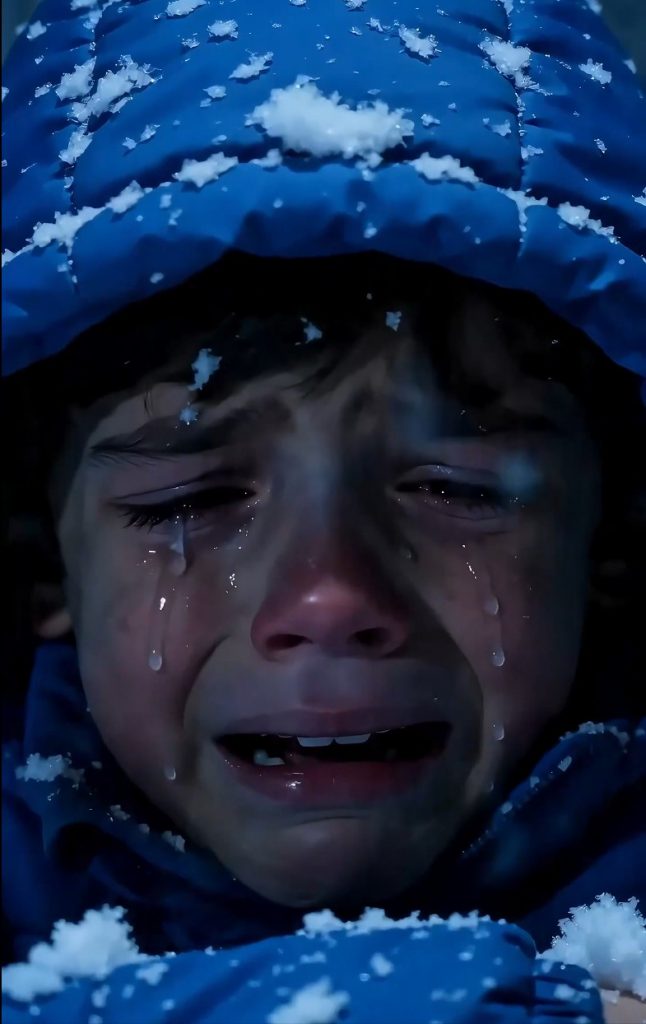
Oliver pressed his back to the door and wrapped both arms around his blue puffer jacket.
His cheeks were red from the cold. Tears ran down his face and froze into the same wet shine as the snow on his sleeves. His body shook so hard the zipper on his coat clicked faintly against his chin.
Behind the door, there was warmth.
Light.
His mother.
And the strange man.
Oliver looked up at the frosted glass panel beside the door, hoping for movement.
Nothing.
He knocked again, harder this time.
“Mommy?”
The wind tore at his voice.
He waited.
No footsteps came.
He curled smaller against the door, knees pressed to his chest, shoes planted in the snow collecting on the mat. The cold had reached through his socks now. His toes hurt in a way that made him want to cry louder, but he had learned loud crying made adults angry.
Then the fear became stronger than the rule.
Oliver lifted his face toward the door.
“Let me in!” he cried, voice breaking. “Mommy said I have to stay out here until the strange man finishes fixing her bed.”
Across the street, a porch light flicked on.
Inside the house, something thudded.
Oliver went still.
For one breath, he thought his mother was coming.
But the door did not open.
Instead, a shadow moved behind the front curtain and disappeared.
Oliver’s lower lip trembled.
He slid down the door again, hugging himself tighter as snow kept falling over his small shoulders.
He did not know that someone had heard him.
He did not know that Mrs. Eleanor Price, the widow across the street, had been awake with a cup of tea and a bad feeling since the strange man’s truck pulled into the driveway.
And he did not know that the words he had just sobbed into the storm would unravel the lie his mother had locked him outside to protect.
Act II
Oliver used to love snow.
Before his father died, snow meant pancakes before sunrise and a plastic sled pulled from the garage. It meant his dad pretending to slip on the driveway so Oliver could laugh until his stomach hurt. It meant coming inside with wet mittens and being wrapped in a blanket while his father said, “Cold only wins if you stay out too long.”
His father, Matthew Hayes, had been careful about everything.
Bills in labeled folders.
Keys on the same hook.
Emergency numbers taped inside a kitchen cabinet.
He worked as an insurance investigator, which meant he noticed details other people missed. A moved chair. A changed signature. A story that sounded rehearsed.
After Matthew died in a late-night road accident, the house changed.
Not all at once.
At first, Oliver’s mother, Dana, cried a lot. She slept late. Forgot meals. Stared at the wall as if the house had become a place she no longer recognized.
Oliver tried to be good.
He made his bed. Fed the cat. Kept his toys in one corner of his room. He whispered when she had headaches and told his teacher his mother was “just tired.”
Then Derek started coming over.
Oliver did not know his last name. He only knew the smell of his coat, sharp and oily from cigarettes and car engines. Derek called Oliver “little man” but never looked at him when he said it.
When Derek was there, Oliver was told to stay in his room.
Then on the couch.
Then outside.
Just for a minute.
Just while grown-ups talked.
Just until Derek finished helping.
That night, the help was “fixing the bed.”
Oliver had heard the words from the hallway while holding his stuffed dinosaur by the tail.
Dana had opened the front door and pushed his coat into his hands.
“Go outside for a little bit.”
“It’s snowing.”
“Then put your hood up.”
“I’m cold.”
Her face changed.
Not into concern.
Into panic.
She glanced behind her toward the bedroom hallway, where Derek stood holding a crowbar and a flashlight.
“You heard me,” she snapped. “Stay out until I call you.”
Then she shut the door.
Oliver did not understand why a bed needed a crowbar.
He did not understand why Derek had been asking about his father’s old safe.
He did not understand why his mother had spent the morning tearing through drawers, whispering, “It has to be here.”
But across the street, Eleanor Price understood enough to be afraid.
She had known Matthew Hayes for twelve years. He shoveled her walkway every storm, fixed her mailbox twice, and once climbed through her kitchen window when she locked herself out carrying groceries.
He was the kind of man who checked on neighbors.
So when Eleanor saw his son trembling against the front door in the snow, she did not tell herself it was none of her business.
She set down her tea.
Picked up her phone.
And called 911 before she even found her boots.
Act III
Eleanor crossed the street with a wool coat thrown over her nightgown and a flashlight shaking in her hand.
“Oliver?”
The boy lifted his head.
For a moment, he looked frightened of her too.
That nearly broke her.
“It’s Mrs. Price, sweetheart. From across the street.”
He blinked through tears.
“Mommy said I can’t go anywhere.”
Eleanor crouched in the snow, old knees protesting beneath her.
“Your mommy made a dangerous choice,” she said carefully. “You are allowed to get warm.”
His eyes moved to the door.
“She’ll be mad.”
“She can be mad at me.”
Oliver hesitated.
Then a loud crash came from inside the house.
Not from the living room.
From the back bedroom.
Oliver flinched so hard Eleanor reached for him before thinking. He pulled back at first, then let her wrap her coat around him.
“What was that?” she whispered.
His voice was tiny.
“The bed.”
Eleanor looked at the house.
The front curtain shifted again.
This time, she saw a man’s outline.
Derek.
She lifted Oliver into her arms as best she could. He was heavier than she expected but far too light for his age. His whole body shook against her chest.
Halfway down the walkway, the front door opened.
Dana appeared in the doorway wearing a cream sweater and an expression that tried to look irritated instead of guilty.
“Eleanor,” she called. “What are you doing with my son?”
Eleanor did not stop moving.
“He’s freezing.”
“He’s being dramatic.”
Oliver buried his face in Eleanor’s shoulder.
Derek stepped into view behind Dana.
Tall. Broad. Dark jacket. One hand hidden behind his leg.
Eleanor saw the crowbar.
So did Dana, because she quickly shifted to block it.
“He ran outside,” Dana said loudly. “I was about to bring him in.”
Eleanor turned at the sidewalk.
“No, you weren’t.”
Dana’s face hardened.
“That is my child.”
Sirens wailed in the distance.
Derek’s expression changed first.
Dana heard them too.
“What did you do?” she hissed.
Eleanor tightened her arms around Oliver.
“What someone should have done sooner.”
Derek disappeared back into the house.
Dana spun toward him.
“Derek!”
That single frightened call told Eleanor everything.
The police arrived less than two minutes later, followed by an ambulance. Oliver was taken into Eleanor’s warm living room, where a paramedic wrapped him in blankets and checked him gently while he clutched a mug of warm chocolate with both hands.
Officer James Keller knocked on Dana’s door.
This time, it opened to authority.
Not a child.
Not a pleading neighbor.
Authority.
Dana tried to cry.
She tried grief first. Then exhaustion. Then confusion. She said Oliver was sensitive. She said Derek was a family friend. She said the bedframe had broken and he was repairing it.
Then Officer Keller walked down the hallway and saw the bedroom.
The mattress had been flipped.
The bedframe split open.
Floorboards pried loose.
And inside the hollow space beneath Matthew Hayes’s side of the bed was an empty metal box.
Not a repair.
A search.
Act IV
Derek was found in the backyard trying to climb the fence.
Snow made him slow.
Officer Keller did not.
When they brought him back through the side gate, he was shouting that he had done nothing wrong, that Dana gave him permission, that whatever was in the house belonged to her now.
Oliver heard his voice from Eleanor’s living room and began to shake again.
The paramedic moved closer.
Eleanor sat beside him.
“You’re safe in here.”
Oliver stared at the window.
“Daddy said the blue folder was for me.”
Eleanor’s hand froze.
“What blue folder?”
Oliver looked down into his cocoa.
“The one under the bed. Daddy said if Mommy got scared and forgot how to be Mommy, I had to give it to a safe grown-up.”
Eleanor felt the room narrow around her.
“Did you give it to someone?”
Oliver nodded.
“Mrs. Price.”
Her heart kicked.
“Me?”
“Daddy said you were safe.”
Eleanor stood slowly.
She had forgotten about the envelope.
Three months earlier, before the accident, Matthew had stopped by with a sealed blue folder and asked her to keep it “just in case.” She had thought it was insurance paperwork. He told her not to open it unless someone came looking for it.
Someone had.
Eleanor walked to her hall closet, reached behind a stack of old Christmas tins, and pulled out the blue folder.
Officer Keller opened it at her kitchen table.
Inside were documents, photographs, bank statements, and a letter written in Matthew’s careful hand.
If you are reading this, I am either dead or unable to protect Oliver myself. Dana has become involved with Derek Vale, who is under investigation for insurance fraud and estate theft. I believe he is pressuring her to access Oliver’s trust and my case files. Do not release Oliver to Derek under any circumstances.
Eleanor covered her mouth.
Officer Keller kept reading.
There was more.
Matthew had been investigating Derek before he died.
Derek had staged accidents, manipulated grieving spouses, and drained settlements through forged repair invoices and fake emergency expenses. Matthew had found a pattern. He had hidden evidence in multiple places because he feared Derek might already be inside his home through Dana.
The metal box under the bed had been bait.
The real folder had been with Eleanor.
The final page was addressed to Oliver.
My brave boy, if grown-ups make you feel like you are the problem, remember this: you are not. You are the reason I tried so hard to leave a map.
Oliver did not understand all the words.
But he understood his father had written to him.
He touched the paper with one finger.
“Daddy knew?”
Eleanor’s eyes filled.
“He knew you mattered.”
Dana was brought into Eleanor’s living room long enough to hear that officers had the folder.
Her face collapsed.
Not with remorse.
With fear.
“Derek said it was only money,” she whispered.
Officer Keller looked at her.
“You locked your son outside in a snowstorm for money?”
Dana started crying then.
Oliver watched her from behind the blanket.
He did not move toward her.
That was the first time Eleanor realized his heart had already learned what the law was only beginning to prove.
A mother can stand close and still not be safe.
Act V
Oliver did not return to the brick house that night.
He went to the hospital first, where nurses warmed his hands and feet, brought him dry socks, and spoke to him as if every answer mattered. Eleanor stayed beside him until Matthew’s sister, Rachel, arrived before dawn with her hair unbrushed and her coat buttoned wrong.
She had been trying to get visitation for months.
Dana had blocked every call.
When Rachel entered the hospital room, Oliver looked at her like she was a dream he was afraid to trust.
“Aunt Rachel?”
She broke instantly.
“Oh, Ollie.”
He reached for her, and she folded around him with a sound that made even the nurse look away.
Emergency custody was granted to Rachel within forty-eight hours.
Dana was charged with child endangerment and neglect. Derek faced a longer list: fraud, attempted theft, evidence tampering, and charges connected to Matthew’s investigation. The old accident report on Matthew’s death was reopened after Keller found messages between Derek and a mechanic tied to the vehicle Matthew had driven that night.
The truth took months.
Truth often does.
It had to be pulled from phones, bank accounts, repair shops, insurance files, and lies told by people who believed grief made families easy to rob.
But the blue folder held.
Matthew had built the map carefully.
Derek had searched the bed.
He should have searched the neighbor who still remembered what decency looked like.
As for Dana, the court did not accept grief as an excuse for leaving a child outside in dangerous cold. Her attorney spoke of manipulation, dependency, emotional collapse. The judge listened, then looked at the photo of Oliver huddled against the gray door under falling snow.
“Whatever happened to you,” the judge said, “you chose to let it happen to him.”
Oliver did not attend that hearing.
Rachel protected him from as much as she could.
His healing happened in smaller rooms.
A kitchen with yellow curtains.
A bedroom with dinosaur sheets.
A school drop-off where Rachel waited until he got inside.
For weeks, he slept with socks on and a flashlight under his pillow. Every closed door made him nervous. Every time snow appeared in the forecast, he asked if he would have to go outside.
Rachel answered the same way every time.
“Only if you want to build something.”
The first snow after the rescue came in January.
Oliver stood by the window, silent.
Rachel did not push.
Eleanor, visiting with a tin of cookies, sat beside him.
After a long while, Oliver whispered, “Daddy liked snow.”
Eleanor nodded.
“He did.”
“I used to.”
“You might again.”
He looked at her.
“Not tonight.”
“Then not tonight.”
That was how trust grew back.
Not by forcing joy.
By allowing no.
By spring, Oliver had opened the blue folder many times with Rachel beside him. He liked the letter best. The one from his father. Rachel had it copied and framed, but Oliver kept the original in a drawer beside his bed.
Sometimes he touched the words before sleeping.
Not because they fixed everything.
Because they reminded him that his father had not left him helpless.
One year later, the brick house was sold.
Rachel took Oliver there one last time before the new owners moved in. Eleanor came too, carrying a small shovel and a bag of tulip bulbs.
The gray door had been repainted.
The welcome mat was gone.
Snow no longer covered the step, but Oliver stood at the edge of the walkway and remembered it anyway.
His blue jacket was too small now. Rachel had bought him a green one, but he kept the old one in his closet because throwing it away felt like throwing away proof.
Eleanor handed him a tulip bulb.
“For the garden,” she said.
Oliver looked at the bushes near the porch, the place where snow had piled around him that night.
“Here?”
“If you want.”
He knelt and dug into the soil.
Rachel crouched beside him.
Together, they planted three bulbs.
One for his father.
One for Eleanor.
One, Oliver decided, for himself.
When they finished, he looked at the door.
For a long time, no one spoke.
Then Oliver said, “It didn’t open.”
Rachel’s eyes filled.
“No.”
He turned toward Eleanor.
“Yours did.”
Eleanor swallowed hard.
“Yes, sweetheart.”
Oliver slipped his hand into Rachel’s.
Then, after a moment, he reached for Eleanor’s too.
The three of them walked away from the porch together.
Behind them, the brick house stood quiet, no longer a prison, no longer a secret, only a building that had failed to protect a child until someone across the street chose not to look away.
That winter night had begun with a closed door.
A boy in a blue jacket.
A mother’s lie.
A strange man tearing apart a bed for money hidden beneath grief.
But it ended because one small voice carried through the snow.
Let me in.
And someone did.